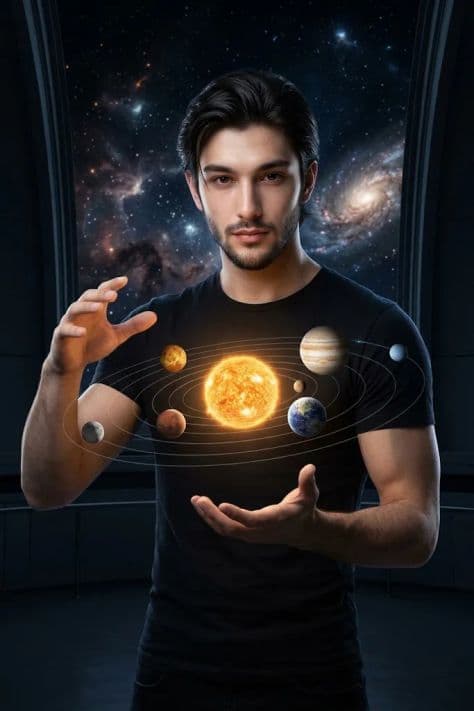

Astronomical Observatory Stargazing Dome Celestial Portrait
[STRICTLY FOLLOW THE REFERENCE IMAGE — use the uploaded photo as the exact identity authority for the first subject ("me"). Preserve the first subject's exact face, facial structure, skin tone, age, body proportions, hairstyle characteristics, and recognizable appearance exactly as shown. Do not redesign, beautify, age, reshape, or reinterpret the first subject's identity.]
Create a hyper-realistic cinematic celestial editorial portrait of the first subject inside a vast, dark observatory-like chamber that appears to open directly into deep space, preserving the uploaded identity exactly.
Reimagine the concept as a moment of quiet control rather than the subject simply holding a miniature sun. Position the first subject in a three-quarter standing pose beside a circular black stone platform, torso turned slightly away from the camera while the head lowers toward a luminous solar system suspended at chest level in front of him. His right hand is held open beneath the orbiting system without touching it, while the left hand hovers slightly above and to the side, as though delicately guiding the planets through their paths. The hands should feel purposeful and anatomically natural, with the gesture restrained rather than theatrical.
Dress the first subject in a plain fitted black short-sleeved T-shirt, allowing the simplicity of the clothing to disappear into the surrounding darkness and keep attention on the face, hands, and celestial light.
At the center of the suspended system, place a brilliant miniature sun radiating warm gold, amber, and white light. Around it, Earth, Mars, Jupiter, Venus, and a dark cratered moon follow distinct luminous orbital paths at different depths, with realistic scale relationships adapted for artistic readability rather than literal astronomy. Some planets should pass closer to the lens while others recede behind the subject, creating genuine foreground, midground, and background layering.
Instead of a flat star-field backdrop, surround the chamber with an enormous curved opening revealing deep space: dense blue-violet nebulae, subtle star clouds, distant planetary fragments, and a large spiral galaxy positioned high in the background. Let the cosmic environment feel vast and dimensional rather than decorative.
Photograph from a slightly elevated wide three-quarter viewpoint using a 28mm full-frame perspective, placing the subject off-center while the orbiting planets sweep diagonally through the frame. Use the circular platform and orbital paths as visual leading lines so the image feels architecturally composed despite the surreal setting.
Let the miniature sun act as the primary key light, casting warm orange-gold illumination upward across the hands, jawline, lower face, and front of the torso. Balance it with subtle cool blue-violet rim light from the surrounding nebulae to separate the subject from the darkness. Keep the lighting physically coherent, with realistic shadow direction, reflections, and glow falloff.
Emphasize exact facial fidelity, realistic skin texture, natural hand anatomy, volumetric light, atmospheric depth, realistic planetary surfaces, restrained lens bloom, rich blacks, deep blue and violet tones, and warm solar highlights. The final image should feel grand, contemplative, intelligent, and mysterious — like a premium cinematic science-fantasy editorial rather than a conventional fantasy portrait. No text, no watermark, no extra people, no duplicate planets, no distorted hands, no artificial skin smoothing.
Ethereal fine-art concept inside a massive astronomical telescope dome open to the night cosmos. Cool cobalt and starlight hues bathe an astronomer in thought beneath celestial navigational charts.