
PromptLabHub
Vibrant Abstract Interior Elegant Backlit Bokeh
4
4
Prompt

Vibrant Abstract Interior Elegant Backlit Bokeh

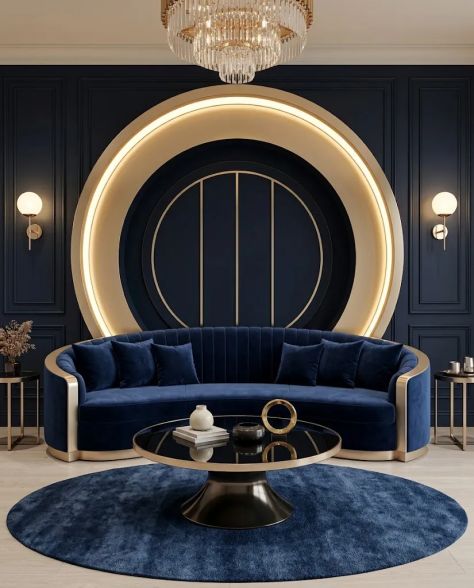
Use the uploaded image as the main visual reference. Recreate the same luxury Art Deco-inspired lounge, same deep-blue curved sofa, same monumental circular gold-trimmed architectural surround, same dark paneled wall, same circular champagne-gold coffee table, same deep-blue rug, same symmetrical side tables and sconces, same partial crystal chandelier, same pale timber floor, same jewel-tone palette, same frontal centered framing, and same controlled luxury atmosphere. Do not invent a new floor plan, different furniture geometry, different wall treatment, new color scheme, additional decorative objects, or a new camera angle. Follow the uploaded image closely and apply only the corrections below.

Generate a maximum-quality photorealistic architectural visualization / highly polished luxury editorial interior image of the same formal sitting area in a 4:5 vertical composition. Position the camera at approximately eye level, facing the seating arrangement directly with almost no lateral rotation or perspective skew. Center the sofa, circular wall feature, rug, and coffee table precisely on the vertical axis. Maintain strong bilateral symmetry, with matching side tables and sconces balanced on frame-left and frame-right. Use approximately 35 mm equivalent architectural perspective, f/5 aperture behavior, deep depth of field, grain level 0–1/10, and post-processing intensity approximately 8/10.

Preserve the exact spatial hierarchy from the uploaded image. Keep the deep-blue oval/circular rug as the lowest foreground layer, the sculptural metallic coffee table centered above it, the large curved sofa directly behind, the enormous circular architectural surround enclosing the sofa visually, the paneled deep navy wall as the architectural background, and the crystal chandelier entering partially from the top center. Do not widen the room, alter the wall proportions, lower the circular feature, shift the sofa, or break the central symmetry.

Preserve the back wall as a deep navy-to-near-black paneled surface around H 215–225°, low saturation and very low brightness. Use traditional rectangular wall molding with clean shallow relief, straight panel boundaries, restrained shadow lines, and a matte-to-low-satin finish. Keep the wall visually dark enough to provide strong contrast behind the luminous circular structure. Do not shift the wall toward gray, black-brown, teal, beige, white, or glossy mirror finishes.

Make the huge circular recessed architectural surround the dominant structural feature. Center it exactly behind the sofa and scale it so it occupies most of the upper-middle composition. Preserve the thick outer ring as a broad champagne-gold metallic border around H 38–44°, medium-high saturation and high brightness. Render the ring as polished warm metal with integrated continuous illumination, subtle metallic grain, broad golden gradients, and controlled specular reflections.

Integrate warm light into the circular outer ring at approximately 2500–2700 K. Keep the illumination continuous, even, and architectural rather than appearing like exposed bulbs or an LED rope. Allow the gold ring to create a strong warm luminous halo around the dark inner circle and trace the upper contour of the sofa. Preserve a bright centerline on the ring with softer warm falloff onto adjacent wall surfaces. Do not make the ring white, neon yellow, silver, or cool LED blue.

Preserve the inner circular recess as a deep blue-black surface around H 215–225°, medium-low saturation and very low brightness. Give it a soft satin finish with subtle radial or center-weighted light falloff, allowing faint cooler blue values to emerge toward the center without becoming bright. Maintain darker outer edges close to the luminous ring for depth.

Inside the circular recess, preserve the thin champagne-gold concentric inner circular line and the three tall vertical gold dividers. Keep the central divider aligned precisely with the frame center and sofa midpoint, with the flanking dividers arranged symmetrically. Render these lines as narrow polished metallic strips around H 38–44°, medium-high saturation and medium-high brightness, with clean straight geometry and subtle warm reflections. Do not add extra lines, decorative motifs, clock markings, mirrors, shelves, or artwork inside the circle.

Keep the pale neutral ceiling visible only as a narrow upper strip above the dark wall. Use a warm neutral cream around H 35–45°, extremely low saturation and high brightness, with a smooth matte finish. Do not expand the ceiling area or introduce coffers, exposed beams, downlight grids, or ornamental plaster.

Preserve the crystal-and-gold chandelier entering partially from the upper center. Render the chandelier with transparent faceted crystal drops, elongated glass prisms, polished warm-gold framework around H 38–45°, and multiple small warm highlights. Keep it only partially visible, naturally cropped by the upper edge. Use chandelier light around 2800–3000 K with small sparkling reflections. Do not enlarge it to dominate the circular wall feature or replace it with a modern pendant.

Preserve the large custom curved sofa centered below the circular feature. Maintain its broad crescent form, gently wrapping silhouette, rounded outer arms, continuous low seat, medium-height back, and upholstered lower plinth. Keep its proportions exactly balanced relative to the circular surround. Do not straighten the sofa, break it into modular sections, increase the back height, or change the arm geometry.

Render the sofa upholstery in deep midnight-to-sapphire navy around H 215–225°, medium saturation and low-to-medium brightness. Use velvet or velour-like material with soft directional sheen, dense short pile, broad highlight rolloff, and deep blue shadow transitions. Maintain richer sapphire reflections on outward-facing curves and deeper blue-black values in recesses and under cushions.

Preserve the backrest’s fine vertical channel stitching. Keep the channels narrow, evenly spaced, and subtly padded with shallow vertical shadow seams. Maintain the long continuous seat cushion with a smooth upholstered surface, slight compression, minimal creasing, and gently curved front edge. Do not add button tufting, diamond quilting, piping patterns, or excessive wrinkles.

Keep the sofa base as a deep-blue upholstered plinth with a thin champagne-gold trim line running near the floor. Render the trim as narrow polished metal with restrained warm reflections. Preserve the outer arm-side metallic panels in champagne gold, following the sofa’s curved silhouette. Do not replace these accents with chrome, silver, black metal, or broad decorative panels.

Preserve approximately eight visible accent pillows distributed in symmetrical clusters across both sides of the sofa, with fewer cushions near the center. Use multiple related deep-blue values: sapphire around H 215–220° at medium saturation and medium-low brightness, midnight navy around H 220–225° at medium saturation and very low brightness, and blue-black around H 215–225° at low saturation and near-black brightness.

Render the pillows in velvet or satin-like textile with soft directional sheen, slightly brighter fold ridges, darker compressed corners, natural cushion bulging, and small seam shadows. Maintain visually balanced left-right clustering without making every pillow position mathematically identical. Do not introduce cream, gold, patterned, striped, or multicolored cushions.

Preserve the low circular statement coffee table in the foreground, centered precisely on the sofa and circular wall feature. Maintain the table’s width, low height, reflective dark top, thin gold perimeter, and sculptural flared pedestal base. Keep the geometry circular and perfectly centered with no lateral shift.

Render the tabletop as black reflective glass or polished dark stone with near-zero base brightness and a very subtle cool undertone. Give it high gloss with clear reflections of the chandelier, gold architectural ring, ceiling light, and tabletop objects. Keep the surface flat, smooth, and polished with a crisp reflective edge. Do not use wood, marble veining, transparent glass, matte stone, or irregular surfaces.

Preserve the thin metallic rim around the tabletop in champagne-brass gold around H 38–44°, medium-high saturation and high brightness. Render it as polished metal with narrow clean specular reflections and soft warm environmental gradients.

Preserve the sculptural table base as a champagne-brass metallic pedestal with a concave hourglass profile, widening smoothly at the top and bottom and narrowing through the middle. Use a satin-polished finish around H 38–44°, medium-high saturation and medium-high brightness. Create broad smooth warm reflections across the curved metal with brighter vertical specular zones and deeper bronze-gold shadow transitions. Do not make the base chrome, silver, faceted, ribbed, or cylindrical.

Preserve the existing tabletop decor only. Place the small white ceramic vase near the center-left of the tabletop composition, using warm ivory around H 40–50°, extremely low saturation and high brightness with a soft satin ceramic finish. Keep the stacked book/tray-like object beneath or near it in muted pale-neutral values. Preserve the small dark vessel as a low-contrast dark decorative element and the small circular gold ornament around H 38–44° with polished metallic highlights. Do not add flowers, books with readable titles, candles, trays, sculptures, bottles, or additional objects.

Preserve the two slim side tables positioned symmetrically at frame-left and frame-right beside the sofa. Maintain narrow rectangular tops, thin metallic legs, and minimal luxury geometry. Use glossy dark tops in blue-black / near-black values and slender champagne-gold frameworks around H 38–44°. Keep the tables equal in height and similar in visual mass.

On the frame-left side table, preserve the small dried botanical arrangement with warm muted brown/gold values around H 30–45°, low-to-medium saturation and medium brightness. Render delicate stems and compact dried foliage without expanding into a large bouquet. On the frame-right side table, retain the small grouped containers/vessels in dark and gold tones. Do not mirror the exact decor objects from one side onto the other unless they are present in the reference.

Preserve the matching wall sconces on both sides of the circular feature. Use opal-white or frosted spherical glass globes around warm neutral H 40–50°, very low saturation and high brightness. Attach the globes to slim polished champagne-gold supports around H 38–44°. Keep the sconces symmetrically placed and approximately equal in height.

Illuminate the sconces at approximately 2800 K with a soft diffuse glow. Allow each globe to produce a warm central brightness with smooth edge falloff and small warm reflections on the nearby wall molding and gold table structures. Do not make the globes transparent, colored, oversized, or sharply directional.

Preserve the floor as pale natural timber around H 32–38°, low saturation and high brightness. Render subtle plank seams, fine linear grain, modest board-to-board tonal variation, and a matte-to-satin finish. Keep floor reflections weak and broad compared with the polished metal and tabletop. Do not shift the floor toward gray oak, orange walnut, dark brown, white marble, or glossy lacquer.

Preserve the large deep-blue area rug beneath the sofa and coffee table. Maintain its softly oval-to-circular footprint, centered alignment, and broad scale extending beneath the seating zone. Render it in navy-to-sapphire values around H 215–225°, medium saturation and low-to-medium brightness.

Give the rug a plush medium-to-high pile with directional tonal variation, soft fiber clumping, darker compressed regions, and brighter blue-silver sheen where fibers turn toward the light. Keep it free of graphic patterns or borders. Do not convert it to flat woven carpet, geometric motifs, cream fibers, or bright cyan.

Use the overall style language of Art Deco revival combined with contemporary luxury and jewel-tone hospitality design. Keep decor density moderate: rely on the giant geometric circle, polished gold accents, blue velvet, chandelier, sconces, and precise symmetry rather than filling the scene with additional objects.

Use soft frontal-to-overhead ambient illumination around 3500 K as the primary general light. Keep it broad, balanced, and flattering to the furniture and architectural surfaces. Illuminate the sofa’s upper planes, tabletop, gold pedestal, wall panels, and floor softly without producing strong directional cast shadows.

Maintain the illuminated circular surround as the dominant accent/backlight at approximately 2500–2700 K. Use it to create warm rim definition around the dark inner recess, upper sofa silhouette, selected pillows, and nearby wall. Preserve strong visual separation between the cool blue furniture mass and warm champagne-gold halo.

Keep the wall sconces around 2800 K and the chandelier around 2900 K. Balance all warm sources so none becomes excessively orange. Maintain an overall lighting range of approximately 2400–3800 K while preserving distinct brighter gold accents against deeper blue surfaces.

Keep fill around 55%. Preserve detail throughout the deep-blue sofa, pillows, inner circular recess, wall moldings, side tables, and rug without flattening the image. Allow only small recessed zones, pillow gaps, sofa underside areas, and wall corners to approach near-black.

Maintain soft controlled shadows. Use broad shadow transitions beneath the coffee table, sofa base, pillows, side furniture, and architectural molding. Avoid hard theatrical cast shadows. Preserve the formal polished studio-like balance of the interior.

Shape reflections according to material. On velvet sofa and pillows, create broad directional highlights with soft edges and darker pile rotation. On champagne-gold metal, use strong polished specular bands with warm gold-white peaks. On the black tabletop, create crisp mirrored reflections. On the rug, use diffuse soft tonal sheen only. On pale timber, use broad restrained satin reflections. On crystal, create small sharp sparkling highlights. On wall panels, keep reflectivity subtle and low-satin.

Maintain the dominant palette exactly: midnight and sapphire blue around H 210–225°, medium saturation and low-to-medium brightness; champagne gold around H 35–45°, medium-high saturation and high brightness; near-black accents with subtle cool undertones; ivory-white decor with extremely low saturation and high brightness; and pale warm timber around H 30–40°, low saturation and high brightness.

Apply a rich jewel-tone luxury color grade with deep navy, sapphire-blue velvet, luminous champagne-gold metal, restrained ivory highlights, and pale warm timber. Use split toning based on cool blue furniture and architecture against warm champagne-gold illumination. Keep overall saturation moderate and concentrate most chroma in the blue upholstery and gold metallic elements.

Maintain strong color contrast without harsh tonal clipping. Keep the blues dark and saturated enough to feel luxurious but not black. Keep gold highlights luminous but retain metal texture and gradient. Do not overexpose the illuminated circular ring or chandelier. Do not crush the inner circular recess until all blue differentiation disappears.

Use deep depth of field. Keep the coffee table, table decor, sofa fabric, pillows, wall detailing, illuminated ring, side tables, sconces, rug fibers, chandelier elements, and pale timber floor clearly readable. Avoid shallow focus or background blur.

Use approximately 35 mm equivalent architectural optics with minimal distortion. Keep the camera centered and level. Maintain straight vertical lines, circular geometry, equal left-right scale, and natural depth. The large circular architectural surround must remain geometrically circular rather than becoming elliptical or distorted.

Render at maximum highly polished photorealistic architectural visualization quality. Use refined ray-traced reflections, physically plausible global illumination, realistic velvet pile, polished warm metal, accurate frosted glass, crystal refraction, subtle timber texture, plush rug fibers, and perfectly controlled geometry. Preserve the high-end CGI/editorial finish rather than introducing raw documentary imperfections.

Follow the uploaded image as the primary reference. Preserve the exact centered composition, giant circular gold surround, deep-blue inner recess, thin concentric gold line, three vertical gold dividers, curved navy sofa, vertical-channel backrest, symmetrical blue pillows, champagne-gold arm accents, gold-trimmed sofa base, reflective circular table, flared gold pedestal, tabletop objects, matching side tables, wall sconces, blue rug, pale timber floor, dark paneled wall, partial chandelier, and 4:5 vertical framing.

Preserve the locked surface finishes exactly: deep-blue velvet sofa and cushions with soft directional sheen; matte-to-low-satin navy wall panels; polished champagne-gold circular frame, trim, sconces, side tables, and coffee-table base; reflective black tabletop; plush navy rug; pale satin-finished timber flooring; frosted globe sconces; and faceted crystal-and-gold chandelier. Do not flatten the material contrast.

Preserve the locked color values exactly: midnight/sapphire blue around H 210–225°, champagne gold around H 35–45°, near-black accents, ivory-white decor, and pale warm timber around H 30–40°. Do not shift the room toward beige, silver, gray, teal, turquoise, rose-gold, or bright multicolor styling.

Preserve the locked lighting model exactly: soft ambient illumination around 3200–3800 K combined with warm 2400–3000 K integrated circular backlighting, sconces, and chandelier highlights. Maintain the luminous gold halo, deep-blue tonal richness, symmetrical illumination, soft shadows, high material separation, and controlled luxury contrast.

No people. No pets. No extra furniture. No additional artwork. No visible text. No logos. No watermark. No television. No mirrors added inside the circular recess. No extra lighting fixtures. No plants beyond the small dried arrangement already present. No excessive decorative clutter. No lens flare. No fog. No rain. No particles. No chromatic aberration. No fisheye distortion. No tilted verticals. No asymmetric furniture placement. No warped circular geometry. No blown-out gold ring. No washed-out blues. No beige redesign. No silver metal substitution. No plastic-looking velvet. Ultra-high resolution. Precise bilateral symmetry. Accurate velvet pile. Polished champagne-gold metal. Reflective black tabletop. Plush rug texture. Photorealistic Art Deco-inspired luxury interior visualization only.

·
Photo Prompts

评价

登录后即可发表评价。

暂无评价。来写第一条吧。

在任何设备上使用 PromptLabHub。

安装应用以便更快打开,或下载 Chrome 扩展并在浏览器中加载。

浏览 Prompt

  • 全部 Prompt
  • 摄影 Prompt
  • 视频 Prompt
  • 美食 Prompt

创作

  • 提交 Prompt

社区

  • 论坛
  • 创作者
  • 排行榜
  • 每周挑战

支持

  • 常见问题
  • 联系我们
  • 隐私政策
  • 服务条款

关注我们

发现并复制精选 AI Prompt,适用于 Midjourney、DALL-E 3、Sora、Runway 等。每周更新。

隐私政策服务条款Cookie 政策

© 2026 PromptLabHub. All rights reserved.

© 2026 PromptLabHub. All rights reserved.

·
隐私政策·服务条款·Cookie 政策
Home
PromptLabHub
Vibrant Abstract Interior Elegant Backlit Bokeh
4
4
Prompt

Vibrant Abstract Interior Elegant Backlit Bokeh

Use the uploaded image as the main visual reference. Recreate the same luxury Art Deco-inspired lounge, same deep-blue curved sofa, same monumental circular gold-trimmed architectural surround, same dark paneled wall, same circular champagne-gold coffee table, same deep-blue rug, same symmetrical side tables and sconces, same partial crystal chandelier, same pale timber floor, same jewel-tone palette, same frontal centered framing, and same controlled luxury atmosphere. Do not invent a new floor plan, different furniture geometry, different wall treatment, new color scheme, additional decorative objects, or a new camera angle. Follow the uploaded image closely and apply only the corrections below.

Generate a maximum-quality photorealistic architectural visualization / highly polished luxury editorial interior image of the same formal sitting area in a 4:5 vertical composition. Position the camera at approximately eye level, facing the seating arrangement directly with almost no lateral rotation or perspective skew. Center the sofa, circular wall feature, rug, and coffee table precisely on the vertical axis. Maintain strong bilateral symmetry, with matching side tables and sconces balanced on frame-left and frame-right. Use approximately 35 mm equivalent architectural perspective, f/5 aperture behavior, deep depth of field, grain level 0–1/10, and post-processing intensity approximately 8/10.

Preserve the exact spatial hierarchy from the uploaded image. Keep the deep-blue oval/circular rug as the lowest foreground layer, the sculptural metallic coffee table centered above it, the large curved sofa directly behind, the enormous circular architectural surround enclosing the sofa visually, the paneled deep navy wall as the architectural background, and the crystal chandelier entering partially from the top center. Do not widen the room, alter the wall proportions, lower the circular feature, shift the sofa, or break the central symmetry.

Preserve the back wall as a deep navy-to-near-black paneled surface around H 215–225°, low saturation and very low brightness. Use traditional rectangular wall molding with clean shallow relief, straight panel boundaries, restrained shadow lines, and a matte-to-low-satin finish. Keep the wall visually dark enough to provide strong contrast behind the luminous circular structure. Do not shift the wall toward gray, black-brown, teal, beige, white, or glossy mirror finishes.

Make the huge circular recessed architectural surround the dominant structural feature. Center it exactly behind the sofa and scale it so it occupies most of the upper-middle composition. Preserve the thick outer ring as a broad champagne-gold metallic border around H 38–44°, medium-high saturation and high brightness. Render the ring as polished warm metal with integrated continuous illumination, subtle metallic grain, broad golden gradients, and controlled specular reflections.

Integrate warm light into the circular outer ring at approximately 2500–2700 K. Keep the illumination continuous, even, and architectural rather than appearing like exposed bulbs or an LED rope. Allow the gold ring to create a strong warm luminous halo around the dark inner circle and trace the upper contour of the sofa. Preserve a bright centerline on the ring with softer warm falloff onto adjacent wall surfaces. Do not make the ring white, neon yellow, silver, or cool LED blue.

Preserve the inner circular recess as a deep blue-black surface around H 215–225°, medium-low saturation and very low brightness. Give it a soft satin finish with subtle radial or center-weighted light falloff, allowing faint cooler blue values to emerge toward the center without becoming bright. Maintain darker outer edges close to the luminous ring for depth.

Inside the circular recess, preserve the thin champagne-gold concentric inner circular line and the three tall vertical gold dividers. Keep the central divider aligned precisely with the frame center and sofa midpoint, with the flanking dividers arranged symmetrically. Render these lines as narrow polished metallic strips around H 38–44°, medium-high saturation and medium-high brightness, with clean straight geometry and subtle warm reflections. Do not add extra lines, decorative motifs, clock markings, mirrors, shelves, or artwork inside the circle.

Keep the pale neutral ceiling visible only as a narrow upper strip above the dark wall. Use a warm neutral cream around H 35–45°, extremely low saturation and high brightness, with a smooth matte finish. Do not expand the ceiling area or introduce coffers, exposed beams, downlight grids, or ornamental plaster.

Preserve the crystal-and-gold chandelier entering partially from the upper center. Render the chandelier with transparent faceted crystal drops, elongated glass prisms, polished warm-gold framework around H 38–45°, and multiple small warm highlights. Keep it only partially visible, naturally cropped by the upper edge. Use chandelier light around 2800–3000 K with small sparkling reflections. Do not enlarge it to dominate the circular wall feature or replace it with a modern pendant.

Preserve the large custom curved sofa centered below the circular feature. Maintain its broad crescent form, gently wrapping silhouette, rounded outer arms, continuous low seat, medium-height back, and upholstered lower plinth. Keep its proportions exactly balanced relative to the circular surround. Do not straighten the sofa, break it into modular sections, increase the back height, or change the arm geometry.

Render the sofa upholstery in deep midnight-to-sapphire navy around H 215–225°, medium saturation and low-to-medium brightness. Use velvet or velour-like material with soft directional sheen, dense short pile, broad highlight rolloff, and deep blue shadow transitions. Maintain richer sapphire reflections on outward-facing curves and deeper blue-black values in recesses and under cushions.

Preserve the backrest’s fine vertical channel stitching. Keep the channels narrow, evenly spaced, and subtly padded with shallow vertical shadow seams. Maintain the long continuous seat cushion with a smooth upholstered surface, slight compression, minimal creasing, and gently curved front edge. Do not add button tufting, diamond quilting, piping patterns, or excessive wrinkles.

Keep the sofa base as a deep-blue upholstered plinth with a thin champagne-gold trim line running near the floor. Render the trim as narrow polished metal with restrained warm reflections. Preserve the outer arm-side metallic panels in champagne gold, following the sofa’s curved silhouette. Do not replace these accents with chrome, silver, black metal, or broad decorative panels.

Preserve approximately eight visible accent pillows distributed in symmetrical clusters across both sides of the sofa, with fewer cushions near the center. Use multiple related deep-blue values: sapphire around H 215–220° at medium saturation and medium-low brightness, midnight navy around H 220–225° at medium saturation and very low brightness, and blue-black around H 215–225° at low saturation and near-black brightness.

Render the pillows in velvet or satin-like textile with soft directional sheen, slightly brighter fold ridges, darker compressed corners, natural cushion bulging, and small seam shadows. Maintain visually balanced left-right clustering without making every pillow position mathematically identical. Do not introduce cream, gold, patterned, striped, or multicolored cushions.

Preserve the low circular statement coffee table in the foreground, centered precisely on the sofa and circular wall feature. Maintain the table’s width, low height, reflective dark top, thin gold perimeter, and sculptural flared pedestal base. Keep the geometry circular and perfectly centered with no lateral shift.

Render the tabletop as black reflective glass or polished dark stone with near-zero base brightness and a very subtle cool undertone. Give it high gloss with clear reflections of the chandelier, gold architectural ring, ceiling light, and tabletop objects. Keep the surface flat, smooth, and polished with a crisp reflective edge. Do not use wood, marble veining, transparent glass, matte stone, or irregular surfaces.

Preserve the thin metallic rim around the tabletop in champagne-brass gold around H 38–44°, medium-high saturation and high brightness. Render it as polished metal with narrow clean specular reflections and soft warm environmental gradients.

Preserve the sculptural table base as a champagne-brass metallic pedestal with a concave hourglass profile, widening smoothly at the top and bottom and narrowing through the middle. Use a satin-polished finish around H 38–44°, medium-high saturation and medium-high brightness. Create broad smooth warm reflections across the curved metal with brighter vertical specular zones and deeper bronze-gold shadow transitions. Do not make the base chrome, silver, faceted, ribbed, or cylindrical.

Preserve the existing tabletop decor only. Place the small white ceramic vase near the center-left of the tabletop composition, using warm ivory around H 40–50°, extremely low saturation and high brightness with a soft satin ceramic finish. Keep the stacked book/tray-like object beneath or near it in muted pale-neutral values. Preserve the small dark vessel as a low-contrast dark decorative element and the small circular gold ornament around H 38–44° with polished metallic highlights. Do not add flowers, books with readable titles, candles, trays, sculptures, bottles, or additional objects.

Preserve the two slim side tables positioned symmetrically at frame-left and frame-right beside the sofa. Maintain narrow rectangular tops, thin metallic legs, and minimal luxury geometry. Use glossy dark tops in blue-black / near-black values and slender champagne-gold frameworks around H 38–44°. Keep the tables equal in height and similar in visual mass.

On the frame-left side table, preserve the small dried botanical arrangement with warm muted brown/gold values around H 30–45°, low-to-medium saturation and medium brightness. Render delicate stems and compact dried foliage without expanding into a large bouquet. On the frame-right side table, retain the small grouped containers/vessels in dark and gold tones. Do not mirror the exact decor objects from one side onto the other unless they are present in the reference.

Preserve the matching wall sconces on both sides of the circular feature. Use opal-white or frosted spherical glass globes around warm neutral H 40–50°, very low saturation and high brightness. Attach the globes to slim polished champagne-gold supports around H 38–44°. Keep the sconces symmetrically placed and approximately equal in height.

Illuminate the sconces at approximately 2800 K with a soft diffuse glow. Allow each globe to produce a warm central brightness with smooth edge falloff and small warm reflections on the nearby wall molding and gold table structures. Do not make the globes transparent, colored, oversized, or sharply directional.

Preserve the floor as pale natural timber around H 32–38°, low saturation and high brightness. Render subtle plank seams, fine linear grain, modest board-to-board tonal variation, and a matte-to-satin finish. Keep floor reflections weak and broad compared with the polished metal and tabletop. Do not shift the floor toward gray oak, orange walnut, dark brown, white marble, or glossy lacquer.

Preserve the large deep-blue area rug beneath the sofa and coffee table. Maintain its softly oval-to-circular footprint, centered alignment, and broad scale extending beneath the seating zone. Render it in navy-to-sapphire values around H 215–225°, medium saturation and low-to-medium brightness.

Give the rug a plush medium-to-high pile with directional tonal variation, soft fiber clumping, darker compressed regions, and brighter blue-silver sheen where fibers turn toward the light. Keep it free of graphic patterns or borders. Do not convert it to flat woven carpet, geometric motifs, cream fibers, or bright cyan.

Use the overall style language of Art Deco revival combined with contemporary luxury and jewel-tone hospitality design. Keep decor density moderate: rely on the giant geometric circle, polished gold accents, blue velvet, chandelier, sconces, and precise symmetry rather than filling the scene with additional objects.

Use soft frontal-to-overhead ambient illumination around 3500 K as the primary general light. Keep it broad, balanced, and flattering to the furniture and architectural surfaces. Illuminate the sofa’s upper planes, tabletop, gold pedestal, wall panels, and floor softly without producing strong directional cast shadows.

Maintain the illuminated circular surround as the dominant accent/backlight at approximately 2500–2700 K. Use it to create warm rim definition around the dark inner recess, upper sofa silhouette, selected pillows, and nearby wall. Preserve strong visual separation between the cool blue furniture mass and warm champagne-gold halo.

Keep the wall sconces around 2800 K and the chandelier around 2900 K. Balance all warm sources so none becomes excessively orange. Maintain an overall lighting range of approximately 2400–3800 K while preserving distinct brighter gold accents against deeper blue surfaces.

Keep fill around 55%. Preserve detail throughout the deep-blue sofa, pillows, inner circular recess, wall moldings, side tables, and rug without flattening the image. Allow only small recessed zones, pillow gaps, sofa underside areas, and wall corners to approach near-black.

Maintain soft controlled shadows. Use broad shadow transitions beneath the coffee table, sofa base, pillows, side furniture, and architectural molding. Avoid hard theatrical cast shadows. Preserve the formal polished studio-like balance of the interior.

Shape reflections according to material. On velvet sofa and pillows, create broad directional highlights with soft edges and darker pile rotation. On champagne-gold metal, use strong polished specular bands with warm gold-white peaks. On the black tabletop, create crisp mirrored reflections. On the rug, use diffuse soft tonal sheen only. On pale timber, use broad restrained satin reflections. On crystal, create small sharp sparkling highlights. On wall panels, keep reflectivity subtle and low-satin.

Maintain the dominant palette exactly: midnight and sapphire blue around H 210–225°, medium saturation and low-to-medium brightness; champagne gold around H 35–45°, medium-high saturation and high brightness; near-black accents with subtle cool undertones; ivory-white decor with extremely low saturation and high brightness; and pale warm timber around H 30–40°, low saturation and high brightness.

Apply a rich jewel-tone luxury color grade with deep navy, sapphire-blue velvet, luminous champagne-gold metal, restrained ivory highlights, and pale warm timber. Use split toning based on cool blue furniture and architecture against warm champagne-gold illumination. Keep overall saturation moderate and concentrate most chroma in the blue upholstery and gold metallic elements.

Maintain strong color contrast without harsh tonal clipping. Keep the blues dark and saturated enough to feel luxurious but not black. Keep gold highlights luminous but retain metal texture and gradient. Do not overexpose the illuminated circular ring or chandelier. Do not crush the inner circular recess until all blue differentiation disappears.

Use deep depth of field. Keep the coffee table, table decor, sofa fabric, pillows, wall detailing, illuminated ring, side tables, sconces, rug fibers, chandelier elements, and pale timber floor clearly readable. Avoid shallow focus or background blur.

Use approximately 35 mm equivalent architectural optics with minimal distortion. Keep the camera centered and level. Maintain straight vertical lines, circular geometry, equal left-right scale, and natural depth. The large circular architectural surround must remain geometrically circular rather than becoming elliptical or distorted.

Render at maximum highly polished photorealistic architectural visualization quality. Use refined ray-traced reflections, physically plausible global illumination, realistic velvet pile, polished warm metal, accurate frosted glass, crystal refraction, subtle timber texture, plush rug fibers, and perfectly controlled geometry. Preserve the high-end CGI/editorial finish rather than introducing raw documentary imperfections.

Follow the uploaded image as the primary reference. Preserve the exact centered composition, giant circular gold surround, deep-blue inner recess, thin concentric gold line, three vertical gold dividers, curved navy sofa, vertical-channel backrest, symmetrical blue pillows, champagne-gold arm accents, gold-trimmed sofa base, reflective circular table, flared gold pedestal, tabletop objects, matching side tables, wall sconces, blue rug, pale timber floor, dark paneled wall, partial chandelier, and 4:5 vertical framing.

Preserve the locked surface finishes exactly: deep-blue velvet sofa and cushions with soft directional sheen; matte-to-low-satin navy wall panels; polished champagne-gold circular frame, trim, sconces, side tables, and coffee-table base; reflective black tabletop; plush navy rug; pale satin-finished timber flooring; frosted globe sconces; and faceted crystal-and-gold chandelier. Do not flatten the material contrast.

Preserve the locked color values exactly: midnight/sapphire blue around H 210–225°, champagne gold around H 35–45°, near-black accents, ivory-white decor, and pale warm timber around H 30–40°. Do not shift the room toward beige, silver, gray, teal, turquoise, rose-gold, or bright multicolor styling.

Preserve the locked lighting model exactly: soft ambient illumination around 3200–3800 K combined with warm 2400–3000 K integrated circular backlighting, sconces, and chandelier highlights. Maintain the luminous gold halo, deep-blue tonal richness, symmetrical illumination, soft shadows, high material separation, and controlled luxury contrast.

No people. No pets. No extra furniture. No additional artwork. No visible text. No logos. No watermark. No television. No mirrors added inside the circular recess. No extra lighting fixtures. No plants beyond the small dried arrangement already present. No excessive decorative clutter. No lens flare. No fog. No rain. No particles. No chromatic aberration. No fisheye distortion. No tilted verticals. No asymmetric furniture placement. No warped circular geometry. No blown-out gold ring. No washed-out blues. No beige redesign. No silver metal substitution. No plastic-looking velvet. Ultra-high resolution. Precise bilateral symmetry. Accurate velvet pile. Polished champagne-gold metal. Reflective black tabletop. Plush rug texture. Photorealistic Art Deco-inspired luxury interior visualization only.

·
Photo Prompts

评价

登录后即可发表评价。

暂无评价。来写第一条吧。

在任何设备上使用 PromptLabHub。

安装应用以便更快打开,或下载 Chrome 扩展并在浏览器中加载。

浏览 Prompt

  • 全部 Prompt
  • 摄影 Prompt
  • 视频 Prompt
  • 美食 Prompt

创作

  • 提交 Prompt

社区

  • 论坛
  • 创作者
  • 排行榜
  • 每周挑战

支持

  • 常见问题
  • 联系我们
  • 隐私政策
  • 服务条款

关注我们

发现并复制精选 AI Prompt,适用于 Midjourney、DALL-E 3、Sora、Runway 等。每周更新。

隐私政策服务条款Cookie 政策

© 2026 PromptLabHub. All rights reserved.

© 2026 PromptLabHub. All rights reserved.

·
隐私政策·服务条款·Cookie 政策
Home