
PromptLabHub
Sketch Portrait Studio Light Bokeh
38
38
Prompt

Sketch Portrait Studio Light Bokeh

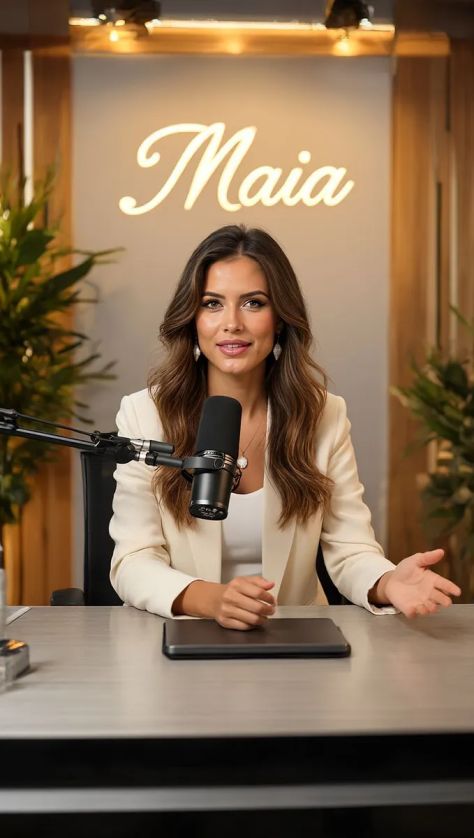
Use the attached source image as the primary governing reference. Recreate its composition, photographic hierarchy, lighting architecture, typography, and colour relationships rather than reinterpreting the design. The reference is a vertical 736 × 1300 image, so rebuild it natively as a square without geometric distortion: preserve the original vertical proportions of the woman, face, title, microphone, furniture, and photographed objects, then extend the studio environment laterally to create the square composition. Treat the original vertical field as a centred structural strip occupying approximately x=21.7–78.3% of the square and continue the warm wood architecture, foliage, wall, tabletop, and environmental lighting naturally into x=0–21.7% and x=78.3–100%.

This is a portrait-photographic, dominance-primary podcast cover: one centrally organised human host is the main recognition element, the studio microphone and environment establish the interview setting, and the luminous first-name lettering remains subordinate to the portrait. Create a square 1:1 composition at 3000 × 3000 pixels in sRGB and use the highest resolution tier available. Deliver flat, full-bleed cover artwork filling the square edge to edge.

Build the photographic background from the bottom upward. Start with a full-frame warm podcast/interview studio consisting of a central tan-beige wall around #D0A981 with perceptual luminosity around 72, amber-brown vertical wood architecture around #88592E with luminosity around 42, dark olive-brown foliage around #2B200F with luminosity around 13 on both lateral sides, a warm grey tabletop around #AFA69C with luminosity around 69 across the lower portion, and deep warm near-black structural shadows around #0B0A07 with luminosity around 3. Continue the architecture naturally through the laterally outpainted side regions so the square looks like one photographed room rather than a vertical photograph placed on a larger background. Use warm practical lighting along the upper cabinetry and wall, with small pools of golden illumination. Keep the central wall and host more exposed than the frame perimeter. Value transitions must arise from physically plausible studio lighting, photographed depth, and edge falloff. Target corner luminosities of approximately 21 at the top-left, 9 at the top-right, 3 at the bottom-left, and 3 at the bottom-right, while the title-zone wall remains around luminosity 69–76.

Apply shallow photographic depth of field so the presenter and foreground microphone remain sharply resolved while the rear wall edges, upper fixtures, foliage, and architecture soften with an effective blur radius equivalent to approximately 1.5–2.5% of canvas width. Apply a global warm amber-and-cream colour grade at approximately 15–25% strength while preserving natural skin variation, cream fabric, dark microphone hardware, brown hair, wood, and green-brown foliage. Finish the photographic base with a deep warm-brown edge luminance falloff at approximately 20–30% strength, concentrated within roughly the outer 8–12% of the square. Keep the centre lifted and the perimeter substantially darker.

Recreate the depicted woman as the primary photographic subject and preserve her identity exactly from the reference; do not change her facial identity. Keep her facial proportions, warm natural skin appearance, brown centre-parted softly waved hair, eye shape, brows, nose, lips, and overall likeness consistent with the uploaded image. Present her seated, torso facing almost directly forward, gaze into the camera, shoulders approximately level, one hand resting near the centre of the desk and the opposite arm extending outward with an open palm. Dress her in the same light ivory-beige blazer over a white or very pale cream top, with understated earrings and a small pendant necklace. Keep her integrated into the full-frame photograph with natural photographic hair edges and continuous skin tones rather than treating her as a graphic cutout. After square translation, target the complete visible subject at approximately x=34.1–77.2%, y=27–74%, with optical centre near x=52.3%, y=51%. Place the face approximately x=44.9–55.7%, y=30–45%, with its centre near x=50.3%, y=38%. Preserve a visible head height of approximately 16–17% of canvas height and a total visible subject height around 47%.

Place the matte charcoal-black podcast microphone around #171716, luminosity about 8, directly in the foreground between the camera and the host, approximately x=44.3–50.6%, y=47–62%, with a cylindrical broadcast-microphone body and realistic dark hardware. Extend its boom arm naturally from the microphone toward and through the left edge at approximately y=49–56%, maintaining the source behaviour in which the arm visibly exits the composition. Keep the black chair behind the host, the warm grey tabletop across x=0–100%, y≈72–89%, a dark tablet or closed device on the table centred near x=52–54%, y≈76.5%, and a near-black table fascia across x=0–100%, y≈88–100%. Preserve the lateral foliage-and-wood framing language: dense dark foliage and warm architectural elements should balance the portrait on both sides while the upper central wall remains the principal negative-space field.

The surface finish is pristine continuous-tone digital photography. All visible texture comes from photographed wood grain, foliage, skin, hair, fabric, tabletop, and hardware. Limit the effect system to the shallow background focus falloff, warm global grade, practical-light bloom, luminous title halo, and edge vignette. Keep dimensionality photographic and physically plausible.

Render the title exactly as "Maia". This string contains exactly 4 characters, spelled M-a-i-a. Use exactly one line, with the full line reading Maia. Verify the spelling and character sequence before rendering. The only text anywhere on the entire canvas is "Maia"; all remaining regions contain photography only.

Construct the lettering as a connected calligraphic brush-script / hand-lettered script with moderate-to-high stroke contrast: thicker downstrokes, much lighter connecting and entry strokes, rounded to softly flared terminals, tight lowercase apertures, low x-height around 0.48–0.55 of the capital height, single-storey lowercase “a” forms with oval enclosed counters, and a narrow connected “i” carrying a detached circular-to-oval dot. Use an oversized capital “M” with a broad left entry swash and long sweeping internal transitions, tightly connected “a-i-a” forms, and a final “a” ending in a short rising terminal. Give the word a rightward calligraphic slant of approximately 10–15 degrees. Use medium-weight main downstrokes with hairline-to-light connectors and physically connected tracking. Great Vibes is a metric-similar reference only; reproduce the extracted skeleton and proportions rather than treating that face name as a verified font identification.

Hold the title’s maximum capital height at approximately 10.5% of the square canvas height. After translating the vertical reference into the square without widening the letterforms, place the title core at approximately x=35.8–64.7%, y=15–25%, with optical centre near x=50.3%, y=20.2%. Keep it optically centred on the main portrait axis. Maintain approximately 1.5–2.5% of canvas height between the lowest title strokes and the top of the hair. Fill the core strokes with warm pale ivory #FEFDE3 at luminosity approximately 98–99. Surround the lettering with a soft localized warm yellow-cream halo derived from approximately #FFE7AD, spreading around 0.8–1.5% of canvas width and blurring approximately 1–2% of canvas width at an equivalent opacity around 35–50%. The glow-inclusive region should occupy approximately x=35.3–65.3%, y=14–26%. Keep the letterforms visually flat and luminous, with the halo as the sole dimensional cue.

Use no secondary typographic hierarchy: the entire communication system consists of the single string "Maia". Reserve all space outside that title for the photographic portrait and studio environment.

Control the photographic colour architecture with these 10 dominant hue/value anchors: rear-wall tan #D0A981 at luminosity about 72; wood amber #88592E at about 42; dark olive-brown foliage #2B200F at about 13; deep chocolate hair brown #3A2419 at about 17; warm peach-tan skin midtone #C9825E at about 61; ivory-beige blazer #F4EDD6 at about 94; title ivory #FEFDE3 at about 99; charcoal-black microphone hardware #171716 at about 8; warm grey tabletop #AFA69C at about 69; and deep warm shadow/table fascia #0B0A07 at about 3. Treat these 10 colours as the closed control system for the image while allowing natural continuous photographic interpolation within their respective hue families. The title halo may derive from the same cream/golden family around #FFE7AD at low opacity. Maintain a warm-dominant, moderate-to-muted saturation structure. Keep the median title-to-background luminosity delta near 27, with localized variation around 21–30 as the lettering crosses naturally illuminated wall regions.

Organise the finished square as title-top / portrait-below, centred on a strong vertical host axis. Reading order must be face first, "Maia" second, microphone third. Keep the face centre near x=50.3%, y=38%; title centre near x=50.3%, y=20.2%; microphone centre near x≈47.5%, y≈54.5%; tablet centre near x≈52–54%, y≈76.5%. Let the tabletop occupy y≈72–89% and the dark fascia y≈88–100%. Keep the upper central tan wall as the main negative-space region around the title and head while the side extensions carry wood, foliage, and low-luminance environmental mass. Preserve full photographic bleed on all four edges, maintain the boom-arm bleed through the left edge, and keep critical information comfortably inside the frame. Reserve the lower 8% of the canvas for noncritical dark table-fascia/background information so player-interface overlays cannot cover the title or face.

Judge the design at thumbnail scale as well as full resolution. At approximately 55 pixels wide, the acceptance test is that the image still reads immediately as a warm brown-and-cream portrait of a woman at a dark studio microphone, with a pale glowing script band above her. The host silhouette and face mass must remain recognisable and the microphone must remain a distinct dark vertical accent; the small script may compress toward a luminous word shape rather than fully resolved lettering, matching the source hierarchy. At approximately 150 pixels, the human portrait, title word shape, microphone, cream blazer, warm studio field, and lateral dark foliage must all remain clearly separated.

Use the visual language of a personality-led interview and conversation podcast with culture-and-lifestyle positioning, carried specifically by the centred host portrait, studio microphone, warm domestic-studio environment, first-name calligraphic lettering, cream/brown colour architecture, controlled lighting, and limited text.

Keep the depicted woman’s identity, facial structure, hair, pose, and overall likeness locked to the uploaded reference; do not change facial identity. Keep the type scale at approximately 10.5% capital height, keep the translated title position fixed, keep the surface photographic, keep the colour architecture inside the specified warm tan/brown/cream/charcoal families, preserve the shallow background softness, edge falloff, and luminous title halo, and render exactly four textual characters forming "Maia" with nothing else written anywhere in the artwork. Preserve the lower 8% as noncritical table/background space and deliver the final result as a native 3000 × 3000 square podcast-cover composition rather than a stretched version of the vertical source.

·
Photo Prompts

评价

登录后即可发表评价。

暂无评价。来写第一条吧。

在任何设备上使用 PromptLabHub。

安装应用以便更快打开,或下载 Chrome 扩展并在浏览器中加载。

浏览 Prompt

  • 全部 Prompt
  • 摄影 Prompt
  • 视频 Prompt
  • 美食 Prompt

创作

  • 提交 Prompt

社区

  • 论坛
  • 创作者
  • 排行榜
  • 每周挑战

支持

  • 常见问题
  • 联系我们
  • 隐私政策
  • 服务条款

关注我们

发现并复制精选 AI Prompt,适用于 Midjourney、DALL-E 3、Sora、Runway 等。每周更新。

隐私政策服务条款Cookie 政策

© 2026 PromptLabHub. All rights reserved.

© 2026 PromptLabHub. All rights reserved.

·
隐私政策·服务条款·Cookie 政策
Home
PromptLabHub
Sketch Portrait Studio Light Bokeh
38
38
Prompt

Sketch Portrait Studio Light Bokeh

Use the attached source image as the primary governing reference. Recreate its composition, photographic hierarchy, lighting architecture, typography, and colour relationships rather than reinterpreting the design. The reference is a vertical 736 × 1300 image, so rebuild it natively as a square without geometric distortion: preserve the original vertical proportions of the woman, face, title, microphone, furniture, and photographed objects, then extend the studio environment laterally to create the square composition. Treat the original vertical field as a centred structural strip occupying approximately x=21.7–78.3% of the square and continue the warm wood architecture, foliage, wall, tabletop, and environmental lighting naturally into x=0–21.7% and x=78.3–100%.

This is a portrait-photographic, dominance-primary podcast cover: one centrally organised human host is the main recognition element, the studio microphone and environment establish the interview setting, and the luminous first-name lettering remains subordinate to the portrait. Create a square 1:1 composition at 3000 × 3000 pixels in sRGB and use the highest resolution tier available. Deliver flat, full-bleed cover artwork filling the square edge to edge.

Build the photographic background from the bottom upward. Start with a full-frame warm podcast/interview studio consisting of a central tan-beige wall around #D0A981 with perceptual luminosity around 72, amber-brown vertical wood architecture around #88592E with luminosity around 42, dark olive-brown foliage around #2B200F with luminosity around 13 on both lateral sides, a warm grey tabletop around #AFA69C with luminosity around 69 across the lower portion, and deep warm near-black structural shadows around #0B0A07 with luminosity around 3. Continue the architecture naturally through the laterally outpainted side regions so the square looks like one photographed room rather than a vertical photograph placed on a larger background. Use warm practical lighting along the upper cabinetry and wall, with small pools of golden illumination. Keep the central wall and host more exposed than the frame perimeter. Value transitions must arise from physically plausible studio lighting, photographed depth, and edge falloff. Target corner luminosities of approximately 21 at the top-left, 9 at the top-right, 3 at the bottom-left, and 3 at the bottom-right, while the title-zone wall remains around luminosity 69–76.

Apply shallow photographic depth of field so the presenter and foreground microphone remain sharply resolved while the rear wall edges, upper fixtures, foliage, and architecture soften with an effective blur radius equivalent to approximately 1.5–2.5% of canvas width. Apply a global warm amber-and-cream colour grade at approximately 15–25% strength while preserving natural skin variation, cream fabric, dark microphone hardware, brown hair, wood, and green-brown foliage. Finish the photographic base with a deep warm-brown edge luminance falloff at approximately 20–30% strength, concentrated within roughly the outer 8–12% of the square. Keep the centre lifted and the perimeter substantially darker.

Recreate the depicted woman as the primary photographic subject and preserve her identity exactly from the reference; do not change her facial identity. Keep her facial proportions, warm natural skin appearance, brown centre-parted softly waved hair, eye shape, brows, nose, lips, and overall likeness consistent with the uploaded image. Present her seated, torso facing almost directly forward, gaze into the camera, shoulders approximately level, one hand resting near the centre of the desk and the opposite arm extending outward with an open palm. Dress her in the same light ivory-beige blazer over a white or very pale cream top, with understated earrings and a small pendant necklace. Keep her integrated into the full-frame photograph with natural photographic hair edges and continuous skin tones rather than treating her as a graphic cutout. After square translation, target the complete visible subject at approximately x=34.1–77.2%, y=27–74%, with optical centre near x=52.3%, y=51%. Place the face approximately x=44.9–55.7%, y=30–45%, with its centre near x=50.3%, y=38%. Preserve a visible head height of approximately 16–17% of canvas height and a total visible subject height around 47%.

Place the matte charcoal-black podcast microphone around #171716, luminosity about 8, directly in the foreground between the camera and the host, approximately x=44.3–50.6%, y=47–62%, with a cylindrical broadcast-microphone body and realistic dark hardware. Extend its boom arm naturally from the microphone toward and through the left edge at approximately y=49–56%, maintaining the source behaviour in which the arm visibly exits the composition. Keep the black chair behind the host, the warm grey tabletop across x=0–100%, y≈72–89%, a dark tablet or closed device on the table centred near x=52–54%, y≈76.5%, and a near-black table fascia across x=0–100%, y≈88–100%. Preserve the lateral foliage-and-wood framing language: dense dark foliage and warm architectural elements should balance the portrait on both sides while the upper central wall remains the principal negative-space field.

The surface finish is pristine continuous-tone digital photography. All visible texture comes from photographed wood grain, foliage, skin, hair, fabric, tabletop, and hardware. Limit the effect system to the shallow background focus falloff, warm global grade, practical-light bloom, luminous title halo, and edge vignette. Keep dimensionality photographic and physically plausible.

Render the title exactly as "Maia". This string contains exactly 4 characters, spelled M-a-i-a. Use exactly one line, with the full line reading Maia. Verify the spelling and character sequence before rendering. The only text anywhere on the entire canvas is "Maia"; all remaining regions contain photography only.

Construct the lettering as a connected calligraphic brush-script / hand-lettered script with moderate-to-high stroke contrast: thicker downstrokes, much lighter connecting and entry strokes, rounded to softly flared terminals, tight lowercase apertures, low x-height around 0.48–0.55 of the capital height, single-storey lowercase “a” forms with oval enclosed counters, and a narrow connected “i” carrying a detached circular-to-oval dot. Use an oversized capital “M” with a broad left entry swash and long sweeping internal transitions, tightly connected “a-i-a” forms, and a final “a” ending in a short rising terminal. Give the word a rightward calligraphic slant of approximately 10–15 degrees. Use medium-weight main downstrokes with hairline-to-light connectors and physically connected tracking. Great Vibes is a metric-similar reference only; reproduce the extracted skeleton and proportions rather than treating that face name as a verified font identification.

Hold the title’s maximum capital height at approximately 10.5% of the square canvas height. After translating the vertical reference into the square without widening the letterforms, place the title core at approximately x=35.8–64.7%, y=15–25%, with optical centre near x=50.3%, y=20.2%. Keep it optically centred on the main portrait axis. Maintain approximately 1.5–2.5% of canvas height between the lowest title strokes and the top of the hair. Fill the core strokes with warm pale ivory #FEFDE3 at luminosity approximately 98–99. Surround the lettering with a soft localized warm yellow-cream halo derived from approximately #FFE7AD, spreading around 0.8–1.5% of canvas width and blurring approximately 1–2% of canvas width at an equivalent opacity around 35–50%. The glow-inclusive region should occupy approximately x=35.3–65.3%, y=14–26%. Keep the letterforms visually flat and luminous, with the halo as the sole dimensional cue.

Use no secondary typographic hierarchy: the entire communication system consists of the single string "Maia". Reserve all space outside that title for the photographic portrait and studio environment.

Control the photographic colour architecture with these 10 dominant hue/value anchors: rear-wall tan #D0A981 at luminosity about 72; wood amber #88592E at about 42; dark olive-brown foliage #2B200F at about 13; deep chocolate hair brown #3A2419 at about 17; warm peach-tan skin midtone #C9825E at about 61; ivory-beige blazer #F4EDD6 at about 94; title ivory #FEFDE3 at about 99; charcoal-black microphone hardware #171716 at about 8; warm grey tabletop #AFA69C at about 69; and deep warm shadow/table fascia #0B0A07 at about 3. Treat these 10 colours as the closed control system for the image while allowing natural continuous photographic interpolation within their respective hue families. The title halo may derive from the same cream/golden family around #FFE7AD at low opacity. Maintain a warm-dominant, moderate-to-muted saturation structure. Keep the median title-to-background luminosity delta near 27, with localized variation around 21–30 as the lettering crosses naturally illuminated wall regions.

Organise the finished square as title-top / portrait-below, centred on a strong vertical host axis. Reading order must be face first, "Maia" second, microphone third. Keep the face centre near x=50.3%, y=38%; title centre near x=50.3%, y=20.2%; microphone centre near x≈47.5%, y≈54.5%; tablet centre near x≈52–54%, y≈76.5%. Let the tabletop occupy y≈72–89% and the dark fascia y≈88–100%. Keep the upper central tan wall as the main negative-space region around the title and head while the side extensions carry wood, foliage, and low-luminance environmental mass. Preserve full photographic bleed on all four edges, maintain the boom-arm bleed through the left edge, and keep critical information comfortably inside the frame. Reserve the lower 8% of the canvas for noncritical dark table-fascia/background information so player-interface overlays cannot cover the title or face.

Judge the design at thumbnail scale as well as full resolution. At approximately 55 pixels wide, the acceptance test is that the image still reads immediately as a warm brown-and-cream portrait of a woman at a dark studio microphone, with a pale glowing script band above her. The host silhouette and face mass must remain recognisable and the microphone must remain a distinct dark vertical accent; the small script may compress toward a luminous word shape rather than fully resolved lettering, matching the source hierarchy. At approximately 150 pixels, the human portrait, title word shape, microphone, cream blazer, warm studio field, and lateral dark foliage must all remain clearly separated.

Use the visual language of a personality-led interview and conversation podcast with culture-and-lifestyle positioning, carried specifically by the centred host portrait, studio microphone, warm domestic-studio environment, first-name calligraphic lettering, cream/brown colour architecture, controlled lighting, and limited text.

Keep the depicted woman’s identity, facial structure, hair, pose, and overall likeness locked to the uploaded reference; do not change facial identity. Keep the type scale at approximately 10.5% capital height, keep the translated title position fixed, keep the surface photographic, keep the colour architecture inside the specified warm tan/brown/cream/charcoal families, preserve the shallow background softness, edge falloff, and luminous title halo, and render exactly four textual characters forming "Maia" with nothing else written anywhere in the artwork. Preserve the lower 8% as noncritical table/background space and deliver the final result as a native 3000 × 3000 square podcast-cover composition rather than a stretched version of the vertical source.

·
Photo Prompts

评价

登录后即可发表评价。

暂无评价。来写第一条吧。

在任何设备上使用 PromptLabHub。

安装应用以便更快打开,或下载 Chrome 扩展并在浏览器中加载。

浏览 Prompt

  • 全部 Prompt
  • 摄影 Prompt
  • 视频 Prompt
  • 美食 Prompt

创作

  • 提交 Prompt

社区

  • 论坛
  • 创作者
  • 排行榜
  • 每周挑战

支持

  • 常见问题
  • 联系我们
  • 隐私政策
  • 服务条款

关注我们

发现并复制精选 AI Prompt,适用于 Midjourney、DALL-E 3、Sora、Runway 等。每周更新。

隐私政策服务条款Cookie 政策

© 2026 PromptLabHub. All rights reserved.

© 2026 PromptLabHub. All rights reserved.

·
隐私政策·服务条款·Cookie 政策
Home