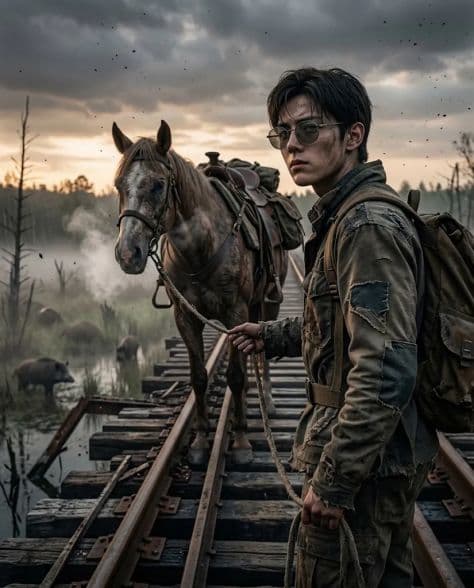

Post-Apocalyptic Survivor Leading Pack Horse Over Broken Bridge
[STRICTLY FOLLOW THE REFERENCE IMAGE — use the uploaded photo as the exact
identity authority for the first subject ("me"). Preserve the first subject's
exact face, facial structure, skin tone, age, body proportions, hairstyle
characteristics, and recognizable appearance exactly as shown. Do not
redesign, beautify, age, reshape, or reinterpret the first subject's
identity.]
Hyper-realistic raw post-apocalyptic cinematic photograph of the first subject from the reference image as a lone survivor leading a heavily burdened horse across the middle span of a collapsing railway bridge above a fog-choked marsh.
Reimagine the scene as a tense pause rather than a direct frontal march. The man has stopped halfway across the bridge and turned slightly back toward the camera while keeping his body angled forward, as if he has heard something behind him but cannot afford to stop for long. One hand grips a frayed lead rope close to the horse’s harness while the other stabilizes a heavily worn backpack slung naturally over one shoulder. His stance is tired but ready to move, with weight distributed realistically across the uneven railway surface. His expression is severe and exhausted, his face weathered by travel, and he wears smoked round glasses with subtle grime and natural reflections from the dim environment.
His survivor clothing is brutally worn rather than stylized: a torn tactical jacket with crude stitched repairs and improvised patches, dirty layered garments beneath, heavily mud-stained trousers, and battered work boots visibly worn down by long travel. Backpack straps are frayed, buckles oxidized, seams stretched, and every material carries dust, moisture, abrasion, and age.
The horse stands just behind and slightly lower along the bridge grade, head hanging with exhaustion. Its dark coat is dirty and uneven with dried sweat, mud, and road dust. The leather harness is cracked and repaired with pieces of wire and improvised fastenings. Worn saddlebags, rough fabric sacks, and a rusted metal lamp hang naturally from the load. Steam escapes from the horse’s muzzle into the cold air while its posture communicates genuine fatigue rather than dramatic posing.
The railway bridge itself becomes a major visual character: buckled and misaligned rails, missing planks exposing the drop below, saturated rotten timber, heavily corroded steel girders, bent supports, rusted chains hanging loosely, fractured joints, black moss, mold, lichen, accumulated grime, and warped metal plates. Everything should feel structurally old, damp, unstable, and punished by decades of neglect.
Below the bridge, stagnant dark water is partially visible through thick low fog. Faint silhouettes of wild boars move through the shallows, partially obscured by haze and oily reflections, creating a subtle background threat rather than an obvious horror element. Dead and burned trees emerge along the edges of the landscape, some reduced to blackened trunks.
Set the atmosphere near dusk beneath dense storm clouds. A weak low sun struggles through layers of haze, producing muted orange-crimson illumination against cold gray ambient light. Use soft backlighting so the edges of the man, horse, rope, and equipment pick up faint ghostly highlights while their faces and bodies remain partially in shadow. Wet rust and metal surfaces catch occasional sharp glints. Fine ash, damp particles, and atmospheric debris remain suspended in the air.
Compose the photograph vertically in 4:5 from a very low camera position near the damaged railway planks, looking slightly upward and diagonally along the bridge rather than placing the figures squarely in the middle. The rails and fractured structural elements create powerful leading lines toward the man and horse. Keep the survivor and the front of the horse sharply resolved while the bridge, dead landscape, and distant debris gradually disappear into atmospheric fog.
Use a cinematic 35mm f/2.8 photographic character with realistic perspective, progressive depth separation, subtle analog grain, physically accurate shadows, authentic moisture, controlled highlights, and extremely restrained motion only in loose chains, fabric edges, drifting fog, and airborne particles.
Maximum tactile realism: natural skin pores and imperfections, individual hair strands, dirty smoked lenses, frayed textile fibers, cracked leather, oxidized steel, corrosion layered into the metal, wet wood grain, chipped surfaces, realistic mud on boots and hooves, damp moss, oily standing water, and believable atmospheric depth.
Aesthetic: raw survival documentary photography, brutal cinematic realism, desaturated dirty grading with restrained orange accents, atmospheric tension, physical exhaustion, and believable environmental decay.
No CGI, no 3D render, no illustration, no concept-art look, no video-game rendering, no plastic skin, no beauty retouching, no clean clothing, no polished equipment, no artificial symmetry, no exaggerated fantasy ruins, no text, no signs, no watermark, no logos, no duplicated limbs, no malformed hands, and no unrealistic animal anatomy.
Haunting post-apocalyptic narrative still of a lone wanderer guiding a pack horse across a rusted railway trestle. Thick ground fog clinging to the marshland below, weathered canvas gear, decaying iron girders, and cold overcast gloom.