
PromptLabHub
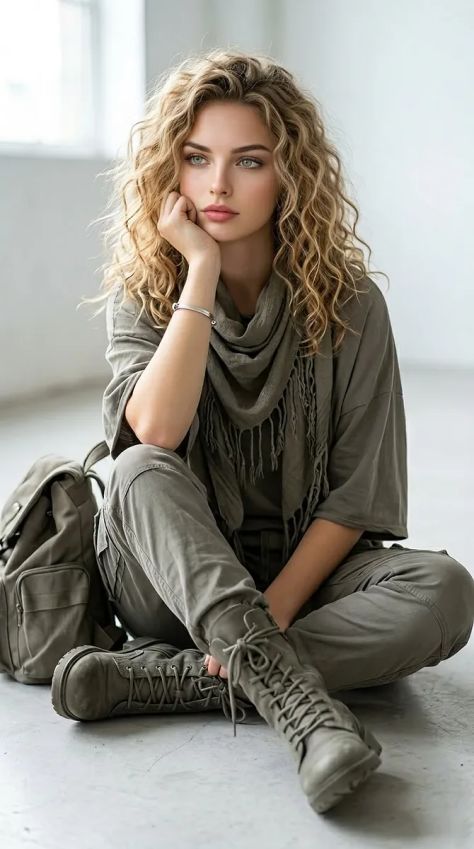
Minimalist Portrait Interior Peaceful Natural Bokeh
1
1
Prompt

Minimalist Portrait Interior Peaceful Natural Bokeh

Use the uploaded image as the main visual reference. Recreate the same minimalist seated lifestyle-fashion portrait: the same centered floor-seated subject, same high-volume honey-blonde curls, same light gray-green eyes, same cheek resting on raised-hand knuckles, same muted olive-gray oversized top, same large fringed scarf, same relaxed utility/cargo trousers, same lace-up combat-style boots, same matching backpack, same bright uncluttered interior, same soft window daylight, same asymmetrical folded-leg pose, same framing, and same muted neutral editorial color grade. Do not use age-based, country-based, nationality-based, ethnicity-based, or region-based descriptions or styling. Follow only the visible facial structure, hair, clothing, pose, accessories, materials, lighting, composition, and environment from the reference.

Generate an ultra-photorealistic high-detail lifestyle fashion editorial portrait in an approximately 9:16 vertical composition matching 736 × 1312 proportional framing.

COMPOSITION — LOCK FIRST

Show nearly the complete seated body.

Keep:

all hair inside the upper frame with modest headroom;

the dominant foreground boot completely visible;

the backpack close to the viewer-left edge;

the opposite knee completely inside the viewer-right boundary.

Position the subject slightly toward viewer-right of center.

Place the head in the upper-middle third, torso centrally, and let the bent legs occupy most of the lower half.

Create a broad triangular visual base through the folded legs.

Use a camera position only slightly above floor level while remaining close to the subject’s seated eye level.

Use mild portrait compression.

Allow the foreground boot to appear noticeably larger because it extends toward the lens, but avoid exaggerated wide-angle distortion.

Maintain this depth structure:

foreground boot → folded legs + backpack → torso + raised hand → face + curls → bright softly blurred room.

Balance the asymmetrical seated pose with the backpack on viewer-left.

FACE — PRESERVE STRUCTURE

Preserve the same facial proportions visible in the uploaded image.

Use:

soft oval face;

gently tapered lower third;

smooth moderately defined jawline;

compact rounded-to-tapered chin;

moderately high softly sculpted cheekbones;

medium-height forehead partially framed by curls.

Keep facial geometry natural and balanced.

Orient the torso slightly three-quarter toward viewer-left while keeping it mostly frontal.

Keep the head slightly more frontal than the torso.

Apply a very subtle tilt toward viewer-right.

Keep the chin approximately level.

SKIN

Render skin as light neutral beige around H 20–30° with low saturation and a subtle peach undertone.

Use a soft satin / natural-matte finish.

Apply approximately 7/10 polished editorial retouching.

Preserve:

fine pores around the nose;

subtle pores across central cheeks;

natural microtexture near the lip perimeter;

softly refined forehead;

gently smoothed broad cheek planes;

smooth jaw and chin transitions;

controlled highlights without oily shine.

Use brighter skin around B 78–92% in directly window-lit regions.

Transition shadowed skin into soft beige-taupe with warm-neutral influence.

Do not flatten the skin into plastic.

Do not introduce coarse raw texture.

EYES — CRITICAL

Preserve both eyes fully open.

Use large almond-shaped eyes with subtly lifted outer corners and moderate spacing.

Maintain light gray-green / sage-green irises around H 90–110°, with low-to-medium saturation and approximately 55–70% brightness.

Add a darker limbal ring around each iris.

Keep pupils dark.

Direct the pupils and gaze slightly off-camera toward viewer-left, not straight into the lens.

Place small soft rectangular window catchlights around approximately 10–11 o’clock in both eyes.

Keep:

clearly visible upper eyelids;

softly defined lower eyelids;

neutral off-white sclera with natural shadowing;

fine-to-medium dark lashes with restrained emphasis.

Do not change the iris color.

Do not redirect the gaze directly at camera.

EYEBROWS

Use medium-dark ash-brown brows.

Keep:

mostly straight construction;

soft natural arch;

medium-full thickness;

high density;

clean but natural grooming;

softly feathered inner ends;

gradually narrowing outer tails;

moderate brow-to-eye distance.

Preserve visible individual brow hairs rather than creating solid makeup blocks.

NOSE

Preserve a straight narrow-to-medium bridge.

Use:

compact softly rounded tip;

subtle frontal nostril visibility;

narrow daylight highlight along bridge and tip;

soft diffuse shadowing.

No hard contour lines.

LIPS + EXPRESSION

Use medium-full lips with the lower lip slightly fuller.

Maintain approximately 0.8:1 upper-to-lower fullness ratio.

Keep:

softly defined cupid’s bow;

natural muted rose-pink around H 350–10°;

soft satin finish;

closed mouth;

lip corners nearly level;

no visible teeth.

Expression geometry should remain relaxed:

forehead relaxed;

brows level;

eyelids open without compression;

mouth gently closed;

jaw relaxed;

minimal cheek contraction.

Do not create a broad smile, pout, frown, or dramatic expression.

MAKEUP

Use restrained polished natural editorial makeup.

Include:

light-to-medium complexion correction;

extremely subtle neutral taupe eye shading;

fine dark lash-line definition without a dramatic wing;

light-to-moderate mascara;

naturally defined brows;

soft peach-rose warmth across upper cheeks;

extremely soft contour;

minimal highlight;

muted rose/nude satin lips.

Do not add:

dramatic eyeliner;

heavy contour;

intense blush;

false lashes;

bold lipstick;

glitter eye makeup.

HAIR — CRITICAL VISUAL ANCHOR

Preserve very high-volume multi-tonal dark-blonde / honey-blonde curls.

Use:

base hue approximately H 35–45°;

medium beige-brown / dark honey-blonde shadow sections;

pale golden-beige highlight strands.

Keep the hair length approximately shoulder to upper-chest.

Use a slightly off-center part.

Build very high root and side volume.

The hair must consist of dense naturally defined curls and irregular loose ringlets, not generic waves.

Vary visible curl diameter approximately 1–3 cm.

Create:

curled face-framing sections around temples;

curls passing beside cheeks and jaw;

irregular ringlet ends;

fine halo flyaways around the silhouette;

individually distinguishable curl groups.

Use a soft satin fiber finish.

The strongest daylight should strike the viewer-left and upper curl masses.

Make highlights break into numerous narrow golden-white ribbons along individual curl ridges rather than forming one smooth continuous sheen.

Do not straighten the hair.

Do not convert curls into loose beach waves.

Do not reduce the volume.

Do not create perfectly uniform ringlets.

POSE — CRITICAL

Keep the subject seated directly on the floor with legs folded asymmetrically.

Maintain an upright but relaxed spine.

Keep the viewer-left shoulder fractionally higher because of the supported arm.

RAISED HAND

Preserve two visible hands.

Raise one hand to the cheek.

Rest its elbow securely on the elevated knee.

Place the knuckles and gently curled fingers against the lower cheek/jaw.

Keep the inner fingers/palm oriented toward the face.

Position the thumb beneath or close to the jaw.

Use:

relaxed fingers;

short natural nails;

no strong nail polish.

The cheek must visibly rest on the hand rather than the hand floating beside the face.

SECOND HAND

Keep the second hand positioned low between the legs / close to the lap.

Allow it to remain partly obscured by the trousers and body.

Keep visible fingers relaxed and pointing naturally downward.

No clearly visible rings.

LEGS

Keep one knee prominently raised toward the chest/front.

Use this raised knee to support the elbow of the hand touching the cheek.

Extend the corresponding lower leg toward the camera, creating the dominant foreground boot perspective.

Bend the opposite leg outward across the floor.

Position the opposite foot toward viewer-left foreground.

Maintain broad floor-seated balance through the hips and folded legs.

Do not convert the pose to kneeling, standing, sitting on a chair, or symmetrical cross-legged posture.

OVERSIZED TOP

Preserve the oversized muted olive-gray short-sleeve top.

Use gray-green / taupe-olive around H 70–90° with low saturation.

Construct it from soft jersey/cotton knit with a matte finish.

Keep:

oversized drape;

dropped shoulders;

loose elbow-length / oversized short sleeves;

broad soft folds around shoulders;

relaxed folds through torso;

no visible logo;

no print;

no fasteners.

The neckline should remain mostly hidden underneath the scarf.

FRINGED SCARF

Preserve the large draped scarf around the neck and chest.

Make it slightly darker olive-gray than the top.

Use soft woven material with:

matte finish;

fine visible woven texture;

multiple overlapping folds;

high volume around neck and upper chest.

Let long narrow fringe/tassel threads fall vertically down the front.

Use fringe lengths approximately 10–18 cm with individual thread separation.

Keep the scarf solid-colored with no visible print.

Do not remove the scarf.

Do not simplify the fringe into one solid edge.

CARGO / UTILITY TROUSERS

Preserve relaxed loose-fitting utility trousers.

Use muted olive-gray / stone-khaki around H 65–80° with very low saturation.

Construct from medium-weight matte cotton twill.

Keep:

relaxed/baggy fit;

medium-to-high rise;

loose legs;

utility seam construction;

pocket/panel details;

prominent seam structures around the raised thigh/knee;

numerous natural compression folds around knees;

folds around hips;

wrinkles around ankles.

No logos.

No patterns.

Do not make the trousers tight.

BOOTS

Preserve mid-calf lace-up utility/combat-style boots.

Use gray-green / muted khaki matte leather or nubuck-like material.

Keep:

rounded toes;

thick rugged rubber outsoles;

tonal laces;

numerous metal eyelets extending high up the shaft;

long padded tongue;

subtle surface grain;

restrained wear-like tonal variation.

The boot closest to the camera must dominate the lower-center foreground and appear enlarged through proximity.

Keep its complete toe and sole inside the frame.

Position the opposite boot more horizontally toward viewer-left.

Use darker muted gray-green soles.

Do not replace the boots with sneakers, heels, sandals, or polished leather footwear.

BRACELET

Place one minimal silver-toned bracelet/bangle immediately above the wrist of the raised hand.

Use:

thin curved polished metal band;

small rounded end detail;

bright compact silver specular highlights.

No watch.

Do not add large jewelry.

BACKPACK

Preserve one matching utility backpack resting on the floor viewer-left.

Use:

muted olive-gray / stone color;

matte canvas/twill textile;

soft rectangular body;

rounded top;

large rectangular external front pocket;

visible zipper seams;

matching/dark shoulder straps.

Allow it to collapse slightly under its own weight.

Scale it to approximately knee height relative to the seated subject.

Position it immediately behind/left of the viewer-left boot and folded leg.

Keep the backpack subordinate to the subject.

No branding.

ENVIRONMENT

Create a bright minimalist indoor room.

Use cool off-white to very pale-gray walls.

Use a light-gray concrete or smooth matte floor.

Keep the space sparse and free of significant furniture.

Place one large bright window area in the upper-left background.

Show pale white window-frame geometry softly, but let all exterior detail blow out and remain unidentifiable.

Maintain a strongly softened background with smooth pale tonal gradients.

No other people.

No readable text.

No decorative clutter.

DEPTH STRUCTURE

Maintain:

Layer 1: enlarged foreground boot.

Layer 2: legs, second boot, backpack, hands.

Layer 3: torso, scarf and face.

Layer 4: window, pale wall and distant floor.

The face and eyes must remain the primary focus plane.

The foreground boot may soften slightly while remaining detailed.

The background must be the softest area.

LIGHTING — CRITICAL

Use a large soft natural window source from approximately 10 o’clock / viewer-left-front.

Set the daylight around 5200–5800 K.

Use extremely soft illumination with a gradual shadow transition.

Brightest facial areas:

viewer-left forehead;

viewer-left cheek;

nose bridge;

upper lip;

chin.

Keep viewer-right cheek/jaw and the areas beneath curls fractionally darker.

Use approximately 60–70% ambient fill, ensuring there are no crushed shadows.

Add strong pale bounce from the light floor and walls.

Use diffuse room fill from viewer-right.

Create a subtle neutral daylight rim around viewer-left curls.

Use stronger natural backlight through outer hair strands near the bright window to generate a fine luminous halo.

HIGHLIGHT BEHAVIOR

Skin: broad diffuse daylight gradients with controlled satin finish.

Eyes: small rectangular soft window catchlights.

Hair: many narrow golden-white highlights following individual curl ridges.

Silver bracelet: sharp compact white reflections.

Boots: very soft low-intensity highlights due matte material.

Top/trousers/scarf: low-contrast diffuse fabric shading.

Background: soft bright window glow without visible lens flare.

COLOR SYSTEM

Lock the palette to:

clothing / boots / backpack: olive-gray H 65–85°, S approximately 8–18%;

hair: golden-beige H 35–45°;

skin: H 20–30° neutral warm beige;

environment: cool off-white / pale gray with extremely low saturation;

shadows: muted gray-green;

accent: polished neutral silver bracelet.

Apply a soft neutral fashion-editorial grade with warm hair/skin against desaturated sage/khaki clothing and a cool pale environment.

Overall saturation must remain muted.

Do not shift the outfit toward bright green.

Do not shift the scene toward yellow/orange warmth.

Do not create a dark moody background.

CAMERA / FOCUS

Simulate approximately a 70–85 mm portrait lens at around f/2–f/2.8.

Use shallow-to-moderate depth of field.

Keep the sharpest zone on:

eyes;

facial features;

raised hand;

front curls.

Keep torso/scarf and raised knee moderately sharp.

Allow the foreground boot to become slightly softer because it projects beyond the primary focal plane while still preserving material detail.

Keep window, walls and distant floor strongly softened.

Use:

grain 1/10;

post-processing 7–8/10;

moderate-low contrast;

softly lifted black point;

essentially no vignette;

minimal natural glow near bright window;

no lens flare;

no chromatic aberration;

zero motion blur.

VISUAL HIERARCHY

Maintain this order:

light gray-green eyes + face → high-volume honey-blonde curls → hand supporting cheek → fringed scarf → raised knee → dominant foreground boot → matching backpack → bright minimalist window background.

Maintain visual flow:

upper curl mass → eyes → supported cheek → raised hand → silver bracelet → scarf folds → raised knee → foreground boot.

Preserve material contrast:

soft curly hair + smooth natural skin + woven fringed scarf + matte cotton utility fabrics + rugged nubuck/leather boots + canvas backpack + polished silver bracelet.

STRICT PRESERVATION RULES

Do not use country-based descriptors.

Do not use region-based descriptors.

Do not use nationality-based descriptors.

Do not use ethnicity-based descriptors.

Do not use age-based descriptors.

Do not change the iris color.

Do not redirect the gaze straight into the camera.

Do not close the eyes.

Do not straighten the hair.

Do not reduce curl density.

Do not convert the curls into generic loose waves.

Do not remove the raised-hand cheek support.

Do not move the elbow away from the raised knee.

Do not hide the second hand completely.

Do not convert the pose into standing, kneeling, chair-seated, or symmetrical cross-legged posture.

Do not remove the scarf.

Do not remove the scarf fringe.

Do not make the top fitted.

Do not make the utility trousers skinny.

Do not replace the boots with another footwear category.

Do not remove the foreground perspective of the closest boot.

Do not remove the backpack.

Do not introduce colorful clothing.

Do not introduce visible brand logos.

Do not add a watch.

Do not add large jewelry.

Do not add glasses or headwear.

Do not add other people.

Do not add furniture or decorative clutter.

Do not replace the bright interior with an outdoor scene.

Do not darken the background.

Do not add strong dramatic shadows.

Do not over-retouch the skin.

No country references. No regional references. No nationality references. No age references. No extra people. No text. No watermark. No fog. No smoke. No particles. No motion blur. No plastic skin. No wide-angle facial distortion.

Ultra-high resolution. Preserve fine natural skin microtexture, exact gray-green eye coloration, small window catchlights, densely separated curl fibers and ringlets, matte olive-gray textile texture, fine woven scarf fringe, rugged boot grain and lacing, canvas backpack construction, polished silver bracelet reflections, and soft natural window-light depth.

Photorealistic minimalist lifestyle fashion-editorial portrait photography only.

·
Photo Prompts

评价

登录后即可发表评价。

暂无评价。来写第一条吧。

在任何设备上使用 PromptLabHub。

安装应用以便更快打开,或下载 Chrome 扩展并在浏览器中加载。

浏览 Prompt

  • 全部 Prompt
  • 摄影 Prompt
  • 视频 Prompt
  • 美食 Prompt

创作

  • 提交 Prompt

社区

  • 论坛
  • 创作者
  • 排行榜
  • 每周挑战

支持

  • 常见问题
  • 联系我们
  • 隐私政策
  • 服务条款

关注我们

发现并复制精选 AI Prompt,适用于 Midjourney、DALL-E 3、Sora、Runway 等。每周更新。

隐私政策服务条款Cookie 政策

© 2026 PromptLabHub. All rights reserved.

© 2026 PromptLabHub. All rights reserved.

·
隐私政策·服务条款·Cookie 政策
Home
PromptLabHub
Minimalist Portrait Interior Peaceful Natural Bokeh
1
1
Prompt

Minimalist Portrait Interior Peaceful Natural Bokeh

Use the uploaded image as the main visual reference. Recreate the same minimalist seated lifestyle-fashion portrait: the same centered floor-seated subject, same high-volume honey-blonde curls, same light gray-green eyes, same cheek resting on raised-hand knuckles, same muted olive-gray oversized top, same large fringed scarf, same relaxed utility/cargo trousers, same lace-up combat-style boots, same matching backpack, same bright uncluttered interior, same soft window daylight, same asymmetrical folded-leg pose, same framing, and same muted neutral editorial color grade. Do not use age-based, country-based, nationality-based, ethnicity-based, or region-based descriptions or styling. Follow only the visible facial structure, hair, clothing, pose, accessories, materials, lighting, composition, and environment from the reference.

Generate an ultra-photorealistic high-detail lifestyle fashion editorial portrait in an approximately 9:16 vertical composition matching 736 × 1312 proportional framing.

COMPOSITION — LOCK FIRST

Show nearly the complete seated body.

Keep:

all hair inside the upper frame with modest headroom;

the dominant foreground boot completely visible;

the backpack close to the viewer-left edge;

the opposite knee completely inside the viewer-right boundary.

Position the subject slightly toward viewer-right of center.

Place the head in the upper-middle third, torso centrally, and let the bent legs occupy most of the lower half.

Create a broad triangular visual base through the folded legs.

Use a camera position only slightly above floor level while remaining close to the subject’s seated eye level.

Use mild portrait compression.

Allow the foreground boot to appear noticeably larger because it extends toward the lens, but avoid exaggerated wide-angle distortion.

Maintain this depth structure:

foreground boot → folded legs + backpack → torso + raised hand → face + curls → bright softly blurred room.

Balance the asymmetrical seated pose with the backpack on viewer-left.

FACE — PRESERVE STRUCTURE

Preserve the same facial proportions visible in the uploaded image.

Use:

soft oval face;

gently tapered lower third;

smooth moderately defined jawline;

compact rounded-to-tapered chin;

moderately high softly sculpted cheekbones;

medium-height forehead partially framed by curls.

Keep facial geometry natural and balanced.

Orient the torso slightly three-quarter toward viewer-left while keeping it mostly frontal.

Keep the head slightly more frontal than the torso.

Apply a very subtle tilt toward viewer-right.

Keep the chin approximately level.

SKIN

Render skin as light neutral beige around H 20–30° with low saturation and a subtle peach undertone.

Use a soft satin / natural-matte finish.

Apply approximately 7/10 polished editorial retouching.

Preserve:

fine pores around the nose;

subtle pores across central cheeks;

natural microtexture near the lip perimeter;

softly refined forehead;

gently smoothed broad cheek planes;

smooth jaw and chin transitions;

controlled highlights without oily shine.

Use brighter skin around B 78–92% in directly window-lit regions.

Transition shadowed skin into soft beige-taupe with warm-neutral influence.

Do not flatten the skin into plastic.

Do not introduce coarse raw texture.

EYES — CRITICAL

Preserve both eyes fully open.

Use large almond-shaped eyes with subtly lifted outer corners and moderate spacing.

Maintain light gray-green / sage-green irises around H 90–110°, with low-to-medium saturation and approximately 55–70% brightness.

Add a darker limbal ring around each iris.

Keep pupils dark.

Direct the pupils and gaze slightly off-camera toward viewer-left, not straight into the lens.

Place small soft rectangular window catchlights around approximately 10–11 o’clock in both eyes.

Keep:

clearly visible upper eyelids;

softly defined lower eyelids;

neutral off-white sclera with natural shadowing;

fine-to-medium dark lashes with restrained emphasis.

Do not change the iris color.

Do not redirect the gaze directly at camera.

EYEBROWS

Use medium-dark ash-brown brows.

Keep:

mostly straight construction;

soft natural arch;

medium-full thickness;

high density;

clean but natural grooming;

softly feathered inner ends;

gradually narrowing outer tails;

moderate brow-to-eye distance.

Preserve visible individual brow hairs rather than creating solid makeup blocks.

NOSE

Preserve a straight narrow-to-medium bridge.

Use:

compact softly rounded tip;

subtle frontal nostril visibility;

narrow daylight highlight along bridge and tip;

soft diffuse shadowing.

No hard contour lines.

LIPS + EXPRESSION

Use medium-full lips with the lower lip slightly fuller.

Maintain approximately 0.8:1 upper-to-lower fullness ratio.

Keep:

softly defined cupid’s bow;

natural muted rose-pink around H 350–10°;

soft satin finish;

closed mouth;

lip corners nearly level;

no visible teeth.

Expression geometry should remain relaxed:

forehead relaxed;

brows level;

eyelids open without compression;

mouth gently closed;

jaw relaxed;

minimal cheek contraction.

Do not create a broad smile, pout, frown, or dramatic expression.

MAKEUP

Use restrained polished natural editorial makeup.

Include:

light-to-medium complexion correction;

extremely subtle neutral taupe eye shading;

fine dark lash-line definition without a dramatic wing;

light-to-moderate mascara;

naturally defined brows;

soft peach-rose warmth across upper cheeks;

extremely soft contour;

minimal highlight;

muted rose/nude satin lips.

Do not add:

dramatic eyeliner;

heavy contour;

intense blush;

false lashes;

bold lipstick;

glitter eye makeup.

HAIR — CRITICAL VISUAL ANCHOR

Preserve very high-volume multi-tonal dark-blonde / honey-blonde curls.

Use:

base hue approximately H 35–45°;

medium beige-brown / dark honey-blonde shadow sections;

pale golden-beige highlight strands.

Keep the hair length approximately shoulder to upper-chest.

Use a slightly off-center part.

Build very high root and side volume.

The hair must consist of dense naturally defined curls and irregular loose ringlets, not generic waves.

Vary visible curl diameter approximately 1–3 cm.

Create:

curled face-framing sections around temples;

curls passing beside cheeks and jaw;

irregular ringlet ends;

fine halo flyaways around the silhouette;

individually distinguishable curl groups.

Use a soft satin fiber finish.

The strongest daylight should strike the viewer-left and upper curl masses.

Make highlights break into numerous narrow golden-white ribbons along individual curl ridges rather than forming one smooth continuous sheen.

Do not straighten the hair.

Do not convert curls into loose beach waves.

Do not reduce the volume.

Do not create perfectly uniform ringlets.

POSE — CRITICAL

Keep the subject seated directly on the floor with legs folded asymmetrically.

Maintain an upright but relaxed spine.

Keep the viewer-left shoulder fractionally higher because of the supported arm.

RAISED HAND

Preserve two visible hands.

Raise one hand to the cheek.

Rest its elbow securely on the elevated knee.

Place the knuckles and gently curled fingers against the lower cheek/jaw.

Keep the inner fingers/palm oriented toward the face.

Position the thumb beneath or close to the jaw.

Use:

relaxed fingers;

short natural nails;

no strong nail polish.

The cheek must visibly rest on the hand rather than the hand floating beside the face.

SECOND HAND

Keep the second hand positioned low between the legs / close to the lap.

Allow it to remain partly obscured by the trousers and body.

Keep visible fingers relaxed and pointing naturally downward.

No clearly visible rings.

LEGS

Keep one knee prominently raised toward the chest/front.

Use this raised knee to support the elbow of the hand touching the cheek.

Extend the corresponding lower leg toward the camera, creating the dominant foreground boot perspective.

Bend the opposite leg outward across the floor.

Position the opposite foot toward viewer-left foreground.

Maintain broad floor-seated balance through the hips and folded legs.

Do not convert the pose to kneeling, standing, sitting on a chair, or symmetrical cross-legged posture.

OVERSIZED TOP

Preserve the oversized muted olive-gray short-sleeve top.

Use gray-green / taupe-olive around H 70–90° with low saturation.

Construct it from soft jersey/cotton knit with a matte finish.

Keep:

oversized drape;

dropped shoulders;

loose elbow-length / oversized short sleeves;

broad soft folds around shoulders;

relaxed folds through torso;

no visible logo;

no print;

no fasteners.

The neckline should remain mostly hidden underneath the scarf.

FRINGED SCARF

Preserve the large draped scarf around the neck and chest.

Make it slightly darker olive-gray than the top.

Use soft woven material with:

matte finish;

fine visible woven texture;

multiple overlapping folds;

high volume around neck and upper chest.

Let long narrow fringe/tassel threads fall vertically down the front.

Use fringe lengths approximately 10–18 cm with individual thread separation.

Keep the scarf solid-colored with no visible print.

Do not remove the scarf.

Do not simplify the fringe into one solid edge.

CARGO / UTILITY TROUSERS

Preserve relaxed loose-fitting utility trousers.

Use muted olive-gray / stone-khaki around H 65–80° with very low saturation.

Construct from medium-weight matte cotton twill.

Keep:

relaxed/baggy fit;

medium-to-high rise;

loose legs;

utility seam construction;

pocket/panel details;

prominent seam structures around the raised thigh/knee;

numerous natural compression folds around knees;

folds around hips;

wrinkles around ankles.

No logos.

No patterns.

Do not make the trousers tight.

BOOTS

Preserve mid-calf lace-up utility/combat-style boots.

Use gray-green / muted khaki matte leather or nubuck-like material.

Keep:

rounded toes;

thick rugged rubber outsoles;

tonal laces;

numerous metal eyelets extending high up the shaft;

long padded tongue;

subtle surface grain;

restrained wear-like tonal variation.

The boot closest to the camera must dominate the lower-center foreground and appear enlarged through proximity.

Keep its complete toe and sole inside the frame.

Position the opposite boot more horizontally toward viewer-left.

Use darker muted gray-green soles.

Do not replace the boots with sneakers, heels, sandals, or polished leather footwear.

BRACELET

Place one minimal silver-toned bracelet/bangle immediately above the wrist of the raised hand.

Use:

thin curved polished metal band;

small rounded end detail;

bright compact silver specular highlights.

No watch.

Do not add large jewelry.

BACKPACK

Preserve one matching utility backpack resting on the floor viewer-left.

Use:

muted olive-gray / stone color;

matte canvas/twill textile;

soft rectangular body;

rounded top;

large rectangular external front pocket;

visible zipper seams;

matching/dark shoulder straps.

Allow it to collapse slightly under its own weight.

Scale it to approximately knee height relative to the seated subject.

Position it immediately behind/left of the viewer-left boot and folded leg.

Keep the backpack subordinate to the subject.

No branding.

ENVIRONMENT

Create a bright minimalist indoor room.

Use cool off-white to very pale-gray walls.

Use a light-gray concrete or smooth matte floor.

Keep the space sparse and free of significant furniture.

Place one large bright window area in the upper-left background.

Show pale white window-frame geometry softly, but let all exterior detail blow out and remain unidentifiable.

Maintain a strongly softened background with smooth pale tonal gradients.

No other people.

No readable text.

No decorative clutter.

DEPTH STRUCTURE

Maintain:

Layer 1: enlarged foreground boot.

Layer 2: legs, second boot, backpack, hands.

Layer 3: torso, scarf and face.

Layer 4: window, pale wall and distant floor.

The face and eyes must remain the primary focus plane.

The foreground boot may soften slightly while remaining detailed.

The background must be the softest area.

LIGHTING — CRITICAL

Use a large soft natural window source from approximately 10 o’clock / viewer-left-front.

Set the daylight around 5200–5800 K.

Use extremely soft illumination with a gradual shadow transition.

Brightest facial areas:

viewer-left forehead;

viewer-left cheek;

nose bridge;

upper lip;

chin.

Keep viewer-right cheek/jaw and the areas beneath curls fractionally darker.

Use approximately 60–70% ambient fill, ensuring there are no crushed shadows.

Add strong pale bounce from the light floor and walls.

Use diffuse room fill from viewer-right.

Create a subtle neutral daylight rim around viewer-left curls.

Use stronger natural backlight through outer hair strands near the bright window to generate a fine luminous halo.

HIGHLIGHT BEHAVIOR

Skin: broad diffuse daylight gradients with controlled satin finish.

Eyes: small rectangular soft window catchlights.

Hair: many narrow golden-white highlights following individual curl ridges.

Silver bracelet: sharp compact white reflections.

Boots: very soft low-intensity highlights due matte material.

Top/trousers/scarf: low-contrast diffuse fabric shading.

Background: soft bright window glow without visible lens flare.

COLOR SYSTEM

Lock the palette to:

clothing / boots / backpack: olive-gray H 65–85°, S approximately 8–18%;

hair: golden-beige H 35–45°;

skin: H 20–30° neutral warm beige;

environment: cool off-white / pale gray with extremely low saturation;

shadows: muted gray-green;

accent: polished neutral silver bracelet.

Apply a soft neutral fashion-editorial grade with warm hair/skin against desaturated sage/khaki clothing and a cool pale environment.

Overall saturation must remain muted.

Do not shift the outfit toward bright green.

Do not shift the scene toward yellow/orange warmth.

Do not create a dark moody background.

CAMERA / FOCUS

Simulate approximately a 70–85 mm portrait lens at around f/2–f/2.8.

Use shallow-to-moderate depth of field.

Keep the sharpest zone on:

eyes;

facial features;

raised hand;

front curls.

Keep torso/scarf and raised knee moderately sharp.

Allow the foreground boot to become slightly softer because it projects beyond the primary focal plane while still preserving material detail.

Keep window, walls and distant floor strongly softened.

Use:

grain 1/10;

post-processing 7–8/10;

moderate-low contrast;

softly lifted black point;

essentially no vignette;

minimal natural glow near bright window;

no lens flare;

no chromatic aberration;

zero motion blur.

VISUAL HIERARCHY

Maintain this order:

light gray-green eyes + face → high-volume honey-blonde curls → hand supporting cheek → fringed scarf → raised knee → dominant foreground boot → matching backpack → bright minimalist window background.

Maintain visual flow:

upper curl mass → eyes → supported cheek → raised hand → silver bracelet → scarf folds → raised knee → foreground boot.

Preserve material contrast:

soft curly hair + smooth natural skin + woven fringed scarf + matte cotton utility fabrics + rugged nubuck/leather boots + canvas backpack + polished silver bracelet.

STRICT PRESERVATION RULES

Do not use country-based descriptors.

Do not use region-based descriptors.

Do not use nationality-based descriptors.

Do not use ethnicity-based descriptors.

Do not use age-based descriptors.

Do not change the iris color.

Do not redirect the gaze straight into the camera.

Do not close the eyes.

Do not straighten the hair.

Do not reduce curl density.

Do not convert the curls into generic loose waves.

Do not remove the raised-hand cheek support.

Do not move the elbow away from the raised knee.

Do not hide the second hand completely.

Do not convert the pose into standing, kneeling, chair-seated, or symmetrical cross-legged posture.

Do not remove the scarf.

Do not remove the scarf fringe.

Do not make the top fitted.

Do not make the utility trousers skinny.

Do not replace the boots with another footwear category.

Do not remove the foreground perspective of the closest boot.

Do not remove the backpack.

Do not introduce colorful clothing.

Do not introduce visible brand logos.

Do not add a watch.

Do not add large jewelry.

Do not add glasses or headwear.

Do not add other people.

Do not add furniture or decorative clutter.

Do not replace the bright interior with an outdoor scene.

Do not darken the background.

Do not add strong dramatic shadows.

Do not over-retouch the skin.

No country references. No regional references. No nationality references. No age references. No extra people. No text. No watermark. No fog. No smoke. No particles. No motion blur. No plastic skin. No wide-angle facial distortion.

Ultra-high resolution. Preserve fine natural skin microtexture, exact gray-green eye coloration, small window catchlights, densely separated curl fibers and ringlets, matte olive-gray textile texture, fine woven scarf fringe, rugged boot grain and lacing, canvas backpack construction, polished silver bracelet reflections, and soft natural window-light depth.

Photorealistic minimalist lifestyle fashion-editorial portrait photography only.

·
Photo Prompts

评价

登录后即可发表评价。

暂无评价。来写第一条吧。

在任何设备上使用 PromptLabHub。

安装应用以便更快打开,或下载 Chrome 扩展并在浏览器中加载。

浏览 Prompt

  • 全部 Prompt
  • 摄影 Prompt
  • 视频 Prompt
  • 美食 Prompt

创作

  • 提交 Prompt

社区

  • 论坛
  • 创作者
  • 排行榜
  • 每周挑战

支持

  • 常见问题
  • 联系我们
  • 隐私政策
  • 服务条款

关注我们

发现并复制精选 AI Prompt,适用于 Midjourney、DALL-E 3、Sora、Runway 等。每周更新。

隐私政策服务条款Cookie 政策

© 2026 PromptLabHub. All rights reserved.

© 2026 PromptLabHub. All rights reserved.

·
隐私政策·服务条款·Cookie 政策
Home