
PromptLabHub
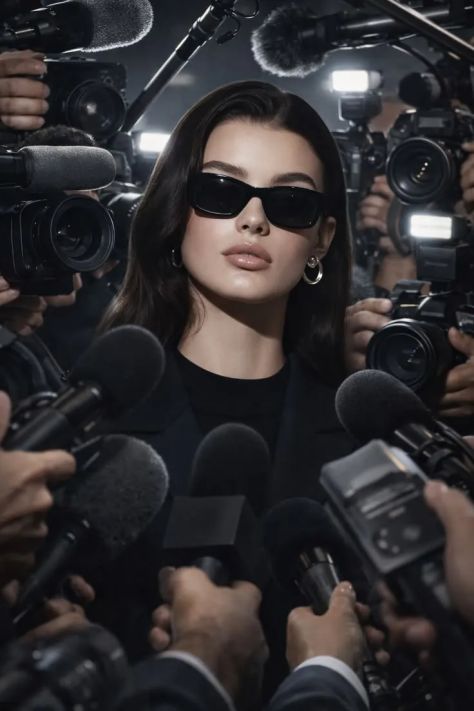
Editorial Portrait Interior Elegant Studio Light
0
Prompt

Editorial Portrait Interior Elegant Studio Light

Use the uploaded image as the main visual reference. Recreate the same close-up luxury press portrait: one centrally framed subject surrounded by professional cameras, camera flashes, boom microphones, handheld reporter microphones, photographer hands, and a dense media scrum. Preserve the same glossy black sunglasses, long dark hair, silver hoop earrings, all-black tailored wardrobe, centered facial framing, radial equipment arrangement, cool monochromatic color grade, controlled flash lighting, and tightly packed composition. Do not use age-based, ethnicity-based, nationality-based, or region-based descriptions. Follow only the visible facial geometry, materials, clothing, pose, lighting, framing, and environmental details from the uploaded image.

Generate an ultra-photorealistic high-fashion editorial press portrait / cinematic paparazzi media-scrum photograph in a 2:3 vertical composition matching approximately 736 × 1104 px.

COMPOSITION — LOCK FIRST

Position the primary subject precisely in the center of the frame.

Use a vertical head-and-upper-torso crop, showing the head, neck, shoulders, upper chest, and part of the black outer garment while the lower torso continues beyond the frame.

Let the head occupy approximately 45–50% of the total frame width.

Use an approximately eye-level camera perspective with an extremely subtle low-angle fashion-editorial feel.

Use a compressed portrait perspective with negligible facial distortion.

Keep almost no empty negative space. Pack the frame densely with:

cameras;

camera lenses;

flash units;

microphones;

reporter hands;

photographer hands;

dark clothing;

boom poles.

Create a radial visual funnel where nearly all cameras and microphones point inward toward the subject’s face.

Heavily crop equipment along the top, left, right, and bottom edges so the viewer feels physically inside a crowded press scrum.

No microphone or camera may cover the central face.

FACE — PRESERVE VISIBLE STRUCTURE

Preserve the same visible facial proportions from the uploaded reference.

Use:

elongated soft-oval facial silhouette;

tapered lower third;

clean narrow moderately defined jawline;

compact rounded-to-tapered chin;

moderately prominent cheekbones;

smooth sculpted cheek planes;

medium-height forehead;

high overall facial symmetry.

Keep the face almost perfectly frontal with an extremely slight rotation toward viewer-left.

Raise the chin only subtly, producing a poised slightly upward facial orientation.

Keep the torso frontal and shoulders almost level.

SKIN

Render the skin as light neutral beige around H 20–28°, S 10–18%, with a muted peach undertone.

Use a soft satin / controlled semi-matte finish.

Apply approximately 8/10 luxury editorial retouching.

Refine the broader areas of:

forehead;

cheeks;

jaw;

chin

while preserving faint authentic microtexture around:

nose;

philtrum;

central cheek;

lip perimeter.

Use lit skin brightness approximately B 72–88% and allow shadow skin to transition toward beige-taupe / neutral gray-brown around B 42–62%.

Keep highlights compact and controlled rather than oily.

No plastic skin.

No excessive pore removal.

No coarse raw texture.

EYEBROWS

Allow the upper brows to remain visible immediately above the sunglasses.

Use dark brown hair-like brows matching the hair family.

Keep:

medium-to-full thickness;

high even density;

mostly straight structure;

subtle lifted outer arch;

softly squared inner ends;

gradually tapering outer tails;

very small distance between brow line and sunglass frame.

Maintain natural individual brow-hair texture.

Do not create heavily blocked cosmetic brows.

SUNGLASSES — CRITICAL

Preserve the dominant black sunglasses.

Use:

glossy black acetate-like frame;

medium-thick construction;

narrow rectangular / softened cat-eye hybrid silhouette;

horizontal rounded-rectangle lenses;

slight upward lift at the outer corners;

integrated black bridge;

black temples partially disappearing beneath the hair.

The sunglasses should span almost the full facial width from temple to temple.

Use near-black charcoal lenses with extremely low transparency.

Add restrained cool-white rectangular reflections from nearby camera flashes.

The eyes must remain completely hidden.

Do not reveal:

irises;

pupils;

eyelids;

lashes;

eye makeup;

ocular catchlights;

gaze direction.

Do not brighten the lenses enough to reveal eyes.

NOSE

Preserve a narrow-to-medium straight nose bridge.

Keep the bridge smooth with restrained central illumination.

Use:

compact rounded tip;

small symmetrical frontal nostril visibility;

narrow soft white-beige highlight along bridge and tip.

Place slightly stronger shadow underneath and toward viewer-right.

Do not create hard contour makeup lines.

LIPS + EXPRESSION

Preserve full neutral nude lips.

Use approximately 0.8:1 upper-to-lower lip fullness ratio.

Keep:

softly defined cupid’s bow;

medium-full upper lip;

fuller and slightly more projected lower lip;

dusty nude-pink / rose-beige hue around H 350–15°;

low-to-medium saturation;

high satin / very subtle gloss finish.

Add a narrow pale horizontal reflection across the lower lip.

Keep the mouth closed to extremely slightly parted, with no visible teeth.

Lip corners remain nearly level.

Expression geometry should remain controlled:

forehead relaxed;

brows level;

jaw relaxed;

lips softly projected;

no pronounced smile;

no open-mouth expression;

no strong cheek lift;

no frown contraction.

MAKEUP

Use a polished monochromatic luxury-beauty finish.

Include:

medium-to-full complexion coverage;

soft cheek sculpting;

groomed dark brows;

very subtle muted beige-rose cheek warmth;

controlled satin highlight across nose/high cheek regions;

nude rose-beige satin/gloss lips.

Do not invent visible eye makeup behind the sunglasses.

No dramatic eyeshadow.

No winged liner.

No visible mascara.

No exaggerated contour.

No heavy blush.

No bold lip color.

HAIR

Preserve long deep espresso / dark chocolate-brown hair around H 20–30°, extending below the shoulders and beyond the visible crop.

Use medium neutral-brown highlights with only subtle warmth.

Create:

deep side part beginning on viewer-left and sweeping toward the subject’s opposite side;

smooth root direction away from part;

mostly straight lengths;

very soft bend through lower sections;

moderate crown and side volume;

broad smooth sheet of hair down viewer-left cheek/shoulder;

viewer-right hair swept or tucked behind the ear to expose the earring;

minimal flyaways;

clean naturally curved hairline.

Render hair with a glossy satin fiber finish.

Add long narrow cool-white specular streaks following curved hair surfaces.

Preserve individual fine edge hairs against illuminated areas.

Do not make the hair curly, windblown, short, tied up, or voluminous beyond the reference.

EARRINGS

Preserve two medium-large polished silver/white-metal hoop earrings.

Use thick rounded oval/circular hoops.

Keep the viewer-right hoop fully visible below the earlobe.

Allow the viewer-left hoop to remain partly concealed by hair.

Use highly polished metal with sharp small white specular glints.

A tiny secondary metallic detail may remain adjacent to the viewer-right hoop.

No necklace.

No oversized additional jewelry.

WARDROBE

Preserve an all-black tailored outfit.

Use a near-black structured blazer/jacket with:

smooth suiting/wool-blend texture;

matte finish;

close-tailored fit;

minimal visible wrinkles;

no logos;

no patterns;

no colorful details.

Underneath, preserve a near-black crew-neck top made from smooth fine knit/jersey.

Keep:

high rounded crew neckline;

close fit;

matte finish;

no logo;

no pattern.

Differentiate blazer and inner top primarily through texture and neckline rather than color.

The complete visible wardrobe should stay almost monochromatic black.

PRIMARY SUBJECT HANDS

Do not show the primary subject’s hands.

The crop must end before the subject’s own hands become visible.

All hands in the frame should belong to surrounding reporters or photographers.

MEDIA SCRUM

Create a tightly packed surrounding press environment.

Include approximately 6–8 clearly recognizable professional camera/lens assemblies, with additional partially cropped equipment.

Use black DSLR/mirrorless-style camera bodies with:

matte/satin housings;

large cylindrical zoom lenses;

glossy dark front elements;

narrow gray-white glass reflections.

Position major cameras:

upper-left;

mid-left;

upper-right;

mid-right;

lower-right;

partially cropped near top edge.

Nearly all major lenses should point directly toward the central face.

FLASH UNITS

Include approximately 4–6 prominent visible rectangular speedlight flashes, plus several partially obscured units.

Place them around:

upper-center;

rear-left;

upper-right;

mid-right;

background layers.

Use black flash housings with bright cool-neutral white flash panels.

Allow selected flashes to clip toward pure white.

Do not create warm yellow flash heads.

Keep flashes as discrete small rectangular hotspots rather than large glowing areas.

MICROPHONES — CRITICAL

Surround the subject with approximately 8–10 clearly readable microphone forms.

Use a mixture of:

professional shotgun microphones;

long boom microphones;

handheld reporter microphones.

Use large charcoal/black foam windscreens and at least one gray-black furry windscreen.

Preserve key positions:

Top-left:

Large horizontal shotgun microphone entering from upper-left with thick gray/black windscreen.

Upper-center:

Long boom microphone crossing diagonally overhead toward the subject.

Upper-right:

Another boom-mounted microphone extending inward.

Mid-left:

Large horizontal foam-covered microphone aimed directly toward the face.

Bottom foreground:

Multiple handheld reporter microphones rising densely toward the chest, chin and mouth area.

Make microphones enter from top, left, right and especially the bottom.

Their directions should converge radially toward the face/mouth.

Do not arrange the microphones into one clean horizontal row.

REPORTER / PHOTOGRAPHER HANDS

Include numerous secondary hands around the frame gripping:

cameras;

lens barrels;

boom poles;

handheld microphones;

flash equipment.

Use natural hand positioning and realistic grip mechanics.

Allow some lower foreground hands to wear dark suit sleeves with white shirt cuffs.

Keep these hands subordinate to the central face.

BACKGROUND PEOPLE

Place multiple photographers/reporters tightly behind and around the subject.

Keep their clothing predominantly:

black;

charcoal;

dark gray;

navy.

Most faces should be:

obscured by camera bodies;

blocked by equipment;

cropped;

or softened by depth.

Do not create clearly dominant secondary portraits.

ENVIRONMENT

Use a dark indoor press/media environment.

Build five depth layers:

Layer 1: foreground microphones, hands and equipment.

Layer 2: central subject.

Layer 3: large cameras immediately beside the face.

Layer 4: photographers and raised camera systems.

Layer 5: dark graphite interior/background.

Keep architecture indistinct.

Do not add:

red-carpet branding;

press-wall logos;

readable signage;

podiums;

stage graphics;

text overlays.

Negative space should remain almost absent.

LIGHTING — CRITICAL

Use a broad frontal beauty key from approximately 11–12 o’clock, slightly stronger from viewer-left/front.

Set the primary key around 5000–5500 K.

Use soft-to-medium quality.

Illuminate:

center forehead;

nose bridge;

cheeks;

philtrum;

lips;

chin.

Keep soft shadowing:

beneath cheekbones;

below jaw;

on viewer-right neck;

inside hair masses.

Use approximately 35–45% fill.

The darker side must remain fully readable.

Add subtle cool-neutral rim illumination along both outer hair edges.

Supplement the main key with multiple harder camera flashes around approximately 5500–6500 K.

The overall lighting pattern should read as:

frontal beauty / loop lighting + multiple independent press-camera flashes.

Use neutral/cool bounce from flash units.

Keep warm bounce minimal.

HIGHLIGHT BEHAVIOR

Skin: broad smooth controlled beauty gradients.

Lips: narrow horizontal satin-gloss reflection.

Sunglasses: rectangular cool-white flash reflections.

Silver earrings: tiny sharp white metallic glints.

Hair: long narrow satin highlight streaks.

Camera lenses: circular gray-white reflections inside dark glass.

Microphone windscreens: soft diffuse gray edge lighting.

Flash panels: clipped cool-white rectangles.

COLOR SYSTEM

Lock the image to a restrained palette:

near-black: H 220–250°, B 2–10%;

cool charcoal: H 210–230°, B 15–30%;

skin: H 20–28°, S 10–18%, B 70–88%;

espresso hair: H 20–30°, S 20–35%, B 12–30%;

cool-white flash accents;

silver-white metal;

dusty nude-rose lips.

Use a cool monochromatic luxury editorial grade.

Apply:

cool graphite/blue-black shadows + slightly warmer neutral skin highlights.

Overall saturation must remain low and restrained.

Do not introduce colorful red, blue, purple or gold accent lighting.

CAMERA / DEPTH OF FIELD

Simulate approximately an 85–105 mm portrait lens around f/2.8–f/4.

Use moderate selective depth of field.

Keep the sharpest zone on:

central face;

sunglasses;

lips;

silver earrings;

nearby hair.

Keep closest microphones and side cameras moderately sharp.

Soften rear photographers progressively.

Do not blur the entire media environment into unrecognizable bokeh; the nearest cameras and microphones must remain identifiable.

Set focus plane precisely on the face/sunglasses.

Use:

grain 1–2/10;

retouching/post-processing 8–9/10;

high contrast;

deep black point while preserving equipment detail;

natural edge darkening created by equipment/crowd;

mild bloom only around active flashes;

minimal localized flare;

no chromatic aberration;

zero motion blur.

VISUAL HIERARCHY

Maintain this priority:

central face → glossy black sunglasses → nude glossy lips → silver hoop earrings → cameras and flashes → dense microphones → dark glossy hair → all-black wardrobe.

Maintain strict central alignment:

hair part / forehead → sunglasses bridge → nose → cupid’s bow → chin → crew-neck center.

Make surrounding lenses and microphones create an inward-pointing radial structure.

The face must remain the brightest continuous organic area while flashes remain smaller isolated near-white hotspots.

STRICT PRESERVATION RULES

Do not use age-based language or visual instructions.

Do not use ethnicity-based language.

Do not use nationality-based language.

Do not use region-based language.

Do not reveal visible eyes through the sunglasses.

Do not invent eye color, gaze, lashes or eye makeup.

Do not remove the sunglasses.

Do not change the sunglasses into round or aviator frames.

Do not add a smile.

Do not expose teeth.

Do not use dramatic lipstick colors.

Do not add a necklace.

Do not remove the silver hoop earrings.

Do not change the wardrobe from black.

Do not introduce colored clothing.

Do not show the primary subject’s hands.

Do not widen to full-body framing.

Do not create large empty background areas.

Do not reduce the crowd to only one or two cameras.

Do not remove the microphones.

Do not arrange the microphones neatly.

Do not allow microphones or cameras to cover the central face.

Do not remove the top boom microphones.

Do not remove the dense bottom microphone cluster.

Do not turn the background into a red carpet or branded step-and-repeat wall.

Do not introduce readable text or logos.

Do not use warm golden cinematic grading.

Do not make the environment colorful.

Do not blur every camera and microphone completely.

No visible eyes. No age references. No regional references. No extra main subject. No text. No watermark. No fog. No smoke. No atmospheric particles. No motion blur. No windblown hair. No plastic skin. No wide-angle distortion.

Ultra-high resolution. Preserve polished natural skin microtexture, glossy opaque sunglasses, satin dark hair fibers, nude satin-gloss lip texture, polished silver hoops, matte black tailored fabrics, realistic professional cameras, reflective lens glass, dense foam microphone windscreens, active cool-white speedlight flashes, and claustrophobic press-scrum depth.

Photorealistic cool-toned luxury fashion-editorial press photography only.

·
Photo Prompts

评价

登录后即可发表评价。

暂无评价。来写第一条吧。

在任何设备上使用 PromptLabHub。

安装应用以便更快打开,或下载 Chrome 扩展并在浏览器中加载。

浏览 Prompt

  • 全部 Prompt
  • 摄影 Prompt
  • 视频 Prompt
  • 美食 Prompt

创作

  • 提交 Prompt

社区

  • 论坛
  • 创作者
  • 排行榜
  • 每周挑战

支持

  • 常见问题
  • 联系我们
  • 隐私政策
  • 服务条款

关注我们

发现并复制精选 AI Prompt,适用于 Midjourney、DALL-E 3、Sora、Runway 等。每周更新。

隐私政策服务条款Cookie 政策

© 2026 PromptLabHub. All rights reserved.

© 2026 PromptLabHub. All rights reserved.

·
隐私政策·服务条款·Cookie 政策
Home
PromptLabHub
Editorial Portrait Interior Elegant Studio Light
0
Prompt

Editorial Portrait Interior Elegant Studio Light

Use the uploaded image as the main visual reference. Recreate the same close-up luxury press portrait: one centrally framed subject surrounded by professional cameras, camera flashes, boom microphones, handheld reporter microphones, photographer hands, and a dense media scrum. Preserve the same glossy black sunglasses, long dark hair, silver hoop earrings, all-black tailored wardrobe, centered facial framing, radial equipment arrangement, cool monochromatic color grade, controlled flash lighting, and tightly packed composition. Do not use age-based, ethnicity-based, nationality-based, or region-based descriptions. Follow only the visible facial geometry, materials, clothing, pose, lighting, framing, and environmental details from the uploaded image.

Generate an ultra-photorealistic high-fashion editorial press portrait / cinematic paparazzi media-scrum photograph in a 2:3 vertical composition matching approximately 736 × 1104 px.

COMPOSITION — LOCK FIRST

Position the primary subject precisely in the center of the frame.

Use a vertical head-and-upper-torso crop, showing the head, neck, shoulders, upper chest, and part of the black outer garment while the lower torso continues beyond the frame.

Let the head occupy approximately 45–50% of the total frame width.

Use an approximately eye-level camera perspective with an extremely subtle low-angle fashion-editorial feel.

Use a compressed portrait perspective with negligible facial distortion.

Keep almost no empty negative space. Pack the frame densely with:

cameras;

camera lenses;

flash units;

microphones;

reporter hands;

photographer hands;

dark clothing;

boom poles.

Create a radial visual funnel where nearly all cameras and microphones point inward toward the subject’s face.

Heavily crop equipment along the top, left, right, and bottom edges so the viewer feels physically inside a crowded press scrum.

No microphone or camera may cover the central face.

FACE — PRESERVE VISIBLE STRUCTURE

Preserve the same visible facial proportions from the uploaded reference.

Use:

elongated soft-oval facial silhouette;

tapered lower third;

clean narrow moderately defined jawline;

compact rounded-to-tapered chin;

moderately prominent cheekbones;

smooth sculpted cheek planes;

medium-height forehead;

high overall facial symmetry.

Keep the face almost perfectly frontal with an extremely slight rotation toward viewer-left.

Raise the chin only subtly, producing a poised slightly upward facial orientation.

Keep the torso frontal and shoulders almost level.

SKIN

Render the skin as light neutral beige around H 20–28°, S 10–18%, with a muted peach undertone.

Use a soft satin / controlled semi-matte finish.

Apply approximately 8/10 luxury editorial retouching.

Refine the broader areas of:

forehead;

cheeks;

jaw;

chin

while preserving faint authentic microtexture around:

nose;

philtrum;

central cheek;

lip perimeter.

Use lit skin brightness approximately B 72–88% and allow shadow skin to transition toward beige-taupe / neutral gray-brown around B 42–62%.

Keep highlights compact and controlled rather than oily.

No plastic skin.

No excessive pore removal.

No coarse raw texture.

EYEBROWS

Allow the upper brows to remain visible immediately above the sunglasses.

Use dark brown hair-like brows matching the hair family.

Keep:

medium-to-full thickness;

high even density;

mostly straight structure;

subtle lifted outer arch;

softly squared inner ends;

gradually tapering outer tails;

very small distance between brow line and sunglass frame.

Maintain natural individual brow-hair texture.

Do not create heavily blocked cosmetic brows.

SUNGLASSES — CRITICAL

Preserve the dominant black sunglasses.

Use:

glossy black acetate-like frame;

medium-thick construction;

narrow rectangular / softened cat-eye hybrid silhouette;

horizontal rounded-rectangle lenses;

slight upward lift at the outer corners;

integrated black bridge;

black temples partially disappearing beneath the hair.

The sunglasses should span almost the full facial width from temple to temple.

Use near-black charcoal lenses with extremely low transparency.

Add restrained cool-white rectangular reflections from nearby camera flashes.

The eyes must remain completely hidden.

Do not reveal:

irises;

pupils;

eyelids;

lashes;

eye makeup;

ocular catchlights;

gaze direction.

Do not brighten the lenses enough to reveal eyes.

NOSE

Preserve a narrow-to-medium straight nose bridge.

Keep the bridge smooth with restrained central illumination.

Use:

compact rounded tip;

small symmetrical frontal nostril visibility;

narrow soft white-beige highlight along bridge and tip.

Place slightly stronger shadow underneath and toward viewer-right.

Do not create hard contour makeup lines.

LIPS + EXPRESSION

Preserve full neutral nude lips.

Use approximately 0.8:1 upper-to-lower lip fullness ratio.

Keep:

softly defined cupid’s bow;

medium-full upper lip;

fuller and slightly more projected lower lip;

dusty nude-pink / rose-beige hue around H 350–15°;

low-to-medium saturation;

high satin / very subtle gloss finish.

Add a narrow pale horizontal reflection across the lower lip.

Keep the mouth closed to extremely slightly parted, with no visible teeth.

Lip corners remain nearly level.

Expression geometry should remain controlled:

forehead relaxed;

brows level;

jaw relaxed;

lips softly projected;

no pronounced smile;

no open-mouth expression;

no strong cheek lift;

no frown contraction.

MAKEUP

Use a polished monochromatic luxury-beauty finish.

Include:

medium-to-full complexion coverage;

soft cheek sculpting;

groomed dark brows;

very subtle muted beige-rose cheek warmth;

controlled satin highlight across nose/high cheek regions;

nude rose-beige satin/gloss lips.

Do not invent visible eye makeup behind the sunglasses.

No dramatic eyeshadow.

No winged liner.

No visible mascara.

No exaggerated contour.

No heavy blush.

No bold lip color.

HAIR

Preserve long deep espresso / dark chocolate-brown hair around H 20–30°, extending below the shoulders and beyond the visible crop.

Use medium neutral-brown highlights with only subtle warmth.

Create:

deep side part beginning on viewer-left and sweeping toward the subject’s opposite side;

smooth root direction away from part;

mostly straight lengths;

very soft bend through lower sections;

moderate crown and side volume;

broad smooth sheet of hair down viewer-left cheek/shoulder;

viewer-right hair swept or tucked behind the ear to expose the earring;

minimal flyaways;

clean naturally curved hairline.

Render hair with a glossy satin fiber finish.

Add long narrow cool-white specular streaks following curved hair surfaces.

Preserve individual fine edge hairs against illuminated areas.

Do not make the hair curly, windblown, short, tied up, or voluminous beyond the reference.

EARRINGS

Preserve two medium-large polished silver/white-metal hoop earrings.

Use thick rounded oval/circular hoops.

Keep the viewer-right hoop fully visible below the earlobe.

Allow the viewer-left hoop to remain partly concealed by hair.

Use highly polished metal with sharp small white specular glints.

A tiny secondary metallic detail may remain adjacent to the viewer-right hoop.

No necklace.

No oversized additional jewelry.

WARDROBE

Preserve an all-black tailored outfit.

Use a near-black structured blazer/jacket with:

smooth suiting/wool-blend texture;

matte finish;

close-tailored fit;

minimal visible wrinkles;

no logos;

no patterns;

no colorful details.

Underneath, preserve a near-black crew-neck top made from smooth fine knit/jersey.

Keep:

high rounded crew neckline;

close fit;

matte finish;

no logo;

no pattern.

Differentiate blazer and inner top primarily through texture and neckline rather than color.

The complete visible wardrobe should stay almost monochromatic black.

PRIMARY SUBJECT HANDS

Do not show the primary subject’s hands.

The crop must end before the subject’s own hands become visible.

All hands in the frame should belong to surrounding reporters or photographers.

MEDIA SCRUM

Create a tightly packed surrounding press environment.

Include approximately 6–8 clearly recognizable professional camera/lens assemblies, with additional partially cropped equipment.

Use black DSLR/mirrorless-style camera bodies with:

matte/satin housings;

large cylindrical zoom lenses;

glossy dark front elements;

narrow gray-white glass reflections.

Position major cameras:

upper-left;

mid-left;

upper-right;

mid-right;

lower-right;

partially cropped near top edge.

Nearly all major lenses should point directly toward the central face.

FLASH UNITS

Include approximately 4–6 prominent visible rectangular speedlight flashes, plus several partially obscured units.

Place them around:

upper-center;

rear-left;

upper-right;

mid-right;

background layers.

Use black flash housings with bright cool-neutral white flash panels.

Allow selected flashes to clip toward pure white.

Do not create warm yellow flash heads.

Keep flashes as discrete small rectangular hotspots rather than large glowing areas.

MICROPHONES — CRITICAL

Surround the subject with approximately 8–10 clearly readable microphone forms.

Use a mixture of:

professional shotgun microphones;

long boom microphones;

handheld reporter microphones.

Use large charcoal/black foam windscreens and at least one gray-black furry windscreen.

Preserve key positions:

Top-left:

Large horizontal shotgun microphone entering from upper-left with thick gray/black windscreen.

Upper-center:

Long boom microphone crossing diagonally overhead toward the subject.

Upper-right:

Another boom-mounted microphone extending inward.

Mid-left:

Large horizontal foam-covered microphone aimed directly toward the face.

Bottom foreground:

Multiple handheld reporter microphones rising densely toward the chest, chin and mouth area.

Make microphones enter from top, left, right and especially the bottom.

Their directions should converge radially toward the face/mouth.

Do not arrange the microphones into one clean horizontal row.

REPORTER / PHOTOGRAPHER HANDS

Include numerous secondary hands around the frame gripping:

cameras;

lens barrels;

boom poles;

handheld microphones;

flash equipment.

Use natural hand positioning and realistic grip mechanics.

Allow some lower foreground hands to wear dark suit sleeves with white shirt cuffs.

Keep these hands subordinate to the central face.

BACKGROUND PEOPLE

Place multiple photographers/reporters tightly behind and around the subject.

Keep their clothing predominantly:

black;

charcoal;

dark gray;

navy.

Most faces should be:

obscured by camera bodies;

blocked by equipment;

cropped;

or softened by depth.

Do not create clearly dominant secondary portraits.

ENVIRONMENT

Use a dark indoor press/media environment.

Build five depth layers:

Layer 1: foreground microphones, hands and equipment.

Layer 2: central subject.

Layer 3: large cameras immediately beside the face.

Layer 4: photographers and raised camera systems.

Layer 5: dark graphite interior/background.

Keep architecture indistinct.

Do not add:

red-carpet branding;

press-wall logos;

readable signage;

podiums;

stage graphics;

text overlays.

Negative space should remain almost absent.

LIGHTING — CRITICAL

Use a broad frontal beauty key from approximately 11–12 o’clock, slightly stronger from viewer-left/front.

Set the primary key around 5000–5500 K.

Use soft-to-medium quality.

Illuminate:

center forehead;

nose bridge;

cheeks;

philtrum;

lips;

chin.

Keep soft shadowing:

beneath cheekbones;

below jaw;

on viewer-right neck;

inside hair masses.

Use approximately 35–45% fill.

The darker side must remain fully readable.

Add subtle cool-neutral rim illumination along both outer hair edges.

Supplement the main key with multiple harder camera flashes around approximately 5500–6500 K.

The overall lighting pattern should read as:

frontal beauty / loop lighting + multiple independent press-camera flashes.

Use neutral/cool bounce from flash units.

Keep warm bounce minimal.

HIGHLIGHT BEHAVIOR

Skin: broad smooth controlled beauty gradients.

Lips: narrow horizontal satin-gloss reflection.

Sunglasses: rectangular cool-white flash reflections.

Silver earrings: tiny sharp white metallic glints.

Hair: long narrow satin highlight streaks.

Camera lenses: circular gray-white reflections inside dark glass.

Microphone windscreens: soft diffuse gray edge lighting.

Flash panels: clipped cool-white rectangles.

COLOR SYSTEM

Lock the image to a restrained palette:

near-black: H 220–250°, B 2–10%;

cool charcoal: H 210–230°, B 15–30%;

skin: H 20–28°, S 10–18%, B 70–88%;

espresso hair: H 20–30°, S 20–35%, B 12–30%;

cool-white flash accents;

silver-white metal;

dusty nude-rose lips.

Use a cool monochromatic luxury editorial grade.

Apply:

cool graphite/blue-black shadows + slightly warmer neutral skin highlights.

Overall saturation must remain low and restrained.

Do not introduce colorful red, blue, purple or gold accent lighting.

CAMERA / DEPTH OF FIELD

Simulate approximately an 85–105 mm portrait lens around f/2.8–f/4.

Use moderate selective depth of field.

Keep the sharpest zone on:

central face;

sunglasses;

lips;

silver earrings;

nearby hair.

Keep closest microphones and side cameras moderately sharp.

Soften rear photographers progressively.

Do not blur the entire media environment into unrecognizable bokeh; the nearest cameras and microphones must remain identifiable.

Set focus plane precisely on the face/sunglasses.

Use:

grain 1–2/10;

retouching/post-processing 8–9/10;

high contrast;

deep black point while preserving equipment detail;

natural edge darkening created by equipment/crowd;

mild bloom only around active flashes;

minimal localized flare;

no chromatic aberration;

zero motion blur.

VISUAL HIERARCHY

Maintain this priority:

central face → glossy black sunglasses → nude glossy lips → silver hoop earrings → cameras and flashes → dense microphones → dark glossy hair → all-black wardrobe.

Maintain strict central alignment:

hair part / forehead → sunglasses bridge → nose → cupid’s bow → chin → crew-neck center.

Make surrounding lenses and microphones create an inward-pointing radial structure.

The face must remain the brightest continuous organic area while flashes remain smaller isolated near-white hotspots.

STRICT PRESERVATION RULES

Do not use age-based language or visual instructions.

Do not use ethnicity-based language.

Do not use nationality-based language.

Do not use region-based language.

Do not reveal visible eyes through the sunglasses.

Do not invent eye color, gaze, lashes or eye makeup.

Do not remove the sunglasses.

Do not change the sunglasses into round or aviator frames.

Do not add a smile.

Do not expose teeth.

Do not use dramatic lipstick colors.

Do not add a necklace.

Do not remove the silver hoop earrings.

Do not change the wardrobe from black.

Do not introduce colored clothing.

Do not show the primary subject’s hands.

Do not widen to full-body framing.

Do not create large empty background areas.

Do not reduce the crowd to only one or two cameras.

Do not remove the microphones.

Do not arrange the microphones neatly.

Do not allow microphones or cameras to cover the central face.

Do not remove the top boom microphones.

Do not remove the dense bottom microphone cluster.

Do not turn the background into a red carpet or branded step-and-repeat wall.

Do not introduce readable text or logos.

Do not use warm golden cinematic grading.

Do not make the environment colorful.

Do not blur every camera and microphone completely.

No visible eyes. No age references. No regional references. No extra main subject. No text. No watermark. No fog. No smoke. No atmospheric particles. No motion blur. No windblown hair. No plastic skin. No wide-angle distortion.

Ultra-high resolution. Preserve polished natural skin microtexture, glossy opaque sunglasses, satin dark hair fibers, nude satin-gloss lip texture, polished silver hoops, matte black tailored fabrics, realistic professional cameras, reflective lens glass, dense foam microphone windscreens, active cool-white speedlight flashes, and claustrophobic press-scrum depth.

Photorealistic cool-toned luxury fashion-editorial press photography only.

·
Photo Prompts

评价

登录后即可发表评价。

暂无评价。来写第一条吧。

在任何设备上使用 PromptLabHub。

安装应用以便更快打开,或下载 Chrome 扩展并在浏览器中加载。

浏览 Prompt

  • 全部 Prompt
  • 摄影 Prompt
  • 视频 Prompt
  • 美食 Prompt

创作

  • 提交 Prompt

社区

  • 论坛
  • 创作者
  • 排行榜
  • 每周挑战

支持

  • 常见问题
  • 联系我们
  • 隐私政策
  • 服务条款

关注我们

发现并复制精选 AI Prompt,适用于 Midjourney、DALL-E 3、Sora、Runway 等。每周更新。

隐私政策服务条款Cookie 政策

© 2026 PromptLabHub. All rights reserved.

© 2026 PromptLabHub. All rights reserved.

·
隐私政策·服务条款·Cookie 政策
Home