
PromptLabHub
Editorial Fashion Studio Dramatic Light Bokeh
0
Prompt

Editorial Fashion Studio Dramatic Light Bokeh

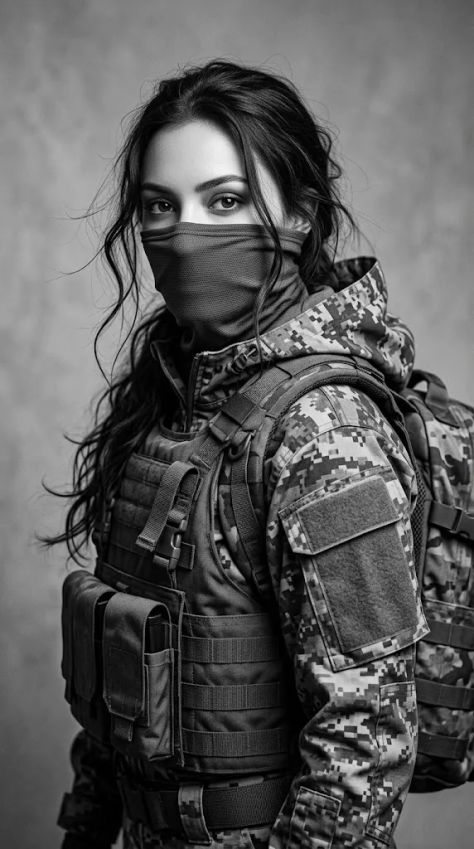
Use the uploaded image as the main visual reference for the subject’s facial identity and overall human proportions. Transform the styling into the extracted monochrome tactical editorial composition while preserving the same recognizable subject identity. Recreate a single tactical/military-inspired figure wearing layered camouflage clothing, a dark load-bearing vest, shoulder protection, scarf/hood layers, a close-fitting fabric face covering, and a large tactical backpack against a plain softly textured studio-gray background. Keep the lower face fully concealed. Do not expose the mouth, jaw, chin, or lower cheeks. Do not preserve the helicopter environment, flight-suit styling, readable patches, crossed-arm pose, or color treatment from the uploaded reference where they conflict with the instructions below.

Generate a photorealistic black-and-white tactical fashion editorial portrait in a 9:16 vertical composition. Frame the subject approximately from mid-thigh or waist upward with the entire head visible and the lower body continuing outside the bottom crop. Position the subject near the center with a slight shift toward frame-right. Let the upper torso occupy most of the vertical frame. Use an eye-level camera with the torso rotated into a subtle three-quarter orientation while the head turns directly back toward the lens. Keep the head nearly level with only a very slight downward inclination. Use approximately 85 mm portrait-equivalent compression, aperture behavior around f/3.2, moderate-shallow depth of field, grain level 2/10, and post-processing intensity approximately 7/10.

Preserve the same facial identity from the uploaded image only in the facial regions that remain visible above the covering. Maintain the same forehead proportions, brow spacing, eye placement, eye width, eyelid geometry, and upper-nose structure. Do not redesign the subject into a different person. Because the lower face is concealed, do not reconstruct or display the lips, mouth, jawline, or chin.

Render the visible skin entirely in monochrome with saturation at 0%. Keep illuminated forehead and upper-cheek skin around 62–76% luminance, midtone skin around 45–60%, and the deeper eye-socket and hair-cast shadows around 20–35%. Use a soft matte skin response rather than glossy beauty lighting.

Maintain skin retouching at approximately 6/10. Refine and smooth the visible forehead, temples, upper cheeks, and eye-surround areas while retaining subtle microtexture, natural eyelid folds, fine eyebrow hairs, eyelashes, and slight tonal irregularity. Keep pores subdued but not completely removed. Do not create raw high-texture skin and do not flatten the visible facial region into plastic.

Preserve both eyes as almond-shaped with slightly lifted outer corners. Keep the same eye spacing and overall geometry. Both eyes must remain open and directed straight toward the camera. Do not redirect the gaze sideways, downward, or upward.

Render the irises in medium-to-dark grayscale values around 30–45% luminance with slightly brighter central radial structure and darker outer limbal rings around 15–25% luminance. Keep the pupils medium-sized and near-black. Add small soft natural catchlights in the upper portions of both irises corresponding to the frame-left-front studio source. Do not add glowing eyes, ring-light circles, oversized catchlights, or colored irises.

Keep the upper eyelids clearly defined with a subtle crease. Apply soft charcoal-to-taupe tonal shading around the upper lids and outer corners, approximately 18–30% luminance, blended smoothly into surrounding skin. Maintain a dark blended upper-lash line around 5–12% luminance without a sharp graphic wing.

Render the upper lashes dark and relatively dense with individually tapered hairs. Lower lashes should remain visible but substantially lighter and less dense. Preserve moderate mascara-like enhancement or digitally intensified lash definition without exaggerated false-lash volume.

Maintain dark medium-thick brows with a softly angled shape, clean but natural edges, and individually readable hair texture. Use approximately 8–18% luminance for brow hairs. Keep the brows mostly level with only slight natural inner tension. Do not dramatically arch, thin, laminate, lighten, or overfill them.

Cover the lower facial region with a dark tactical gaiter or scarf extending securely over the nose, mouth, lower cheeks, jaw, and chin. The visible facial opening should stop around the upper nose/under-eye region according to the reference styling. Do not expose the nostrils, lips, teeth, jaw, or chin.

Render the face covering from tightly woven technical textile with a clearly readable fine grid structure. Use very dark charcoal values around 6–18% luminance. Give it a completely matte finish with minimal reflectivity. Keep the fabric fitted closely around the lower face while preserving shallow horizontal tension lines and mild compression folds across the nose-to-cheek and mouth regions. Do not make the mask smooth neoprene, glossy leather, mesh with visible skin underneath, or a rigid respirator.

Keep all lower-face makeup completely unobservable because of the covering. Do not invent lipstick, visible lip shape, blush beneath the mask, exposed contouring, or lower-face cosmetics.

Preserve the expression mechanics through the visible upper face only: brows approximately level with restrained inner tension, eyelids moderately open, gaze directly camera-facing, frontalis mostly relaxed, and orbicularis oculi minimally contracted. Do not create a smile, squint, raised brows, or visible lower-face expression.

Restyle the hair as long, dark, and loosely swept around the head and shoulders. Use fully desaturated dark values around 10–25% luminance with narrow silver-gray highlights reaching approximately 45–60%. Keep the finish satin rather than glossy.

Use mostly straight hair with irregular natural bends, loose wind-swept strands, and moderate volume concentrated around the crown and side of the head. Use a deep side part. Allow several thin strands to descend beside the forehead and temple. Add numerous fine flyaways around the crown and especially along frame-left. Do not preserve the very large voluminous curl pattern from the uploaded reference; reduce it into straighter, tactical-editorial hair with only irregular bends.

Keep some hair tucked or compressed by the tactical layers while other strands fall across the shoulder and outer torso. Use individually readable fiber direction, narrow highlights following strand orientation, soft overlap shadows, and natural tapering. Do not create braids, a ponytail, a helmet, a hat, or perfectly styled salon hair.

Dress the subject in a layered camouflage hooded jacket or combat-style shell. Render the camouflage entirely in grayscale using a dense digital/pixel pattern formed from near-black around 8–15% luminance, dark charcoal around 18–28%, medium gray around 35–48%, and selective pale gray around 52–62%. Keep all saturation at 0%.

Use technical woven fabric with slightly crisp structural behavior, fine textile grain, matte-to-low-satin finish, visible seams, stitching, compression lines, and layered overlaps. Preserve realistic folds around the shoulders, elbows, upper arms, collar, and torso. Do not render the camouflage as printed plastic or smooth synthetic armor.

Keep the jacket hood present but resting around the shoulders and upper back rather than covering the head. Build layered collar, hood, and scarf fabric around the neck so the transition into the face covering feels integrated and functional. Preserve multiple folds, compressed textile ridges, and overlapping dark layers.

Add structured protective shoulder armor on the nearer shoulder. Use a segmented slightly angular cap extending over the upper arm. Cover the protective structure with camouflage technical textile and visible seam construction. Keep the material firm but flexible rather than rigid glossy metal.

Include a large rectangular hook-and-loop patch field on the upper arm. Render it as rough looped fabric with visibly different microtexture from the surrounding shell. Keep the patch blank and unreadable. Do not reproduce the readable flag, lettering, military insignia, name tapes, or logos visible in the uploaded image.

Layer a dark tactical load-bearing vest over the torso. Use deep charcoal values around 8–20% luminance. Construct it from heavy nylon, woven webbing, straps, stitched reinforcement, modular attachment fields, small utility compartments, and broad horizontal webbing rows.

Keep the vest matte with a fine woven nylon texture. Add several rectangular utility pouches attached across the front torso with stitched borders, flap structures, retention straps, and subtle compression. Use slight grayscale differences between adjacent modules so the construction remains readable while staying dark.

Add multiple broad black webbing bands crossing and securing the vest. Include small dark buckles and clips where mechanically appropriate. Keep the hardware mostly near-black and low-gloss rather than bright metallic. Do not add decorative chrome, colorful plastic, visible brand marks, or readable labeling.

Preserve the three-quarter torso orientation. Rotate the torso slightly away from the lens while turning the head back toward the camera. Keep the nearer shoulder projected slightly forward, creating a diagonal shoulder line. Do not preserve the symmetrical arms-crossed stance from the uploaded reference.

Keep zero clearly visible hands. Arrange the arms, framing, vest, and tactical layers so hands remain outside the crop or fully obscured. Do not invent hand gestures, crossed exposed fingers, weapons, or held objects.

Add a large tactical backpack behind the frame-right shoulder and continuing along the side torso. Use a bulky rectangular-to-rounded profile, camouflage technical fabric, dark webbing, stitched attachment zones, external compartments, compression straps, and layered structural padding.

Keep the backpack partially outside the sharpest focal plane. Maintain enough detail to show fabric weave, pockets, webbing, and shape while allowing it to soften slightly behind the primary facial and vest plane. Do not make the backpack tiny, sleek, civilian, or brightly highlighted.

Keep conventional jewelry absent. No necklace. No visible rings. No bracelet. No watch. No obvious earrings. If a tiny bright element remains partially visible near the ear, keep it extremely subtle and mostly obscured by hair without making it a recognizable jewelry focal point.

Keep glasses absent. Keep hat and helmet absent. Keep held objects absent. Keep weapons absent. No visible tattoos, scars, decorative face markings, or additional accessories.

Replace the helicopter and airfield setting with a plain studio-style backdrop. Build the background as a softly textured neutral-gray field with no recognizable environment. Use approximately 28–42% luminance through most of the background with subtle natural tonal variation. Keep the background softly defocused so it separates from the subject.

Maintain only two primary depth layers: the sharply rendered tactical subject and the soft neutral studio background. Keep bokeh absent. Keep furniture absent. Keep aircraft absent. Keep vehicles absent. Keep props absent. Keep other people absent. No readable text, signs, logos, or watermark anywhere.

Use a large soft directional key from approximately the 10–11 o’clock position at frame-left-front, equivalent to neutral studio daylight around 5300 K before monochrome conversion. Keep the light broad enough to create smooth skin transitions but directional enough to reveal textile microstructure, webbing, shoulder armor seams, and hair highlights.

Illuminate the central forehead, upper nose bridge above the mask, visible upper cheekbone, selected hair strands, and the upper portion of the nearer shoulder. Allow the frame-left eye socket beneath hair, lower face covering, deep vest recesses, pouch overlaps, and backpack folds to descend into darker charcoal values.

Maintain a soft-to-moderate shadow terminator across the visible face. Use short-light / soft directional editorial modeling. Do not flatten the face with frontal beauty lighting and do not create hard theatrical shadows.

Use approximately 35% fill. Preserve readable detail inside the dark mask, vest, utility pouches, black webbing, shoulder protection, and backpack while maintaining strong separation between dark tactical layers. Avoid crushing all black textiles into one featureless mass.

Add only a very subtle rim or separation light along selected frame-right hair strands, the rear shoulder edge, and portions of the backpack silhouette. Keep this rim neutral silver-gray and physically subtle. Do not create a glowing outline or dramatic colored edge.

Shape highlights by material. On skin, use broad soft matte-to-satin highlights. On hair, use narrow silver-gray directional streaks. On technical camouflage fabric, use diffuse low-intensity reflections following fold geometry. On nylon vest material, use restrained woven highlights. On rough hook-and-loop patches, keep reflection almost fully diffuse. On dark buckles and clips, use tiny controlled edge reflections only.

Render the entire final image at saturation 0%. Use near-black around 2–8% luminance for the deepest mask, vest, hair, and backpack recesses; charcoal around 10–28%; middle gray around 30–50%; pale gray around 52–70%; and restrained silver-white highlights around 72–88%. Reserve the brightest values for the eye catchlights and small illuminated skin/hair details.

Apply a black-and-white tactical editorial grade with deep controlled blacks, moderately bright visible facial highlights, high textile microcontrast, crisp eye definition, refined skin, and strong grayscale separation between camouflage, vest, mask, and background. Maintain medium-high contrast without excessive HDR.

Keep shadow values predominantly deep charcoal rather than completely crushed black so woven textile structure remains visible. Use selective near-black clipping only inside the deepest webbing intersections, mask folds, hair cavities, and backpack recesses.

Use moderate-shallow depth of field. Keep both eyes, brows, mask texture, forward hair, tactical vest, and nearer shoulder armor sharply rendered. Keep front utility pouches readable. Allow the rear backpack, far shoulder layers, and studio background to soften progressively.

Use approximately 70–100 mm portrait-equivalent optical behavior with no wide-angle distortion. Preserve realistic head-to-torso proportions and avoid enlargement of the nearer shoulder beyond natural three-quarter perspective.

Render at maximum photorealistic black-and-white editorial photography quality. Preserve realistic anatomy, crisp technical textiles, authentic woven camouflage, believable nylon webbing, detailed hook-and-loop texture, natural hair fibers, polished but non-plastic skin, and controlled studio light falloff.

Maintain grain around 2/10. Apply post-processing at approximately 7/10 using monochrome conversion, selective eye sharpening, strong textile microcontrast, moderate visible-skin cleanup, controlled deep-shadow shaping, and restrained local sharpening. Do not oversharpen the entire frame.

Follow the uploaded image as the facial-identity reference while following these extracted styling instructions as the required scene and wardrobe treatment. Preserve the subject’s recognizable upper-face identity, eye geometry, direct camera relationship, and realistic proportions while transforming the portrait into the specified masked monochrome tactical editorial.

Keep both eyes open and directed straight toward the camera with small upper catchlights. Keep the lower face completely covered throughout. Do not expose the mouth, lips, jaw, chin, or lower cheeks.

Preserve only the visible makeup configuration: even upper-face complexion, soft charcoal/taupe eye shading, blended dark upper-lash definition, dark enhanced lashes, and defined natural brows. Do not invent visible lipstick, blush, contouring, or lower-face cosmetics beneath the mask.

Maintain skin retouching at approximately 6/10: smooth and refine the forehead, temples, upper cheek, and eye area while retaining eyebrow hairs, eyelashes, eyelid folds, subtle skin texture, and realistic tonal transitions. Do not render raw skin and do not flatten the visible facial region into textureless plastic.

No exposed mouth. No exposed jaw. No exposed chin. No visible lips. No crossed bare hands. No readable military text. No readable name tapes. No readable flag. No recognizable insignia. No logos. No helicopter. No aircraft. No airfield. No additional people. No extra props. No weapons. No jewelry emphasis. No glasses. No helmet. No text. No watermark. No color. No bokeh circles. No fog. No rain. No particles. No lens flare. No chromatic aberration. No fisheye distortion. No anatomical errors. No plastic skin. No glossy tactical fabric. Ultra-high resolution. Sharp eyes. Fine eyebrow and lash detail. Crisp face-covering weave. Detailed digital camouflage. Precise vest webbing and pouch construction. Realistic tactical backpack texture. Photorealistic monochrome tactical fashion editorial photography only.

·
Photo Prompts

评价

登录后即可发表评价。

暂无评价。来写第一条吧。

在任何设备上使用 PromptLabHub。

安装应用以便更快打开,或下载 Chrome 扩展并在浏览器中加载。

浏览 Prompt

  • 全部 Prompt
  • 摄影 Prompt
  • 视频 Prompt
  • 美食 Prompt

创作

  • 提交 Prompt

社区

  • 论坛
  • 创作者
  • 排行榜
  • 每周挑战

支持

  • 常见问题
  • 联系我们
  • 隐私政策
  • 服务条款

关注我们

发现并复制精选 AI Prompt,适用于 Midjourney、DALL-E 3、Sora、Runway 等。每周更新。

隐私政策服务条款Cookie 政策

© 2026 PromptLabHub. All rights reserved.

© 2026 PromptLabHub. All rights reserved.

·
隐私政策·服务条款·Cookie 政策
Home
PromptLabHub
Editorial Fashion Studio Dramatic Light Bokeh
0
Prompt

Editorial Fashion Studio Dramatic Light Bokeh

Use the uploaded image as the main visual reference for the subject’s facial identity and overall human proportions. Transform the styling into the extracted monochrome tactical editorial composition while preserving the same recognizable subject identity. Recreate a single tactical/military-inspired figure wearing layered camouflage clothing, a dark load-bearing vest, shoulder protection, scarf/hood layers, a close-fitting fabric face covering, and a large tactical backpack against a plain softly textured studio-gray background. Keep the lower face fully concealed. Do not expose the mouth, jaw, chin, or lower cheeks. Do not preserve the helicopter environment, flight-suit styling, readable patches, crossed-arm pose, or color treatment from the uploaded reference where they conflict with the instructions below.

Generate a photorealistic black-and-white tactical fashion editorial portrait in a 9:16 vertical composition. Frame the subject approximately from mid-thigh or waist upward with the entire head visible and the lower body continuing outside the bottom crop. Position the subject near the center with a slight shift toward frame-right. Let the upper torso occupy most of the vertical frame. Use an eye-level camera with the torso rotated into a subtle three-quarter orientation while the head turns directly back toward the lens. Keep the head nearly level with only a very slight downward inclination. Use approximately 85 mm portrait-equivalent compression, aperture behavior around f/3.2, moderate-shallow depth of field, grain level 2/10, and post-processing intensity approximately 7/10.

Preserve the same facial identity from the uploaded image only in the facial regions that remain visible above the covering. Maintain the same forehead proportions, brow spacing, eye placement, eye width, eyelid geometry, and upper-nose structure. Do not redesign the subject into a different person. Because the lower face is concealed, do not reconstruct or display the lips, mouth, jawline, or chin.

Render the visible skin entirely in monochrome with saturation at 0%. Keep illuminated forehead and upper-cheek skin around 62–76% luminance, midtone skin around 45–60%, and the deeper eye-socket and hair-cast shadows around 20–35%. Use a soft matte skin response rather than glossy beauty lighting.

Maintain skin retouching at approximately 6/10. Refine and smooth the visible forehead, temples, upper cheeks, and eye-surround areas while retaining subtle microtexture, natural eyelid folds, fine eyebrow hairs, eyelashes, and slight tonal irregularity. Keep pores subdued but not completely removed. Do not create raw high-texture skin and do not flatten the visible facial region into plastic.

Preserve both eyes as almond-shaped with slightly lifted outer corners. Keep the same eye spacing and overall geometry. Both eyes must remain open and directed straight toward the camera. Do not redirect the gaze sideways, downward, or upward.

Render the irises in medium-to-dark grayscale values around 30–45% luminance with slightly brighter central radial structure and darker outer limbal rings around 15–25% luminance. Keep the pupils medium-sized and near-black. Add small soft natural catchlights in the upper portions of both irises corresponding to the frame-left-front studio source. Do not add glowing eyes, ring-light circles, oversized catchlights, or colored irises.

Keep the upper eyelids clearly defined with a subtle crease. Apply soft charcoal-to-taupe tonal shading around the upper lids and outer corners, approximately 18–30% luminance, blended smoothly into surrounding skin. Maintain a dark blended upper-lash line around 5–12% luminance without a sharp graphic wing.

Render the upper lashes dark and relatively dense with individually tapered hairs. Lower lashes should remain visible but substantially lighter and less dense. Preserve moderate mascara-like enhancement or digitally intensified lash definition without exaggerated false-lash volume.

Maintain dark medium-thick brows with a softly angled shape, clean but natural edges, and individually readable hair texture. Use approximately 8–18% luminance for brow hairs. Keep the brows mostly level with only slight natural inner tension. Do not dramatically arch, thin, laminate, lighten, or overfill them.

Cover the lower facial region with a dark tactical gaiter or scarf extending securely over the nose, mouth, lower cheeks, jaw, and chin. The visible facial opening should stop around the upper nose/under-eye region according to the reference styling. Do not expose the nostrils, lips, teeth, jaw, or chin.

Render the face covering from tightly woven technical textile with a clearly readable fine grid structure. Use very dark charcoal values around 6–18% luminance. Give it a completely matte finish with minimal reflectivity. Keep the fabric fitted closely around the lower face while preserving shallow horizontal tension lines and mild compression folds across the nose-to-cheek and mouth regions. Do not make the mask smooth neoprene, glossy leather, mesh with visible skin underneath, or a rigid respirator.

Keep all lower-face makeup completely unobservable because of the covering. Do not invent lipstick, visible lip shape, blush beneath the mask, exposed contouring, or lower-face cosmetics.

Preserve the expression mechanics through the visible upper face only: brows approximately level with restrained inner tension, eyelids moderately open, gaze directly camera-facing, frontalis mostly relaxed, and orbicularis oculi minimally contracted. Do not create a smile, squint, raised brows, or visible lower-face expression.

Restyle the hair as long, dark, and loosely swept around the head and shoulders. Use fully desaturated dark values around 10–25% luminance with narrow silver-gray highlights reaching approximately 45–60%. Keep the finish satin rather than glossy.

Use mostly straight hair with irregular natural bends, loose wind-swept strands, and moderate volume concentrated around the crown and side of the head. Use a deep side part. Allow several thin strands to descend beside the forehead and temple. Add numerous fine flyaways around the crown and especially along frame-left. Do not preserve the very large voluminous curl pattern from the uploaded reference; reduce it into straighter, tactical-editorial hair with only irregular bends.

Keep some hair tucked or compressed by the tactical layers while other strands fall across the shoulder and outer torso. Use individually readable fiber direction, narrow highlights following strand orientation, soft overlap shadows, and natural tapering. Do not create braids, a ponytail, a helmet, a hat, or perfectly styled salon hair.

Dress the subject in a layered camouflage hooded jacket or combat-style shell. Render the camouflage entirely in grayscale using a dense digital/pixel pattern formed from near-black around 8–15% luminance, dark charcoal around 18–28%, medium gray around 35–48%, and selective pale gray around 52–62%. Keep all saturation at 0%.

Use technical woven fabric with slightly crisp structural behavior, fine textile grain, matte-to-low-satin finish, visible seams, stitching, compression lines, and layered overlaps. Preserve realistic folds around the shoulders, elbows, upper arms, collar, and torso. Do not render the camouflage as printed plastic or smooth synthetic armor.

Keep the jacket hood present but resting around the shoulders and upper back rather than covering the head. Build layered collar, hood, and scarf fabric around the neck so the transition into the face covering feels integrated and functional. Preserve multiple folds, compressed textile ridges, and overlapping dark layers.

Add structured protective shoulder armor on the nearer shoulder. Use a segmented slightly angular cap extending over the upper arm. Cover the protective structure with camouflage technical textile and visible seam construction. Keep the material firm but flexible rather than rigid glossy metal.

Include a large rectangular hook-and-loop patch field on the upper arm. Render it as rough looped fabric with visibly different microtexture from the surrounding shell. Keep the patch blank and unreadable. Do not reproduce the readable flag, lettering, military insignia, name tapes, or logos visible in the uploaded image.

Layer a dark tactical load-bearing vest over the torso. Use deep charcoal values around 8–20% luminance. Construct it from heavy nylon, woven webbing, straps, stitched reinforcement, modular attachment fields, small utility compartments, and broad horizontal webbing rows.

Keep the vest matte with a fine woven nylon texture. Add several rectangular utility pouches attached across the front torso with stitched borders, flap structures, retention straps, and subtle compression. Use slight grayscale differences between adjacent modules so the construction remains readable while staying dark.

Add multiple broad black webbing bands crossing and securing the vest. Include small dark buckles and clips where mechanically appropriate. Keep the hardware mostly near-black and low-gloss rather than bright metallic. Do not add decorative chrome, colorful plastic, visible brand marks, or readable labeling.

Preserve the three-quarter torso orientation. Rotate the torso slightly away from the lens while turning the head back toward the camera. Keep the nearer shoulder projected slightly forward, creating a diagonal shoulder line. Do not preserve the symmetrical arms-crossed stance from the uploaded reference.

Keep zero clearly visible hands. Arrange the arms, framing, vest, and tactical layers so hands remain outside the crop or fully obscured. Do not invent hand gestures, crossed exposed fingers, weapons, or held objects.

Add a large tactical backpack behind the frame-right shoulder and continuing along the side torso. Use a bulky rectangular-to-rounded profile, camouflage technical fabric, dark webbing, stitched attachment zones, external compartments, compression straps, and layered structural padding.

Keep the backpack partially outside the sharpest focal plane. Maintain enough detail to show fabric weave, pockets, webbing, and shape while allowing it to soften slightly behind the primary facial and vest plane. Do not make the backpack tiny, sleek, civilian, or brightly highlighted.

Keep conventional jewelry absent. No necklace. No visible rings. No bracelet. No watch. No obvious earrings. If a tiny bright element remains partially visible near the ear, keep it extremely subtle and mostly obscured by hair without making it a recognizable jewelry focal point.

Keep glasses absent. Keep hat and helmet absent. Keep held objects absent. Keep weapons absent. No visible tattoos, scars, decorative face markings, or additional accessories.

Replace the helicopter and airfield setting with a plain studio-style backdrop. Build the background as a softly textured neutral-gray field with no recognizable environment. Use approximately 28–42% luminance through most of the background with subtle natural tonal variation. Keep the background softly defocused so it separates from the subject.

Maintain only two primary depth layers: the sharply rendered tactical subject and the soft neutral studio background. Keep bokeh absent. Keep furniture absent. Keep aircraft absent. Keep vehicles absent. Keep props absent. Keep other people absent. No readable text, signs, logos, or watermark anywhere.

Use a large soft directional key from approximately the 10–11 o’clock position at frame-left-front, equivalent to neutral studio daylight around 5300 K before monochrome conversion. Keep the light broad enough to create smooth skin transitions but directional enough to reveal textile microstructure, webbing, shoulder armor seams, and hair highlights.

Illuminate the central forehead, upper nose bridge above the mask, visible upper cheekbone, selected hair strands, and the upper portion of the nearer shoulder. Allow the frame-left eye socket beneath hair, lower face covering, deep vest recesses, pouch overlaps, and backpack folds to descend into darker charcoal values.

Maintain a soft-to-moderate shadow terminator across the visible face. Use short-light / soft directional editorial modeling. Do not flatten the face with frontal beauty lighting and do not create hard theatrical shadows.

Use approximately 35% fill. Preserve readable detail inside the dark mask, vest, utility pouches, black webbing, shoulder protection, and backpack while maintaining strong separation between dark tactical layers. Avoid crushing all black textiles into one featureless mass.

Add only a very subtle rim or separation light along selected frame-right hair strands, the rear shoulder edge, and portions of the backpack silhouette. Keep this rim neutral silver-gray and physically subtle. Do not create a glowing outline or dramatic colored edge.

Shape highlights by material. On skin, use broad soft matte-to-satin highlights. On hair, use narrow silver-gray directional streaks. On technical camouflage fabric, use diffuse low-intensity reflections following fold geometry. On nylon vest material, use restrained woven highlights. On rough hook-and-loop patches, keep reflection almost fully diffuse. On dark buckles and clips, use tiny controlled edge reflections only.

Render the entire final image at saturation 0%. Use near-black around 2–8% luminance for the deepest mask, vest, hair, and backpack recesses; charcoal around 10–28%; middle gray around 30–50%; pale gray around 52–70%; and restrained silver-white highlights around 72–88%. Reserve the brightest values for the eye catchlights and small illuminated skin/hair details.

Apply a black-and-white tactical editorial grade with deep controlled blacks, moderately bright visible facial highlights, high textile microcontrast, crisp eye definition, refined skin, and strong grayscale separation between camouflage, vest, mask, and background. Maintain medium-high contrast without excessive HDR.

Keep shadow values predominantly deep charcoal rather than completely crushed black so woven textile structure remains visible. Use selective near-black clipping only inside the deepest webbing intersections, mask folds, hair cavities, and backpack recesses.

Use moderate-shallow depth of field. Keep both eyes, brows, mask texture, forward hair, tactical vest, and nearer shoulder armor sharply rendered. Keep front utility pouches readable. Allow the rear backpack, far shoulder layers, and studio background to soften progressively.

Use approximately 70–100 mm portrait-equivalent optical behavior with no wide-angle distortion. Preserve realistic head-to-torso proportions and avoid enlargement of the nearer shoulder beyond natural three-quarter perspective.

Render at maximum photorealistic black-and-white editorial photography quality. Preserve realistic anatomy, crisp technical textiles, authentic woven camouflage, believable nylon webbing, detailed hook-and-loop texture, natural hair fibers, polished but non-plastic skin, and controlled studio light falloff.

Maintain grain around 2/10. Apply post-processing at approximately 7/10 using monochrome conversion, selective eye sharpening, strong textile microcontrast, moderate visible-skin cleanup, controlled deep-shadow shaping, and restrained local sharpening. Do not oversharpen the entire frame.

Follow the uploaded image as the facial-identity reference while following these extracted styling instructions as the required scene and wardrobe treatment. Preserve the subject’s recognizable upper-face identity, eye geometry, direct camera relationship, and realistic proportions while transforming the portrait into the specified masked monochrome tactical editorial.

Keep both eyes open and directed straight toward the camera with small upper catchlights. Keep the lower face completely covered throughout. Do not expose the mouth, lips, jaw, chin, or lower cheeks.

Preserve only the visible makeup configuration: even upper-face complexion, soft charcoal/taupe eye shading, blended dark upper-lash definition, dark enhanced lashes, and defined natural brows. Do not invent visible lipstick, blush, contouring, or lower-face cosmetics beneath the mask.

Maintain skin retouching at approximately 6/10: smooth and refine the forehead, temples, upper cheek, and eye area while retaining eyebrow hairs, eyelashes, eyelid folds, subtle skin texture, and realistic tonal transitions. Do not render raw skin and do not flatten the visible facial region into textureless plastic.

No exposed mouth. No exposed jaw. No exposed chin. No visible lips. No crossed bare hands. No readable military text. No readable name tapes. No readable flag. No recognizable insignia. No logos. No helicopter. No aircraft. No airfield. No additional people. No extra props. No weapons. No jewelry emphasis. No glasses. No helmet. No text. No watermark. No color. No bokeh circles. No fog. No rain. No particles. No lens flare. No chromatic aberration. No fisheye distortion. No anatomical errors. No plastic skin. No glossy tactical fabric. Ultra-high resolution. Sharp eyes. Fine eyebrow and lash detail. Crisp face-covering weave. Detailed digital camouflage. Precise vest webbing and pouch construction. Realistic tactical backpack texture. Photorealistic monochrome tactical fashion editorial photography only.

·
Photo Prompts

评价

登录后即可发表评价。

暂无评价。来写第一条吧。

在任何设备上使用 PromptLabHub。

安装应用以便更快打开,或下载 Chrome 扩展并在浏览器中加载。

浏览 Prompt

  • 全部 Prompt
  • 摄影 Prompt
  • 视频 Prompt
  • 美食 Prompt

创作

  • 提交 Prompt

社区

  • 论坛
  • 创作者
  • 排行榜
  • 每周挑战

支持

  • 常见问题
  • 联系我们
  • 隐私政策
  • 服务条款

关注我们

发现并复制精选 AI Prompt,适用于 Midjourney、DALL-E 3、Sora、Runway 等。每周更新。

隐私政策服务条款Cookie 政策

© 2026 PromptLabHub. All rights reserved.

© 2026 PromptLabHub. All rights reserved.

·
隐私政策·服务条款·Cookie 政策
Home