
PromptLabHub
Cinematic Portrait Urban Dramatic Backlit Bokeh
0
Prompt

Cinematic Portrait Urban Dramatic Backlit Bokeh

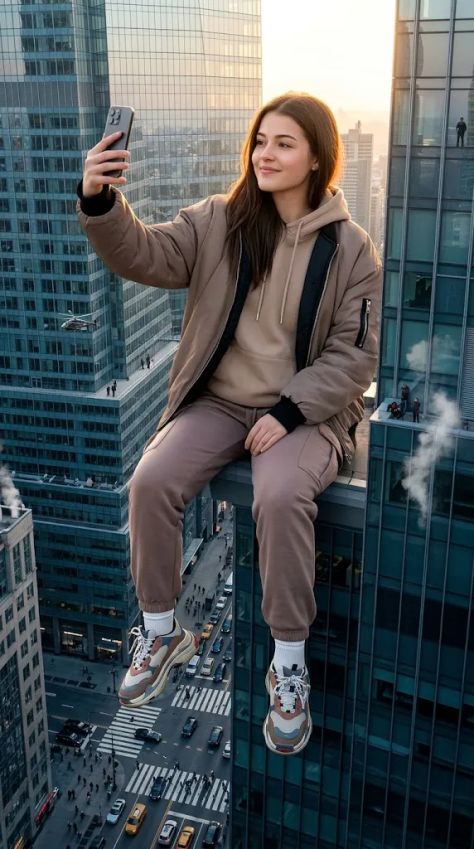
Use the uploaded image as the main visual reference. Recreate the same surreal luxury streetwear/lifestyle editorial scene: one female-presenting subject seated monumentally on the edge of a modern glass high-rise while taking a smartphone selfie, rendered at impossible giant scale above a dense commercial city core. Preserve the same subject identity, selfie gesture, warm taupe layered streetwear, dangling legs, chunky sneakers, glass-tower framing, miniature traffic, pedestrians, helicopter, rooftop figures, localized steam plumes, golden backlight, elevated aerial viewpoint, and cinematic atmosphere. Do not invent a new face, new clothing palette, new city arrangement, new pose, or new camera angle. Follow the uploaded image closely and apply only the specifications below.

Generate a maximum-photorealistic cinematic giant-scale urban composite in a vertical 9:16 composition. Use a full-body environmental portrait with the entire head, torso, both arms, both legs, and both shoes visible. Position the subject across the upper-center to right half of the composition. Extend the selfie-holding arm diagonally toward the upper-left while both legs descend vertically through the center of the frame. Use an elevated aerial viewpoint looking slightly downward through the urban canyon while keeping the camera approximately near the subject's seated torso level. Visually bridge the subject between two tall glass towers, with the streets below producing strong vertical depth lines toward the lower frame. Render the subject approximately 15–25 building stories tall relative to the ordinary-scale vehicles and pedestrians beneath her.

Preserve the exact facial identity and facial proportions from the uploaded reference. Keep a soft oval facial structure with a lightly tapered jaw and rounded chin. Use a light beige skin base around H 25–30° with moderate saturation and a warm peach-neutral undertone. Render illuminated skin around H 28–30°, S 30%, B 82–87%, while shadowed skin remains around H 22–26°, S 25–30%, B 55–62%. Maintain a natural satin skin finish with soft controlled highlights on the forehead, cheekbones, nose, and upper lip.

Set skin retouching to approximately 6/10. Smooth major tonal variation across the cheeks and forehead while retaining visible structural definition around the eyelids, nose, lips, jaw, and facial contour transitions. Preserve subtle natural material variation without adding exaggerated high-frequency pores. Do not flatten the complexion into plastic, waxy, or over-filtered skin.

Preserve the same almond-shaped eyes fully open, with gaze directed upward and toward frame-left at the smartphone screen rather than toward the viewer or camera lens. Maintain small warm rectangular/daylight catchlights near the upper iris. Keep medium-thickness warm-dark-blonde to light-brown eyebrows with soft arches, groomed edges, and no harsh sculpting. Maintain relaxed frontalis activity, mildly engaged orbicularis, slightly raised cheek structure, gently elevated mouth corners, and closed lips. Do not redirect the eyes toward the camera.

Preserve the exact restrained makeup configuration: medium natural-coverage satin base, extremely subtle warm beige-to-taupe eyeshadow, minimal upper-lash definition without a dramatic wing, darkened and moderately separated lashes with mascara, soft peach-rose coloration centered on the cheeks, softly groomed light-brown brows, and muted rose-beige lips with a satin finish. Keep the lower lip approximately 1.3 times fuller than the upper lip. Do not add dramatic glam makeup, glitter, heavy contour, dark smoky eyes, exaggerated lashes, glossy lacquered lips, intense blush, or additional cosmetics absent from the reference.

Preserve the same warm dark-blonde/light-brown hair base around H 30–40° with golden-beige highlight strands. Render shoulder-to-upper-chest-length hair in loose medium-to-large waves and curls with clearly defined clumps, soft strand separation, and medium-high volume concentrated around the sides and crown. Maintain a near-center part. Give the fibers a soft satin surface with broad warm backlit specular response along the perimeter. Keep flyaways minimal and the silhouette controlled. Do not straighten the hair, change the curl scale, reduce the side volume, or alter the warm highlight behavior.

Preserve the same seated selfie pose exactly. Orient the torso three-quarter toward frame-left. Turn the head upward and toward frame-left at the smartphone with an approximately 8–12° upward tilt. Raise the shoulder on the phone-holding side naturally due to the extended arm.

Keep the arm on frame-left fully extended upward and forward while holding the smartphone. Slightly flex the wrist and wrap the fingers securely around the phone edges. Keep the other hand visible on frame-right, resting naturally on the building ledge with relaxed fingers extending over the edge. Show exactly two hands. Keep nails short-to-medium with a neutral nude surface finish.

Preserve both legs hanging over the high-rise edge. Keep the leg on frame-left more extended downward and slightly toward frame-left. Keep the leg on frame-right slightly more bent at the knee. Angle both feet downward with relaxed ankle orientation. Maintain believable seated weight and contact with the architectural ledge despite the intentionally impossible giant scale.

Preserve the oversized bomber jacket using warm taupe/greige around H 30–35°, S 12–18%, B 55–65%. Render it as a matte nylon-to-satin-polyester shell with only a subtle soft sheen. Keep the body oversized and relaxed with dropped shoulders, voluminous sleeves, and natural compression around the seated posture. Preserve ribbed striped cuffs, darker charcoal-to-muted-olive inner trim and shoulder insert areas, and the visible front zipper in an open position.

Underneath, preserve the pullover hoodie in muted beige/taupe around H 28–32°, S 12–18%, B 68–75%. Render it as brushed cotton/fleece with a matte, softly fibrous surface. Keep the hood resting behind the neck and preserve exactly two light-taupe drawstrings hanging vertically over the chest. Do not change the hoodie into a crewneck, remove the hood, or add graphics.

Preserve the relaxed cargo/jogger trousers in dusty taupe/stone brown around H 30°, S 15–20%, B 55–62%. Render them as matte cotton twill/canvas with subtle visible weave. Keep a loose fit through the thighs transitioning into tapered ankles. Preserve the large flap cargo pocket on the outer thigh, stitched utility seam construction, elasticized ankle openings, and strong natural compression folds around the hips, knees, and ankle cuffs.

Preserve the chunky retro-running sneakers using an off-white, warm-gray, beige, and muted-charcoal material palette. Build each shoe from breathable mesh, synthetic suede/leather overlays, and rubber. Keep the thick sculpted off-white/gray midsoles and darker outsole tread. Preserve visible white ankle socks above both shoes. Do not substitute slim shoes, boots, heels, or minimalist footwear.

Keep accessories restrained exactly as in the reference. No visible necklace. No clearly visible rings. No watch. No bracelet. No glasses. No headwear. No bag. Small subtle earrings may remain only if naturally supported by the uploaded reference; do not enlarge or emphasize them.

Preserve the smartphone as a silver-to-gray device with three rear camera lenses. Render a satin metallic frame and matte/light-metallic rear panel. Keep it in portrait orientation with the rear camera cluster facing the viewer while the subject looks toward its screen. Do not add a case with bright graphics, additional lenses, text, logos, or decorative elements not clearly present.

Build the urban environment as approximately six distinct depth layers.

Layer 1: rooftop and architectural foreground surfaces immediately around and beneath the subject, including the high-rise ledge on which she sits and the lower-right rooftop containing miniature people.

Layer 2: the giant subject sharply defined against the city, with legs hanging down into the architectural void and the selfie arm extending toward the upper-left.

Layer 3: adjacent modern glass curtain-wall towers. On frame-left, preserve a tall glass façade with a cool blue-gray rectangular window grid and reflected warm sky. On frame-right, preserve a matching modern glass high-rise with repetitive square window modules and cooler reflective shadow structure.

Layer 4: one small helicopter flying through the mid-left background behind the subject, together with several localized white-gray steam plumes rising from rooftops and spaces between buildings. Keep the helicopter at ordinary city scale and dramatically smaller than the subject.

Layer 5: layered masonry and glass towers receding through the dense commercial city core. Keep the architecture varied in height and material while maintaining believable perspective and increasing atmospheric softness with distance.

Layer 6: the distant golden-cream sky and deeper skyline fading through moderate aerial haze.

Below the subject, preserve a multi-lane avenue populated by numerous miniature vehicles, including yellow taxi-like vehicles, darker cars, buses, traffic lights, lane structures, and repeated zebra crosswalks. Scatter ordinary-scale pedestrians along sidewalks and crossings. Their facial detail should remain minimal because of scale.

Preserve several miniature rooftop figures on the lower-right rooftop. Keep them standing near the roof edge and visually reacting toward the giant subject, but maintain ordinary human scale and low facial detail. Do not increase their size or convert them into secondary portrait subjects.

Preserve one small helicopter on the mid-left side behind the subject. Render realistic fuselage, rotor assembly, glazing, and aviation materials while keeping markings too small to become reliable readable text. Do not add additional aircraft.

Maintain several white-gray steam plumes emerging from rooftop equipment and city gaps. Give each plume semi-transparent volumetric density, irregular soft edges, upward expansion, and gentle atmospheric integration. Steam must remain localized rather than covering the entire scene. No rain. No airborne particles.

Maintain a low-to-moderate background blur gradient. Keep the subject sharply defined, adjacent towers comparatively detailed, and deeper skyline progressively softer through atmospheric distance. Do not produce prominent circular bokeh orbs.

Preserve the brightness hierarchy from the reference: the golden sky and backlit hair perimeter are brightest; skin and taupe clothing occupy warm middle values; cool glass towers, deep streets, and architectural recesses create the darker structural masses. Yellow vehicles below should provide small controlled saturated accents.

Use a large soft golden-hour key light positioned behind and toward frame-left of the subject at approximately 10–11 o'clock. Set the key temperature around 4200–4600 K. Filter the sunlight through thin cloud to produce broad, soft-to-medium transitions rather than hard midday edges.

Illuminate the outer hair perimeter, extended selfie arm, selected facial edges, jacket shoulders, and upper trouser folds with warm golden light. Keep inner jacket cavities, underside of the chin, space between the legs, deep building recesses, and the lower street canyon in cooler, denser shadow.

Use frontal/environmental fill at approximately 45–55% relative to the key, generated primarily by cool sky and reflective glass façades. Introduce subtle cool blue-gray bounce into shadow-facing skin, clothing, and architecture. Preserve a strong but natural warm-gold rim along the hair perimeter, outer shoulder, extended arm, and clothing silhouette.

Use warm backlighting with broad frontal environmental fill rather than a conventional studio portrait pattern. Do not introduce butterfly, split, or strong Rembrandt lighting.

Maintain moderate atmospheric haze, increasing progressively through distant city depth. Combine the haze with localized steam to create convincing layered aerial perspective without hiding important architecture.

Apply a golden-cream sky palette around H 35–40°, S 25–35%, B 88–95%. Maintain taupe clothing primarily around H 30–35°, S 12–20%, B 55–72%. Keep glass architecture around H 200–210°, S 15–28%, B 40–65%. Render warm skin near H 27°, S 28–32%, B 78–84% in general lit conditions. Keep asphalt and deeper urban structures around H 210°, S 8–15%, B 18–30%.

Use moderately muted overall saturation. Allow warm golden highlights and tiny yellow vehicle accents to provide controlled saturation points while the majority of taupe clothing, blue-gray glass, and urban materials remain sophisticated and restrained.

Apply a warm cinematic golden-hour editorial grade with cool blue-gray architectural shadows. Split-tone highlights toward golden-peach and shadows toward cool slate/cyan-gray. Maintain an overall visual temperature around 4500 K.

Use approximately a 28–35 mm full-frame-equivalent lens. Preserve an elevated wide environmental perspective with a dramatic vertical drop into the streets below, but avoid extreme fisheye distortion. Position the camera visually near rooftop/subject torso height and several meters in front of the seated subject.

Use approximately f/4–f/5.6 depth behavior. Maintain moderate-to-deep depth of field: keep the subject sharply defined and the immediate glass towers detailed while allowing distant city structures to soften progressively through optical depth and atmospheric haze.

Keep digital grain at approximately 2/10 with a clean high-resolution photographic surface. Apply post-processing at approximately 8/10, including extensive giant-scale compositing, seamless atmospheric integration, accurate color matching between subject and environment, dynamic-range control, glass reflection balancing, believable steam integration, controlled cinematic glow, and realistic edge blending.

Add only very mild golden veiling around the brightest sky region. Do not create obvious lens-flare streaks, colored flare polygons, or heavy bloom. Preserve high dynamic range in both bright sky and dark street-canyon regions.

Render the architecture with realistic glass reflection behavior. Reflections should combine golden sky tones, neighboring high-rises, blue-gray shadowed structures, and interior illuminated windows. Maintain repetitive window grids without warped or melting geometry.

Render at maximum photorealistic composite quality. Follow the uploaded image as the primary visual reference. Preserve the exact facial identity, facial proportions, upward frame-left phone gaze, hair color and wave structure, selfie-arm diagonal, seated posture, dangling legs, taupe bomber jacket, beige hoodie, cargo joggers, chunky sneakers, smartphone placement, giant scale relationship, glass-tower framing, street depth, helicopter, steam plumes, rooftop people, traffic, golden backlight, cool architectural shadows, and cinematic elevated composition.

Do not change the subject's identity. Do not make the subject look like a different person. Do not redirect the eyes toward the viewer. Do not lower the phone or replace the selfie gesture. Do not change the warm taupe monochrome clothing system. Do not remove the bomber jacket, hoodie, cargo trousers, or sneakers. Do not alter the seated rooftop pose. Do not reduce the monumental scale. Do not move the helicopter into the foreground. Do not remove the steam layers. Do not convert the golden-hour sky into blue midday light or nighttime illumination.

No extra dominant people. No second giant subject. No extra limbs. No extra fingers. No malformed hands. No duplicated legs. No distorted phone. No invented jewelry. No bag. No hat. No glasses. No random product placement. No readable background text. No watermark. No cartoon rendering. No painterly treatment. No low-detail CGI appearance. No plastic skin. No exaggerated beauty filter. No excessive raw skin texture. No motion blur. No artificial circular bokeh. No strong fisheye distortion. No rain. No particles. No pronounced chromatic aberration.

Ultra-high resolution. Sharp facial and clothing detail. Accurate satin skin, wavy hair fibers, brushed fleece, matte nylon, cotton twill, mesh, synthetic suede, rubber, glass, steel, masonry, asphalt, atmospheric steam, vehicle materials, and helicopter surfaces. Preserve physically believable reflections, atmospheric depth, scale cues, color temperature, and lighting integration. Photorealistic cinematic giant-scale urban fashion composite only.

·
Photo Prompts

评价

登录后即可发表评价。

暂无评价。来写第一条吧。

在任何设备上使用 PromptLabHub。

安装应用以便更快打开,或下载 Chrome 扩展并在浏览器中加载。

浏览 Prompt

  • 全部 Prompt
  • 摄影 Prompt
  • 视频 Prompt
  • 美食 Prompt

创作

  • 提交 Prompt

社区

  • 论坛
  • 创作者
  • 排行榜
  • 每周挑战

支持

  • 常见问题
  • 联系我们
  • 隐私政策
  • 服务条款

关注我们

发现并复制精选 AI Prompt,适用于 Midjourney、DALL-E 3、Sora、Runway 等。每周更新。

隐私政策服务条款Cookie 政策

© 2026 PromptLabHub. All rights reserved.

© 2026 PromptLabHub. All rights reserved.

·
隐私政策·服务条款·Cookie 政策
Home
PromptLabHub
Cinematic Portrait Urban Dramatic Backlit Bokeh
0
Prompt

Cinematic Portrait Urban Dramatic Backlit Bokeh

Use the uploaded image as the main visual reference. Recreate the same surreal luxury streetwear/lifestyle editorial scene: one female-presenting subject seated monumentally on the edge of a modern glass high-rise while taking a smartphone selfie, rendered at impossible giant scale above a dense commercial city core. Preserve the same subject identity, selfie gesture, warm taupe layered streetwear, dangling legs, chunky sneakers, glass-tower framing, miniature traffic, pedestrians, helicopter, rooftop figures, localized steam plumes, golden backlight, elevated aerial viewpoint, and cinematic atmosphere. Do not invent a new face, new clothing palette, new city arrangement, new pose, or new camera angle. Follow the uploaded image closely and apply only the specifications below.

Generate a maximum-photorealistic cinematic giant-scale urban composite in a vertical 9:16 composition. Use a full-body environmental portrait with the entire head, torso, both arms, both legs, and both shoes visible. Position the subject across the upper-center to right half of the composition. Extend the selfie-holding arm diagonally toward the upper-left while both legs descend vertically through the center of the frame. Use an elevated aerial viewpoint looking slightly downward through the urban canyon while keeping the camera approximately near the subject's seated torso level. Visually bridge the subject between two tall glass towers, with the streets below producing strong vertical depth lines toward the lower frame. Render the subject approximately 15–25 building stories tall relative to the ordinary-scale vehicles and pedestrians beneath her.

Preserve the exact facial identity and facial proportions from the uploaded reference. Keep a soft oval facial structure with a lightly tapered jaw and rounded chin. Use a light beige skin base around H 25–30° with moderate saturation and a warm peach-neutral undertone. Render illuminated skin around H 28–30°, S 30%, B 82–87%, while shadowed skin remains around H 22–26°, S 25–30%, B 55–62%. Maintain a natural satin skin finish with soft controlled highlights on the forehead, cheekbones, nose, and upper lip.

Set skin retouching to approximately 6/10. Smooth major tonal variation across the cheeks and forehead while retaining visible structural definition around the eyelids, nose, lips, jaw, and facial contour transitions. Preserve subtle natural material variation without adding exaggerated high-frequency pores. Do not flatten the complexion into plastic, waxy, or over-filtered skin.

Preserve the same almond-shaped eyes fully open, with gaze directed upward and toward frame-left at the smartphone screen rather than toward the viewer or camera lens. Maintain small warm rectangular/daylight catchlights near the upper iris. Keep medium-thickness warm-dark-blonde to light-brown eyebrows with soft arches, groomed edges, and no harsh sculpting. Maintain relaxed frontalis activity, mildly engaged orbicularis, slightly raised cheek structure, gently elevated mouth corners, and closed lips. Do not redirect the eyes toward the camera.

Preserve the exact restrained makeup configuration: medium natural-coverage satin base, extremely subtle warm beige-to-taupe eyeshadow, minimal upper-lash definition without a dramatic wing, darkened and moderately separated lashes with mascara, soft peach-rose coloration centered on the cheeks, softly groomed light-brown brows, and muted rose-beige lips with a satin finish. Keep the lower lip approximately 1.3 times fuller than the upper lip. Do not add dramatic glam makeup, glitter, heavy contour, dark smoky eyes, exaggerated lashes, glossy lacquered lips, intense blush, or additional cosmetics absent from the reference.

Preserve the same warm dark-blonde/light-brown hair base around H 30–40° with golden-beige highlight strands. Render shoulder-to-upper-chest-length hair in loose medium-to-large waves and curls with clearly defined clumps, soft strand separation, and medium-high volume concentrated around the sides and crown. Maintain a near-center part. Give the fibers a soft satin surface with broad warm backlit specular response along the perimeter. Keep flyaways minimal and the silhouette controlled. Do not straighten the hair, change the curl scale, reduce the side volume, or alter the warm highlight behavior.

Preserve the same seated selfie pose exactly. Orient the torso three-quarter toward frame-left. Turn the head upward and toward frame-left at the smartphone with an approximately 8–12° upward tilt. Raise the shoulder on the phone-holding side naturally due to the extended arm.

Keep the arm on frame-left fully extended upward and forward while holding the smartphone. Slightly flex the wrist and wrap the fingers securely around the phone edges. Keep the other hand visible on frame-right, resting naturally on the building ledge with relaxed fingers extending over the edge. Show exactly two hands. Keep nails short-to-medium with a neutral nude surface finish.

Preserve both legs hanging over the high-rise edge. Keep the leg on frame-left more extended downward and slightly toward frame-left. Keep the leg on frame-right slightly more bent at the knee. Angle both feet downward with relaxed ankle orientation. Maintain believable seated weight and contact with the architectural ledge despite the intentionally impossible giant scale.

Preserve the oversized bomber jacket using warm taupe/greige around H 30–35°, S 12–18%, B 55–65%. Render it as a matte nylon-to-satin-polyester shell with only a subtle soft sheen. Keep the body oversized and relaxed with dropped shoulders, voluminous sleeves, and natural compression around the seated posture. Preserve ribbed striped cuffs, darker charcoal-to-muted-olive inner trim and shoulder insert areas, and the visible front zipper in an open position.

Underneath, preserve the pullover hoodie in muted beige/taupe around H 28–32°, S 12–18%, B 68–75%. Render it as brushed cotton/fleece with a matte, softly fibrous surface. Keep the hood resting behind the neck and preserve exactly two light-taupe drawstrings hanging vertically over the chest. Do not change the hoodie into a crewneck, remove the hood, or add graphics.

Preserve the relaxed cargo/jogger trousers in dusty taupe/stone brown around H 30°, S 15–20%, B 55–62%. Render them as matte cotton twill/canvas with subtle visible weave. Keep a loose fit through the thighs transitioning into tapered ankles. Preserve the large flap cargo pocket on the outer thigh, stitched utility seam construction, elasticized ankle openings, and strong natural compression folds around the hips, knees, and ankle cuffs.

Preserve the chunky retro-running sneakers using an off-white, warm-gray, beige, and muted-charcoal material palette. Build each shoe from breathable mesh, synthetic suede/leather overlays, and rubber. Keep the thick sculpted off-white/gray midsoles and darker outsole tread. Preserve visible white ankle socks above both shoes. Do not substitute slim shoes, boots, heels, or minimalist footwear.

Keep accessories restrained exactly as in the reference. No visible necklace. No clearly visible rings. No watch. No bracelet. No glasses. No headwear. No bag. Small subtle earrings may remain only if naturally supported by the uploaded reference; do not enlarge or emphasize them.

Preserve the smartphone as a silver-to-gray device with three rear camera lenses. Render a satin metallic frame and matte/light-metallic rear panel. Keep it in portrait orientation with the rear camera cluster facing the viewer while the subject looks toward its screen. Do not add a case with bright graphics, additional lenses, text, logos, or decorative elements not clearly present.

Build the urban environment as approximately six distinct depth layers.

Layer 1: rooftop and architectural foreground surfaces immediately around and beneath the subject, including the high-rise ledge on which she sits and the lower-right rooftop containing miniature people.

Layer 2: the giant subject sharply defined against the city, with legs hanging down into the architectural void and the selfie arm extending toward the upper-left.

Layer 3: adjacent modern glass curtain-wall towers. On frame-left, preserve a tall glass façade with a cool blue-gray rectangular window grid and reflected warm sky. On frame-right, preserve a matching modern glass high-rise with repetitive square window modules and cooler reflective shadow structure.

Layer 4: one small helicopter flying through the mid-left background behind the subject, together with several localized white-gray steam plumes rising from rooftops and spaces between buildings. Keep the helicopter at ordinary city scale and dramatically smaller than the subject.

Layer 5: layered masonry and glass towers receding through the dense commercial city core. Keep the architecture varied in height and material while maintaining believable perspective and increasing atmospheric softness with distance.

Layer 6: the distant golden-cream sky and deeper skyline fading through moderate aerial haze.

Below the subject, preserve a multi-lane avenue populated by numerous miniature vehicles, including yellow taxi-like vehicles, darker cars, buses, traffic lights, lane structures, and repeated zebra crosswalks. Scatter ordinary-scale pedestrians along sidewalks and crossings. Their facial detail should remain minimal because of scale.

Preserve several miniature rooftop figures on the lower-right rooftop. Keep them standing near the roof edge and visually reacting toward the giant subject, but maintain ordinary human scale and low facial detail. Do not increase their size or convert them into secondary portrait subjects.

Preserve one small helicopter on the mid-left side behind the subject. Render realistic fuselage, rotor assembly, glazing, and aviation materials while keeping markings too small to become reliable readable text. Do not add additional aircraft.

Maintain several white-gray steam plumes emerging from rooftop equipment and city gaps. Give each plume semi-transparent volumetric density, irregular soft edges, upward expansion, and gentle atmospheric integration. Steam must remain localized rather than covering the entire scene. No rain. No airborne particles.

Maintain a low-to-moderate background blur gradient. Keep the subject sharply defined, adjacent towers comparatively detailed, and deeper skyline progressively softer through atmospheric distance. Do not produce prominent circular bokeh orbs.

Preserve the brightness hierarchy from the reference: the golden sky and backlit hair perimeter are brightest; skin and taupe clothing occupy warm middle values; cool glass towers, deep streets, and architectural recesses create the darker structural masses. Yellow vehicles below should provide small controlled saturated accents.

Use a large soft golden-hour key light positioned behind and toward frame-left of the subject at approximately 10–11 o'clock. Set the key temperature around 4200–4600 K. Filter the sunlight through thin cloud to produce broad, soft-to-medium transitions rather than hard midday edges.

Illuminate the outer hair perimeter, extended selfie arm, selected facial edges, jacket shoulders, and upper trouser folds with warm golden light. Keep inner jacket cavities, underside of the chin, space between the legs, deep building recesses, and the lower street canyon in cooler, denser shadow.

Use frontal/environmental fill at approximately 45–55% relative to the key, generated primarily by cool sky and reflective glass façades. Introduce subtle cool blue-gray bounce into shadow-facing skin, clothing, and architecture. Preserve a strong but natural warm-gold rim along the hair perimeter, outer shoulder, extended arm, and clothing silhouette.

Use warm backlighting with broad frontal environmental fill rather than a conventional studio portrait pattern. Do not introduce butterfly, split, or strong Rembrandt lighting.

Maintain moderate atmospheric haze, increasing progressively through distant city depth. Combine the haze with localized steam to create convincing layered aerial perspective without hiding important architecture.

Apply a golden-cream sky palette around H 35–40°, S 25–35%, B 88–95%. Maintain taupe clothing primarily around H 30–35°, S 12–20%, B 55–72%. Keep glass architecture around H 200–210°, S 15–28%, B 40–65%. Render warm skin near H 27°, S 28–32%, B 78–84% in general lit conditions. Keep asphalt and deeper urban structures around H 210°, S 8–15%, B 18–30%.

Use moderately muted overall saturation. Allow warm golden highlights and tiny yellow vehicle accents to provide controlled saturation points while the majority of taupe clothing, blue-gray glass, and urban materials remain sophisticated and restrained.

Apply a warm cinematic golden-hour editorial grade with cool blue-gray architectural shadows. Split-tone highlights toward golden-peach and shadows toward cool slate/cyan-gray. Maintain an overall visual temperature around 4500 K.

Use approximately a 28–35 mm full-frame-equivalent lens. Preserve an elevated wide environmental perspective with a dramatic vertical drop into the streets below, but avoid extreme fisheye distortion. Position the camera visually near rooftop/subject torso height and several meters in front of the seated subject.

Use approximately f/4–f/5.6 depth behavior. Maintain moderate-to-deep depth of field: keep the subject sharply defined and the immediate glass towers detailed while allowing distant city structures to soften progressively through optical depth and atmospheric haze.

Keep digital grain at approximately 2/10 with a clean high-resolution photographic surface. Apply post-processing at approximately 8/10, including extensive giant-scale compositing, seamless atmospheric integration, accurate color matching between subject and environment, dynamic-range control, glass reflection balancing, believable steam integration, controlled cinematic glow, and realistic edge blending.

Add only very mild golden veiling around the brightest sky region. Do not create obvious lens-flare streaks, colored flare polygons, or heavy bloom. Preserve high dynamic range in both bright sky and dark street-canyon regions.

Render the architecture with realistic glass reflection behavior. Reflections should combine golden sky tones, neighboring high-rises, blue-gray shadowed structures, and interior illuminated windows. Maintain repetitive window grids without warped or melting geometry.

Render at maximum photorealistic composite quality. Follow the uploaded image as the primary visual reference. Preserve the exact facial identity, facial proportions, upward frame-left phone gaze, hair color and wave structure, selfie-arm diagonal, seated posture, dangling legs, taupe bomber jacket, beige hoodie, cargo joggers, chunky sneakers, smartphone placement, giant scale relationship, glass-tower framing, street depth, helicopter, steam plumes, rooftop people, traffic, golden backlight, cool architectural shadows, and cinematic elevated composition.

Do not change the subject's identity. Do not make the subject look like a different person. Do not redirect the eyes toward the viewer. Do not lower the phone or replace the selfie gesture. Do not change the warm taupe monochrome clothing system. Do not remove the bomber jacket, hoodie, cargo trousers, or sneakers. Do not alter the seated rooftop pose. Do not reduce the monumental scale. Do not move the helicopter into the foreground. Do not remove the steam layers. Do not convert the golden-hour sky into blue midday light or nighttime illumination.

No extra dominant people. No second giant subject. No extra limbs. No extra fingers. No malformed hands. No duplicated legs. No distorted phone. No invented jewelry. No bag. No hat. No glasses. No random product placement. No readable background text. No watermark. No cartoon rendering. No painterly treatment. No low-detail CGI appearance. No plastic skin. No exaggerated beauty filter. No excessive raw skin texture. No motion blur. No artificial circular bokeh. No strong fisheye distortion. No rain. No particles. No pronounced chromatic aberration.

Ultra-high resolution. Sharp facial and clothing detail. Accurate satin skin, wavy hair fibers, brushed fleece, matte nylon, cotton twill, mesh, synthetic suede, rubber, glass, steel, masonry, asphalt, atmospheric steam, vehicle materials, and helicopter surfaces. Preserve physically believable reflections, atmospheric depth, scale cues, color temperature, and lighting integration. Photorealistic cinematic giant-scale urban fashion composite only.

·
Photo Prompts

评价

登录后即可发表评价。

暂无评价。来写第一条吧。

在任何设备上使用 PromptLabHub。

安装应用以便更快打开,或下载 Chrome 扩展并在浏览器中加载。

浏览 Prompt

  • 全部 Prompt
  • 摄影 Prompt
  • 视频 Prompt
  • 美食 Prompt

创作

  • 提交 Prompt

社区

  • 论坛
  • 创作者
  • 排行榜
  • 每周挑战

支持

  • 常见问题
  • 联系我们
  • 隐私政策
  • 服务条款

关注我们

发现并复制精选 AI Prompt,适用于 Midjourney、DALL-E 3、Sora、Runway 等。每周更新。

隐私政策服务条款Cookie 政策

© 2026 PromptLabHub. All rights reserved.

© 2026 PromptLabHub. All rights reserved.

·
隐私政策·服务条款·Cookie 政策
Home