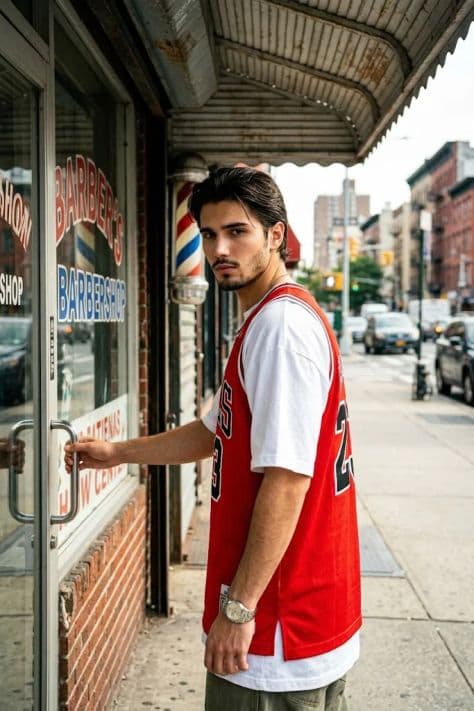

Early 2000s NYC Hip Hop Baggy Streetwear Urban Nostalgia
[STRICTLY FOLLOW THE REFERENCE IMAGE — use the uploaded photo as the exact identity authority for the first subject ("me"). Preserve the first subject's exact face, facial structure, skin tone, age, body proportions, hairstyle characteristics, and recognizable appearance exactly as shown. Do not redesign, beautify, age, reshape, or reinterpret the first subject's identity.]
Create a hyper-realistic early-2000s hip-hop streetwear editorial of the first subject in New York City, preserving the uploaded identity exactly.
Reimagine the scene as the moment he has just stepped out of a neighborhood barbershop rather than a static centered portrait. Position him on the sidewalk beneath a weathered storefront awning, body turned three-quarters toward the street while his head turns sharply back toward the camera with a serious, self-assured expression. One hand remains on the chrome barbershop door handle behind him, while the other hangs naturally near his waist, clearly revealing a metallic watch catching the sunlight. The posture should feel candid, confident, and unmistakably early-2000s rather than fashion-model stiff.
Style him in a red Bulls number 23 basketball jersey with black-and-white detailing layered over an oversized white T-shirt, paired with period-appropriate loose streetwear bottoms kept mostly outside the crop so the jersey and silhouette remain dominant. Keep the styling authentic to turn-of-the-millennium rap and streetwear editorials.
Use the barbershop environment as part of the storytelling: a classic striped barber pole, chrome window trim, faded signage shapes, brick storefronts, and a glimpse of passing cars farther down the block. Keep the background softly out of focus so the city reads as atmosphere rather than clutter.
Photograph from just below chest height with a slightly wide 40–50mm full-frame perspective, allowing the storefront lines and open doorway to frame the subject. Compose vertically with the first subject off-center rather than perfectly centered, giving space for the blue sky, awning, and city texture to create a more editorial layout.
Use bright natural afternoon sunlight with crisp highlights across the face, jersey mesh, watch, and chrome surfaces. Keep the sky saturated blue, the jersey richly red, and the white T-shirt bright but textured. Add subtle digital-era character: slightly increased saturation, restrained sharpening, modest contrast, and the clean punchy rendering associated with early-2000s music and streetwear magazines.
Emphasize exact facial fidelity, realistic skin texture, authentic jersey mesh, natural fabric folds, metallic accessory reflections, and believable urban detail. The final image should feel like a rediscovered 2000s New York hip-hop editorial — confident, raw, vivid, stylish, and photographically authentic. No watermark, no extra people dominating the frame, no distorted anatomy, no cartoon styling, no excessive modern color grading.
Authentic Y2K hip-hop streetwear editorial set on a New York brownstone stoop. Featuring an oversized vintage leather jacket, baggy raw-denim jeans, classic yellow work boots, and bold throwback urban attitude.