/
AI Business Strategy & Executive Management Prompts
Professional Female Physician Clinical Consultation Suite Shoot Business Prompts AI Prompt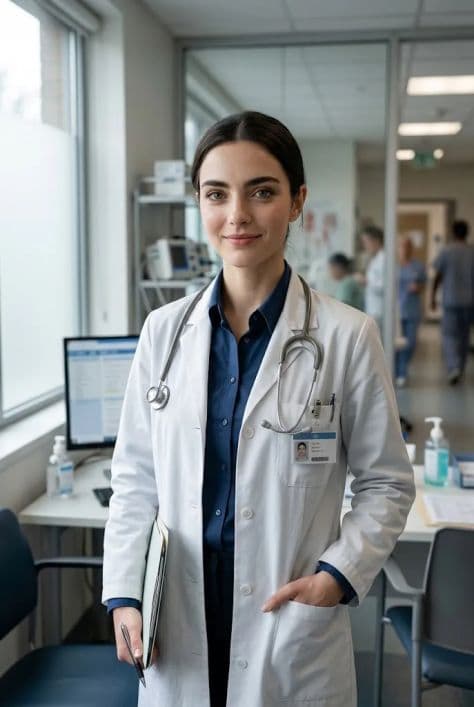

Professional Female Physician Clinical Consultation Suite Shoot
Create a hyper-realistic professional portrait of an adult female doctor captured in a quiet hospital consultation suite just after beginning her morning rounds. She stands beside a large frosted-glass window with soft daylight filtering into the room, creating a calm, clean, and reassuring medical atmosphere. Her expression is warm, confident, and approachable, with a natural direct gaze into the camera and a gentle smile that feels genuinely comforting. She wears a crisp white medical coat over a neat formal outfit, with a stethoscope resting naturally around her neck. One hand holds a slim patient file against her side while the other rests lightly in the coat pocket, giving her posture a composed and professional ease. Her appearance is polished, realistic, and dignified, with natural skin texture, subtle grooming, and believable medical professionalism. The setting should feel like a modern high-quality hospital space, with softly blurred background details such as a desk, medical monitor, glass partition, and minimal clinical furnishings. Keep the environment bright, refined, and authentic without clutter. Use soft cinematic lighting, realistic skin detail, accurate fabric texture, gentle depth of field, and a premium editorial-medical photography style. Photorealistic, highly detailed, cinematic healthcare portrait, natural anatomy, realistic stethoscope and coat details, 8K quality, soft clean color rendering, and a trustworthy professional mood. No text, watermark, logo, distorted anatomy, extra fingers, artificial skin, cartoon styling, or unrealistic hospital equipment.
Category:Business Prompts
Model:
0
Podcast Studio Interview Portrait in Cognac Leather Lounge Chair Business Prompts AI Prompt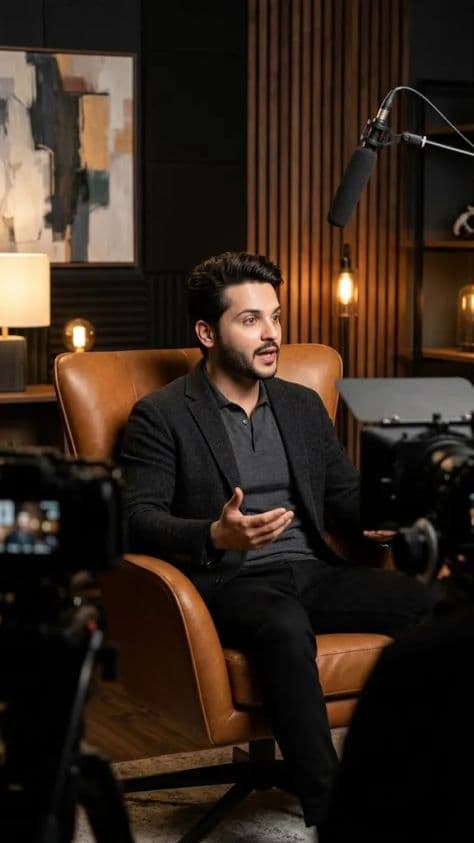

Podcast Studio Interview Portrait in Cognac Leather Lounge Chair
[STRICTLY FOLLOW THE REFERENCE IMAGE — use the uploaded photo as the exact identity authority for the first subject ("me"). Preserve the first subject's exact face, facial structure, skin tone, body proportions, hairstyle characteristics, and recognizable appearance exactly as shown. Do not redesign, beautify, reshape, or reinterpret the first subject's identity.] Create an ultra-photorealistic cinematic interview portrait of the first subject from the reference image inside an intimate premium podcast studio. Use the uploaded image only as the identity authority; rebuild the wardrobe, pose, lighting, composition, and environment from scratch. Capture a spontaneous moment immediately after the interviewer has asked a difficult question. The subject sits deep in a cognac leather lounge chair, body turned three-quarter toward an off-camera interviewer rather than facing straight forward. The torso leans subtly toward the conversation. One forearm rests naturally along the chair arm while the opposite hand is caught mid-explanation with an open, relaxed gesture near waist level. The mouth is slightly open mid-sentence, eyebrows subtly lifted, and the eyes remain attentive and engaged toward the interviewer rather than the camera. The posture should feel intelligent, animated, and completely unstaged. Dress the subject in a refined charcoal merino knit polo layered beneath a softly structured dark jacket, paired with tailored black trousers. Keep the materials matte and tactile so the clothing absorbs most of the studio light while the leather chair produces restrained highlights. Avoid copying clothing from the reference image. Build a sophisticated interview environment with dark acoustic wall panels, vertical walnut slats, one large abstract artwork, discreet shelving, and a warm practical floor lamp glowing deeper in the room. Include subtle cool blue-gray shadow tones to balance the amber practical lighting. Create a strong foreground layer: the blurred silhouette of a cinema camera and matte box occupies one lower corner, while a suspended broadcast microphone and boom arm enter softly from the opposite side. Both foreground elements should remain heavily defocused, naturally framing the subject and making the photograph feel like a genuine behind-the-scenes frame captured during a real interview production. Use a soft cinematic key light from camera-left, broad enough to preserve natural skin texture and facial structure. Add a restrained rim light along the hair and far shoulder for separation, while the warm practical lamp provides believable ambient glow. Keep reflections and catchlights physically consistent with the studio setup. Maintain detailed shadows rather than crushed blacks. Photograph from a slightly off-axis seated camera position using an 85mm-style cinematic perspective at approximately f/2.8. Frame from mid-torso upward, allowing part of the leather chair and foreground production equipment to remain visible. Keep the subject’s eyes, facial texture, and nearest clothing critically sharp while the microphone, cinema camera, artwork, and background lights fall gradually into creamy depth. Render natural skin pores, realistic facial hair if present in the reference, individual hair strands, knit fibers, leather grain, brushed metal equipment, walnut texture, and subtle atmospheric depth. Apply restrained film grain, medium-high contrast, smooth highlight roll-off, and a premium palette of deep brown, charcoal, warm tungsten gold, and soft cool shadows. Aesthetic: world-class documentary interview photography, premium streaming-series portraiture, intelligent conversational energy, authentic production atmosphere, cinematic realism. Negative prompt: CGI, 3D render, cartoon, anime, plastic skin, beauty retouching, identity drift, copied reference clothing, stiff interview pose, direct-to-camera presenter look, malformed hands, extra fingers, duplicated limbs, fake microphone geometry, unrealistic studio lighting, oversaturated colors, artificial bokeh, blurry face, watermark, logo, signature, random text.
Category:Business Prompts
Model:
0
Glass Skyscraper Commercial Plaza Executive Menswear Business Prompts AI Prompt

Glass Skyscraper Commercial Plaza Executive Menswear
Create an ultra-realistic full-body luxury menswear editorial outside a contemporary glass-and-steel commercial building. Capture the subject in a relaxed but sophisticated seated pose on a low polished architectural stone ledge beside a reflective glass facade. His torso leans slightly forward, shoulders relaxed, one leg extended naturally while the other is bent slightly closer to the ledge. His right hand lightly adjusts the edge of his black sunglasses while his left hand rests naturally near his thigh. His face turns subtly toward the camera with a calm, confident expression. Style him in a lightweight dark charcoal tailored overcoat worn completely open, layered over a crisp white shirt worn unbuttoned and a fitted premium white tank underneath. IMPORTANT OUTFIT IMPROVEMENT: Do NOT use cargo shorts, knee-length shorts, cropped trousers, or tactical bottoms. Instead, dress him in full-length charcoal-black tailored wide-leg trousers with a clean high-waisted structure, subtle front pleats, elegant straight fall, and a slight natural break over the shoes. The trousers should visually connect with the dark coat and create one continuous sophisticated silhouette from shoulder to ankle. Pair the trousers with refined navy low-profile leather sneakers with a clean minimal shape. Avoid chunky athletic footwear. The outfit should feel deliberately styled as modern luxury menswear: dark charcoal coat + white open shirt + white fitted tank + full-length charcoal tailored trousers + minimal navy sneakers. Give the overcoat a fluid premium drape with realistic movement around the seated body. Allow the open white shirt to fall naturally between the darker outer layers while the fitted tank keeps the center silhouette clean. Render the trousers with premium wool-blend texture, precise pleats, natural tension around the seated knees, realistic folds at the hips, and clean fabric fall toward the shoes. Preserve thick naturally styled dark hair with controlled volume and a neatly maintained short beard. Keep realistic skin texture with visible natural detail and no artificial smoothing. Position the subject near the corner of the reflective glass facade so the architecture creates strong vertical lines and clean geometric framing. The glass should show a subtle, physically accurate partial reflection of the subject, surrounding pavement, sky, and architecture. Keep the wider environment minimal and premium: clean stone paving, contemporary glass surfaces, restrained city architecture, and distant urban elements softened into elegant background blur. Use bright cinematic daylight softened by reflections from the building. Create clean highlights along the sunglasses, hair, coat edges, white shirt, and trouser folds while preserving dimensional shadows through the layered outfit. Photograph from a slightly low three-quarter full-body angle, keeping the entire outfit clearly visible from head to footwear. Use shallow depth of field, crisp focus on the subject, realistic fabric micro-texture, physically accurate reflections, subtle cinematic color grading, and premium commercial retouching. The final image should feel like a sophisticated international menswear campaign — tailored, metropolitan, expensive, mature, effortless, and professionally styled. Vertical 9:16 composition, high-resolution 4K finish. Negative prompt: shorts, cargo shorts, knee-length pants, cropped trousers, tactical pants, baggy cargo pockets, awkward coat-and-shorts combination, oversized chunky sneakers, rigid pose, unnatural coat draping, floating fabric, plastic skin, malformed hands, extra fingers, duplicated limbs, incorrect reflections, distorted architecture, CGI, 3D render, oversharpening, text, watermark, logo, signature, username, visible AI artifacts.
Category:Business Prompts
Model:
12
0
Commercial Airline Pilot Cockpit Preflight Flight Deck Portrait Business Prompts AI Prompt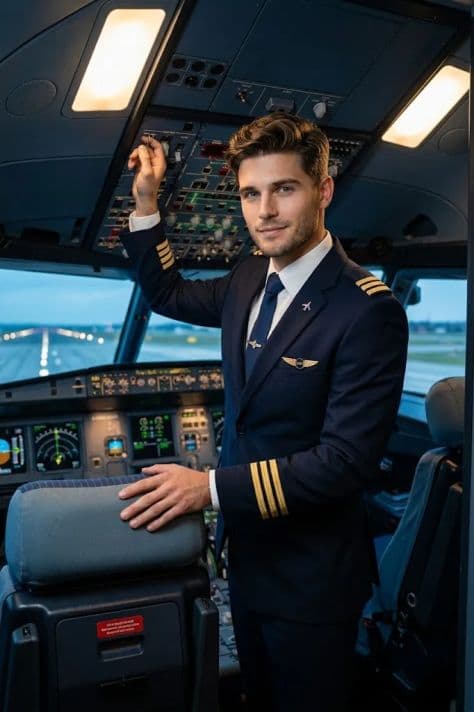

Commercial Airline Pilot Cockpit Preflight Flight Deck Portrait
Create a hyper-realistic cinematic editorial portrait of a commercial airline pilot during a quiet preflight moment inside a modern aircraft cockpit. Reimagine the concept as an active, intelligent moment rather than a conventional seated cockpit portrait. Position the subject standing slightly behind the captain’s seat, torso angled toward the illuminated overhead panel while his head turns back toward the camera with a calm, assured expression. One hand rests naturally on the top edge of the captain’s seat, while the other reaches toward a single overhead control as if completing a final systems check. The posture should feel authentic, composed, and purposeful rather than staged. Dress the subject in an immaculate commercial pilot uniform: tailored dark jacket, crisp white shirt, structured epaulettes, dark tie, and polished aviation detailing. Keep the styling precise, understated, and professional. Use the cockpit itself as the visual architecture of the photograph: glowing instrument displays, softly illuminated switches, metallic surfaces, control columns, and the windshield framing distant runway lights outside. Let the warm amber tones of the cockpit instrumentation contrast with cooler blue light entering through the windshield, creating a refined technological atmosphere. Photograph from a slightly low three-quarter angle from the center aisle behind the seats, allowing the cockpit geometry to create depth and strong leading lines toward the subject. Keep the subject slightly off-center so the illuminated panels, windshield, and empty co-pilot seat contribute to the composition. Use soft editorial lighting rather than harsh theatrical light: a warm practical glow from the instrument panel shaping the lower face and uniform, balanced by subtle cool ambient light from the windshield and a faint rim along the shoulder. Maintain realistic reflections on glass, metal, buttons, and displays. Emphasize realistic skin texture, crisp uniform fabric, accurate cockpit materials, sharp facial detail, natural hand placement, subtle instrument reflections, and cinematic depth of field. The final image should feel like a premium aviation magazine campaign — intelligent, composed, modern, authoritative, and photographically believable. No text, no watermark, no exaggerated glow, no distorted cockpit controls, no artificial skin smoothing, no unnecessary props.
Category:Business Prompts
Model:
1
0
Executive Boardroom Conference Table Contemplative Portrait Business Prompts AI Prompt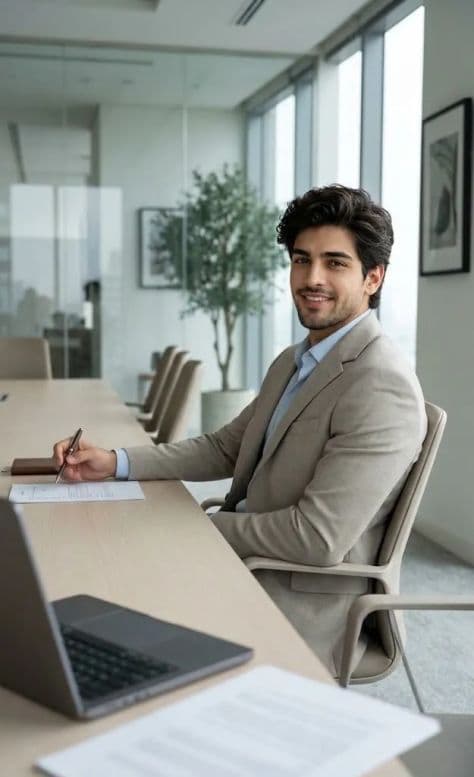

Executive Boardroom Conference Table Contemplative Portrait
[STRICTLY FOLLOW THE REFERENCE IMAGE — use the uploaded photo as the exact identity authority for the first subject ("me"). Preserve the first subject's exact face, facial structure, skin tone, age, body proportions, hairstyle characteristics, and recognizable appearance exactly as shown. Do not redesign, beautify, age, reshape, or reinterpret the first subject's identity.] Preserve the reference subject’s facial expression exactly. Create a refined, hyper-realistic executive portrait set immediately after a private meeting in a contemporary office. Instead of posing conventionally behind a desk, place the first subject slightly off-center beside the end of a long pale-wood conference table, seated sideways in a minimalist chair with the torso turned naturally toward the camera. One forearm rests comfortably across the chair arm while the other hand loosely holds a closed pen above a single document, suggesting a genuine pause between decisions rather than a staged business pose. Style the first subject in a softly structured stone-colored tailored jacket over a crisp pale blue shirt, elegant and understated. An open laptop and a small stack of neatly arranged documents occupy the near foreground but remain subtly out of focus, creating dimensional layering without competing with the face. Compose the portrait from a slightly elevated three-quarter camera position rather than a standard eye-level headshot. Frame from approximately mid-thigh upward, allowing the conference table to create a diagonal leading line toward the subject. Behind him, use floor-to-ceiling windows with soft overcast daylight, architectural glass partitions, a restrained indoor tree, and one minimal framed artwork, all rendered with realistic depth and gentle separation. Soft directional window light should shape the face naturally, with a faint reflected fill from the table and realistic catchlights. Maintain natural skin texture, accurate fabric detail, believable hand anatomy, subtle reflections in the glass, controlled depth of field, elegant neutral tones, crisp facial focus, and the visual polish of a high-end corporate editorial campaign. No exaggerated luxury styling, no artificial studio glow, no clutter, no watermark, no visible branding.
Category:Business Prompts
Model:
0
Contemporary Collaborative Office Professional Portrait Portrait AI Prompt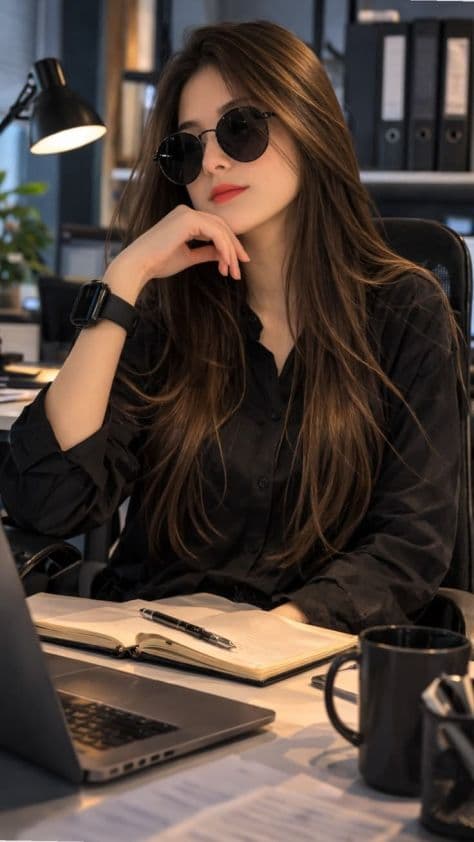

Contemporary Collaborative Office Professional Portrait
Use the uploaded image as the main visual reference. Recreate the same subject, same setting, same outfit, same objects, same framing, and same atmosphere. Do not invent a new face, new outfit, new background, or new camera angle. Follow the uploaded image closely and apply only the corrections below. Generate a photorealistic image of a young adult woman, early-to-mid 20s, in a seated waist-up office lifestyle portrait in a 9:16 tall vertical composition. The subject is centred with the face slightly above the middle of the frame. Body near-frontal with a mild turn toward camera-left. Shoulder line slightly tilted with the camera-right shoulder marginally higher. Head turned slightly toward camera-left with a mild tilt toward the subject's right. Chin resting lightly on the raised right hand. Right elbow resting on or near the desk or chair arm at camera-left, right hand raised beneath the chin with index finger resting under the chin, middle and ring fingers curving loosely downward, little finger slightly separated, back of the hand and knuckles visible, short-to-medium nails with natural pale nude finish, no ring. Left hand partially visible near the lower centre-right behind the open notebook, mostly concealed by the notebook, sleeve and desk edge. Crop from complete hairstyle at the top with limited headroom to approximately the lower waist at the bottom behind the desk. Keep everything close to the original uploaded image. Preserve the same facial identity: oval face shape with a gently tapered lower third, smooth and moderately defined jawline, narrow chin with a softly rounded point, moderately prominent cheekbones, straight narrow-to-medium nose with a medium-high bridge partly hidden by the glasses bridge, compact softly-rounded nose tip, narrow-to-moderate nostril width, medium-length philtrum. Skin tone is light beige with neutral-to-warm peach undertones rendered at retouching level 9 out of 10: strong smoothing across the forehead, cheeks, nose, jaw and chin with almost no visible pores or fine lines, slight natural texture remaining only around the lips, nostrils and hairline, gentle controlled sheen on the cheekbones and nose bridge — not flat plastic, not raw skin. Apply a full polished makeup look: full even complexion coverage, subtle warm peach blush at approximately hue 15°, saturation 35%, brightness 82% across the upper cheeks, coral-red lips at approximately hue 8°, saturation 75%, brightness 65% with smooth satin-matte finish, clearly defined edges and defined cupid's bow, lower lip slightly fuller than the upper, corners neutral with a very slight upward lift, mouth closed with no visible teeth. Eyebrows dark brown, softly angled, medium thickness, neatly groomed and softly filled where visible above the sunglasses frames. Eye makeup concealed behind the sunglasses. Expression as muscle map: orbicularis oris gently closed and relaxed, mentalis neutral, jaw relaxed, frontalis flat, corrugator absent, zygomatic region composed and neutral. Contemplative composed appearance with no broad smile or frown. Hair is rich medium-to-dark chestnut brown with warm caramel-brown highlight strands at approximately base hue 28°, saturation 45%, brightness 38%, with highlight strands at approximately hue 32°, saturation 50%, brightness 58%. Rendered as long smooth silky fiber strands with moderately glossy surface finish, moderate-to-high strand separation, gentle natural bends along the length. Length extends below the chest toward the waist. Slightly off-centre parting. Full volume around the crown and both shoulders with heavier coverage falling across camera-right. A few fine flyaway strands crossing the shirt and face area. Warm caramel-toned specular reflections from the key light emphasize individual strand surfaces along the upper crown and camera-right fall. Strand behavior: smooth directional flow downward from the crown with gentle wave at mid-length and loose ends. Both eyes are completely and fully concealed behind oversized round sunglasses with a thin glossy black or dark gunmetal frame and thin dark metal bridge. Lens color opaque black to very dark smoke-grey with extremely low transparency — eyes fully hidden with no visible pupils, no eyelids, no natural catchlights under any circumstances. Small soft rectangular and circular office-light reflections appear on both lenses. Head turned slightly toward camera-left. Keep the same clothing exactly: relaxed and slightly loose full-length black button-front blouse in deep neutral black at approximately hue 210°, saturation 5%, brightness 7%, smooth satin-like or fine synthetic woven fabric with subtle surface sheen. Soft pointed shirt collar worn open at the upper neck creating a shallow open V from unfastened top buttons. Small black front buttons with remaining visible buttons fastened below the open collar. Right sleeve pushed or gathered to the forearm exposing the wrist and lower arm. Left sleeve extending close to the wrist partly concealed by the desk edge. Soft unstructured cuffs with gathered folds. Numerous soft fold wrinkles around the elbows, waist, shoulders and lower sleeves. No pattern, no print, no logo. No undershirt visible. No jacket. No necklace visible. Accessories: black rectangular smartwatch on the subject's right wrist with rounded corners, dark inactive screen, wide matte black silicone strap, worn above the exposed forearm. No earrings visible as both ears are covered by hair. No necklace, no rings on the visible right hand, no bracelets, no hat, no bag, no held objects. No tattoos or visible marks. Foreground desk objects exactly as in the uploaded image: open laptop at bottom-left with keyboard and side ports visible; open lined notebook directly in front of the subject; black-and-silver pen resting diagonally across the open notebook pages; large black ceramic mug at bottom-right; black pen or stationery holder beside the mug; white printed or blank paper sheets scattered across the desk surface. All foreground objects rendered with moderate sharpness consistent with shallow depth of field falling off from the subject. Background follows the uploaded image across three depth layers. Layer one foreground: desk surface with all objects described above. Layer two middle: seated subject in a black mesh-backed office chair, only portions of the chair back visible at the sides. Layer three background: modern indoor office with a black adjustable desk lamp at upper-left with warm illuminated interior, small green plant blurred behind the lamp, dark office shelving behind the subject, several black ring binders positioned vertically at upper-right, additional blurred office furniture. Background rendered with moderate-to-strong blur with warm illuminated accents from the desk lamp. No other people. No readable text. No watermark or graphic overlay. Background brightness similar to or slightly darker than the subject with warm amber-gold accent from the lamp interior. Lighting: primary key light from approximately 10 o'clock camera-left and front, broad and diffused quality at approximately 4,200 to 4,800 K warm-neutral, illuminating the forehead, nose, cheekbones and lips evenly. Camera-right side retains gentle shadow without becoming dark. Shadow transition very smooth. Fill level moderate-to-high. Ambient cooler blue-grey office light from the background and camera-right at approximately 5,500 to 6,500 K. Warm edge highlight rim traces the hair along camera-right and upper crown producing caramel-toned reflections on the hair strand surfaces. No natural eye catchlights visible through the sunglasses. Small soft rectangular and circular reflections on the sunglasses lenses only. Key highlight zones: forehead centre, nose bridge, cheekbones, chin, lips — all broad and smooth consistent with large softbox or window diffusion. Shadow zones: under the jaw, camera-right cheek, neck, lower right of the face. Color grade: warm cinematic office grade with cool blue-grey shadows. Dominant palette: deep black, rich chestnut brown hair, warm light beige skin, amber-gold lamp accent, cool blue-grey background shadows. Saturation moderate and controlled. Skin highlights warm peach-cream at approximately hue 25°, saturation 18%, brightness 90%. Shadows cool blue-grey at approximately hue 210°, saturation 15%, brightness 20%. Split tone: highlights biased warm amber, shadows biased cool blue-grey. Strong contrast from black clothing and accessories against light skin and warm hair highlights. Overall color temperature feel approximately 4,500 K on the subject with cooler ambient fill from the background. Camera: 85mm equivalent focal length, aperture f/1.8 to f/2.2, shallow depth of field with focus plane locked on the subject's face and upper torso, foreground desk objects rendered with slight front-focus softening, background office rendered as soft blur. Grain level 1 out of 10. Retouching level 9 out of 10. Aspect ratio 9:16. Post-processing style: warm cinematic office editorial with high beauty retouching, warm-cool color contrast, strong black-and-skin tonal separation, and polished luxury workplace lifestyle aesthetic. Render at maximum photorealistic quality. Follow the uploaded image as the primary reference. Preserve exact facial proportions, chin-on-hand pose, outfit, desk objects in exact positions, office background elements, lighting direction, color temperature and portrait framing. Do not change her identity. Do not make her look like a different person. Do not change the black button-front blouse. Do not change the office setting. Do not change the foreground desk objects. Do not add extra people. Do not add extra objects. No watermark. No CGI look. No plastic skin. No anatomical errors. No beauty filter overdrive. No motion blur. No lens distortion. Ultra high resolution. Sharp facial and hair detail on subject. Natural satin-matte skin texture at retouching level 9. Photorealistic only.
Categories:Macro PhotographyProduct PhotographyFood PhotographyBusiness PromptsPortraitPhoto PromptsMidjourney PromptsFlux Prompts
Model:
14
0
Corporate Glass Tower Penthouse Twilight Executive Portrait Business Prompts AI Prompt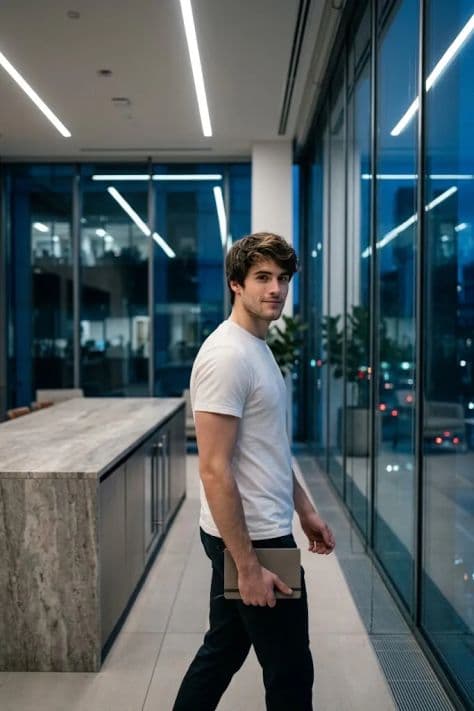
Corporate Glass Tower Penthouse Twilight Executive Portrait
Create a hyper-realistic cinematic lifestyle portrait of a man inside a refined contemporary office tower after working hours, preserving the core mood of quiet confidence, natural night ambience, and sophisticated modern architecture. Reimagine the photograph as an observed transitional moment rather than a conventional subject leaning against a counter. Place him beside a floor-to-ceiling glass wall at the edge of an elevated office lounge, captured just as he pauses while walking through the space. His body remains angled toward the corridor, but his head turns slightly back toward the camera with a restrained, relaxed smile. One hand loosely carries a slim closed notebook at thigh level while the other hangs naturally beside the body, keeping the gesture effortless and believable. Dress him in a perfectly fitted plain white T-shirt with clean lines and natural cotton texture, paired with understated dark trousers. Keep the styling minimal and contemporary, allowing the architecture, light, and body language to carry the sophistication. Use the office environment as an active part of the composition: an elongated stone-and-metal work island crossing the foreground, floor-to-ceiling windows extending into the distance, subtle indoor greenery near the glass, and narrow linear ceiling lights creating strong perspective lines overhead. Beyond the windows, reveal a restrained nighttime cityscape with scattered office lights, distant traffic, and softly illuminated vegetation on a terrace below. Photograph from a slightly elevated three-quarter position using a 50mm full-frame perspective, with the foreground counter softly entering one side of the frame and leading toward the subject. Position him away from the center, allowing the window grid and ceiling lights to create depth and controlled negative space. Let cool natural night illumination from the windows act as the dominant ambient source, supplemented only by soft architectural lighting within the office. Add a faint warm reflected glow from interior surfaces to shape the face and white T-shirt without making the scene look artificially lit. Maintain realistic reflections in the glass and subtle highlights along the counter and floor. Use shallow but believable depth of field, keeping the subject crisp while the city lights, ceiling fixtures, and distant office elements dissolve gradually into creamy professional bokeh. Emphasize natural skin texture, realistic cotton fibers, glass reflections, stone surfaces, architectural precision, and soft tonal transitions. The final image should feel like a premium corporate-lifestyle editorial photographed late at night — calm, intelligent, modern, approachable, and quietly aspirational rather than staged. No text, no watermark, no clutter, no exaggerated blue lighting, no artificial skin smoothing, no distorted anatomy.
Category:Business Prompts
Model:
1
0
Financial Center Glass Plaza Golden Hour Business Tailoring Business Prompts AI Prompt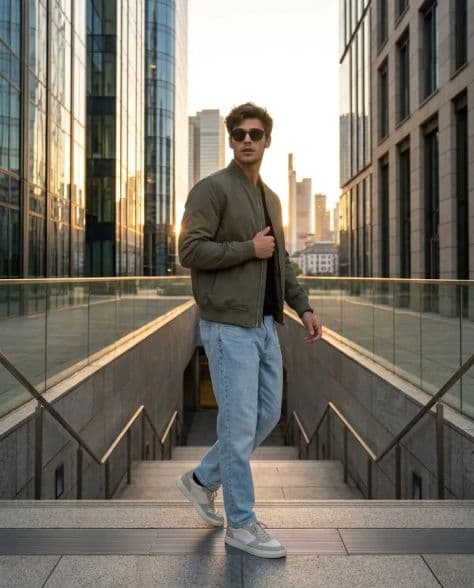
Financial Center Glass Plaza Golden Hour Business Tailoring
[STRICTLY FOLLOW THE REFERENCE IMAGE — use the uploaded photo as the exact identity authority for the first subject ("me"). Preserve the first subject's exact face, facial structure, skin tone, age, body proportions, hairstyle characteristics, and recognizable appearance exactly as shown. Do not redesign, beautify, age, reshape, or reinterpret the first subject's identity.] Create a hyper-realistic 4:5 cinematic menswear editorial of the first subject during golden hour in a modern urban business district, preserving the uploaded identity exactly. Ignore any text, captions, watermarks, or graphic overlays visible in the source image. Reimagine the concept as a transitional city moment rather than a conventional seated or hands-in-pockets portrait. Place the first subject on an elevated pedestrian terrace between glass towers, captured just as he reaches the top of a broad architectural stairway. His body remains angled along the direction of movement while his head turns slightly toward the glowing skyline, creating a composed, aspirational presence. Style him in a refined olive-green bomber jacket, a minimal dark inner layer, light-wash relaxed jeans, clean contemporary sneakers, and dark sunglasses. Let a light evening breeze catch the lower edge of the bomber naturally. One hand rests briefly against the front of the jacket near the zipper as if settling it after walking, while the other arm hangs loosely beside the body, keeping the gesture effortless and believable. Use the architecture as part of the visual storytelling: towering reflective façades, clean stone surfaces, transparent balustrades, and a distant skyline layered behind the subject. Position the setting sun between two buildings rather than directly behind the head, allowing warm gold reflections to travel across the glass towers and the terrace floor. Photograph from a gentle low three-quarter angle using a 35mm full-frame perspective, framing from approximately the knees upward while preserving enough environment to show scale. Place the subject off-center, with diagonal stair lines and building reflections guiding the eye through the composition. Use natural golden-hour light as the primary source. Warm amber light should skim the face, sunglasses, bomber jacket, and hairline, while cooler reflected sky light fills the shadow side. Let the sunglasses capture a believable fragment of the illuminated skyline and sunset without obscuring the face completely. Keep the skyline recognizable but softly separated at approximately f/2.8, balancing environmental clarity with premium portrait depth. Emphasize exact facial fidelity, realistic skin texture, natural fabric drape, glass reflections, subtle wind movement, clean architectural detail, and sophisticated warm-versus-cool color contrast. The final image should feel like a high-end urban lifestyle campaign — confident, modern, aspirational, cinematic, and naturally luxurious rather than posed. No text, no watermark, no signage dominating the frame, no distorted anatomy, no artificial skin smoothing, no excessive orange grading.
Category:Business Prompts
Model:
0
Sophisticated Executive Boardroom Private Office Portrait Business Prompts AI Prompt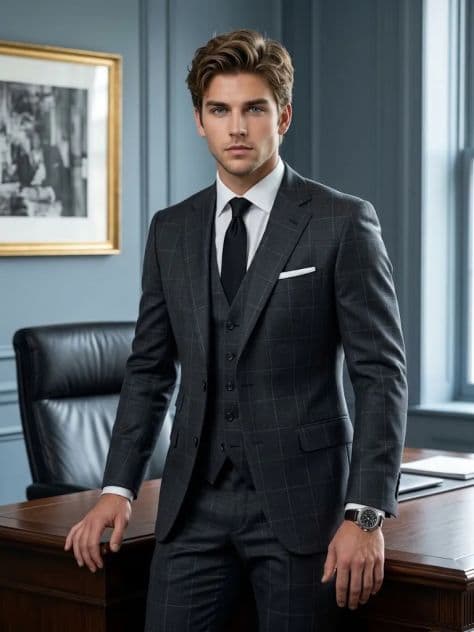
Sophisticated Executive Boardroom Private Office Portrait
[STRICTLY FOLLOW THE REFERENCE IMAGE — use the uploaded photo as the exact identity authority for the first subject ("me"). Preserve the first subject's exact face, facial structure, skin tone, age, body proportions, hairstyle characteristics, and recognizable appearance exactly as shown. Do not redesign, beautify, age, reshape, or reinterpret the first subject's identity.] Create a hyper-realistic executive editorial portrait of the first subject inside a sophisticated private office, preserving the uploaded identity exactly. Keep the original pose and hand gesture as a locked requirement: the first subject stands firmly behind the desk with both hands resting naturally on the tabletop, maintaining the same serious gaze and composed posture as the reference. Preserve the visible hand tattoos, elegant wristwatch, and discreet ring exactly in placement and character. Dress him in a perfectly tailored dark charcoal three-piece suit with a subtle windowpane check, a crisp white shirt, a classic black tie, and a clean white pocket square. Keep the tailoring refined, masculine, and understated, with realistic fabric texture and natural drape. Reimagine the office as a more cinematic executive setting rather than a generic corporate room. Use blue-gray paneled walls, a large black leather executive chair positioned behind him, and a substantial dark wood desk with restrained brass detailing. Behind the subject, place a single classical black-and-white artwork inside an aged gold frame, slightly off-center so it contributes to the composition rather than sitting directly behind the head. On the desk, include a closed black leather portfolio and one partially visible document, arranged sparingly to preserve a sense of authority and control. Avoid clutter. Photograph from a slightly low three-quarter camera position rather than straight-on, allowing the desk edge to create a strong foreground line while the subject remains dominant. Frame from approximately mid-thigh upward so the hands, accessories, suit structure, and expression all remain clearly visible. Use soft natural window light from one side as the main source, shaping the face, hair, beard, lapels, and hands with realistic depth. Add a very subtle warm practical glow from the room to separate the subject from the cool blue-gray background. Keep shadow transitions soft and controlled, with realistic highlights on the watch, ring, desk surface, and gold frame. Emphasize exact facial fidelity, natural skin texture, beard detail, neatly arranged hair, visible tattoo texture, fine suit weave, polished leather, wood grain, and restrained metallic reflections. The final image should feel like a premium executive campaign or a still from a sophisticated corporate drama — powerful, intelligent, disciplined, and photographically believable. No text, no watermark, no clutter, no distorted anatomy, no artificial skin smoothing.
Category:Business Prompts
Model:
0
Executive Business Portrait in High-Rise Modern Office Suite Business Prompts AI Prompt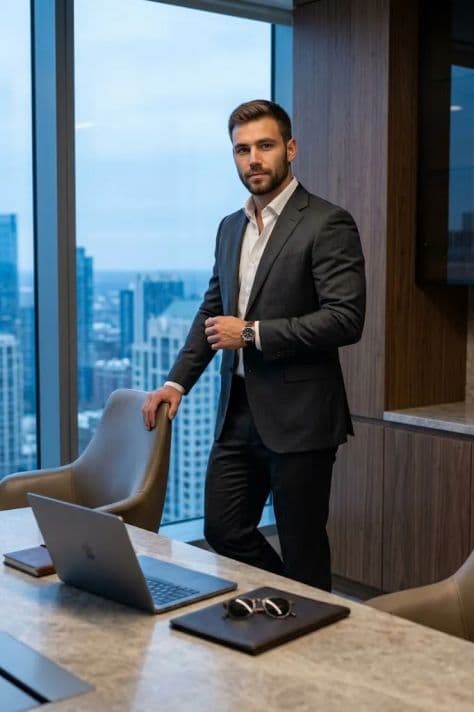
Executive Business Portrait in High-Rise Modern Office Suite
[STRICTLY FOLLOW THE REFERENCE IMAGE — use the uploaded photo as the exact identity authority for the first subject ("me"). Preserve the first subject's exact face, facial structure, skin tone, age, body proportions, hairstyle characteristics, and recognizable appearance exactly as shown. Do not redesign, beautify, age, reshape, or reinterpret the first subject's identity.] Create an ultra-realistic cinematic executive portrait of the first subject inside a high-rise private office just after a major business meeting, preserving the uploaded identity exactly. Ignore any text, captions, watermarks, usernames, or graphic overlays visible in the source image. Do not recreate the predictable seated-behind-a-desk businessman portrait. Instead, capture the first subject standing beside a floor-to-ceiling window at the far end of a refined executive office, moments after leaving the conference table. His body is angled toward the city while his head turns back toward the camera with a calm, self-assured expression that feels observant rather than posed. Give the body language quiet authority. One hand rests lightly on the back of a sculptural leather conference chair he has just moved away from, while the other adjusts the cuff near a refined metal wristwatch. His stance is relaxed but deliberate, with one foot slightly forward as if he has paused while walking toward the window. Dress him in a sharply tailored charcoal suit with a crisp open-collar white shirt, no tie, clean dark leather shoes, and restrained luxury detailing. Keep the tailoring precise and contemporary, with natural fabric tension at the elbows and shoulders rather than an unnaturally perfect costume fit. Instead of sunglasses indoors, place a pair of dark premium sunglasses folded on the edge of the conference table, catching a controlled reflection from the window light. This keeps the sophistication of the original concept while allowing the subject’s eyes and facial identity to remain fully visible. Design the office as a sophisticated architectural environment rather than a generic luxury set: smoked glass partitions, warm walnut cabinetry, integrated shelving with a few carefully selected books and sculptural objects, brushed metal detailing, soft linear ceiling illumination, and a long stone conference table extending toward the foreground. Use the conference table as a storytelling layer. Place an open slim laptop, a closed leather folio, a premium pen, and a smartphone near an empty chair, suggesting a meeting has just concluded. Keep every object restrained and functional rather than arranged as status props. Photograph from the opposite end of the conference table using a 50–65mm full-frame lens, allowing the table to form a strong leading line toward the first subject. Shoot slightly below eye level so the architecture feels expansive without exaggerating body proportions. Frame from approximately the knees upward, leaving enough negative space around the window and skyline for a premium editorial composition. Set the scene during blue hour immediately after sunset. Cool city light enters through the glazing while warm interior practical lighting shapes the walnut surfaces and one side of the suit. Let the face remain naturally illuminated by a broad, soft reflection from the window rather than a visible studio source. Allow the glass wall beside the subject to create a faint secondary reflection of his silhouette, adding depth and visual sophistication without duplicating the face unnaturally. City lights outside should appear as controlled, soft bokeh rather than an exaggerated neon skyline. Emphasize exact facial fidelity, realistic skin texture, clean tailoring, brushed metal, leather grain, stone reflections, glass depth, subtle watch highlights, and naturally layered office lighting. Keep the color grade restrained: graphite, warm walnut, soft champagne light, and cool blue-gray exterior tones. The final image should feel like a premium global finance or luxury leadership campaign — intelligent, composed, modern, understated, and expensive without relying on obvious wealth symbols. No text, no watermark, no exaggerated luxury props, no artificial skin smoothing, no distorted hands, no generic crossed-leg CEO pose, no fake skyline, no excessive HDR, no theatrical studio glow.
Category:Business Prompts
Model:
0
Modern Corporate Executive Portrait by Glass Facade Portrait AI Prompt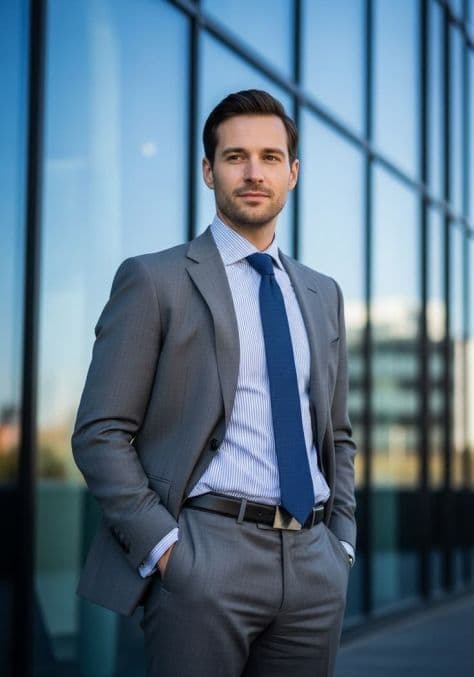
Modern Corporate Executive Portrait by Glass Facade
Use the uploaded image as the main visual reference. Recreate the same subject, same setting, same outfit, same objects, same framing, and same atmosphere. Do not invent a new face, new outfit, new background, or new camera angle. Follow the uploaded image closely and apply only the corrections below. Generate a photorealistic image of a single adult male subject, early 30s to late 30s, in a vertical portrait composition approximately 7:10 in aspect ratio. The subject is framed from the upper-to-mid thighs to just above the top of the hair, positioned slightly right of center with the head near the upper-central portion of the frame. Camera height is at chest-to-eye level with mild portrait-lens compression and no strong perspective distortion. Keep everything close to the original uploaded image. Preserve the same facial identity precisely. Face shape is oval-to-rectangular. Jawline is defined and moderately angular. Chin is medium-width with a softly squared lower contour. Cheekbones are moderately prominent. Nose is straight and proportionate, medium-narrow bridge, moderately high, rounded compact tip, medium nostril width, medium philtrum length. Lips have a slightly fuller lower lip, subtle cupid's bow on the upper lip, corners nearly level with very slight upward tension, natural muted rose-brown color, smooth matte texture with zero gloss. Mouth is fully closed. Lip corners lift by one to two millimeters only. Jaw remains relaxed. Brows are neutral with zero corrugator engagement. Eyes remain focused and open without squinting. Orbicularis oculi carries no tension. The overall facial muscle map reads as composed, attentive and calm with minimal smile engagement. Render the skin as a light beige complexion with neutral-to-warm peach undertones. Lit zones — camera-left forehead, nose bridge, upper cheeks — carry a warm neutral tone at approximately hue 25°, saturation 20%, brightness 82%. Shadow zones — camera-right cheek, beneath the jaw, lower nose flanks — shift to approximately hue 22°, saturation 16%, brightness 60%. Skin finish is smooth matte-satin with limited natural sheen on the forehead center, nose bridge and upper cheekbones only. Retouching level is 6 out of 10: moderate smoothing across the forehead, cheeks and under-eye area, fine pores and minor lines reduced but not completely erased, natural beard stubble texture retained visibly around the jaw, chin and upper lip, mild skin texture present near the nose and lower cheeks, small specular highlights remaining on the forehead, nose bridge and cheekbones. The result must read as commercially retouched without becoming poreless or plastic. Both eyes are fully open and unobstructed — no glasses, no hair covering. Eyes are almond-shaped, medium-sized, evenly spaced. Iris color is medium brown to hazel-brown. Pupils are medium-sized. Defined upper eyelid crease visible. Small soft diffused catchlights present near the upper portions of both irises. Natural short-to-medium lashes, unenhanced. Gaze is directed slightly off-frame toward camera-right at a middle-distance point — not into the camera lens. Gaze follows the slight camera-right turn of the head. No direct eye contact. Calm, focused quality with no intensity or tension. Eyebrows are dark brown, medium thickness, mostly straight with a subtle outer arch, neatly groomed but not sharply sculpted, positioned at a moderate distance above the eyes, no laminated or cosmetically filled appearance. Hair is dark brown with slightly warmer brown highlights. Short-to-medium length on top. Shorter tapered sides. Side-parted toward the subject's left. Front and top sections combed upward and swept backward. Smooth controlled texture with mild natural sheen. Moderate volume at the front and crown. No flyaways, no frizz. Specular highlight sits as a narrow controlled band along the parted crown. Facial hair is short dark-brown stubble, evenly distributed across the jaw, chin, upper lip and lower cheeks, slightly denser along the jaw and chin, neatly maintained without a sharply drawn cheek line, moustache connecting subtly with the beard. No groomed boxed-beard edges — natural stubble boundary only. Render no cosmetic makeup of any kind. No eyeliner, no eyeshadow, no blush, no lipstick, no visible foundation. Complexion evenness comes from lighting and retouching only. Brows are natural. Lip color is the subject's own muted rose-brown. Keep the exact clothing. Outer garment is a tailored single-breasted suit jacket in medium charcoal grey with a subtle cool-blue undertone at approximately hue 210°, saturation 8%, brightness 45%. Fine woven suiting fabric, likely wool or wool-blend, with a smooth surface and faint micro-weave texture visible. Fit is structured and tailored through the shoulders, chest and waist. Medium-width notched lapels. Two-button front, lower jacket body open or loosely positioned, one dark button clearly visible. Full-length sleeves with dark cuff buttons visible on the right sleeve. Flap hip pockets and a chest welt pocket. No pocket square. No prominent stripe or check — very subtle tonal weave only. No logo. Light tension folds appear around the elbows, waist, shoulders and pocketed hands. Middle garment is a long-sleeve dress shirt in white to very pale blue base with fine vertical blue pinstripes running the full length. Smooth woven cotton. Tailored close fit. Structured point or semi-spread collar. Small front buttons mostly hidden by the tie. Full-length sleeves with button cuffs extending slightly beyond the jacket sleeves. Light compression folds around the waist and lower torso. No logo. Neckwear is a formal necktie in medium-to-deep royal blue at approximately hue 220°, saturation 72%, brightness 48%. Textured woven silk or silk-blend. Very fine tonal surface texture with no visible print. Compact four-in-hand or half-Windsor knot, centered beneath the collar. Tie extends to approximately the waistband and belt buckle. No tie clip. Lower garment is matching tailored charcoal grey suit trousers identical in color and fabric to the jacket. Tailored through the waist, hips and upper thighs. Mid-rise. Flat-front construction, no pleats. Slanted front pockets holding both hands. Front closure concealed beneath the belt and tie. No visible pattern or logo. Natural tension folds around the hip creases, pockets and upper thighs. Belt is a black leather strap, smooth polished finish, silver-toned geometric buckle, belt loops visible around the waistband. Accessories must be exact. Partially visible silver-toned watch on the subject's left wrist, only a small portion visible near the jacket and shirt cuff edge — dial and band construction mostly concealed. No rings visible on either hand. No earrings. No necklace. No bracelet. No tattoos. No visible marks or scars. Both arms descend naturally along the sides with elbows bent to place both hands inside the front trouser pockets. No arm crosses the torso. Subject's right hand is inside the trouser pocket on camera-left: wrist and a narrow portion of the hand visible beneath the jacket cuff, fingers and nails fully concealed, right forearm angles downward toward the pocket, no ring or bracelet visible. Subject's left hand is inside the trouser pocket on camera-right: wrist partially visible between the shirt cuff and pocket opening, fingers and nails concealed, left elbow bends outward slightly, partially visible silver watch edge near this wrist. Both hands remain fully inside the pockets — do not show exposed fingers or palms. Head turns slightly toward the subject's left, which is camera-right. Head tilt is nearly level with a subtle upward chin lift. Torso has a three-quarter orientation turned slightly toward camera-left. Head and torso relationship must be preserved: torso angled slightly camera-left while head redirects toward camera-right. Posture is upright with chest open, shoulders lowered and back straight. Weight appears shifted slightly onto the subject's right leg. Stance is moderately narrow. Background follows the uploaded image exactly across four depth layers. Foreground layer: dark walkway or building base section visible along the lower-right side. Subject layer: man stands close to the camera with sharp facial and clothing detail. Midground layer: large blue-tinted glass panels occupying most of the background, thick black vertical and diagonal structural mullion frames creating a geometric grid pattern, building façade receding toward camera-right. Rear layer: soft reflections of sky, distant buildings and landscape visible through the glass — pale cream and green tones near the horizon — all strongly defocused. Background brightness is lighter and cooler than the suit. Background blur is strong with structural lines remaining recognizable but no sharp detail. No other people. No readable text. No signage. No graphic overlays. No watermarks. Lighting setup: soft diffused broad daylight from approximately 10 o'clock camera-left and front. Low-contrast illumination with no hard shadow edges. Camera-left side of the forehead, cheek and nose receives slightly stronger illumination. Camera-right side falls into gentle graduated shading. Shadow transitions are soft and gradual with no harsh cast shadow under the nose or jaw. Body illumination: soft highlights define both shoulders and lapels, shirt remains bright without losing pinstripe detail, grey suit retains visible weave and fold structure throughout shadow zones. Fill level is moderate-to-high due to reflected light from the glass façade behind — shadows remain fully readable without collapsing toward black. Subtle cool edge separation along the subject's left shoulder and camera-right sleeve from the glass ambient bounce. Small diffused catchlights in both eyes. Key light color temperature approximately 5,200 to 5,600 K neutral daylight. Ambient light temperature is cool blue from the reflective glass panels, approximately 6,000 to 6,500 K. Color grade: dominant palette is medium charcoal grey, royal blue, pale blue-white, cool glass blue, black and silver. Saturation is moderate and controlled. Highlights carry a neutral to slightly cool tone. Shadows carry cool grey and blue-charcoal tones. Blue tie and pinstripe shirt contrast clearly against the charcoal suit. Warm skin and structured grey clothing stand out against the luminous cool blue glass façade. Split toning: shadows lean toward hue 210° cool blue-grey, highlights lean toward hue 28° subtle warm skin. Skin is preserved slightly warmer than the surrounding cool environment. Overall color temperature feel approximately 4,700 to 5,200 K with cool ambient push from the glass. Camera: focal length approximately 85mm equivalent. Aperture approximately f/2.0 to f/2.5. Depth of field shallow with sharp focus on the subject's face, hair, tie and suit, background strongly blurred but structurally legible. Grain level 1 out of 10. Retouching level 6 out of 10. Post-processing style is cool commercial corporate portrait with enhanced blues and blue-greys, skin preserved warmer than environment, deepened blacks, controlled mid-tone contrast and soft background defocus. Render at maximum photorealistic quality. Preserve exact facial proportions, head turn direction, hands-in-pockets pose, outfit, lighting, color temperature, glass façade environment and portrait framing. Do not change his identity. Do not make him look like a different person. Do not change the charcoal grey suit. Do not change the royal blue tie. Do not change the pinstripe shirt. Do not redirect the gaze toward the camera. Do not expose the concealed hands or fingers. Do not add cosmetic makeup. No extra people. No extra objects. No text. No watermark. No CGI look. No plastic skin. No anatomical errors. No beauty filter. No motion blur. No lens distortion. Ultra high resolution. Sharp facial detail on subject. Natural retouched skin with visible stubble texture preserved. Photorealistic only.
Categories:Macro PhotographyProduct PhotographyFood PhotographyBusiness PromptsPortraitPhoto PromptsMidjourney PromptsFlux Prompts
Model:
16
0
已全部看完
Accelerate executive decision-making and business planning with our strategic business AI prompts. Built for startup founders, venture capitalists, management consultants, and corporate leaders seeking clarity and leverage.
Execute critical business initiatives: conduct comprehensive Porter's Five Forces and SWOT analyses, draft compelling 10-slide investor pitch decks, structure quarterly company OKRs, model unit economics, and formulate go-to-market (GTM) rollout strategies.
Tackle complex commercial negotiations and corporate strategy with frameworks derived from Harvard Business School and leading tier-1 consulting firms.