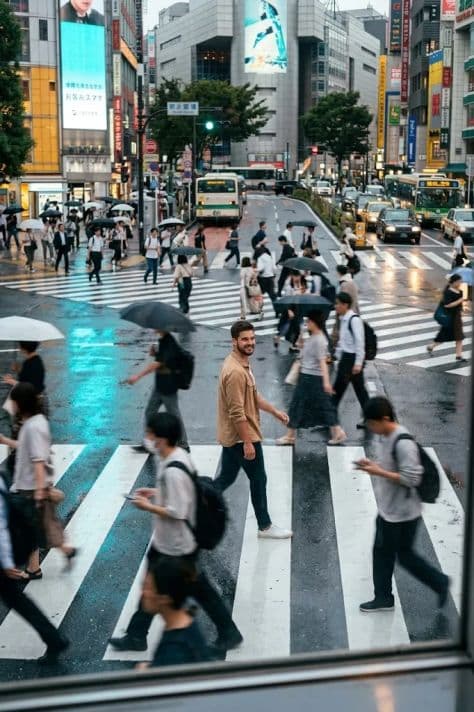

Tokyo Shibuya Crossing Street Fashion Environmental Portrait
[STRICTLY FOLLOW THE REFERENCE IMAGE — use the uploaded photo as the exact identity authority for the first subject ("me"). Preserve the first subject's exact face, facial structure, skin tone, age, body proportions, hairstyle characteristics, and recognizable appearance exactly as shown. Do not redesign, beautify, age, reshape, or reinterpret the first subject's identity.]
Create an ultra-realistic cinematic environmental portrait of the first subject at Shibuya Crossing, preserving the uploaded identity exactly.
Do not recreate the ordinary “person standing in the middle of the crossing” composition. Instead, capture the first subject during the final seconds of the pedestrian signal, moving diagonally across the intersection while hundreds of people flow in different directions around him. He has just slowed for a fraction of a second and turns his head toward the camera with a calm, self-assured expression while his body remains oriented with the movement of the crossing.
Keep the posture natural and unstaged: one foot planted mid-stride, the trailing leg still in motion, shoulders relaxed, one arm swinging naturally while the other briefly adjusts the edge of his outer layer near the waist. Preserve his natural body proportions exactly from the reference.
Photograph from a slightly elevated second-floor viewpoint through a clean glass frontage overlooking the crossing, using a 50mm full-frame perspective. Let a faint reflection from the glass overlap one edge of the frame, creating visual depth without obscuring the subject. Position the first subject off-center rather than directly in the middle.
Use the bold white zebra-crossing geometry as the main compositional structure. Surround him with pedestrians rendered with restrained directional motion blur while the first subject remains tack-sharp, creating a powerful contrast between stillness and urban movement.
Set the scene immediately after a brief rain shower during late afternoon. The asphalt is dark and reflective, catching fragmented cyan, amber, red, and white light from large digital façades and street signals. Keep the sky visible between the buildings with soft blue-gray clouds and a narrow break of warm daylight near the horizon.
Build the background from dense Tokyo architecture, elevated signage, glass façades, traffic signals, distant buses, taxis, and layered pedestrian movement. Avoid prominent third-party logos or readable brand names; use authentic urban signage shapes, abstract screen graphics, and subtle Japanese visual texture instead.
Use natural ambient daylight mixed with reflected city light. Soft warm light should reach one side of the face while cooler reflected tones from the surrounding screens shape the opposite side. Maintain physically accurate reflections across wet pavement, windows, and nearby vehicles.
Use moderate shallow depth of field rather than extreme bokeh, keeping enough architectural detail to make Shibuya unmistakable while still separating the subject from the crowd. Emphasize exact facial fidelity, realistic skin texture, natural clothing movement, rain-darkened asphalt, glass reflections, pedestrian motion, and cinematic atmospheric depth.
The final photograph should feel like a premium international street-fashion campaign captured inside the rhythm of Tokyo itself — composed, energetic, modern, observational, and visually sophisticated rather than a generic tourist portrait.
No text overlay, no watermark, no third-party logos, no distorted pedestrians, no duplicate limbs, no artificial skin smoothing, no exaggerated HDR, no fake neon glow.
Dynamic environmental street portrait set at the iconic Shibuya Crossing in Tokyo. Focuses on a stylish subject frozen in sharp clarity amidst the gentle motion blur of passing pedestrians, illuminated by towering digital billboards and golden hour reflections.