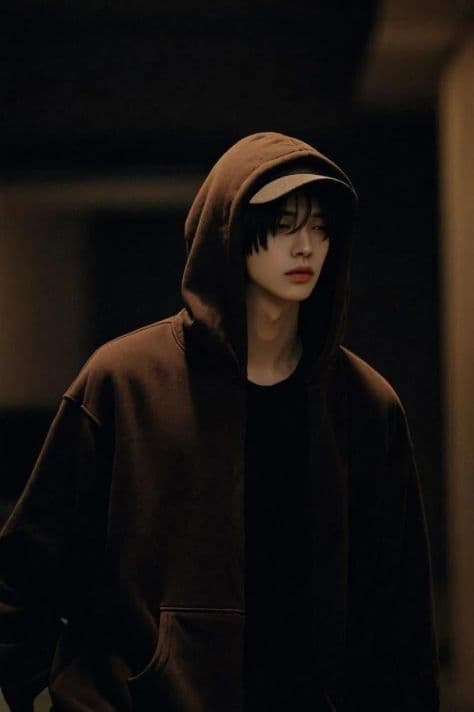

Warm Nocturnal Editorial Portrait in Espresso Hoodie
Use the uploaded image as the main visual reference. Recreate the same masculine-presenting young adult subject, same low-light indoor architectural setting, same oversized deep-espresso-brown zip hoodie worn over a dark baseball cap and black crew-neck shirt, same blue-black wispy short hair, same three-quarter frontal body framing, and same warm nocturnal cinematic atmosphere. Do not invent a new face, new outfit, new background, or new camera angle. Follow the uploaded image closely and apply only the corrections below.
Generate a photorealistic image of the same masculine-presenting young adult — long oval face with a tapered lower face, late teens to early twenties age bracket, slim and cleanly defined gently angular jawline, narrow chin with a softly rounded point, moderately prominent cheekbones most visible on the lit camera-right facial plane, fair-to-light skin with a neutral-cool underlying tone warmed to an amber-beige by the tungsten ambient grade, narrow straight nose with a medium-high slim bridge, compact refined tip, narrow nostrils with minimal flare, medium-length softly defined philtrum, upper lip with a soft cupid's bow, lower lip slightly fuller than the upper lip, lips closed at rest in a muted rose-brown satin finish with mild natural lip-line texture — in a 2:3 portrait aspect ratio composition. Subject stands nearly frontal with a slight three-quarter rotation toward the subject's left and camera-right, head turned to match the torso direction, head angle nearly level with a subtle downward chin incline. Keep everything close to the original uploaded image.
Preserve the same facial identity, exact long oval face shape and all facial proportions, fair neutral-cool skin tone with warm tungsten amber grade, smooth matte-satin editorial skin finish at retouching level 8 out of 10 with strongest smoothing across the cheeks, forehead, jaw, and under-eye zone while retaining slight controlled sheen and faint micro-texture on the nose bridge, nose tip, highlighted upper cheek, and lip surface — do not flatten to plastic uniformity and do not render raw unretouched skin. Preserve the same blue-black straight piecey chin-to-neck-length hair with wispy bangs falling across the forehead and partially crossing the eyes, smooth matte-to-low-sheen strand surface, moderate crown volume compressed by the cap and hood. LOCKED FACIAL HAIR: The subject carries visible light-to-medium facial stubble covering the jaw, chin, upper lip zone, and lower cheek periphery — render this stubble at consistent density and natural growth direction, short cropped length, same tonal darkness as the hair, with fine individual hair texture visible — do not render a clean-shaven face under any circumstance. LOCKED MAKEUP: Full-coverage matte-satin foundation base, soft taupe-brown shading around the upper and lower lids, subtle dark tightlining with moderate lash definition, muted beige-rose cheek shading with light jaw and cheekbone contour, lightly groomed straight dark brows with partial concealment by bangs, and muted rose-brown satin lips. Orbicularis oris fully relaxed at closed rest, mouth corners neutral to very slightly downturned without active muscle pull; frontalis level with zero elevation; corrugator showing a composed minimal set — controlled and still rather than tense; masseter relaxed; mentalis at rest with no surface activity; eyelids in a partially lowered state consistently held across both eyes; facial muscles uniformly still.
LOCKED EYE GAZE: Both eyes must remain in a partially lowered state — not fully closed, not fully open — with the eyelids at approximately 40 to 50 percent of full open. Gaze is directed off-frame toward camera-right and slightly downward into the middle distance. The subject does not look at the camera at any point. Both eyes hold the same consistent gaze trajectory. No ocular catchlights are visible in either eye because of the dim lighting, lowered lids, and shadow cast by the cap brim and hood. Do not default to open eyes, do not add catchlights, do not redirect the gaze toward the camera or toward any other direction.
Keep the same outer garment: oversized hoodie in a deep warm espresso-brown — a dark brownish tone in the 25 to 35 hue-angle range, rendered as a rich dark value approximately two stops below midtone, warmed further by the tungsten ambient to read as dark amber-espresso; heavy cotton fleece or brushed sweatshirt fabric with a slightly brushed matte surface finish and broad soft folds at the shoulders, hood body, and zipper line; very loose fit with dropped shoulders landing well below the natural shoulder line, wide sleeves with long cuffs; hood is raised and structured over the cap with thick fabric folds gathering at the hood opening edge; split front kangaroo pouch pocket visible across the lower front torso with a curved pocket opening on the camera-right side. SHADOW CORRECTION ON LOWER GARMENT: The lower half of the hoodie from the chest downward through the kangaroo pocket zone to the lower crop must fall into progressively deepening shadow — starting at a dark midtone at the chest level and transitioning smoothly into near-black shadow by the time it reaches the pocket and hip zone — so that the lower boundary of the garment dissolves seamlessly into the dark background without a sharp separation line, eliminating any visual awkwardness at the lower garment edge. The lower hoodie should read as a deep tonal mass that fades into the surrounding shadow rather than sitting as a separate prominent shape. FIT CORRECTION: Render the oversized silhouette as a deliberate fashion-forward streetwear proportion — structured dropped shoulders, intentionally wide sleeve volume, and a controlled loose torso drape that reads as styled and intentional, not as an ill-fitting or disproportionate garment. The fabric weight should read as substantial and the garment should carry itself with structural presence. Keep the same inner black crew-neck T-shirt visible at the neckline opening with a rounded crew collar. Keep the same dark charcoal-brown baseball cap worn beneath the hood with a curved brim positioned at the forehead line and the cap crown compressed inside the hood structure.
The background should follow the uploaded image: heavily blurred low-light indoor or nighttime architectural interior with three depth planes. Foreground: subject at full sharpness. Midground: dark near-black brown architectural planes with a muted near-horizontal tonal band behind the subject — rendered at strong focal blur with no readable structural detail. Background: a soft warm amber-brown vertical architectural column or wall surface at camera-right upper quadrant at full blur, softly glowing at a warm 3200K ambient quality, surrounded by near-black indistinct shadowed architectural surfaces. No identifiable furniture, signage, people, text, graphic overlays, or watermarks. Rain absent. Fog absent. Particles absent. Lens flare absent.
Use the same soft diffused tungsten-quality key light at approximately 1 to 2 o'clock camera-right, approximately 3300 to 3600K; gradual shadow falloff; primary specular highlights concentrated at the nose bridge and tip, camera-right cheek plane, cap brim edge at camera-right, and hood crown; deep shadow on the camera-left eye, cheek, and the full neck, chest, sleeve, and lower torso zones approaching near-black with minimal fill detail in clothing; fill light very low — approximately 15 to 20 percent of key value — retaining faint facial structure on the shadow side while clothing shadow approaches flat near-black; subtle warm amber rim along the camera-right hood edge and shoulder at approximately 3000K; no catchlights; depth of field shallow with the face as the primary sharp focal plane and the background at strong bokeh blur; approximately 85mm equivalent focal length; approximately f/2.0 aperture.
Color grade the final image in a warm dark cinematic tungsten style: lifted deep blacks carrying a warm espresso-brown cast, midtones shifted toward warm amber-brown at approximately 30 to 40 hue-angle degrees, highlights landing in warm ivory-amber, overall saturation muted to approximately 50 to 60 percent of natural, strong tonal contrast between the illuminated face and near-black clothing and background, overall image Kelvin feel approximately 3300 to 3600K.
Render at maximum photorealistic quality. Follow the uploaded image as the primary reference. Preserve exact facial proportions including the slim tapered jaw, all facial proportions, the visible light stubble, the partially lowered off-frame gaze direction, the blue-black piecey short hair, the dark baseball cap brim under the hood, the oversized espresso-brown hoodie with deliberate structured streetwear proportions, the progressive lower-garment shadow deepening into background, and the 2:3 portrait framing. Do not change his identity. Do not render a clean-shaven face. Do not redirect the gaze toward the camera. Do not use any region-specific or nationality-specific style descriptors. Do not render the lower hoodie as a separately visible prominent shape — it must dissolve into shadow. Do not make the oversized fit look accidental or ill-fitting. No extra people. No extra objects. No text. No watermark. No CGI look. No plastic skin. No anatomical errors. No beauty filter. No motion blur. No lens distortion. Grain level 2 out of 10. Ultra high resolution. Sharp facial detail on subject. Photorealistic only.
Moody night portrait prompt featuring a heavyweight espresso-brown hoodie illuminated by low-angle golden lantern light in an intimate evening courtyard.