
Vibrant Product Studio Dramatic Aerial
Use the uploaded image as the main visual reference. Recreate the same luxury fragrance hero bottle, same symmetrical theatrical floral studio setting, same faceted ruby-crystal surface system, same cylindrical pedestal, same dense crimson floral framing, same red volumetric fog, same overhead light shafts, same typography placement, same framing, and same high-contrast crimson atmosphere. Do not invent a new bottle, new color scheme, new floral arrangement, new pedestal, new background, or new camera angle. Follow the uploaded image closely and apply only the precision corrections below.
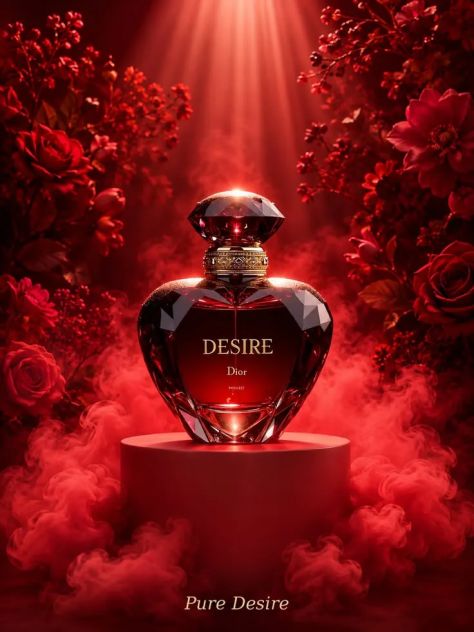
Generate a maximum-photorealistic luxury commercial fragrance advertising image of the same faceted perfume bottle in a vertical 3:4 composition. Keep the bottle precisely centered on the vertical axis in the middle-lower portion of the frame, occupying approximately 45–50% of total frame height. Show the complete bottle, cap, ornate neck hardware, pedestal top, and surrounding mist. Maintain strong bilateral compositional symmetry. Use a near eye-level frontal product viewpoint with a very mild downward angle so the top surface of the cylindrical pedestal appears as a shallow ellipse. Keep the lens axis centered on the front face of the bottle and preserve minimal perspective distortion.
Preserve the exact product design: a broad heart-/shield-like crystal bottle with a body width approximately 1.15 times its body height, wide rounded-faceted shoulders, narrowing lower sidewalls, and a pointed geometric lower base. Construct the bottle from optically thick transparent crystal-like glass with a perfectly polished high-gloss exterior. Divide the shoulders, sidewalls, lower body, and base into large sharply defined angular facets that create hard planar reflections, internal prismatic refractions, and alternating illuminated and near-black-red planes. Keep the exterior completely smooth with no grain, stitching, frosting, condensation, embossing, or surface roughness.
Render the bottle’s internal color system as deep ruby-to-burgundy transparent material. Use dominant illuminated transmission around H 355–2°, S 85–100%, B 35–75%. Push deeper internal zones toward H 350–5°, S 65–90%, B 12–35%. Allow the darkest side facets to approach extremely low-brightness black-crimson while retaining a detectable red chromatic component rather than neutral black. Use saturated scarlet internal reflections around H 355–5°, S 90–100%, B 65–95% where direct illumination passes through the thick glass. Do not introduce blue, green, violet, or neutral-gray glass coloration.
Preserve the short cylindrical neck assembly exactly above the bottle shoulders. Render the collar and hardware in engraved polished metal around H 40–48°, S 45–70%, B 65–95%. Include multiple thin horizontal rings, ornate engraved and embossed geometric banding, and small dark jewel-like recessed accents. Give the polished raised metal edges compact high-intensity specular highlights while retaining darker warm metallic tones inside engraved recesses. Do not simplify the collar into a plain ring.
Preserve the oversized low-profile faceted gemstone cap. Give it a broad octagonal/diamond-like silhouette, substantially wider than the neck, with angular upper and lower planes. Render it as transparent smoky ruby crystal with deep internal zones around H 350–3°, S 70–95%, B 10–35% and illuminated ruby planes around H 355–3°, S 85–100%, B 35–70%. Use an optically polished finish with sharp planar reflections. Place the strongest concentrated highlight along the upper central rim of the cap, reaching H 40–50°, S 8–18%, B 98–100%, with secondary saturated ruby reflections visible through the cap interior.
Preserve the exact frontal branding placement. Place the word “DESIRE” prominently in the center of the front face using uppercase medium-thin high-contrast serif typography, horizontally centered and evenly tracked. Render the lettering in pale warm ivory around H 42–52°, S 10–20%, B 92–100%. Place “Dior” centered directly below in substantially smaller pale warm ivory serif typography. Include one very small centered line of microtext beneath “Dior,” matching the visual scale and placement of the reference without enlarging it into a dominant design element. Keep all product lettering aligned, crisp, planar, and integrated into the bottle face. Do not add a symbol logo, label panel, border, sticker, or additional product copy.
Keep deep translucent red contents implied inside the bottle but do not create a clearly visible horizontal liquid boundary. Integrate the apparent contents with the ruby glass and lighting treatment. No bubbles, pouring, splashes, suspended particles, droplets, condensation, or visible fluid motion.
Keep the bottle standing on the same smooth cylindrical pedestal. Render the pedestal in a matte-to-satin red material around H 355–3°, S 75–95%, B 30–60% depending on illumination. Preserve its clean untextured surface, circular geometry, visible elliptical top, and straight vertical front face. Center the pedestal exactly beneath the bottle. Let its lower front surface become progressively obscured by foreground fog while keeping the top edge and bottle contact area clearly readable. Do not add logos, engraving, cracks, marble veining, metallic trim, or texture to the pedestal.
Create dense floral framing on both sides while leaving the central vertical region behind the perfume bottle comparatively open. On the left, reproduce large rose forms, smaller clustered blossoms, buds, broad leaves, fine branching stems, and small berry-like botanical clusters. Crop several branches and petals naturally beyond the left and top frame edges. On the right, preserve the large open multi-petal bloom in the upper-right zone, the prominent rose at mid-right, smaller blossoms, berry-like branching clusters, and broad foliage. Crop several right-side botanical elements beyond the right and top boundaries.
Render illuminated flower petals primarily around H 355–5°, S 80–100%, B 50–90%. Recessed petal folds should shift toward H 350–3°, S 70–95%, B 15–40%. Give petals a velvety micro-surface with broad diffused highlights and soft shadow transitions while preserving clear individual petal geometry. Render foliage in deep oxblood values around H 350–5°, S 60–90%, B 8–30%, with only narrow scarlet edge reflections. Keep the entire botanical system within the crimson/burgundy palette.
Build four distinct depth layers. Layer 1: soft foreground volumetric fog rolling across the lower image and partially covering the pedestal front. Layer 2: the critically sharp perfume bottle and cylindrical pedestal. Layer 3: dense side floral masses, with front-facing petals retaining moderate detail while deeper branches progressively soften. Layer 4: a seamless dark-red studio background with rear atmospheric haze and overhead light shafts. Do not introduce identifiable architecture, furniture, windows, landscape elements, or location-specific details.
Generate thick red-tinted volumetric mist concentrated around the pedestal base, lower bottle region, bottom-left, and bottom-right areas. Form the mist into dense cauliflower-like curls, overlapping rolling clouds, soft vortices, and translucent low-density layers. Use illuminated fog around H 355–5°, S 80–100%, B 55–90%, with darker internal folds around H 350–5°, S 65–90%, B 15–40%. Keep the central front label area comparatively free of mist so “DESIRE” and “Dior” remain clearly visible. Allow rear haze to interact physically with the overhead light beams. Do not generate smoke from the bottle or cap; all mist should remain environmental and concentrated around the lower scene.
Use a theatrical overhead lighting system centered at approximately 12 o’clock. Create approximately six visible converging light shafts entering from the upper frame and widening downward through the atmospheric haze. Keep the brightest central shaft aligned directly behind the gemstone cap and bottle centerline. The remaining shafts should spread symmetrically left and right. Render the source as approximately 3600 K before crimson environmental grading, with the beam illumination strongly filtered toward H 355–8° through the red atmosphere.
Use a frontal-top key centered between approximately 11:30 and 12:30, moderately directional and capable of producing hard specular responses on glass while becoming diffused through the fog and flower surfaces. Place intense highlights across the cap rim, collar hardware, upper bottle shoulders, selected side facets, pointed lower facets, and thick geometric base. Keep the hottest highlights around H 40–55°, S 8–20%, B 95–100% instead of neutral blue-white.
Maintain approximately 35% frontal fill relative to key intensity so the front typography remains readable while large side facets retain deep black-burgundy contrast. Neutral fill is absent. Let surrounding crimson flowers, pedestal, fog, and background provide saturated red environmental bounce.
Add a strong saturated red accent from below and slightly in front of the bottle, centered beneath the lower body. Use approximately H 355–2°, S 95–100%, B 80–100%. Make this underlight visible as a concentrated internal ruby glow through the pointed bottle base and as a luminous red hotspot along the pedestal top directly beneath the bottle. Allow the transmitted light to illuminate selected lower glass facets without flattening their geometry.
Add thin bilateral rim illumination along both outer shoulders and selected side contours. Keep the rim warm-white to scarlet, with the hottest narrow edge values around H 40–50°, S 10–25%, B 90–100% and adjacent red edge transmission around H 355–5°, S 85–100%, B 70–95%. Do not create a continuous artificial outline around the complete bottle.
Shape the faceted glass using hard specular planes and rapid shadow transitions. Keep moderately sharp terminators between individual glass facets, while fog and flower shadows remain broad and soft. Produce physically convincing internal reflection, refraction, total-internal-reflection behavior, and subtle prismatic depth without rainbow dispersion. Metallic neck hardware should carry small concentrated hard reflections; pedestal highlights should remain diffuse and satin.
Keep the background darker than the bottle and primary flowers. Use a seamless dark crimson gradient around H 350–5°, S 70–90%, B 8–25%, with the central upper region lifted by the light shafts. Preserve strong subject separation through luminance rather than changing hue.
Use a nearly monochromatic luxury color grade dominated by crimson/scarlet H 355–5°, deep burgundy H 350–5°, and ruby glass H 355–2°. Restrict secondary contrast to engraved metal around H 40–48°, S 45–70%, B 65–95% and pale warm ivory highlights around H 40–55°, S 10–25%, B 90–100%. Keep shadows black-red rather than neutral black, and keep extreme highlights warm ivory rather than cool white. Maintain very high overall saturation.
Use an approximately 85 mm full-frame-equivalent commercial product lens. Set aperture around f/4.5. Keep the entire bottle front, cap, neck hardware, primary shoulder facets, base geometry, and pedestal top critically sharp. Maintain moderate detail on nearby side flowers while allowing more distant stems, foliage, and seamless background to progressively soften. Keep foreground mist deliberately soft. Use smooth optical depth transitions with no artificial edge blur.
Apply digital grain at 1/10. Apply commercial post-processing at approximately 9/10: aggressive but controlled crimson monochromatic grading, sculpted local contrast, hero-object sharpening, controlled specular bloom, enhanced volumetric beams, realistic fog density separation, precise black-level shaping, and subtle highlight glow. Do not crush important bottle-facet geometry into featureless black.
Place the phrase “Pure Desire” as the only separate graphic overlay at the bottom center of the frame, positioned over the dark lower atmospheric area rather than on the bottle or pedestal. Use an elegant italic serif typeface in pale warm ivory around H 42–52°, S 10–18%, B 92–100%. Keep the text centered, moderately sized, and visually subordinate to the perfume bottle.
Render at maximum photorealistic luxury advertising quality with physically convincing polished crystal, thick refractive glass, engraved metal, satin pedestal material, velvet flower surfaces, and volumetric atmospheric scattering. Follow the uploaded image as the primary visual reference. Preserve the exact shield-/heart-like bottle proportions, pointed geometric base, oversized faceted cap, ornate gold collar, front typography hierarchy, centered pedestal, symmetrical floral corridor, four-layer depth structure, fog distribution, overhead light-shaft arrangement, crimson color system, frontal symmetry, camera height, and theatrical lighting geometry.
Do not alter the bottle silhouette. Do not simplify or round away the glass facets. Do not substitute the smoky ruby gemstone cap. Do not remove the engraved gold collar. Do not change the crimson/scarlet H 355–5° dominant palette. Do not introduce contrasting blue, cyan, green, violet, or cool-white lighting. Do not move the bottle away from the center axis. Do not remove the pedestal. Do not replace the side floral masses with different decorative objects. Do not eliminate the overhead beams or red volumetric fog.
No people. No additional perfume bottles. No extra products. No extra props outside the established floral, pedestal, fog, and bottle composition. No additional text beyond “DESIRE,” “Dior,” the tiny bottle microtext, and “Pure Desire.” No watermark. No floating logo. No border. No rain. No condensation. No lens flare. No significant chromatic aberration. No motion blur. No wide-angle distortion. No warped typography. No malformed glass geometry. No melted facets. No plastic-looking crystal. No cloudy low-quality transparency. No flat red wash that destroys material separation. Ultra-high resolution. Sharp hero product detail. Accurate thick-glass refraction. Accurate engraved metallic texture. Controlled saturated ruby transmission. Physically convincing volumetric haze. Premium photorealistic luxury-fragrance advertising finish only.