
Vibrant Abstract Studio Dramatic Light Bokeh
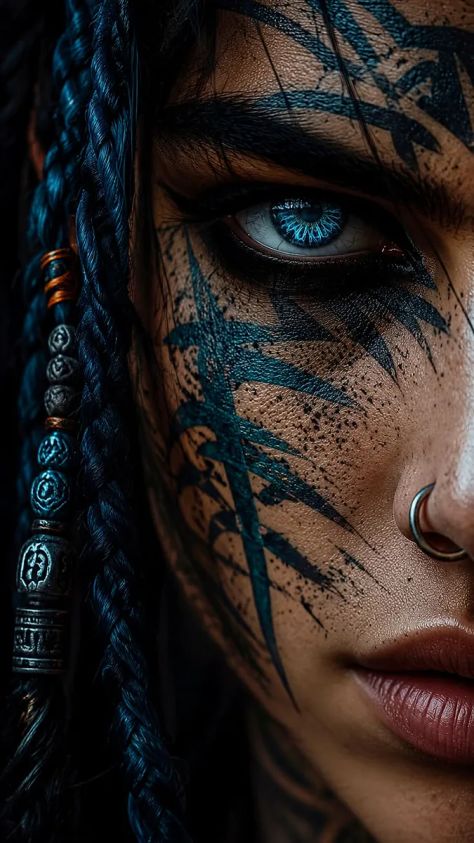
Use the uploaded image as the main visual reference. Recreate the same subject, same near-black studio setting, same extreme cinematic beauty styling, same braided hair and metallic braid ornaments, same geometric facial pigment, same nose hoop, same framing, and same high-contrast teal-and-warm-copper atmosphere. Do not invent a new face, new color scheme, new background, new camera angle, additional jewelry, additional makeup, clothing, or unseen environmental elements. Follow the uploaded image closely and apply only the corrections and precision instructions below.
Generate a photorealistic cinematic editorial beauty photograph of the same subject in a 9:16 vertical composition. Use an extreme close-up crop showing approximately half of the face: retain the visible forehead section, one eye, upper and mid cheek, partial nose, nostril hoop, and closed lips; crop out the chin and opposite side of the face. Anchor the face strongly toward frame-right, position the visible eye slightly above the vertical center, and let the braided hair create a dense vertical mass along the frame-left edge. Maintain a near eye-level camera position with a subtle three-quarter facial orientation. Use approximately 95 mm equivalent macro/portrait compression, f/2.4 aperture behavior, shallow selective depth of field, grain level 2/10, and post-processing intensity approximately 7/10.
Preserve the same facial identity and all visible facial proportions from the uploaded image. Do not extrapolate or redesign portions of the face hidden by the crop. Maintain the softly rounded visible cheek contour with moderate cheekbone prominence. Render the skin as a medium-deep burnished amber-brown base around H 28–32°, moderate saturation and medium-low brightness, with copper undertones and localized cooler cyan reflections around the painted regions. In directly illuminated skin zones, shift toward warm amber-brown around H 30–35° with increased brightness; in shadow zones, retain deep neutral brown around H 22–28° with subtle teal contamination around H 188–194°. Keep a satin-to-dewy material response with controlled specular highlights concentrated on the nose edge, upper cheek, and selected raised pore surfaces.
Preserve pronounced natural skin microstructure. Render clearly readable pores across the cheek and nose, fine epidermal texture, subtle tonal irregularity, small pore-shadow transitions, and localized surface reflectivity rather than uniform smoothing. Maintain retouching at approximately 4/10: retain strong pore visibility and microtexture across cheek and nose, apply only selective smoothing to flatter facial zones and skin immediately adjacent to the lips, and keep the overall material response organic. Do not flatten pores, erase fine texture, create waxy surfaces, or produce plastic skin.
Recreate the dense asymmetrical black-to-deep-teal facial markings exactly in placement, scale, layering, and direction. Apply broad angular painted bands, intersecting geometric forms, sharp triangular strokes, fine irregular edges, and scattered speckled pigment across the visible forehead, eye surround, cheek, and lower facial area. Use near-black pigment with low reflectivity beside deep cyan-teal pigment around H 188–194°, high saturation and low-to-medium brightness. Give the markings a predominantly matte-to-satin finish while allowing narrow cyan-blue specular reflections where the cool secondary illumination strikes raised or moist skin beneath the pigment. Preserve the irregular layered character of the pattern; do not simplify it into clean graphic lines, perfect symmetry, decorative decals, or culturally attributed symbols.
Preserve the same almond-shaped visible eye with a moderately hooded upper lid and slightly lowered upper eyelid. Keep the gaze almost directly toward the camera with only a very slight lateral offset. Do not redirect the eye upward, downward, or clearly sideways. Render a medium-sized dark pupil surrounded by a dark blue-gray inner iris transitioning into an extremely saturated electric cyan-turquoise outer iris around H 188–193°, very high saturation and medium-high luminosity. Build dense luminous radial filament structures extending outward through the iris while keeping the pupil and inner iris visibly darker. Preserve the intentionally digitally intensified cyan eye treatment rather than naturalizing the iris color. Add one small bright upper catchlight around the 12–1 o’clock iris position together with the strong cyan radial luminosity. Keep the sclera realistic and subdued so the electric iris remains dominant.
Maintain dense dark upper eyelashes with strong separation near the eye edge; keep lower lash definition reduced by the surrounding dark pigment. Preserve heavy matte-black smoky pigment around both upper and lower eyelids, with near-zero shimmer. Use thick black liner that merges organically into the smoky eye treatment rather than appearing as an isolated graphic line. Keep lashes deeply darkened. Do not add colored eyeshadow, glitter, wing extensions, additional liner shapes, false-lash exaggeration, or secondary cosmetic accents.
Preserve the same extremely dense, low-set brow positioned close to the eye. Render broad dark brown-to-near-black brow hairs with individually readable strand direction, high density, strong natural texture, and restrained grooming. Do not thin, arch dramatically, laminate, overfill, or lighten the brow.
Keep the complexion base sheer-to-medium so the real pore structure and tonal variation remain visible through it. Do not introduce visible blush. Render the lips in a deep muted rose-brown around H 8–14°, moderate saturation and medium-low brightness, with a slightly warmer red undertone. Use a satin finish with fine vertical lip ridges, subtle central reflectivity, and no glossy wet coating. Preserve the lower lip at approximately 1.45 times the fullness of the upper lip and retain a moderately defined cupid’s bow.
Keep the brow mostly level with no visible frontalis contraction. Maintain the upper eyelid slightly lowered, keep the orbicularis oculi region relaxed, keep the lips fully closed with almost no corner elevation, leave the orbicularis oris and mentalis without pronounced contraction, and do not introduce forehead tension or exaggerated facial movement.
Preserve the same near-black braided hair with deep blue-black base values and cool cyan specular reflections around H 188–195°. Render multiple thick, tightly woven braids with individually readable strand ridges, compact woven clumps, high density, and glossy-to-satin fiber behavior. Along frame-left, maintain high braid volume while allowing peripheral braids to soften slightly outside the narrow focal plane. Add the same fine loose strands crossing diagonally over the forehead and eyebrow plus a small number of natural flyaways. Do not replace the braids with smooth hair, loose waves, dreadlock-like forms, or uniform synthetic strands.
Preserve all visible braid ornaments in their original positions. Render multiple dark metallic cylindrical and engraved beads with aged gunmetal-to-oxidized-silver material response, low-to-medium brightness, engraved relief, recessed dark grooves, narrow hard specular edges, and visible wear. Maintain the small copper/bronze wraps on selected braid sections using metal around H 25–35°, medium-high saturation and medium brightness with polished highlights and darker oxidized recesses. Do not add extra beads or substitute bright gold.
Preserve the single smooth circular nostril hoop in exactly the same position and scale. Render it as polished silver-tone metal with a narrow bright specular edge, dark reflected underside, and realistic metallic curvature. Do not add septum jewelry, earrings, necklaces, headwear, glasses, or additional facial jewelry.
Keep clothing completely outside the crop. Keep the neck outside the usable frame. Keep both hands absent with zero visible hands. Include no held objects, props, furniture, or foreground accessories beyond the subject’s existing hair ornaments and nose hoop.
The background must follow the uploaded image as a two-layer depth stack. Layer one is the sharply rendered face and primary braid structures occupying almost the entire frame. Layer two is a nearly pure black studio field with extremely low brightness, no discernible surface texture, no architecture, no objects, no readable forms, and no visible horizon. Keep the background dramatically darker than the subject. Bokeh is absent. Background people are absent. Atmospheric particles are absent. Fog, rain, smoke, and lens flare are absent. No readable text or watermark anywhere.
Use a primary key light from approximately the 1–2 o’clock position at camera-right-front, striking the visible facial plane obliquely. Set the skin-facing key near 5000 K with moderate directional softness: hard enough to reveal pores, fine skin relief, engraved metal texture, and narrow specular edges, but soft enough to avoid razor-hard shadow boundaries. Maintain short side-lighting with split-light characteristics. Let the frame-left facial and hair side descend rapidly into deep shadow while preserving a moderately defined shadow terminator.
Keep fill at approximately 20%, sufficient to retain limited detail in the dark painted regions and deepest braids without significantly lifting black levels. Introduce a secondary cool cyan-blue light equivalent to approximately 8200 K, concentrated along selected braid ridges, the electric iris, edges of the teal facial pigment, and narrow hair contours. Maintain a subtle cyan rim/specular separation along the outer braided hair against the black background. Do not introduce a warm rim light or broad frontal fill.
Shape facial highlights as small controlled satin-to-dewy reflections on the upper cheek and nose, narrow metallic streaks on the nostril hoop, short hard highlights on raised bead engravings, elongated cyan reflections following the braid ridges, and small directional reflections across selected teal-painted skin ridges. Keep the visible eye catchlight compact and high in the iris. Do not create large beauty-dish circles, multiple studio catchlights, blown forehead hotspots, or diffuse global glow.
Maintain the dominant palette of near-black around H 210–230° at extremely low brightness, electric cyan/teal around H 185–195° at high saturation and medium brightness, copper/bronze around H 25–35° at medium-high saturation and medium brightness, warm amber-brown illuminated skin around H 30–35°, deep neutral-brown shadow skin around H 22–28°, and muted rose-brown lips around H 8–14°. Apply a cinematic teal-and-warm-copper grade with strong local contrast, cool cyan shadow accents, warm skin highlights, controlled black compression, intensified cyan details, and no global desaturation. Preserve neutral-warm skin under the key while keeping the accent illumination distinctly cooler.
Render at maximum photorealistic quality. Follow the uploaded image as the primary reference. Preserve the exact visible facial identity, visible facial proportions, extreme crop, eye position, gaze, braided-hair placement, geometric pigment layout, nose hoop, metallic braid ornaments, skin texture, makeup configuration, lighting direction, color temperature, contrast structure, black background, and 9:16 portrait framing.
Do not change the subject’s identity. Do not reconstruct the hidden half of the face into the composition. Do not change the electric-cyan iris treatment. Do not naturalize the iris. Do not redirect the gaze. Do not alter the heavy matte-black smoky eye treatment. Do not invent blush or additional makeup. Do not smooth away pores. Do not change the facial marking geometry, braid structure, braid ornament materials, nose hoop, teal-and-copper color grade, or black studio setting.
No extra people. No extra objects. No text. No watermark. No CGI look. No plastic skin. No anatomical errors. No beauty filter. No motion blur. No lens distortion. No visible chromatic aberration. No lens flare. No fog. No rain. No floating particles. Ultra-high resolution. Maximum sharp detail on the visible eye, adjacent cheek texture, facial pigment, nose jewelry, and primary braid structures. Natural skin texture, physically accurate metal texture, realistic braided hair fibers, photorealistic photography only.