
Vibrant Abstract Interior Dramatic Backlit Macro
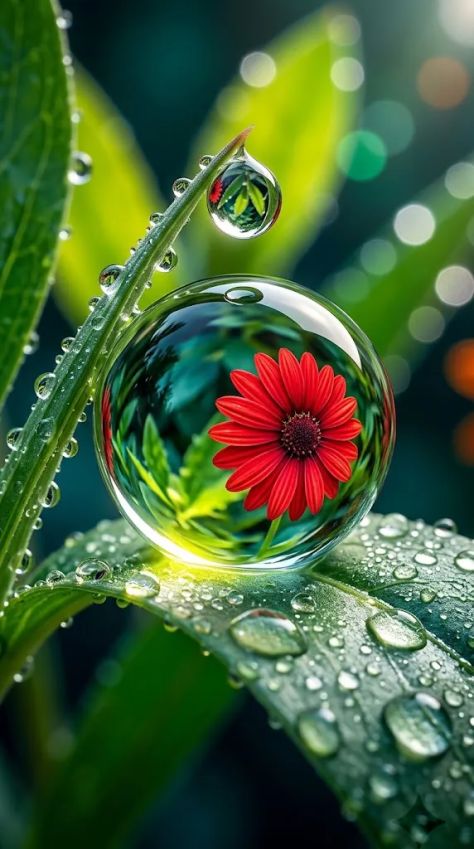
Use the uploaded image as the main visual reference. Recreate the same large spherical water droplet resting on the same broad dew-covered green leaf, same sharply refracted scarlet-red flower inside the main sphere, same smaller suspended droplet directly above it, same diagonal droplet-covered leaf/stem on frame-left, same surrounding dew beads, same blurred botanical background, same shallow macro perspective, same vivid emerald/yellow-green/red palette, and same highly polished hyperreal optical atmosphere. Do not invent a different flower, different plant structure, different droplet arrangement, new color scheme, new background, or new camera angle. Follow the uploaded image closely and apply only the corrections below.
Generate a hyperreal photorealistic botanical macro image in a 9:16 vertical composition. Position the nearly perfect transparent main water sphere slightly below the vertical center of the frame, resting physically on the broad foreground leaf. Place the smaller spherical droplet directly above the main sphere to create the same vertical visual chain. Keep the diagonal moisture-covered leaf/stem rising through frame-left and preserve numerous smaller droplets scattered across it and the lower leaf surface. Use a very low macro camera angle close to leaf-surface level. Maintain approximately 105 mm macro-equivalent compression, f/3.5 aperture behavior, strong near-life-size magnification, extremely shallow selective depth of field, grain level 1/10, and post-processing intensity approximately 9/10.
Preserve the exact overall composition from the uploaded image. Keep the main sphere as the dominant focal object, occupying a substantial portion of the central-lower frame without touching the borders. Maintain the smaller upper droplet aligned almost vertically with the main sphere. Keep the foreground leaf extending across the lower frame, the diagonal leaf/stem entering from upper-left to lower-middle regions, large blurred leaf shapes in the background, and dark teal-to-near-black negative space between foliage. Do not center every secondary droplet symmetrically or rearrange the natural asymmetry.
Render the main water droplet as a nearly spherical transparent body with slight compression and flattening exactly at its contact point with the leaf. It must visibly rest on the leaf through realistic surface tension rather than float above it. Keep the exterior curvature smooth and continuous with no faceting, geometric deformation, or bubble-like skin thickness.
Give the main droplet an extremely glossy glass-like water surface with high optical clarity, physically plausible refraction, strong internal reflection, and sharply defined specular behavior. Maintain transparency high enough to see the refracted botanical content clearly while preserving darker mirrored reflections across the upper half of the sphere.
Place a bright curved neutral-white specular highlight along the upper-right region of the sphere and maintain additional bright edge reflection along the lower perimeter. Keep the brightest reflections compact and mirror-like, approaching very high brightness without broad clipping. Preserve dark green and deep teal reflected zones across the sphere so the transparent object maintains dimensional contrast.
Recreate the scarlet-red daisy-like flower as a sharply magnified refracted image within the main sphere. Preserve its apparent inverted/distorted optical behavior created by the curved water surface rather than rendering it as a literal miniature flower physically trapped inside the droplet. Keep the primary bloom centered slightly right of the sphere’s internal axis, with multiple narrow petals radiating around a dark red-to-burgundy center.
Render the main flower petals around H 355–5°, extremely high saturation and medium-high brightness. Maintain clean individual petal separation, tapered petal tips, localized red-orange highlights, deeper crimson overlaps, and a dark burgundy central core around H 350–360° with lower brightness. Preserve smaller scarlet buds and flower forms around the central bloom inside the refracted scene.
Surround the refracted flower with magnified and optically distorted green foliage inside the sphere. Use deep emerald around H 115–130°, medium-high saturation and low-to-medium brightness, transitioning into brighter yellow-green around H 80–95° where internal light concentrates. Allow the curved water optics to bend stems, leaves, and bright points naturally toward the sphere edges.
Maintain physically coherent refraction through the entire main sphere. The refracted vegetation and flower must distort consistently with a spherical water lens, with stronger curvature toward the perimeter and relatively clearer magnification through the center. Preserve inversion and directional bending where present. Do not treat the sphere as flat glass, an ordinary mirror, a crystal ball containing a landscape, or a decorative transparent ornament.
Preserve the smaller droplet directly above the main sphere as a highly reflective near-spherical bead. Give it mirrored green, neutral-white, and restrained scarlet-red accents. Maintain a bright upper highlight, deep green interior reflection, and crisp glass-like edge. Keep it visually separate from the main sphere by a small air gap or narrow stem-associated spacing matching the reference. Do not merge the two drops.
Preserve additional medium-sized droplets behind and around the main sphere, including the softly focused round drop in the upper-right/mid-background. Render these secondary droplets with accurate spherical optics but progressively softer focus according to their depth. Maintain green, white, yellow-green, and dark teal reflected zones without making every background droplet equally sharp.
Keep numerous tiny water beads attached along the diagonal leaf/stem at frame-left. Vary their diameter naturally from pin-sized micro-droplets to small spherical beads. Some should sit directly on the surface as hemispherical dew, while larger drops should protrude with stronger curvature. Preserve realistic surface-tension attachment and irregular spacing rather than arranging them into a perfect pattern.
Cover the foreground leaf with abundant dew. Use hundreds of tiny bright moisture points and several larger water beads across the surface, particularly along raised veins and lower-frame regions. Render each dew bead as a physically plausible transparent liquid body with small neutral-white highlights and green reflected bases. Keep the quantity high without turning the leaf into foam or glitter.
Preserve the broad plant leaves with pronounced linear veins and subtle longitudinal ridges. Render the foreground leaf around H 115–130° in shadowed emerald regions with medium-high saturation and low-to-medium brightness, transitioning through H 95–110° greener midtones and H 75–95° yellow-green highlights where light passes through or reflects from the wet surface.
Give the leaves a satin-to-gloss wet material response. Keep the underlying biological surface visible beneath moisture: pronounced primary veins, fine parallel ridges, microscopic irregularity, slight waviness, and soft surface curvature. Do not smooth the leaves into plastic sheets or increase roughness until the water reflections disappear.
Render moisture differently from the leaf substrate. Droplets must show hard high-energy specular points and transparent refraction, while the wet leaf should retain broader softer reflections with visible botanical texture beneath them. Preserve this strong material contrast.
Keep the main leaf contact zone beneath the large sphere visibly compressed by the optical and lighting interaction. Add a concentrated yellow-green luminous bounce immediately under and around the sphere around H 80–90°, high saturation and medium-high brightness. This glow must read as refracted/redirected leaf light rather than artificial neon illumination.
Preserve the diagonal leaf/stem on frame-left as a major compositional line extending upward through the image. Render its edge and central ridges sharply near the focal plane, with gradually reduced sharpness as it leaves the focus region. Maintain many small droplets attached along its edge and face.
Preserve the tiny pointed botanical form touching or approaching the smaller droplet above the main sphere. Keep it as a slender yellow-green/brownish plant tip with natural curvature and restrained saturation, interacting visually with the upper droplet without becoming the main subject.
Keep the foreground as the dew-covered leaf plane extending across the lower third and lower half of the image. Maintain several out-of-focus foreground droplets close to the bottom edge, including soft circular dark-green/white forms. These should provide depth without competing with the central sphere.
Build the background as a four-layer optical depth structure. Layer one is the dew-covered foreground leaf and nearest beads, with selected regions sharp and others progressively soft. Layer two is the main water sphere and upper aligned droplet, which form the critical focal plane. Layer three consists of large green leaf forms and secondary droplets in the mid-background with strong optical blur. Layer four is a dark teal-to-near-black botanical background with indistinct foliage and isolated bokeh highlights.
Preserve the large blurred green foliage shapes behind the main sphere. Use broad smooth zones of emerald around H 105–135°, yellow-green around H 75–95° where backlit, and deep green-teal around H 150–175° in shadow. Keep their contours organic and soft with no readable fine vein detail outside the focal plane.
Maintain multiple soft circular bokeh highlights especially across frame-right and the upper background. Use neutral-white bokeh with high brightness, emerald/green around H 105–135°, yellow-green around H 75–95°, and a few restrained warm orange highlights around H 25–35°. Vary bokeh size and brightness. Keep edges soft and optical rather than graphic circles.
Use deep teal shadows around H 165–190°, medium saturation and extremely low brightness in the darkest background zones. Let these areas create strong negative-space contrast around the transparent sphere and bright plant highlights. Do not lift the background into evenly illuminated green foliage.
Use a strong directional macro key light from approximately the 1–2 o’clock position at upper-right. Set the source near 5500 K neutral daylight. Keep it relatively hard for macro photography so droplets receive crisp mirror-like highlights and leaf ridges retain strong micro-contrast.
Allow the upper-right key to strike the main sphere at an oblique angle, producing a concentrated bright highlight on its upper-right curvature, a bright rim along selected right and lower edges, crisp highlights on nearby dew beads, and narrow reflective bands on the wet leaf surface.
Use approximately 35% fill. Preserve readable green detail in the leaf shadows and internal sphere reflections without flattening the scene. Keep deep clean shadow pockets below the main sphere, between leaf folds, and throughout the dark background.
Add partial back/edge illumination through the leaves and water structures. Use this to strengthen the transparent outline of the large sphere, brighten selected lower and right edges, enhance the upper droplet, and create luminous yellow-green transmission through thinner leaf zones.
Preserve warm yellow-green bounce from the leaf beneath the main sphere. Keep this reflected light localized to the lower hemisphere, sphere contact zone, and nearby underside reflections. Do not introduce separate orange or red artificial lighting.
Shape highlights precisely by material. On the large sphere, use hard curved white specular bands and crisp micro-reflections. On small droplets, use tiny high-intensity white points and miniature mirrored environment reflections. On wet leaves, use elongated softer highlights that follow the vein geometry. On the flower refraction, allow bright red petal highlights but avoid white clipping across the red surfaces.
Maintain the dominant palette exactly: emerald and forest green around H 105–135° at medium-high saturation; yellow-green highlights around H 75–95° at high saturation; scarlet flower petals around H 350–10° at extremely high saturation; deep teal shadows around H 165–190° at medium saturation and very low brightness; and neutral-white specular highlights at extremely high brightness.
Apply a vivid botanical macro color grade with strong complementary red-versus-green separation, enhanced emerald depth, luminous yellow-green highlights, deep teal shadow compression, crisp neutral-white water reflections, and restrained warm accents. Keep overall saturation high while preserving realistic hue differentiation inside leaves and droplets.
Use cool green-teal shadow toning against warmer yellow-green illuminated zones. Keep the overall temperature neutral-to-cool, driven by approximately 5500 K daylight, while allowing leaf transmission to create warmer green highlights. Do not add magenta, cyan-neon, blue-light, or orange-cinematic grading.
Use extremely shallow/selective depth of field. Keep the main sphere, its refracted red flower, the upper attached/aligned droplet, the immediate contact leaf zone, and selected nearby dew beads extremely sharp. Allow the foreground edges outside the focal plane, distant droplets, large background leaves, and dark environment to fall rapidly into creamy optical blur.
Maintain strong macro magnification with approximately 90–120 mm macro-equivalent optics. Preserve realistic perspective compression, circular droplet geometry, and natural leaf-scale relationships. Do not use fisheye distortion, wide-angle stretching, or flattened telephoto abstraction.
Render at maximum hyperreal macro photography quality with extremely accurate water optics, physically coherent refraction, crisp flower magnification, precise dew surface tension, realistic botanical microtexture, subtle leaf translucency, hard specular highlights, shallow optical depth, and near-CGI cleanliness while remaining photographic in material behavior.
Use exceptionally clean rendering with grain around 1/10. Apply high local contrast and selective sharpening only to the main droplet, flower refraction, upper droplet, leaf veins near the focal plane, and nearest dew beads. Keep distant elements smooth rather than globally oversharpened.
Preserve the high post-processing character at approximately 9/10: intensify green/red separation, strengthen local optical contrast, refine white highlights, deepen teal shadows, enhance droplet transparency, and increase the clarity of the refracted flower. Do not create halos around sharpened edges or flatten natural tonal transitions.
Follow the uploaded image as the primary reference. Preserve the exact nearly spherical main droplet, slight leaf-contact compression, vertical upper droplet alignment, crisp scarlet flower refraction, surrounding smaller red buds, diagonal dew-covered frame-left leaf/stem, broad foreground leaf, secondary droplets, green blurred foliage, dark negative space, bokeh placement, upper-right key direction, and 9:16 vertical macro framing.
Preserve the locked surface finishes exactly: transparent glass-like water spheres with hard mirror specular reflections; satin-to-gloss wet leaves with pronounced veins and fine ridges; tiny surface-tension dew beads; and a crisp refracted flower image within the main sphere. Do not flatten the water optics or remove the wet-surface contrast.
Preserve the locked color system exactly: emerald/forest greens around H 105–135°, yellow-green highlights around H 75–95°, saturated scarlet red around H 350–10°, deep teal shadows around H 165–190°, and bright neutral-white specular points. Do not shift the foliage toward cyan, olive-brown, pastel green, or desaturated gray.
Preserve the locked lighting model exactly: hard-to-moderately-hard neutral macro key from upper-right around 5200–5800 K, bright mirror-like droplet highlights, partial backlighting, concentrated green leaf bounce beneath the main sphere, deep clean background shadows, approximately 30–40% fill, and extremely shallow selective depth of field.
No people. No animals. No insects. No extra flowers outside the optical structure supported by the reference. No floating fantasy particles. No text. No watermark. No logo. No artificial glass ornament. No solid crystal ball. No impossible internal landscape. No physically detached main droplet. No cloudy water. No milky transparency. No flattened refraction. No plastic leaves. No fake glitter. No rain streaks. No fog. No lens flare. No chromatic aberration. No excessive bloom. No motion blur. No fisheye distortion. Ultra-high resolution. Precise spherical water optics. Sharp scarlet flower refraction. Accurate dew surface tension. Detailed wet-leaf veins. Hyperreal botanical macro photography only.