
Oil Painting Portrait Interior Elegant Backlit
Use the uploaded image as the main visual reference. Recreate the same subject, same setting, same outfit, same objects, same framing, and same atmosphere. Do not invent a new face, new outfit, new background, or new camera angle. Follow the uploaded image closely and apply only the corrections below.
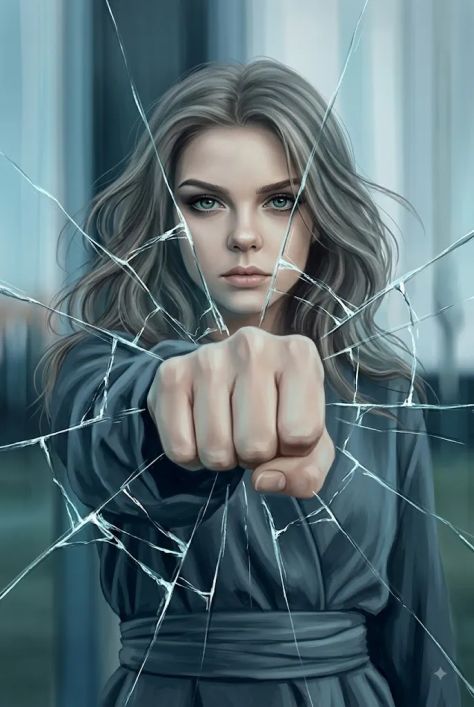
Generate a highly stylized cinematic digital painting of a single female subject in a 2:3 vertical portrait composition. Subject centered on the central axis. Face positioned upper-center. One closed fist thrusting directly toward the viewer through a shattered transparent glass surface, occupying the visual center of the composition in extreme foreground. Strong forced perspective — the fist rendered substantially larger than the face because it projects toward the viewer. Depth sequence from front to back: shattered glass layer → enlarged closed fist → face and upper torso → loose draped garment body → soft vertical architectural background plane. Keep everything close to the original uploaded image.
Preserve the same facial identity: oval-to-tapered face shape, defined jawline partially obscured by shadows and glass fractures, narrow-to-rounded chin, moderately pronounced cheekbones. Skin rendered as light beige with neutral-to-cool treatment pulled by the blue color grade — rendered in a smooth painterly digital-illustration surface. Skin retouching level 8/10 — strongly blended cheeks and forehead with heavily refined digital-painting smoothness, clean luminous highlights on nose bridge and cheekbones, minimal true photographic pore texture, fine artificial brush-grain texture remaining across the surface. Shadow-to-light transition painterly and smooth rather than naturally photographic. Nose bridge retains a clean painted highlight definition. Do not render raw photographic skin — this is stylized cinematic illustration, not documentary photography.
Cinematic polished makeup rendering — HARD LOCK. Subtle dark gray/charcoal shading around the eye socket area. Darkened upper lash line present. Lashes dark and visibly emphasized — enhanced beyond natural density. Very subtle cool-neutral cheek coloration. Lips muted nude-pink/pale rose — approximately 350–355° hue angle, low saturation, soft satin-matte surface finish, lips closed with minimal curvature. Brows defined, dark ash-brown, groomed and clean. Overall face: polished cinematic makeup rendering — not bare-face realism, not bright glamour. Do not remove the eye definition. Do not remove the lash emphasis. Do not introduce warm or colorful makeup tones.
Eyes almond-shaped, medium-large. Iris gray-blue to blue-green — approximately 200–210° hue angle, low-to-medium saturation. Pupil medium-to-dark dilation. Upper lids defined. Dark lash line enhanced. Small bright high-contrast catchlights visible in each iris. Eye surround darkened with cool gray-charcoal shading to increase dramatic intensity. Both eyes fully open — widened enough to establish strong direct confrontational focus while chin sits slightly lowered. Gaze locked directly into the viewer/camera beneath slightly lowered brows. Eyes must remain visible and readable through the fractured glass layer crossing the face — do not eliminate eye contact. Do not generate an averted, downward or unfocused gaze.
Eyebrows: softly angled, medium thickness, dark brown to ash-brown — approximately 22–25° hue angle at high darkness value. Groomed and clean. Positioned at moderate distance above eyes. Brows sitting slightly lowered toward center — corrugator creating a mild assertive set without a full frown.
Lips closed, minimal curvature. Lower lip fractionally fuller than upper. Cupid's bow defined. Pale muted rose/nude color, soft satin finish. No gloss. No smile.
Frontalis slightly lowered toward center — not fully furrowed but carrying mild assertive tension. Orbicularis oculi holding a widened alert state. Orbicularis oris closed and relaxed. Mentalis soft. Chin slightly lowered while eyes maintain forward lock. Overall expression: assertive, confrontational, direct — not angry, not smiling.
Hair: ash brown to dark blonde-brown with grayish-cool highlights — approximately 28–32° hue angle at medium darkness, with cooler highlighted strands at approximately 200° hue angle desaturated. Medium length. Loose, tousled, softly wavy texture. Near-center to slightly off-center parting. Several strands falling loosely across forehead and temple. Hair spreading outward behind ears and around shoulders. Some strands appearing swept outward reinforcing the action motion. Soft airy painterly fiber rendering — slightly matte with cool highlighted strand catches. Do not render hair as a flat mass — individual strand groupings must be visible.
Clothing: loose draped robe-like coat or wrap garment. Deep desaturated blue-gray/slate/steel navy — approximately 220–225° hue angle, low saturation, medium-low brightness. Soft heavy fabric with substantial volume and broad sleeves. Open overlapping V-like front neckline. Long loose sleeves — the extended arm sleeve bunches and folds around the forearm due to the arm projecting forward toward the camera. Painterly fabric folds with cool highlights and deep shadow pockets across all surfaces. No buttons, no zipper, no logo, no pattern. Wide matching deep blue-black fabric sash or belt tied/wrapped at the waist — same or similar fabric as the garment — cinching the otherwise loose silhouette. Dark inner layer partially visible at the open neckline. No tie, no scarf, no decorative neckwear.
Fist detail: closed punching fist in extreme foreground, knuckles prominently facing the viewer. Four fingers tightly curled toward the palm. Thumb folded across/along the curled fingers. Dorsal knuckle surfaces and upper finger surfaces dominate the fist view. Palm largely hidden by the curled finger geometry. Strong extreme foreshortening on the forearm — the forearm appears compressed as it recedes from the large fist toward the elbow and torso. Fist skin is the brightest skin element in the composition because it occupies the foreground and receives the strongest direct illumination. No rings, no polish, no visible jewelry on the punching hand. Do not reduce fist size — the exaggerated scale relative to the face is essential to the composition.
Shattered glass: physically present as a distinct foreground spatial layer sitting between the viewer and the subject — not a flat graphic overlay. Central impact point located at the fist/face center. Numerous long radial cracks extending outward from the impact center in nearly every direction — spiderweb fracture network. Large triangular shards remaining attached around the impact zone. Several fracture lines crossing the subject's face and clothing. Glass shard edges carrying bright white to cyan specular highlights — approximately 185–195° hue angle, very high brightness, icy metallic quality. Some shards semi-transparent with refraction effect. Central impact area more fragmented and dense than outer edges. Glass depth rendered with visible thickness — shards have transparent volume, not flat lines. Bright icy glow tracing the sharpest fracture edges. Painterly sharpening contrast along all glass edges. Do not reduce the glass — it must dominate the foreground and cross the face plane.
Background: stylized soft interior architectural environment. Tall vertical bluish panels or wall/window surfaces. Pale cyan, steel blue and blue-gray tones — approximately 195–210° hue angle, low-to-medium saturation, medium-low brightness. Highly softened and painterly rendering — no sharp edges, no readable text, no people, no furniture, no signage. Four depth layers: extreme foreground glass → near foreground fist → midground face and torso → soft vertical background architecture. Background brightness: pale and slightly luminous compared with the dark garment.
Lighting: soft frontal-upper key source from approximately 11–12 o'clock position. Diffused with stronger stylized specular highlights on glass edges and fist knuckles. Forehead, nose bridge, cheekbones, and fist knuckle surface receive the strongest illumination. Shadow side of face still readable through substantial cool blue ambient fill from the environment. Subtle cool rim around hair silhouette and clothing shoulder edge. Glass edges: strong white/cyan specular highlights — the brightest elements in the entire composition. Shadow transitions painterly and smooth throughout. Small bright catchlights in the eyes. Key light color temperature neutral-to-cool approximately 5500–6000K. Ambient environment: strong cool cyan/blue at approximately 7500–8500K. Contrast: medium-high across the whole image.
Color grade: pronounced cool blue/cyan dominant grade throughout. Shadows lean toward navy/teal — approximately 220–225° hue angle in shadow zones. Highlights lean toward pale cyan and silver — approximately 185–200° hue angle at maximum brightness. Skin tones intentionally restrained rather than warm or orange — neutral beige pulled slightly cool by the grade. Hair: ash-cool highlight strands reinforcing the overall cold palette. Clothing and background fully absorbed into the blue-gray-cyan color world. Overall saturation: moderately desaturated with blue dominance. Skin provides the main warm-neutral counterpoint in an otherwise cold-toned image.
Rendering style: highly stylized cinematic digital painting with AI-illustration quality. Strong painterly brushwork visible in hair, fabric folds, and background. Photorealistic anatomical accuracy combined with painterly surface treatment. Not a natural photograph — stylized cinematic illustration is the correct aesthetic. High artificial detail in broken-glass fracture elements. Slight luminous glow on brightest glass edges. Painterly atmospheric softness in the background layer.
Render at maximum quality. Follow the uploaded image as the primary reference. Preserve exact facial proportions, fist pose and scale, shattered glass structure, garment drape, lighting, color grade, and portrait framing. Do not change the subject's identity. Do not make the subject look like a different person. Do not change the dark blue-gray draped garment. Do not reduce the fist to normal portrait scale. Do not flatten the glass into a graphic overlay — it must have physical depth and thickness. Do not remove the eye contact through the glass. No extra people. No readable text. No watermark. No anatomical errors. No motion blur. No warm color grade. Ultra high detail on glass fractures, fist knuckles, facial features, and fabric folds. Cinematic digital painting style only.