
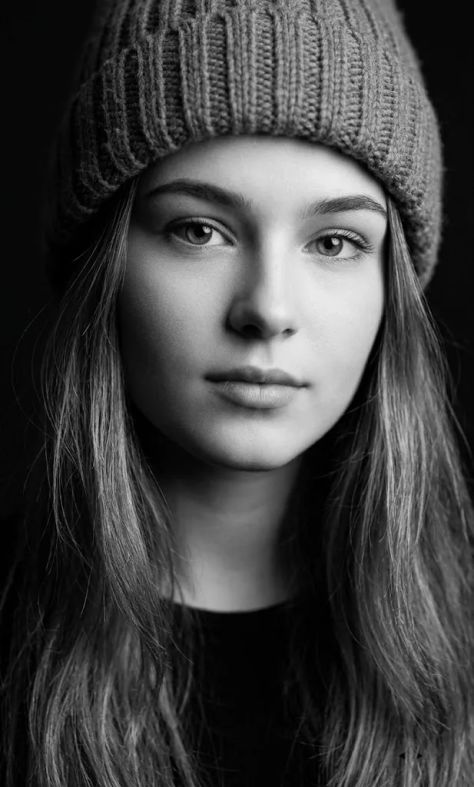
Monochrome Portrait Backlit Elegant Bokeh
Use the uploaded image as the main visual reference. Recreate the same subject, same heavy knitted beanie, same long loose hair, same dark upper garment, same near-black background, same tight face-dominant framing, same direct eye contact, same monochrome editorial treatment, and same controlled low-key lighting. Do not invent a new face, new hairstyle, new clothing design, new accessories, new background, new pose, or new camera angle. Follow the uploaded image closely and apply only the corrections below.
Generate a photorealistic black-and-white close-up editorial beauty portrait of the same subject in a 3:5 vertical composition. Use a tight head-and-shoulders crop with the face dominating the frame, the upper edge of the thick knitted hat touching or nearly touching the top border, and the lower crop ending around the upper chest. Position the face close to center with a slight shift toward frame-right. Let the hat occupy most of the upper third and allow long hair to frame both sides of the face. Use an eye-level camera position, near-frontal orientation, and only minimal three-quarter rotation. Keep the torso nearly frontal and maintain a very slight head tilt toward frame-left. Use approximately 95 mm portrait-equivalent compression, f/2.0–f/2.2 aperture behavior, shallow depth of field, grain level 2/10, and post-processing intensity approximately 7/10.
Preserve the exact facial identity and visible facial proportions from the uploaded image. Maintain the soft oval facial structure, gently tapered jaw, narrow rounded chin, moderate cheekbone prominence, original forehead height, brow-to-eye spacing, nose proportions, nose-to-lip distance, mouth width, lip proportions, chin width, and jaw angle. Do not widen or sharpen the jaw, enlarge the eyes, shorten the midface, alter the nose, or reshape the subject into a different person.
Render the complexion entirely in monochrome with saturation fixed at 0%. Keep the illuminated facial zones in pale-to-mid silver-gray values around 68–84% luminance, midtones around 48–66%, and the darkest modeled facial shadows around 18–32%. Maintain soft tonal transitions with controlled highlight roll-off rather than clipped whites. Give the skin a matte-to-satin material response with subtle broad reflectivity across the central forehead, nose bridge, frame-right cheek, upper-lip ridge, and chin.
Maintain skin retouching at approximately 7/10. Apply substantial smoothing across the forehead, cheeks, jaw, and chin while preserving clear anatomical definition around the eyelids, tear lines, nostril edges, philtrum, nose contour, lip boundaries, and fine lip texture. Keep pores and surface irregularity heavily subdued but not completely erased. The skin should appear polished and editorially refined without becoming perfectly textureless, waxy, or synthetic.
Preserve both eyes as large almond shapes with slightly elevated outer corners. Keep the upper lids clearly defined with a subtle crease and the lower lids gently modeled. Maintain both eyes fully open at the same degree as the uploaded reference. Direct both eyes straight toward the camera with no lateral, upward, or downward deviation.
Render both irises as light monochrome values around 58–72% luminance with darker charcoal limbal rings around 18–28% luminance and restrained radial texture within the iris. Keep the pupils medium-sized and dark at approximately 5–12% luminance. Add small soft catchlight reflections in the upper portions of both irises, consistent with the soft frame-right-front key source. Do not add ring-light circles, oversized white reflections, glowing eyes, artificial iris luminosity, or colored irises.
Preserve dark moderately dense upper lashes with clean tapered strands and restrained lower-lash visibility. Apply only light-to-moderate mascara darkening. Add extremely subtle soft-gray tonal shading along the upper lid and outer eye, approximately 20–30% luminance, with smooth diffusion and no visible hard cosmetic boundary. Keep upper-lash definition minimal and blended in dark charcoal, closely following the natural lash line. Do not introduce winged liner, heavy eyeliner, smoky-eye blocks, glitter, shimmer, graphic makeup, or dramatic lash extensions.
Preserve the medium-thick dark brows with their softly arched shape, original density, and individually readable hair direction. Keep brow values around 8–18% luminance and maintain natural variation between hairs. Preserve the original brow distance from the eyes and do not overfill, sharpen, laminate, lighten, thin, or dramatically increase the arch.
Use an even medium-coverage complexion base that produces a refined monochrome skin surface without concealing facial structure. Do not introduce visible contour bands, bronzer, highlight stripes, or a distinct blush region. Keep tonal modeling dependent on lighting rather than stronger cosmetic sculpting.
Preserve the lips at medium-full volume with the lower lip approximately 1.25 times fuller than the upper lip. Maintain the softly defined cupid’s bow and closed mouth. Render the lips in natural mid-gray values around 45–60% luminance with slight internal tonal variation and a matte-to-soft-satin finish. Preserve fine vertical lip texture and only restrained broad surface reflectivity. Do not add glossy wet highlights, visible lipstick contrast, exaggerated lip volume, open-mouth posing, or visible teeth.
Preserve the expression mechanics exactly: keep the frontalis relaxed, brows approximately level, orbicularis oculi minimally contracted, both eyes open and level, mouth fully closed, corners neutral, orbicularis oris relaxed, and mentalis without pronounced contraction. Do not introduce a smile, pout, frown, squint, eyebrow raise, or expressive head movement.
Preserve the same long loose hair emerging from beneath the hat and extending beyond the lower crop. Render the hair entirely in monochrome using a dark base around 12–25% luminance, deeper overlapping sections around 5–12%, and narrow satin highlights around 40–60% where the directional light catches individual strand bundles.
Keep the hair mostly straight with gentle bends and naturally irregular directional flow. Maintain moderate volume around both sides of the face. Keep the part largely concealed by the beanie. Preserve fine loose strands descending along the temples and cheek edges, with several additional flyaways especially around frame-right and the outer hair contour.
Render hair fibers with individually readable strands within the focal plane, narrow directional highlights, smooth strand grouping, natural overlap, tapered flyaways, and a soft satin finish. Do not convert the hair into curls, waves with excessive volume, braids, wet strands, short hair, or a uniformly styled salon shape.
Preserve the same thick knitted beanie. Render it in very dark charcoal-to-near-black monochrome values around 5–18% luminance with raised knit ridges reaching approximately 22–35% where struck by light. Reproduce heavy ribbed and cabled construction with oversized yarn loops, visible interlocking knit structure, fuzzy fiber edges, and strong three-dimensional textile relief. Keep the material matte and absorbent rather than glossy. Preserve the hat’s exact overall silhouette and fit. Do not replace it with a hood, cap, beret, smooth beanie, helmet, or fine-gauge knit.
Keep the dark upper garment only minimally visible at the lower edge of the composition. Render it as a near-black knit or soft woven textile around 4–15% luminance with restrained diffuse highlights and minimal readable construction because most of the garment remains outside the crop or lost in shadow. Do not invent a specific neckline, collar, fastening system, logo, pattern, embroidery, visible sleeve construction, or additional garment detail that is not supported by the reference.
Keep zero visible hands. Do not generate fingers, wrists, or gestures. No held objects. Keep all jewelry absent: no visible earrings, necklace, rings, bracelet, or watch. No glasses. No bag. No additional headwear. No visible tattoos, scars, facial markings, or piercings.
The background should follow the uploaded image as a two-layer depth structure. Layer one is the sharply rendered subject consisting of the eyes, central facial plane, hat, forward hair strands, and limited upper garment. Layer two is a featureless near-black background with no readable environmental detail, architecture, furniture, vegetation, texture, horizon, or objects.
Keep the background around 0–5% luminance across most of the frame, with only extremely subtle tonal variation where necessary to separate dark hair edges. Bokeh is absent. Other people are absent. Props are absent. Readable text and watermark are absent. The face must remain substantially brighter than the hair, beanie, garment, and background.
Use a soft directional key light from approximately the 1–2 o’clock position at frame-right-front. Treat the physical source as neutral daylight around 5300 K before monochrome conversion. Keep the source moderately large and controlled, producing smooth but noticeable dimensional modeling across the face.
Illuminate the central forehead, nose bridge, frame-right cheek, upper-lip ridge, and chin. Let the frame-left cheek, temple, jaw edge, nearby hair, and lower facial plane descend gradually into deep charcoal shadow. Maintain soft-to-moderate shadow transitions with no hard theatrical boundaries.
Use a soft short-light to loop-style facial pattern. Keep fill around 30%, sufficient to preserve the frame-left eye, cheek contour, nostril structure, lip edge, and some hair detail without flattening the directional lighting. Allow selective dark areas in the hair, hat, garment, and background to approach near-black.
Add only a very subtle neutral rim or edge separation along selected frame-right hair strands, created by the same general light environment rather than a visibly separate colored source. Keep this edge highlight narrow, irregular, and understated. Do not create a glowing halo around the hair or hat.
Shape highlights according to surface type. On skin, use broad diffused matte-to-satin reflections. On the nose, retain a slightly narrower vertical highlight. On the eyes, use small soft upper catchlights. On hair, use thin elongated silver-gray reflections following strand direction. On the knitted beanie, let raised yarn ridges catch diffuse pale-gray highlights while recessed knit valleys remain near-black. On the lips, use only mild satin reflectivity without gloss.
Render the entire image with saturation at exactly 0%. Use a controlled monochrome scale ranging from near-black around 1–5% luminance, charcoal around 8–25%, middle gray around 30–55%, pale silver-gray around 60–82%, and selective soft whites around 85–94%. Reserve the brightest values for small facial highlights and eye reflections. Do not produce broad clipped white areas.
Apply a polished monochrome editorial grade with deep blacks, medium-high facial contrast, clean midtone separation, soft highlight roll-off, restrained local sharpening, and controlled shadow compression. Keep the darkest background and garment regions selectively close to black while retaining more detail in the face. Do not add sepia, cyan toning, split toning, selective color, faded-film coloration, or retained iris/hair color.
Use shallow selective depth of field. Keep both eyes, brows, central nose plane, lips, and central face sharply resolved. Maintain good definition in the nearest hat knit and frontal hair strands while allowing outer hair edges, rear strands, shoulders, and background to soften progressively. Do not blur the irises, eyelashes, nose edge, or lips.
Render at maximum photorealistic black-and-white photography quality. Preserve realistic anatomy, clean editorial skin, natural eye geometry, physically plausible hair fibers, authentic heavy-knit textile structure, natural optical depth, and refined grayscale transitions. Keep digital grain extremely restrained at approximately 2/10.
Follow the uploaded image as the primary reference. Preserve the exact facial identity, soft oval proportions, direct light-gray gaze, eye openness, medium-thick natural brows, subtle eye makeup, natural closed lips, long mostly straight hair, fine temple strands, heavy knitted beanie, near-black clothing, direct facial orientation, slight frame-left head tilt, low-key lighting, featureless dark background, and 3:5 portrait framing.
Do not change the subject’s identity. Do not redirect the gaze. Do not alter eye openness. Do not brighten the eyes into glowing white or darken them until iris texture disappears. Do not add dramatic eye makeup, heavy eyeliner, vivid lip treatment, stronger contouring, jewelry, or accessories. Maintain only the even complexion base, subtle soft-gray eye shading, minimal blended upper-lash definition, light-to-moderate mascara, natural dark brows, and matte-to-satin natural lips.
Maintain skin retouching at approximately 7/10: substantial smoothing across the forehead, cheeks, jaw, and chin while preserving eye contours, nostril edges, nose shape, philtrum, lip boundaries, and fine lip texture. Do not flatten the face into completely textureless plastic skin.
No extra people. No extra objects. No visible hands. No text. No watermark. No logo. No jewelry. No glasses. No bag. No facial piercings. No tattoos. No CGI look. No plastic skin. No anatomical errors. No facial reshaping. No motion blur. No lens distortion. No lens flare. No fog. No rain. No particles. No chromatic aberration. No bokeh circles. Ultra-high resolution. Sharp eye detail. Accurate heavy-knit fiber texture. Natural soft-satin hair fibers. Controlled editorial skin finish. Photorealistic black-and-white beauty photography only.