
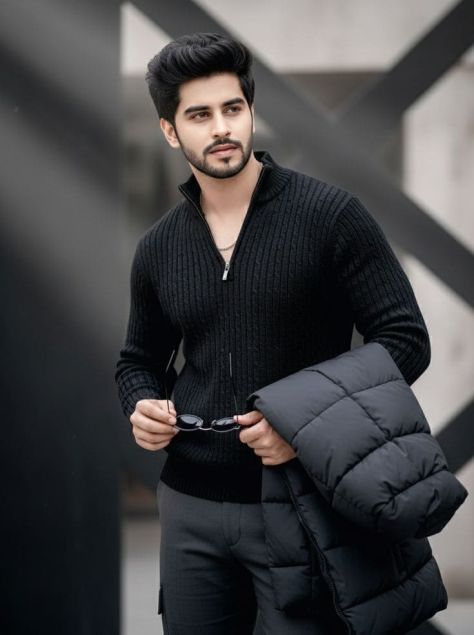
Monochromatic Editorial Portrait in Geometric Architecture
Use the uploaded image as the main visual reference. Recreate the same adult male subject, same modern geometric architectural environment, same monochromatic winter outfit, same black oval sunglasses, same charcoal-black puffer jacket, same three-quarter portrait framing, and same controlled editorial atmosphere. Do not invent a new face, new outfit, new background, or new camera angle. Follow the uploaded image closely and apply only the corrections below.
Generate a photorealistic image of the same adult man, approximately mid-20s to early 30s, with a tapered oval face, mildly rectangular facial structure, sharply defined narrowing jawline, rounded-square chin, moderately prominent cheekbones, straight high-bridge nose, medium-length philtrum, medium almond-shaped dark-brown eyes, thick soft-angled black-brown eyebrows positioned close to the eyes, medium-full closed lips with the lower lip slightly fuller, and a dense sharply lined short boxed beard and moustache, in a vertical 3:4 composition. Show him from the full head to approximately mid-thigh, with clear negative space above his hair. Position his torso close to the centre, his head slightly left of centre, and the carried puffer jacket occupying the lower-right quadrant and extending beyond the bottom-right edge. Keep his torso almost frontal with a mild three-quarter rotation, shoulders slightly descending toward frame-right, head held upright with the chin subtly raised, and both elbows bent. His frame-left hand should hold one temple of the sunglasses in front of his lower abdomen, while his other hand holds the opposite temple near the centre of his waist. His subject-left forearm must support the folded puffer jacket. Keep everything close to the original uploaded image.
Preserve the same facial identity, facial proportions, light-to-medium beige skin with a neutral-warm golden undertone around hue 28°, medium saturation and controlled luminance, almond-shaped dark-brown irises around hue 24° with a dark limbal ring, deep-black hair around hue 220° with low saturation and cool specular highlights, high-volume swept-back hair with shorter tapered sides, fitted near-black charcoal rib-knit quarter-zip sweater, dark charcoal tailored trousers, and overall appearance from the uploaded image. Maintain a relaxed closed-mouth expression with inactive frontalis and corrugator muscles, relaxed orbicularis oculi, relaxed lip corners, minimal mentalis tension, and an upright neck. Change only the gaze so both eyes look directly toward the camera while remaining fully open, aligned, and anatomically natural, with small soft rectangular-white catchlights positioned near the upper-left area of both irises.
Keep the same fitted near-black charcoal quarter-zip sweater, approximately hue 220°, saturation 8%, brightness 10–15%, constructed from dense vertically ribbed knit fabric with a soft matte-satin surface, raised stand collar, long fitted sleeves, ribbed waistband, subtle compression folds around the elbows and lower abdomen, and a small silver-toned metallic zipper partly opened to the upper chest. Retain the fine silver-toned chain visible inside the open collar. Keep the same dark charcoal tailored trousers around hue 220°, saturation 7%, brightness 18–22%, with a smooth low-sheen woven surface, fitted hips and thighs, subtle vertical creases, and the partially visible side-pocket or flap detail. Keep the same matte charcoal-black puffer jacket draped over the subject’s left forearm, with thick synthetic padding, large horizontal quilted baffles, black zipper hardware, soft compression folds, and no visible logo. Keep the same small black oval sunglasses held horizontally with both hands at waist level, with glossy nearly opaque lenses, thin black frame and narrow dark temples. No table or supporting surface is present. No additional foreground objects are present.
The background should follow the uploaded image: a three-layer depth stack consisting of the sharply focused subject and carried accessories in the foreground, heavily blurred geometric wall and structural elements in the middle layer, and a deeper dark recessed corridor or opening on frame-left. Use large near-black diagonal structural bands around hue 220°, saturation 6%, brightness 10–18%, crossing pale beige-grey panels around hue 35°, saturation 10–14%, brightness 68–76%. Keep a lighter warm-grey panel behind the subject’s head and frame-right shoulder, a predominantly dark charcoal recessed area on frame-left, and pale angular and triangular architectural forms near the top of the frame. Apply strong optical background blur with no identifiable furniture, no background people, no readable text, no signage, no logo, no bokeh orbs, no rain, no water, no fog, no airborne particles, no smoke, and no lens flare. The background must remain soft and out of focus with no clear facial details and no readable text.
Use the same broad diffused key light positioned at approximately 10 o’clock and slightly above the subject, striking from front-left at an incidence angle of approximately 35–45 degrees. Use a large softbox-like modifier positioned several feet from the subject. Set the key light near 5450 K and the neutral-cool ambient fill near 5000 K. Illuminate the subject’s frame-left forehead, cheekbone, nose bridge, beard edge and sweater ribs more strongly, with the shadow terminator crossing softly along the frame-right side of the nose, left cheek and jaw. Use approximately 55–65% fill relative to the key so facial shadows retain detail. Add subtle cool-grey environmental bounce from frame-right without a separate hard rim light. Keep small soft catchlights in both eyes. Preserve mild edge separation around the hair and frame-right shoulder from the lighter background. Use a shallow depth of field with the focus point locked on the eyes and facial hair, an approximately 85 mm full-frame portrait focal length, aperture around f/2.0 to f/2.4, minimal perspective distortion, grain level 1/10, and high-end editorial retouching level 8/10. Smooth the forehead, cheeks, under-eye area and jaw while retaining restrained pore texture around the nose, lips and beard boundary. Keep skin highlights narrow and satin-like rather than wet or glossy. Use a neutral-cool monochromatic editorial grade with cool charcoal shadows around hue 220° and slightly warm highlights around hue 32°. Render lit skin around hue 28°, saturation 28%, brightness 68%, and shadowed skin around hue 24°, saturation 22%, brightness 48%.
Render at maximum photorealistic quality. Follow the uploaded image as the primary reference. Preserve exact facial proportions, pose, outfit, lighting, color temperature, environment, foreground objects, and portrait framing. Do not change his identity. Do not make him look like a different person. Do not change the near-black charcoal clothing colors. Do not change the modern geometric architectural setting. No extra people. No extra objects. No text. No watermark. No CGI look. No plastic skin. No anatomical errors. No exaggerated beauty filter. No motion blur. No lens distortion. Ultra-high resolution. Sharp facial detail on the subject. Realistic skin micro-texture. Photorealistic only.