
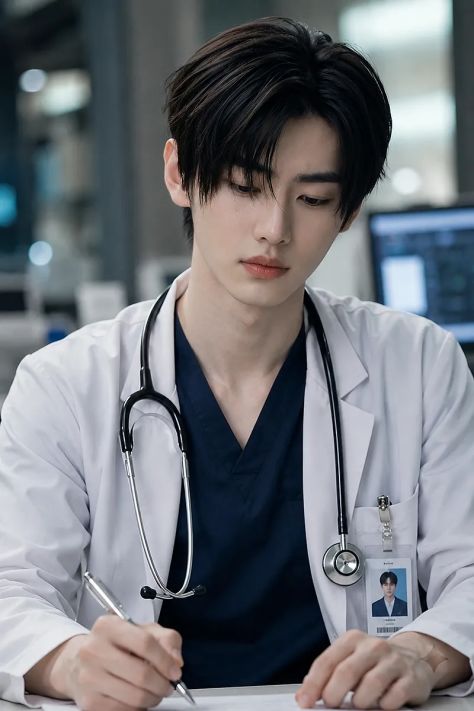
Cinematic Portrait Interior Peaceful Bokeh
Use the uploaded image as the primary visual reference. Recreate the same subject, same clinical workstation setting, same white medical coat and navy scrubs, same framing and composition, same cinematic atmosphere and muted cool-neutral color world. Do not invent a new face, new color scheme, new background, or new camera angle. Apply only the instructions below — follow the uploaded image for everything else.
Generate a photorealistic cinematic editorial portrait of the same human subject wearing a white medical coat over a dark navy V-neck medical top, with a black-and-metal stethoscope around the neck, a metallic pen in hand, and an identification badge attached to the coat. Use a 2:3 vertical frame with an approximately waist-up crop; lower forearms and hands extend toward the bottom edge. Keep the subject centered with a slight rightward bias. The torso is approximately three-quarter toward the camera, the shoulder line descends slightly toward the subject's right, and the subject leans or sits forward while writing. The head is turned slightly downward toward the subject's left and tilted downward approximately 15–20 degrees. Maintain shallow selective depth of field, keeping the face and upper clothing relatively sharp while the clinical environment falls into strong blur.
Preserve the same facial identity and physical appearance exactly as shown in the reference. Maintain the oval-to-soft-angular facial structure, tapered jaw, moderate cheekbone prominence, short nose-to-lip distance, and small rounded chin. Skin must retain the same light behavior and physical appearance as the reference, with warm beige-brown illumination in lit facial zones transitioning into cooler, deeper shadows. Preserve smooth editorial retouching at approximately level 6/10: smoother cheek and forehead areas while retaining subtle natural facial texture; never flatten the skin into a plastic filter.
Eyes must remain narrow and almond-like with dark irises, visible pupils, partially lowered upper eyelids, and a gaze directed downward toward the lower frame. Preserve the small, subdued eye catchlights. Do not make the eyes open wide or camera-facing. Brows remain dark, moderately thick, naturally shaped, and closely following the orbital contours. Keep the lower lip slightly fuller than the upper lip, with a defined cupid's bow and naturally saturated muted reddish-brown coloration with a soft satin finish. Keep the frontalis relaxed, eyelids partially lowered, orbicularis-oris region relaxed, mentalis relaxed, and neck musculature minimally tense. Do not introduce visible foundation, eyeshadow, eyeliner, mascara, blush, or other makeup.
Preserve the same very dark near-black hair with a glossy surface, medium-to-thick strand grouping, moderate volume, directional highlights, and forward-swept strands separated across the forehead. Maintain the same hair texture, length, density, fiber behavior, and light interaction. Do not alter the physical appearance of the subject.
Clothing / Surface: preserve the smooth lightweight white medical coat with relaxed fit, open front, long sleeves, subtle natural folds, and no prominent visible fasteners or decorative logos. Preserve the dark navy V-neck medical top beneath it with matte fabric and minimal visible texture. Preserve the multiple small metallic ear piercings on the subject's left ear. No necklace, glasses, headwear, wristwatch, bracelet, or visible ring. Preserve the metallic pen held near the lower frame and the black-and-metal stethoscope positioned around the neck. Preserve the identification badge attached to the coat, including its portrait photograph and professional formatting, but do not introduce additional readable identifying text.
Preserve the exact hand arrangement: two visible hands/forearms near the lower frame, with one hand gripping the metallic pen and the other partially visible near the writing surface. Maintain natural hand anatomy, correct finger proportions, realistic joints, and the original orientations and positions.
Background: preserve the indoor clinical/workstation environment with substantial blur. Foreground consists of the subject and medical equipment. Midground contains blurred workstation and clinical surfaces. Background contains vertical architectural panels and illuminated equipment. Preserve the diffuse circular and irregular bokeh patches with low edge sharpness. Preserve the blurred monitor/display and clinical workstation elements. No other people are visible. No fog, rain, particles, lens flare, or graphic overlays. Keep the background darker and less exposed than the bright white coat, with a brighter illuminated region toward the upper-right. Background must remain strongly out of focus.
Lighting: use a large soft key source from approximately the 1–2 o'clock upper-right/front-right position, approximately 5000–5600 K, with a close-to-mid distance and broad soft quality. Maintain a soft gradual shadow terminator. Keep deeper shadows along the left facial side and within the hair while preserving comparatively bright illumination across the white coat. Maintain approximately 35–45% visibility within shadow zones through moderate fill. Add only subtle cool edge separation around portions of the hair and background-facing contours. Preserve small subdued reflections in the downward-looking eyes. Maintain cool ambient bounce from the clinical environment. Use broad/short portrait lighting with motivated environmental illumination.
Color: preserve a near-black, very-low-saturation hair palette around 220° hue; neutral, low-saturation white coat; approximately 215° moderately saturated navy scrubs; approximately 25–35° moderately saturated warm facial illumination; and approximately 205° moderately saturated cool-blue background accents. Maintain a muted, filmic saturation level. Apply a cool-neutral cinematic editorial grade with restrained warm separation in the skin. Preserve cooler shadows and comparatively warmer facial highlights, with an overall frame temperature of approximately 4800–5200 K.
Camera: approximately 50–70 mm focal length equivalent, approximately f/2.0–f/2.8 aperture, 2:3 vertical aspect ratio, shallow selective depth of field, approximately 2/10 film grain, and approximately 6/10 editorial retouching. Maintain natural perspective without lens distortion.
Render at maximum photorealistic cinematic photography quality. Follow the uploaded image as the primary reference. Preserve exact facial proportions, physical appearance, pose, clothing, medical equipment placement, hand positioning, lighting, color temperature, clinical environment, depth of field, and framing.
DO NOT change identity, facial structure, skin appearance, hair texture, or physical features. DO NOT shift the skin appearance, material finishes, clothing colors, lighting geometry, or background layout. DO NOT add objects, people, makeup, accessories, or text not present in the original. DO NOT alter the color values. Keep the downward eye gaze and partially lowered eyelids locked exactly as shown. Keep skin retouching at approximately 6/10, with natural facial texture retained.
No extra people. No extra objects. No text overlay. No watermark. No CGI plastic look. No anatomical errors. No beauty filter flattening. No motion blur. No lens distortion. Ultra-high resolution. Razor-sharp subject detail. Natural skin texture. Accurate fabric and medical-equipment surfaces. Photorealistic only.