PromptLabHub
Vibrant Portrait Interior Energetic Backlit
96
96
Prompt

Vibrant Portrait Interior Energetic Backlit

Use the attached photograph as the primary governing reference. Recreate its structure exactly without reinterpreting it.

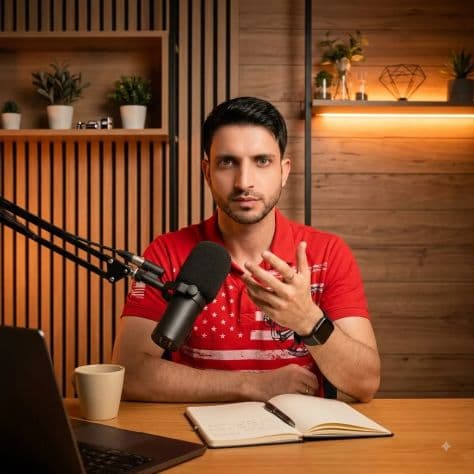
This is a portrait-photographic dominant-figure cover. One centrally framed seated person occupies approximately 61% of canvas height and provides the sole recognition anchor. A large broadcast microphone overlaps the torso from the left. Foreground desk objects — open notebook, cream cup and partially visible laptop — establish the recording workspace environment. No designed title block exists anywhere on the canvas.

Square 1:1 composition, 3000 × 3000 pixels, sRGB. Artwork fills the full canvas edge to edge. No device frame, no mockup, no rounded corners, no border.

Background system constructed bottom upward.

The base layer is a continuous-tone photographic warm timber recording workspace interior. The rear wall is divided into two distinct architectural zones separated by black vertical structural bars at approximately 52–56% and 64–67% canvas width. The left zone from 0–53% width, 0–58% height is covered in narrow vertical wood slats with a rhythmic pattern of approximately 3–5% canvas width per slat-and-gap cycle. The right zone from 53–100% width, 0–57% height is covered in broader horizontal wood boards with a rhythm of approximately 4–7% canvas height per board. Both zones share the same warm amber-brown wood grain character. Black vertical structural bars divide and frame these zones as architectural elements, luminosity approximately 3–7.

An upper-left open shelf sits at approximately 19–52% width, 9–28% height. On this shelf: small decorative plants with olive-green foliage

#40552F in white or natural planters, small decorative objects. An upper-right shelving structure occupies approximately 76–100% width, 10–45% height with a warm amber under-shelf illuminated strip light at approximately 76–100% width, 28–32% height producing a strong horizontal warm amber-orange bloom across the right wall. On these right shelves: small plants, glass vessels, small decorative objects, all partially defocused. A geometric wire-frame diamond or angular decorative object is visible at approximately 80–95% width, 15–30% height.

Apply rear-background depth-of-field softening across shelves, plants, decorative objects and wood surfaces behind the subject at approximately 1–2% canvas width blur radius. Background architectural structure — slat and board rhythms, shelf positions, black bars — remains legible as broad shapes while fine surface detail softens. This is optical camera depth-of-field, not a compositing mask.

Apply a warm amber-orange global colour grade at 20–30% strength across the full canvas. This pulls all timber surfaces and ambient light toward warm amber-orange values while retaining the high-saturation red of the garment and the near-black of the microphone and equipment.

Apply moderate practical-light warm bloom in the left background at approximately 0–25% width, 20–55% height where warm amber ambient illumination radiates from behind the slatted wall, and in the right shelf zone at approximately 76–100% width, 28–45% height from the under-shelf strip light. Bloom colour warm amber

#D78327, spread approximately 1.5–2.5% canvas width from each source.

Apply peripheral luminance falloff vignette at 10–20% strength, strongest at outer 8–12% of each edge. Vignette colour near-black warm brown

#15110C. Irregular edge-hugging photographic falloff, not centred radial. Corner luminosity targets: top-left ≈7, top-right ≈10, bottom-left ≈4, bottom-right ≈54. The bottom-right reading is high because the open notebook and desk surface occupy that region — this is not a symmetrical gradient.

Primary visual element — figure.

One seated person occupies approximately 0–100% width, 16–77% height, optical centre (52%, 48%). Full-colour photographic figure. No cutout, no mask, no silhouette simplification, natural photographic edges throughout. Treatment chain: full-colour photography, warm amber colour grade applied, naturalistic skin rendering retained, optical background separation maintained. No duotone, no halftone, no painterly rendering, no graphic overlay on figure, no artificial contour glow, no cutout drop shadow.

Do not lock the subject's identity, skin tone, facial features, age, ethnicity, nationality, or any demographic characteristic. Preserve only the composition, pose, wardrobe colour, object placement, lighting and camera framing as described below.

Pose — exact.

The person is seated behind a desk, torso approximately frontal with a slight angular offset. Head is nearly frontal. Gaze is directed toward the camera with a serious, composed, direct expression — mouth is closed or very slightly open, not smiling. The right hand is raised to approximately chest-to-chin level in a speaking or emphasis gesture. The fingers of the raised hand are loosely grouped, not clenched into a fist — the hand reads as mid-gesture, as if making a point in conversation. The raised hand occupies approximately 50–76% width, 47–65% height. The left arm extends outward toward the lower-left, resting naturally, with the hand at approximately desk level. The shoulder line is slightly angled. The subject faces inward toward the camera rather than out of frame. Body approaches or intersects both lateral canvas edges.

The person wears a saturated red short-sleeve collared polo shirt. Garment bounding box approximately 0–100% width, 35–77% height. Dominant red colour

#D51D18 in shadow areas,

#ED3225 in highlight areas, luminosity 28–40. The shirt has white graphic motifs — star shapes and stripe-style geometric patterns — visible on the chest area and on the left sleeve. These are geometric decorative graphics, not readable text. A black smartwatch or wrist device is visible on the left wrist at approximately 69–79% width, 57–67% height. A ring is visible on one finger of the raised right hand.

Head bounding box approximately 34–69% width, 16–43% height. Face bounding box approximately 37–67% width, 21–43% height. Face centre approximately (52%, 32%). Face height approximately 22% canvas height. Head height approximately 27% canvas height.

Microphone and boom arm — exact geometry.

The microphone is a large black cylindrical broadcast dynamic microphone with a foam or mesh grille head and a visible mount or shock absorber assembly. Colour charcoal near-black

#181815, matte-satin surface. The microphone occupies approximately 22–55% width, 39–58% height, optical centre (38.5%, 48.5%). It is oriented diagonally, descending from the upper-left boom arm joint toward the lower-right, so the microphone grille points toward the subject's mouth and chin from the left side. The microphone body height/extent is approximately 19% canvas height. The microphone mount assembly with small metallic hardware components is visible at the upper connection point. The boom arm enters the frame from the left edge at approximately 0–34% width, 31–46% height, running mostly horizontally with a slight downward angle from left edge toward the microphone. The boom arm is black articulated metal tubular construction and bleeds off the left edge of the canvas.

Foreground desk.

The desk surface is warm honey-brown wood occupying approximately 0–100% width, 72–100% height and bleeding off the left, right and bottom edges. On the desk from left to right: a cream off-white matte ceramic cup at approximately 3–23% width, 67–80% height, luminosity 65–80, colour

#DCC9A7; an open notebook at approximately 14–98% width, 75–89% height, optical centre (56%, 82%). The notebook has a warm tan-brown cover and open ivory-cream pages

#E7D9B9 with fine dark handwritten strokes visible across both pages — render these as non-readable handwriting texture, not as legible words. A dark pen lies diagonally across the open notebook pages at approximately 50–67% width, 77–83% height. A partially visible laptop occupies approximately 0–60% width, 80–100% height in three-quarter perspective wedge from lower-left toward centre, dark warm charcoal-grey colour

#665B4B, with keyboard partially visible, bleeding off the left and bottom edges.

Surface finish.

The surface carries no added film grain, no digital noise, no paper tooth, no halftone, no scanlines, no distress, no chromatic aberration, and no geometric decorative overlay. Specular highlights appear as small natural photographic accents on the skin, watch face, microphone hardware and cup surface — not graphic glow effects.

Typography.

There is no designed primary title anywhere on this canvas. Title cap-height is 0% of canvas height. Render no title text, no show name, no episode label, no host name, no tagline, no wall sign, no laptop branding, no demographic label, no location label, and no age identifier. The notebook handwriting marks are environmental texture only and must not be rendered as readable characters. No additional readable words, letters or marks anywhere on the canvas.

Closed palette — 13 photographic control families.

#15110C deep warm shadow,

#482B15 dark timber,

#8E5522 mid timber amber-brown,

#D78327 illuminated amber wood and practical light,

#D51D18 primary red garment,

#ED3225 red garment highlight,

#A96849 warm skin midtone reference — adapt naturally to chosen subject while preserving equivalent luminance separation,

#D49B78 warm skin highlight reference — adapt naturally to chosen subject,

#181815 microphone and equipment charcoal,

#E7D9B9 notebook ivory page,

#DCC9A7 cup cream,

#665B4B laptop warm charcoal-grey,

#40552F plant foliage olive. Skin colour references are not locked demographic attributes — they must adapt naturally to the depicted subject while preserving the luminance hierarchy. Continuous photographic tonal interpolation within these families. No additional hue families introduced. The strong red garment must remain the dominant saturated colour field. The warm amber timber system must not be neutralised. Near-black equipment regions must not be lifted toward mid-grey.

Layout and reading order.

Compositional primary axis at x≈52%. Face and raised hand occupy the upper-central zone. Red shirt torso fills the middle zone. Desk objects fill the lower zone. Reading order: face first driven by facial recognition and central placement; red shirt second as the largest saturated colour field; microphone third as a near-black diagonal crossing the red torso from the left; raised hand fourth as a foreground gesture near the face; notebook fifth as a large warm light-value horizontal shape at the bottom. Negative space approximately 10–14%, concentrated in the upper background around the head and between shelf structures. Minimum element-to-edge distance is 0% — subject body, boom arm, laptop, desk and background scene reach or bleed all four edges. Face is safely centred above 16% from the top edge. Lower 8% of canvas carries only laptop, desk and paper surface — no critical identity information placed there.

At 55 pixels wide this cover must read as: a person in a bright red collared shirt beside a black microphone in a warm amber wood recording workspace. The red garment mass and face silhouette are the primary recognition shapes. The microphone reads as a dark diagonal form entering from the left. The open notebook reads as a warm light rectangle at the bottom. All shelf detail, watch, ring, shirt graphics, handwriting, pen and plant leaves may collapse to colour mass at 55 pixels.

Genre register is interview and conversation carried by the broadcast microphone entering from the left, the direct camera-facing gaze, and the seated desk-based workspace with notebook, pen and laptop. Secondary register is education and commentary carried by the open notebook, pen and structured workspace. Brand personality is bold-accessible: high-saturation red garment dominant, warm amber timber environment, large direct-gaze face, prominent microphone.

Do not lock the identity of the depicted person. Preserve pose, wardrobe colour, object placement, lighting character, surface materials and camera framing. Palette is closed to the 13 colour families listed above, with skin tones adapting naturally. No readable text anywhere. Surface is full-colour photographic with no illustrative, graphic, or dimensional conversion. Lower 8% of canvas is kept clear of any critical element.

·
Social Media Banners

レビュー

レビューするにはログインしてください。

まだレビューはありません。最初のレビューを書きましょう。

どのデバイスでも PromptLabHub を。

アプリをインストールしてすばやく開くか、Chrome 拡張機能をダウンロードしてブラウザに読み込めます。

プロンプトを見る

  • すべての Prompt
  • 写真 Prompt
  • 動画 Prompt
  • フード Prompt

作成

  • Prompt を投稿

コミュニティ

  • フォーラム
  • クリエイター
  • リーダーボード
  • ウィークリーチャレンジ

サポート

  • よくある質問
  • お問い合わせ
  • プライバシーポリシー
  • 利用規約

フォローする

Midjourney、DALL-E 3、Sora、Runway など向けの厳選 AI Prompt を発見してコピー。毎週更新。

プライバシーポリシー利用規約Cookie ポリシー

© 2026 PromptLabHub. All rights reserved.

© 2026 PromptLabHub. All rights reserved.

·
プライバシーポリシー·利用規約·Cookie ポリシー
Home
PromptLabHub
Vibrant Portrait Interior Energetic Backlit
96
96
Prompt

Vibrant Portrait Interior Energetic Backlit

Use the attached photograph as the primary governing reference. Recreate its structure exactly without reinterpreting it.

This is a portrait-photographic dominant-figure cover. One centrally framed seated person occupies approximately 61% of canvas height and provides the sole recognition anchor. A large broadcast microphone overlaps the torso from the left. Foreground desk objects — open notebook, cream cup and partially visible laptop — establish the recording workspace environment. No designed title block exists anywhere on the canvas.

Square 1:1 composition, 3000 × 3000 pixels, sRGB. Artwork fills the full canvas edge to edge. No device frame, no mockup, no rounded corners, no border.

Background system constructed bottom upward.

The base layer is a continuous-tone photographic warm timber recording workspace interior. The rear wall is divided into two distinct architectural zones separated by black vertical structural bars at approximately 52–56% and 64–67% canvas width. The left zone from 0–53% width, 0–58% height is covered in narrow vertical wood slats with a rhythmic pattern of approximately 3–5% canvas width per slat-and-gap cycle. The right zone from 53–100% width, 0–57% height is covered in broader horizontal wood boards with a rhythm of approximately 4–7% canvas height per board. Both zones share the same warm amber-brown wood grain character. Black vertical structural bars divide and frame these zones as architectural elements, luminosity approximately 3–7.

An upper-left open shelf sits at approximately 19–52% width, 9–28% height. On this shelf: small decorative plants with olive-green foliage

#40552F in white or natural planters, small decorative objects. An upper-right shelving structure occupies approximately 76–100% width, 10–45% height with a warm amber under-shelf illuminated strip light at approximately 76–100% width, 28–32% height producing a strong horizontal warm amber-orange bloom across the right wall. On these right shelves: small plants, glass vessels, small decorative objects, all partially defocused. A geometric wire-frame diamond or angular decorative object is visible at approximately 80–95% width, 15–30% height.

Apply rear-background depth-of-field softening across shelves, plants, decorative objects and wood surfaces behind the subject at approximately 1–2% canvas width blur radius. Background architectural structure — slat and board rhythms, shelf positions, black bars — remains legible as broad shapes while fine surface detail softens. This is optical camera depth-of-field, not a compositing mask.

Apply a warm amber-orange global colour grade at 20–30% strength across the full canvas. This pulls all timber surfaces and ambient light toward warm amber-orange values while retaining the high-saturation red of the garment and the near-black of the microphone and equipment.

Apply moderate practical-light warm bloom in the left background at approximately 0–25% width, 20–55% height where warm amber ambient illumination radiates from behind the slatted wall, and in the right shelf zone at approximately 76–100% width, 28–45% height from the under-shelf strip light. Bloom colour warm amber

#D78327, spread approximately 1.5–2.5% canvas width from each source.

Apply peripheral luminance falloff vignette at 10–20% strength, strongest at outer 8–12% of each edge. Vignette colour near-black warm brown

#15110C. Irregular edge-hugging photographic falloff, not centred radial. Corner luminosity targets: top-left ≈7, top-right ≈10, bottom-left ≈4, bottom-right ≈54. The bottom-right reading is high because the open notebook and desk surface occupy that region — this is not a symmetrical gradient.

Primary visual element — figure.

One seated person occupies approximately 0–100% width, 16–77% height, optical centre (52%, 48%). Full-colour photographic figure. No cutout, no mask, no silhouette simplification, natural photographic edges throughout. Treatment chain: full-colour photography, warm amber colour grade applied, naturalistic skin rendering retained, optical background separation maintained. No duotone, no halftone, no painterly rendering, no graphic overlay on figure, no artificial contour glow, no cutout drop shadow.

Do not lock the subject's identity, skin tone, facial features, age, ethnicity, nationality, or any demographic characteristic. Preserve only the composition, pose, wardrobe colour, object placement, lighting and camera framing as described below.

Pose — exact.

The person is seated behind a desk, torso approximately frontal with a slight angular offset. Head is nearly frontal. Gaze is directed toward the camera with a serious, composed, direct expression — mouth is closed or very slightly open, not smiling. The right hand is raised to approximately chest-to-chin level in a speaking or emphasis gesture. The fingers of the raised hand are loosely grouped, not clenched into a fist — the hand reads as mid-gesture, as if making a point in conversation. The raised hand occupies approximately 50–76% width, 47–65% height. The left arm extends outward toward the lower-left, resting naturally, with the hand at approximately desk level. The shoulder line is slightly angled. The subject faces inward toward the camera rather than out of frame. Body approaches or intersects both lateral canvas edges.

The person wears a saturated red short-sleeve collared polo shirt. Garment bounding box approximately 0–100% width, 35–77% height. Dominant red colour

#D51D18 in shadow areas,

#ED3225 in highlight areas, luminosity 28–40. The shirt has white graphic motifs — star shapes and stripe-style geometric patterns — visible on the chest area and on the left sleeve. These are geometric decorative graphics, not readable text. A black smartwatch or wrist device is visible on the left wrist at approximately 69–79% width, 57–67% height. A ring is visible on one finger of the raised right hand.

Head bounding box approximately 34–69% width, 16–43% height. Face bounding box approximately 37–67% width, 21–43% height. Face centre approximately (52%, 32%). Face height approximately 22% canvas height. Head height approximately 27% canvas height.

Microphone and boom arm — exact geometry.

The microphone is a large black cylindrical broadcast dynamic microphone with a foam or mesh grille head and a visible mount or shock absorber assembly. Colour charcoal near-black

#181815, matte-satin surface. The microphone occupies approximately 22–55% width, 39–58% height, optical centre (38.5%, 48.5%). It is oriented diagonally, descending from the upper-left boom arm joint toward the lower-right, so the microphone grille points toward the subject's mouth and chin from the left side. The microphone body height/extent is approximately 19% canvas height. The microphone mount assembly with small metallic hardware components is visible at the upper connection point. The boom arm enters the frame from the left edge at approximately 0–34% width, 31–46% height, running mostly horizontally with a slight downward angle from left edge toward the microphone. The boom arm is black articulated metal tubular construction and bleeds off the left edge of the canvas.

Foreground desk.

The desk surface is warm honey-brown wood occupying approximately 0–100% width, 72–100% height and bleeding off the left, right and bottom edges. On the desk from left to right: a cream off-white matte ceramic cup at approximately 3–23% width, 67–80% height, luminosity 65–80, colour

#DCC9A7; an open notebook at approximately 14–98% width, 75–89% height, optical centre (56%, 82%). The notebook has a warm tan-brown cover and open ivory-cream pages

#E7D9B9 with fine dark handwritten strokes visible across both pages — render these as non-readable handwriting texture, not as legible words. A dark pen lies diagonally across the open notebook pages at approximately 50–67% width, 77–83% height. A partially visible laptop occupies approximately 0–60% width, 80–100% height in three-quarter perspective wedge from lower-left toward centre, dark warm charcoal-grey colour

#665B4B, with keyboard partially visible, bleeding off the left and bottom edges.

Surface finish.

The surface carries no added film grain, no digital noise, no paper tooth, no halftone, no scanlines, no distress, no chromatic aberration, and no geometric decorative overlay. Specular highlights appear as small natural photographic accents on the skin, watch face, microphone hardware and cup surface — not graphic glow effects.

Typography.

There is no designed primary title anywhere on this canvas. Title cap-height is 0% of canvas height. Render no title text, no show name, no episode label, no host name, no tagline, no wall sign, no laptop branding, no demographic label, no location label, and no age identifier. The notebook handwriting marks are environmental texture only and must not be rendered as readable characters. No additional readable words, letters or marks anywhere on the canvas.

Closed palette — 13 photographic control families.

#15110C deep warm shadow,

#482B15 dark timber,

#8E5522 mid timber amber-brown,

#D78327 illuminated amber wood and practical light,

#D51D18 primary red garment,

#ED3225 red garment highlight,

#A96849 warm skin midtone reference — adapt naturally to chosen subject while preserving equivalent luminance separation,

#D49B78 warm skin highlight reference — adapt naturally to chosen subject,

#181815 microphone and equipment charcoal,

#E7D9B9 notebook ivory page,

#DCC9A7 cup cream,

#665B4B laptop warm charcoal-grey,

#40552F plant foliage olive. Skin colour references are not locked demographic attributes — they must adapt naturally to the depicted subject while preserving the luminance hierarchy. Continuous photographic tonal interpolation within these families. No additional hue families introduced. The strong red garment must remain the dominant saturated colour field. The warm amber timber system must not be neutralised. Near-black equipment regions must not be lifted toward mid-grey.

Layout and reading order.

Compositional primary axis at x≈52%. Face and raised hand occupy the upper-central zone. Red shirt torso fills the middle zone. Desk objects fill the lower zone. Reading order: face first driven by facial recognition and central placement; red shirt second as the largest saturated colour field; microphone third as a near-black diagonal crossing the red torso from the left; raised hand fourth as a foreground gesture near the face; notebook fifth as a large warm light-value horizontal shape at the bottom. Negative space approximately 10–14%, concentrated in the upper background around the head and between shelf structures. Minimum element-to-edge distance is 0% — subject body, boom arm, laptop, desk and background scene reach or bleed all four edges. Face is safely centred above 16% from the top edge. Lower 8% of canvas carries only laptop, desk and paper surface — no critical identity information placed there.

At 55 pixels wide this cover must read as: a person in a bright red collared shirt beside a black microphone in a warm amber wood recording workspace. The red garment mass and face silhouette are the primary recognition shapes. The microphone reads as a dark diagonal form entering from the left. The open notebook reads as a warm light rectangle at the bottom. All shelf detail, watch, ring, shirt graphics, handwriting, pen and plant leaves may collapse to colour mass at 55 pixels.

Genre register is interview and conversation carried by the broadcast microphone entering from the left, the direct camera-facing gaze, and the seated desk-based workspace with notebook, pen and laptop. Secondary register is education and commentary carried by the open notebook, pen and structured workspace. Brand personality is bold-accessible: high-saturation red garment dominant, warm amber timber environment, large direct-gaze face, prominent microphone.

Do not lock the identity of the depicted person. Preserve pose, wardrobe colour, object placement, lighting character, surface materials and camera framing. Palette is closed to the 13 colour families listed above, with skin tones adapting naturally. No readable text anywhere. Surface is full-colour photographic with no illustrative, graphic, or dimensional conversion. Lower 8% of canvas is kept clear of any critical element.

·
Social Media Banners

レビュー

レビューするにはログインしてください。

まだレビューはありません。最初のレビューを書きましょう。

どのデバイスでも PromptLabHub を。

アプリをインストールしてすばやく開くか、Chrome 拡張機能をダウンロードしてブラウザに読み込めます。

プロンプトを見る

  • すべての Prompt
  • 写真 Prompt
  • 動画 Prompt
  • フード Prompt

作成

  • Prompt を投稿

コミュニティ

  • フォーラム
  • クリエイター
  • リーダーボード
  • ウィークリーチャレンジ

サポート

  • よくある質問
  • お問い合わせ
  • プライバシーポリシー
  • 利用規約

フォローする

Midjourney、DALL-E 3、Sora、Runway など向けの厳選 AI Prompt を発見してコピー。毎週更新。

プライバシーポリシー利用規約Cookie ポリシー

© 2026 PromptLabHub. All rights reserved.

© 2026 PromptLabHub. All rights reserved.

·
プライバシーポリシー·利用規約·Cookie ポリシー
Home