
PromptLabHub
Editorial Product Nature Dramatic Natural Bokeh
1
1
Prompt

Editorial Product Nature Dramatic Natural Bokeh

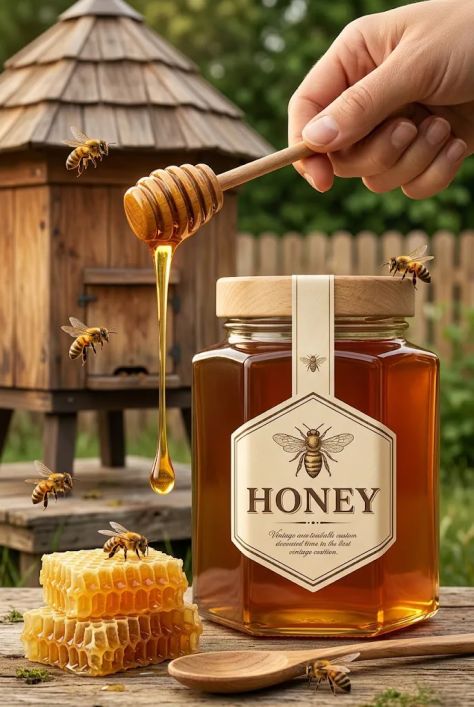
Use the uploaded image as the main visual reference. Recreate the same rustic premium honey advertising composition: the same large faceted glass honey jar filled with amber honey, same light wooden lid, same vertical cream neck band, same large hexagonal HONEY label, same hand entering from the upper-right holding a wooden honey dipper, same uninterrupted suspended honey stream, same stacked honeycomb blocks, same wooden spoon, same individually separated bees, same large wooden beehive on viewer-left, same natural wood/earth surface, same grass, same blurred fence and green foliage, same framing, and same warm outdoor daylight. Do not invent a different jar, packaging design, label structure, hive, background, props, camera angle, or color palette.

Generate an ultra-photorealistic rustic artisanal honey commercial / premium farm-to-table product advertisement in a 2:3 vertical composition matching approximately 736 × 1104 proportional framing.

COMPOSITION — LOCK FIRST

Place the main honey jar in the lower-right / center-right portion of the frame.

The jar should occupy approximately:

45–48% of total frame width

48–52% of total frame height

Keep its base near the lower-right quarter.

Position the large wooden beehive behind it on viewer-left, occupying much of the left background while remaining clearly subordinate to the hero product.

Place two stacked honeycomb blocks in the lower-left foreground.

Place one shallow wooden spoon across the lower-center/right foreground.

From the upper-right edge, introduce one human hand holding a wooden honey dipper diagonally toward center-left.

Create a strong visual flow:

hand → dipper handle → grooved dipper head → descending honey stream → jar lid → HONEY label → stacked honeycomb → wooden spoon.

Maintain this depth stack:

foreground spoon + honeycomb → hero jar → honey dipper + nearby bees → wooden hive → blurred wooden fence → deeply defocused green foliage.

Use a slightly low-to-eye-level commercial product camera angle with moderate perspective compression.

Do not turn this into a symmetrical studio composition.

HERO JAR — EXACT FORM

Preserve a broad faceted polygonal/hexagonal glass honey jar.

Keep:

broad body;

body width approximately equal to or slightly greater than visible body height;

straight polygonal sides;

beveled shoulders;

short cylindrical neck;

large flat central front face;

angled transparent side facets;

broad flat base;

strongly beveled bottom corners.

Construct the jar from clear highly polished transparent glass.

Make the glass visibly thick at the corners, shoulders and bottom.

Use high optical transparency while creating strong amber distortions through the angled side planes.

Add:

broad soft white-gold reflections along the front-left facets;

narrower highlights on side edges;

strong orange/amber refraction through the side planes;

concentrated golden caustics near the lower facets;

realistic thick-glass distortions around the base.

The glass must remain pristine.

No scratches.

No condensation.

No dust.

No frosting.

No fingerprints.

HONEY INSIDE THE JAR

Fill the jar almost to shoulder level with deep transparent amber-golden honey around H 28–38°, S 75–95%.

Maintain medium-high transparency and very high viscosity.

The central honey should glow amber-gold while thick optical paths along the side facets deepen toward burnt orange/brown.

Create realistic light transmission through the honey and powerful internal amber refraction around the beveled glass edges.

The honey should appear:

dense;

sticky;

transparent;

high-viscosity;

optically rich;

naturally luminous.

Do not make the honey watery.

Do not make it opaque.

Do not shift it toward neon orange or lemon yellow.

WOODEN LID

Preserve the wide circular lid made from light natural wood/bamboo.

Use a warm beige/tan wooden tone with a matte-to-satin finish.

Make the lid a shallow cylindrical disk with softly rounded outer edges, slightly wider than the jar neck.

Show fine realistic wood grain.

Keep the wood unpainted and natural.

No metal lid.

No branding on the lid.

No glossy lacquer appearance.

VERTICAL NECK BAND

Preserve the narrow cream paper/fabric strip descending vertically from beneath the lid.

Position it around the center-to-slightly-right front of the neck.

Keep its width approximately 10–12% of the lid width.

Use warm ivory/off-white matte paper with:

thin dark border lines on both sides;

a small bee/crest motif near the upper portion;

subtle natural paper texture.

Let the band overlap naturally with the jar neck and main label system.

MAIN HEXAGONAL LABEL

Center a large warm ivory hexagonal/polygonal paper label on the jar’s main front face.

Use a vertical six-sided badge structure with thin dark double-line borders.

Keep the label matte with very subtle fibrous paper grain.

At the upper portion, include a detailed dark brown/near-black illustrated bee.

Preserve several small decorative vintage-apothecary text lines, but do not invent prominent unrelated branding.

The primary readable word must be:

HONEY

Render HONEY in a large uppercase classical serif, medium-bold, dark brown to near-black, centered across the middle-lower portion of the label.

Place smaller decorative copy above and below it, maintaining a premium vintage honey/apothecary aesthetic.

Keep HONEY as the dominant readable typography.

Do not change the label into a modern minimalist sticker.

HUMAN HAND

Generate exactly one visible human hand entering naturally from the upper-right edge.

Only show:

fingers;

thumb;

palm edge;

partial wrist.

The hand should hold the narrow honey-dipper handle between the thumb and index finger while the middle fingers support it from below.

Curve the index finger naturally over the handle.

Keep the thumb on the opposite side.

Keep the remaining fingers relaxed.

Use short, clean, natural nails with a matte-to-soft-satin finish.

Render the skin as light warm-neutral peach-beige, with fine realistic microtexture and restrained smoothing.

No jewelry.

No ring.

No bracelet.

No watch.

No nail polish.

No extra hand.

HAND-HELD HONEY DIPPER

Create one large wooden honey dipper in the upper-middle of the frame.

The handle must extend diagonally from the dipper head toward the hand at upper-right.

Position the grooved dipper head to the left of the hand.

Use natural polished warm wood around H 28–35°.

Make the head a rounded cylindrical spool with a domed end and approximately 4–5 deep concentric grooves.

Fill the grooves with thick amber honey.

Use satin natural wood beneath the honey with bright warm specular highlights where the syrup coats the grooves.

The hand must clearly grip the narrow handle, never the grooved head.

HONEY DRIP — CRITICAL

From the lowest edge of the grooved dipper head, create one dominant continuous vertical honey stream.

Build the stream as:

narrow upper filament → elongated teardrop swelling at midpoint → thin continuous lower filament → rounded suspended terminal droplet.

Use transparent amber-gold honey with high surface tension.

The stream must appear extremely viscous, sticky and stringy.

Use strong back/side illumination to create luminous yellow-gold edges and transparent amber internal depth.

Freeze the drip perfectly in time.

No splash.

No broken stream.

No multiple competing honey strings.

No watery behavior.

The complete honey path must read clearly from the dipper head to the terminal droplet.

BEES — INDIVIDUALLY READABLE

Include approximately six clearly separated realistic honey bees, never a dense swarm.

Place them approximately as follows:

one upper-left/center near the hive roof;

one mid-left hovering in front of the hive door;

one lower/mid-left near the honeycomb area;

one upper-right near or hovering over the wooden jar lid;

one perched on the upper honeycomb block;

one lower-right near the wooden spoon handle.

Each bee should have:

fuzzy ochre/golden-brown thorax;

alternating amber and dark brown/black abdominal stripes;

glossy near-black compound eyes;

six thin articulated dark legs;

two fine antennae;

transparent pale gray/gold-tinted wings;

clearly resolved wing-vein networks;

subtle bright glints along wing edges.

Flying bees should have wings extended laterally/backward.

Perched bees must visibly contact the honeycomb, lid or spoon.

Keep insects largely frozen with essentially no motion blur.

Do not create a swarm.

STACKED HONEYCOMB

Place exactly two dominant honeycomb slabs in the lower-left foreground.

Make the lower slab broader and flatter.

Place the smaller upper slab slightly offset above it.

Use rough rectangular cut forms with irregular natural edges.

Preserve clearly recognizable repeating hexagonal cells.

Use:

luminous yellow-gold wax around H 38–48°;

amber-orange honey inside the cells;

darker amber cell centers;

bright golden rims;

semi-translucent wax;

wet glossy honey coating.

Show slight honey wetness along cut edges.

Keep one bee interacting with the upper slab.

The honeycomb must look naturally cut and sticky, not like a perfect synthetic hexagonal block.

WOODEN SPOON

Place one shallow wooden spoon across the lower-center/right foreground.

Orient it nearly horizontally with a slight diagonal.

Keep its bowl toward viewer-left and handle extending toward viewer-right.

Use natural light-brown wood with visible grain and a matte-to-satin finish.

Keep honey coverage minimal or absent compared with the dipper.

Place one bee close to the spoon’s right-side handle/end.

No branding on the spoon.

WOODEN BEEHIVE

Preserve the large rustic beehive structure on viewer-left in the background.

Construct it as a small house-like apiary box elevated on dark wooden legs.

Use warm medium-brown wood with a matte/weathered finish.

Create:

vertical wooden body;

rectangular framed front door/panel;

dark support legs;

large multi-tiered conical/pyramidal shingle roof;

layered radial wooden shingles;

strong wood grain;

cracks;

weathered ridges;

small pointed polygonal roof cap.

Use darker weathered brown on the roof than on the hive body.

Keep the hive large and recognizable but softer and lower contrast than the hero jar.

GROUND / FOREGROUND SURFACE

Use a rustic outdoor wood/earth/table-like brown support surface.

Keep it matte rather than reflective.

Show fine natural grain, slight dirt and weathering.

Add patches of muted green grass around the lower-left and behind the honeycomb.

Create soft natural contact shadows beneath:

jar;

honeycomb;

spoon.

Do not create glossy studio reflections.

BACKGROUND — OUTDOOR APIARY

Create a natural outdoor apiary/garden depth stack.

Behind the hive and jar, include a warm tan/brown wooden fence in moderate-to-strong blur.

Beyond that, create dense dark-green foliage around H 90–125°, strongly defocused into creamy organic shapes.

No visible sky.

No buildings beyond the hive.

No people.

No text overlay.

No artificial point-light bokeh.

The background should be recognizable as a natural outdoor setting while remaining strongly blurred so the product dominates.

LIGHTING

Use soft warm-natural commercial daylight from approximately 10–11 o’clock / upper-left-front at 4700–5200 K.

Use a broad soft key rather than dramatic studio split lighting.

Keep fill around 45–55%, ensuring the shadow side remains fully readable.

On the hand, place the brightest illumination across the upper fingers and knuckles with soft lower shadows.

On the wooden dipper, create warm top/front highlights that reveal grain and honey-filled grooves.

Back/side illuminate the honey stream so it glows transparent amber-gold.

On the jar, create broad soft daylight reflections across the front-left and side facets.

Use subtle warm backlighting through the jar to generate internal honey glow.

Illuminate the wooden lid softly enough to reveal its grain.

Keep the cream label evenly front-lit and fully readable.

Illuminate honeycomb from upper/front so the individual cell depth remains clear.

Catch warm highlights on bee thorax hairs and wing edges.

Keep the hive slightly darker and softer than the foreground.

Use subtle golden rim illumination along selected jar edges and the honey stream.

Add warm amber/brown environmental bounce from honey, wood and ground.

Do not convert the scene into glossy black studio lighting.

COLOR SYSTEM

Lock the palette to:

honey: amber-gold H 28–38°, S 75–95%;

wood: warm brown H 25–35°;

honeycomb: golden yellow H 38–48°;

foliage: muted/deep natural green H 90–125°;

label/band: warm cream/ivory H 40–50° with low saturation;

bees/typography: dark brown to near-black accents;

hand: warm-neutral peach-beige.

Apply a warm rustic honey-and-wood commercial grade with natural green environmental contrast.

Keep shadows warm brown/olive rather than neutral black.

Use cream-gold daylight highlights.

Do not push the scene toward orange neon, lemon yellow, cold gray or oversaturated artificial green.

CAMERA / DEPTH OF FIELD

Simulate approximately a 70–100 mm food/product lens at f/3.5–f/5.6.

Use moderate selective depth of field.

Keep the sharpest zones on:

HONEY label;

jar front facets;

honey contents;

hand-held dipper;

descending honey stream;

stacked foreground honeycomb.

Keep nearby bees moderately sharp.

Make the wooden hive softer.

Make the fence and distant green foliage the softest depth layer.

Place the principal focus plane across the jar front and honey-dipper area.

Use:

grain 1–2/10;

post-processing 8–9/10;

medium-high contrast;

soft black point;

extremely mild vignette;

minimal bloom only on strongest honey highlights;

no lens flare;

no chromatic aberration;

essentially zero motion blur.

VISUAL HIERARCHY

Maintain this priority:

faceted honey jar → hand-held honey dipper + honey stream → HONEY label → stacked honeycomb → individually separated bees → rustic wooden hive → wooden spoon + natural environment.

Keep the hero jar substantially larger and visually more dominant than the bees and honeycomb.

Maintain the left/right balance:

large hive + honeycomb on viewer-left ↔ hero jar + hand/dipper on viewer-right.

STRICT PRESERVATION RULES

Do not change the jar into a cylindrical jar.

Do not remove the polygonal/faceted glass structure.

Do not make the jar smaller than the honeycomb.

Do not use a metal lid.

Do not remove the wooden lid grain.

Do not remove the vertical cream neck band.

Do not change the main label into a rectangle.

Do not remove the large readable word HONEY.

Do not invent unrelated large branding.

Do not add extra hands.

Do not add jewelry.

Do not alter the natural short nails.

Do not let the hand grip the grooved dipper head.

Do not break the primary honey stream.

Do not create a honey splash.

Do not make the honey watery or opaque.

Do not create dozens of bees.

Do not form a dense bee swarm.

Do not remove the two stacked honeycomb blocks.

Do not smooth away the honeycomb cells.

Do not make the hive dominate the hero product.

Do not replace the rustic hive with a modern commercial bee box.

Do not create glossy reflective studio flooring.

Do not remove the grass and natural outdoor context.

Do not replace the garden background with a black or gold studio background.

Do not sharpen the fence and distant foliage as much as the product.

No extra people. No extra jars. No flowers. No smoke. No fog. No rain. No atmospheric particle field. No watermark. No artificial neon colors. No dramatic lens flare. No motion blur.

Ultra-high resolution. Preserve clear faceted glass, dense transparent amber honey, matte natural wood, fibrous ivory paper, wet glossy honeycomb, fuzzy bee thoraxes, translucent veined wings, natural hand texture, and soft outdoor background depth.

Photorealistic rustic premium honey advertising photography only.

·
Photo Prompts

レビュー

レビューするにはログインしてください。

まだレビューはありません。最初のレビューを書きましょう。

どのデバイスでも PromptLabHub を。

アプリをインストールしてすばやく開くか、Chrome 拡張機能をダウンロードしてブラウザに読み込めます。

プロンプトを見る

  • すべての Prompt
  • 写真 Prompt
  • 動画 Prompt
  • フード Prompt

作成

  • Prompt を投稿

コミュニティ

  • フォーラム
  • クリエイター
  • リーダーボード
  • ウィークリーチャレンジ

サポート

  • よくある質問
  • お問い合わせ
  • プライバシーポリシー
  • 利用規約

フォローする

Midjourney、DALL-E 3、Sora、Runway など向けの厳選 AI Prompt を発見してコピー。毎週更新。

プライバシーポリシー利用規約Cookie ポリシー

© 2026 PromptLabHub. All rights reserved.

© 2026 PromptLabHub. All rights reserved.

·
プライバシーポリシー·利用規約·Cookie ポリシー
Home
PromptLabHub
Editorial Product Nature Dramatic Natural Bokeh
1
1
Prompt

Editorial Product Nature Dramatic Natural Bokeh

Use the uploaded image as the main visual reference. Recreate the same rustic premium honey advertising composition: the same large faceted glass honey jar filled with amber honey, same light wooden lid, same vertical cream neck band, same large hexagonal HONEY label, same hand entering from the upper-right holding a wooden honey dipper, same uninterrupted suspended honey stream, same stacked honeycomb blocks, same wooden spoon, same individually separated bees, same large wooden beehive on viewer-left, same natural wood/earth surface, same grass, same blurred fence and green foliage, same framing, and same warm outdoor daylight. Do not invent a different jar, packaging design, label structure, hive, background, props, camera angle, or color palette.

Generate an ultra-photorealistic rustic artisanal honey commercial / premium farm-to-table product advertisement in a 2:3 vertical composition matching approximately 736 × 1104 proportional framing.

COMPOSITION — LOCK FIRST

Place the main honey jar in the lower-right / center-right portion of the frame.

The jar should occupy approximately:

45–48% of total frame width

48–52% of total frame height

Keep its base near the lower-right quarter.

Position the large wooden beehive behind it on viewer-left, occupying much of the left background while remaining clearly subordinate to the hero product.

Place two stacked honeycomb blocks in the lower-left foreground.

Place one shallow wooden spoon across the lower-center/right foreground.

From the upper-right edge, introduce one human hand holding a wooden honey dipper diagonally toward center-left.

Create a strong visual flow:

hand → dipper handle → grooved dipper head → descending honey stream → jar lid → HONEY label → stacked honeycomb → wooden spoon.

Maintain this depth stack:

foreground spoon + honeycomb → hero jar → honey dipper + nearby bees → wooden hive → blurred wooden fence → deeply defocused green foliage.

Use a slightly low-to-eye-level commercial product camera angle with moderate perspective compression.

Do not turn this into a symmetrical studio composition.

HERO JAR — EXACT FORM

Preserve a broad faceted polygonal/hexagonal glass honey jar.

Keep:

broad body;

body width approximately equal to or slightly greater than visible body height;

straight polygonal sides;

beveled shoulders;

short cylindrical neck;

large flat central front face;

angled transparent side facets;

broad flat base;

strongly beveled bottom corners.

Construct the jar from clear highly polished transparent glass.

Make the glass visibly thick at the corners, shoulders and bottom.

Use high optical transparency while creating strong amber distortions through the angled side planes.

Add:

broad soft white-gold reflections along the front-left facets;

narrower highlights on side edges;

strong orange/amber refraction through the side planes;

concentrated golden caustics near the lower facets;

realistic thick-glass distortions around the base.

The glass must remain pristine.

No scratches.

No condensation.

No dust.

No frosting.

No fingerprints.

HONEY INSIDE THE JAR

Fill the jar almost to shoulder level with deep transparent amber-golden honey around H 28–38°, S 75–95%.

Maintain medium-high transparency and very high viscosity.

The central honey should glow amber-gold while thick optical paths along the side facets deepen toward burnt orange/brown.

Create realistic light transmission through the honey and powerful internal amber refraction around the beveled glass edges.

The honey should appear:

dense;

sticky;

transparent;

high-viscosity;

optically rich;

naturally luminous.

Do not make the honey watery.

Do not make it opaque.

Do not shift it toward neon orange or lemon yellow.

WOODEN LID

Preserve the wide circular lid made from light natural wood/bamboo.

Use a warm beige/tan wooden tone with a matte-to-satin finish.

Make the lid a shallow cylindrical disk with softly rounded outer edges, slightly wider than the jar neck.

Show fine realistic wood grain.

Keep the wood unpainted and natural.

No metal lid.

No branding on the lid.

No glossy lacquer appearance.

VERTICAL NECK BAND

Preserve the narrow cream paper/fabric strip descending vertically from beneath the lid.

Position it around the center-to-slightly-right front of the neck.

Keep its width approximately 10–12% of the lid width.

Use warm ivory/off-white matte paper with:

thin dark border lines on both sides;

a small bee/crest motif near the upper portion;

subtle natural paper texture.

Let the band overlap naturally with the jar neck and main label system.

MAIN HEXAGONAL LABEL

Center a large warm ivory hexagonal/polygonal paper label on the jar’s main front face.

Use a vertical six-sided badge structure with thin dark double-line borders.

Keep the label matte with very subtle fibrous paper grain.

At the upper portion, include a detailed dark brown/near-black illustrated bee.

Preserve several small decorative vintage-apothecary text lines, but do not invent prominent unrelated branding.

The primary readable word must be:

HONEY

Render HONEY in a large uppercase classical serif, medium-bold, dark brown to near-black, centered across the middle-lower portion of the label.

Place smaller decorative copy above and below it, maintaining a premium vintage honey/apothecary aesthetic.

Keep HONEY as the dominant readable typography.

Do not change the label into a modern minimalist sticker.

HUMAN HAND

Generate exactly one visible human hand entering naturally from the upper-right edge.

Only show:

fingers;

thumb;

palm edge;

partial wrist.

The hand should hold the narrow honey-dipper handle between the thumb and index finger while the middle fingers support it from below.

Curve the index finger naturally over the handle.

Keep the thumb on the opposite side.

Keep the remaining fingers relaxed.

Use short, clean, natural nails with a matte-to-soft-satin finish.

Render the skin as light warm-neutral peach-beige, with fine realistic microtexture and restrained smoothing.

No jewelry.

No ring.

No bracelet.

No watch.

No nail polish.

No extra hand.

HAND-HELD HONEY DIPPER

Create one large wooden honey dipper in the upper-middle of the frame.

The handle must extend diagonally from the dipper head toward the hand at upper-right.

Position the grooved dipper head to the left of the hand.

Use natural polished warm wood around H 28–35°.

Make the head a rounded cylindrical spool with a domed end and approximately 4–5 deep concentric grooves.

Fill the grooves with thick amber honey.

Use satin natural wood beneath the honey with bright warm specular highlights where the syrup coats the grooves.

The hand must clearly grip the narrow handle, never the grooved head.

HONEY DRIP — CRITICAL

From the lowest edge of the grooved dipper head, create one dominant continuous vertical honey stream.

Build the stream as:

narrow upper filament → elongated teardrop swelling at midpoint → thin continuous lower filament → rounded suspended terminal droplet.

Use transparent amber-gold honey with high surface tension.

The stream must appear extremely viscous, sticky and stringy.

Use strong back/side illumination to create luminous yellow-gold edges and transparent amber internal depth.

Freeze the drip perfectly in time.

No splash.

No broken stream.

No multiple competing honey strings.

No watery behavior.

The complete honey path must read clearly from the dipper head to the terminal droplet.

BEES — INDIVIDUALLY READABLE

Include approximately six clearly separated realistic honey bees, never a dense swarm.

Place them approximately as follows:

one upper-left/center near the hive roof;

one mid-left hovering in front of the hive door;

one lower/mid-left near the honeycomb area;

one upper-right near or hovering over the wooden jar lid;

one perched on the upper honeycomb block;

one lower-right near the wooden spoon handle.

Each bee should have:

fuzzy ochre/golden-brown thorax;

alternating amber and dark brown/black abdominal stripes;

glossy near-black compound eyes;

six thin articulated dark legs;

two fine antennae;

transparent pale gray/gold-tinted wings;

clearly resolved wing-vein networks;

subtle bright glints along wing edges.

Flying bees should have wings extended laterally/backward.

Perched bees must visibly contact the honeycomb, lid or spoon.

Keep insects largely frozen with essentially no motion blur.

Do not create a swarm.

STACKED HONEYCOMB

Place exactly two dominant honeycomb slabs in the lower-left foreground.

Make the lower slab broader and flatter.

Place the smaller upper slab slightly offset above it.

Use rough rectangular cut forms with irregular natural edges.

Preserve clearly recognizable repeating hexagonal cells.

Use:

luminous yellow-gold wax around H 38–48°;

amber-orange honey inside the cells;

darker amber cell centers;

bright golden rims;

semi-translucent wax;

wet glossy honey coating.

Show slight honey wetness along cut edges.

Keep one bee interacting with the upper slab.

The honeycomb must look naturally cut and sticky, not like a perfect synthetic hexagonal block.

WOODEN SPOON

Place one shallow wooden spoon across the lower-center/right foreground.

Orient it nearly horizontally with a slight diagonal.

Keep its bowl toward viewer-left and handle extending toward viewer-right.

Use natural light-brown wood with visible grain and a matte-to-satin finish.

Keep honey coverage minimal or absent compared with the dipper.

Place one bee close to the spoon’s right-side handle/end.

No branding on the spoon.

WOODEN BEEHIVE

Preserve the large rustic beehive structure on viewer-left in the background.

Construct it as a small house-like apiary box elevated on dark wooden legs.

Use warm medium-brown wood with a matte/weathered finish.

Create:

vertical wooden body;

rectangular framed front door/panel;

dark support legs;

large multi-tiered conical/pyramidal shingle roof;

layered radial wooden shingles;

strong wood grain;

cracks;

weathered ridges;

small pointed polygonal roof cap.

Use darker weathered brown on the roof than on the hive body.

Keep the hive large and recognizable but softer and lower contrast than the hero jar.

GROUND / FOREGROUND SURFACE

Use a rustic outdoor wood/earth/table-like brown support surface.

Keep it matte rather than reflective.

Show fine natural grain, slight dirt and weathering.

Add patches of muted green grass around the lower-left and behind the honeycomb.

Create soft natural contact shadows beneath:

jar;

honeycomb;

spoon.

Do not create glossy studio reflections.

BACKGROUND — OUTDOOR APIARY

Create a natural outdoor apiary/garden depth stack.

Behind the hive and jar, include a warm tan/brown wooden fence in moderate-to-strong blur.

Beyond that, create dense dark-green foliage around H 90–125°, strongly defocused into creamy organic shapes.

No visible sky.

No buildings beyond the hive.

No people.

No text overlay.

No artificial point-light bokeh.

The background should be recognizable as a natural outdoor setting while remaining strongly blurred so the product dominates.

LIGHTING

Use soft warm-natural commercial daylight from approximately 10–11 o’clock / upper-left-front at 4700–5200 K.

Use a broad soft key rather than dramatic studio split lighting.

Keep fill around 45–55%, ensuring the shadow side remains fully readable.

On the hand, place the brightest illumination across the upper fingers and knuckles with soft lower shadows.

On the wooden dipper, create warm top/front highlights that reveal grain and honey-filled grooves.

Back/side illuminate the honey stream so it glows transparent amber-gold.

On the jar, create broad soft daylight reflections across the front-left and side facets.

Use subtle warm backlighting through the jar to generate internal honey glow.

Illuminate the wooden lid softly enough to reveal its grain.

Keep the cream label evenly front-lit and fully readable.

Illuminate honeycomb from upper/front so the individual cell depth remains clear.

Catch warm highlights on bee thorax hairs and wing edges.

Keep the hive slightly darker and softer than the foreground.

Use subtle golden rim illumination along selected jar edges and the honey stream.

Add warm amber/brown environmental bounce from honey, wood and ground.

Do not convert the scene into glossy black studio lighting.

COLOR SYSTEM

Lock the palette to:

honey: amber-gold H 28–38°, S 75–95%;

wood: warm brown H 25–35°;

honeycomb: golden yellow H 38–48°;

foliage: muted/deep natural green H 90–125°;

label/band: warm cream/ivory H 40–50° with low saturation;

bees/typography: dark brown to near-black accents;

hand: warm-neutral peach-beige.

Apply a warm rustic honey-and-wood commercial grade with natural green environmental contrast.

Keep shadows warm brown/olive rather than neutral black.

Use cream-gold daylight highlights.

Do not push the scene toward orange neon, lemon yellow, cold gray or oversaturated artificial green.

CAMERA / DEPTH OF FIELD

Simulate approximately a 70–100 mm food/product lens at f/3.5–f/5.6.

Use moderate selective depth of field.

Keep the sharpest zones on:

HONEY label;

jar front facets;

honey contents;

hand-held dipper;

descending honey stream;

stacked foreground honeycomb.

Keep nearby bees moderately sharp.

Make the wooden hive softer.

Make the fence and distant green foliage the softest depth layer.

Place the principal focus plane across the jar front and honey-dipper area.

Use:

grain 1–2/10;

post-processing 8–9/10;

medium-high contrast;

soft black point;

extremely mild vignette;

minimal bloom only on strongest honey highlights;

no lens flare;

no chromatic aberration;

essentially zero motion blur.

VISUAL HIERARCHY

Maintain this priority:

faceted honey jar → hand-held honey dipper + honey stream → HONEY label → stacked honeycomb → individually separated bees → rustic wooden hive → wooden spoon + natural environment.

Keep the hero jar substantially larger and visually more dominant than the bees and honeycomb.

Maintain the left/right balance:

large hive + honeycomb on viewer-left ↔ hero jar + hand/dipper on viewer-right.

STRICT PRESERVATION RULES

Do not change the jar into a cylindrical jar.

Do not remove the polygonal/faceted glass structure.

Do not make the jar smaller than the honeycomb.

Do not use a metal lid.

Do not remove the wooden lid grain.

Do not remove the vertical cream neck band.

Do not change the main label into a rectangle.

Do not remove the large readable word HONEY.

Do not invent unrelated large branding.

Do not add extra hands.

Do not add jewelry.

Do not alter the natural short nails.

Do not let the hand grip the grooved dipper head.

Do not break the primary honey stream.

Do not create a honey splash.

Do not make the honey watery or opaque.

Do not create dozens of bees.

Do not form a dense bee swarm.

Do not remove the two stacked honeycomb blocks.

Do not smooth away the honeycomb cells.

Do not make the hive dominate the hero product.

Do not replace the rustic hive with a modern commercial bee box.

Do not create glossy reflective studio flooring.

Do not remove the grass and natural outdoor context.

Do not replace the garden background with a black or gold studio background.

Do not sharpen the fence and distant foliage as much as the product.

No extra people. No extra jars. No flowers. No smoke. No fog. No rain. No atmospheric particle field. No watermark. No artificial neon colors. No dramatic lens flare. No motion blur.

Ultra-high resolution. Preserve clear faceted glass, dense transparent amber honey, matte natural wood, fibrous ivory paper, wet glossy honeycomb, fuzzy bee thoraxes, translucent veined wings, natural hand texture, and soft outdoor background depth.

Photorealistic rustic premium honey advertising photography only.

·
Photo Prompts

レビュー

レビューするにはログインしてください。

まだレビューはありません。最初のレビューを書きましょう。

どのデバイスでも PromptLabHub を。

アプリをインストールしてすばやく開くか、Chrome 拡張機能をダウンロードしてブラウザに読み込めます。

プロンプトを見る

  • すべての Prompt
  • 写真 Prompt
  • 動画 Prompt
  • フード Prompt

作成

  • Prompt を投稿

コミュニティ

  • フォーラム
  • クリエイター
  • リーダーボード
  • ウィークリーチャレンジ

サポート

  • よくある質問
  • お問い合わせ
  • プライバシーポリシー
  • 利用規約

フォローする

Midjourney、DALL-E 3、Sora、Runway など向けの厳選 AI Prompt を発見してコピー。毎週更新。

プライバシーポリシー利用規約Cookie ポリシー

© 2026 PromptLabHub. All rights reserved.

© 2026 PromptLabHub. All rights reserved.

·
プライバシーポリシー·利用規約·Cookie ポリシー
Home