
PromptLabHub
Editorial Portrait Studio Elegant Natural
0
Prompt

Editorial Portrait Studio Elegant Natural

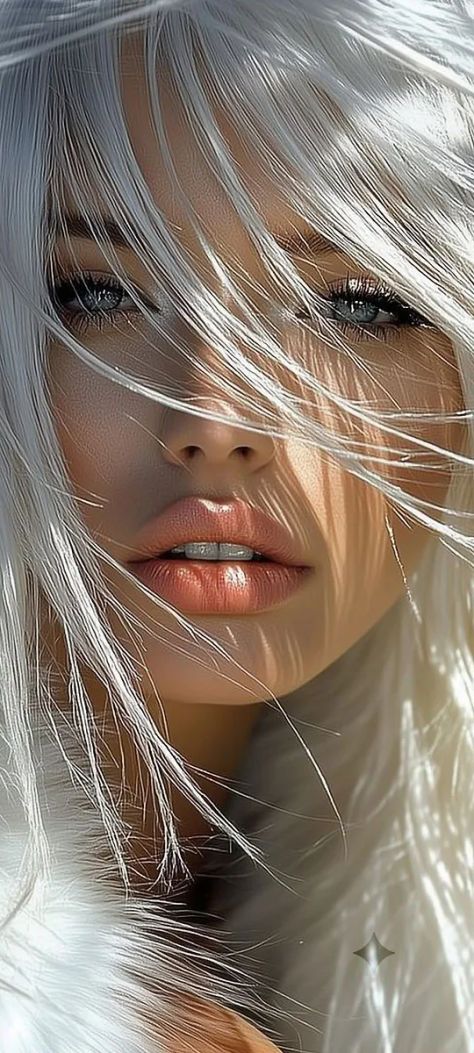
Use the uploaded image as the main visual reference. Recreate the same subject, same extreme close-up beauty framing, same silver-white hair sweeping across the face, same direct gray-green gaze, same warm bronze-beige complexion, same glossy peach-nude lips, same restrained smoky eye makeup, same pale neutral background, and same clean cool-silver editorial atmosphere. Do not invent a new face, different hairstyle, different hair color, different makeup palette, additional accessories, new clothing, new background, or a new camera angle. Follow the uploaded image closely and apply only the corrections below.

Generate a highly polished photorealistic editorial beauty portrait of the same subject in a 9:16 vertical composition. Use an extreme close-up extending from the upper forehead and hairline through the lower neck/shoulder area. Allow the long silver-white hair to continue beyond both lateral frame edges. Center the face on the vertical axis, place both eyes in the upper-middle third, and place the mouth slightly below the image midpoint. Use a near-frontal, eye-level camera position with the head approximately level and almost no rotational offset. Maintain approximately 105 mm portrait/macro-equivalent compression, f/2.4 aperture behavior, shallow selective depth of field, grain level 1/10, and post-processing intensity approximately 9/10.

Preserve the exact facial identity and visible facial proportions from the uploaded image. Maintain the same soft oval face, gently tapered jaw, narrow rounded chin, moderate cheekbone definition, forehead proportions, brow-to-eye spacing, nose width and length, nose-to-lip spacing, mouth width, lip proportions, and lower-face taper. Do not widen the jaw, sharpen the chin, shorten the midface, enlarge the eyes, modify the nose, increase cheek projection, or reshape the subject into a different person.

Render the skin with a warm medium beige-bronze base around H 28–34°, low-to-medium saturation and medium-high brightness, carrying a golden-caramel undertone. Keep directly illuminated zones around H 30–36° with slightly higher brightness, while shadowed facial planes remain around H 24–30° with lower saturation and reduced brightness. Preserve warm skin chroma against the cooler hair and highlights.

Use a satin-to-luminous skin finish. Place controlled broad highlights across the frame-right forehead, nose bridge, nose tip, upper cheek, philtrum, lip ridges, and selected central facial planes. Keep the strongest skin reflectivity localized around the nose and lips rather than creating uniformly wet skin.

Maintain retouching at approximately 8/10. Apply extensive smoothing and tonal evening across the forehead, cheeks, jaw, and chin while retaining restrained natural microtexture in the cheek and nose areas. Keep subtle pore structure visible only at close inspection. Preserve crisp anatomical definition around eyelids, tear lines, nostril edges, philtrum, lip boundaries, and fine lip texture. Do not render raw untreated skin, exaggerated pores, acne texture, freckles not visible in the reference, or completely textureless plastic skin.

Preserve both eyes as almond-shaped with subtly elevated outer corners and the same openness as the uploaded image. Keep the upper eyelids clearly defined with shallow visible creases. Direct both eyes straight toward the camera. The gaze must remain camera-facing even where silver-white strands partially cross the eye regions. Do not redirect either eye upward, downward, or laterally.

Render the irises in a cool muted gray-green to blue-green range around H 175–195°, low saturation and medium brightness. Preserve darker outer limbal rings around the same hue range at lower brightness and subtle radial iris structure. Keep the pupils medium-sized and dark. Add small bright neutral-white catchlights in the upper portions of both irises, consistent with the upper-right-front beauty source.

Preserve the existing partial hair obstruction across both eye regions. Allow multiple pale strands to cross in front of the eyes while maintaining enough transparency and spacing between strands for both irises and the direct gaze to remain readable. Do not clear the hair away from the eyes and do not cover the eyes completely.

Render long, dense upper eyelashes with dark near-black values, high density, clear tapered strand separation, and enhanced length. Keep lower lashes individually visible but lighter and less dense. Maintain strong mascara or digital lash intensification without creating oversized theatrical false lashes.

Apply smoky taupe-to-charcoal eyeshadow around H 25–35° at extremely low saturation and low brightness, concentrated along the upper lids, upper lash line, and outer corners. Keep the blending soft and diffused. Preserve dark near-black upper-lash liner closely following the lash roots and extending only subtly beyond the outer corners. Do not add graphic wings, glitter, metallic shadow, vivid colored eyeshadow, or lower-waterline exaggeration.

Preserve the medium-thick dark brows with softly arched shapes, natural directional hair texture, and individually readable strands. Use dark brown around H 22–28°, low saturation and very low brightness. Keep the brows moderately groomed rather than sharply sculpted. Do not thin, lighten, laminate, overfill, or dramatically increase the arch.

Maintain an even medium-to-full complexion base. Preserve only very subtle warm peach-bronze cheek variation around H 18–28°, low-to-medium saturation and medium brightness. Keep blush understated and integrated into the skin rather than appearing as a distinct cosmetic patch. Do not add heavy contouring, visible bronzer bands, bright highlighter stripes, or strong blush.

Render the lips in a warm peach-nude to terracotta-beige range around H 16–24°, medium saturation and medium-high brightness. Preserve the lower lip at approximately 1.3 times the fullness of the upper lip. Maintain a softly defined cupid’s bow and the same mouth width as the reference.

Keep the lips slightly parted with only a narrow gap between them. Preserve the small central portion of teeth visible through the opening. Keep the teeth subdued warm-white rather than brilliant artificial white. Do not open the mouth further, show the full teeth, expose the tongue, or close the lips completely.

Give the lips a high satin-to-gloss finish with distinct bright neutral-white specular highlights, strongest on the central lower lip and selected upper-lip ridges. Preserve fine vertical lip texture beneath the gloss. Do not change the lip treatment to matte, vivid red, pink, brown, or highly lacquered wet gloss.

Preserve the expression mechanics exactly: frontalis relaxed, brows relaxed, eyes level and open, orbicularis oculi minimally contracted, lips slightly separated, mouth corners neutral, orbicularis oris relaxed, and mentalis without pronounced contraction. Do not introduce a smile, pout, frown, squint, eyebrow raise, or exaggerated expression.

Preserve the same very long silver-white / platinum hair with a cool pearl bias around H 205–220°, extremely low saturation and very high brightness. Use cooler gray strands in shadow around H 205–220° with low brightness and strong neutral-white specular streaks approaching near-white in directly illuminated fibers.

Keep the hair extremely glossy and silky. Render thousands of individually readable fibers and strand bundles with narrow elongated specular lines, subtle gray shadow separation, smooth surface flow, and strong directional highlights. The hair must remain clearly fibrous rather than looking like solid white ribbons, plastic sheets, metallic wires, or painted strokes.

Preserve the mostly straight texture with gentle bends and broad sweeping directional flow. Maintain high volume across the upper frame and both sides of the face. Keep the actual parting largely obscured by the dense frontal strands. Do not convert the hair into curls, waves with large volume, braids, wet hair, short hair, or a rigid styled fringe.

Recreate multiple overlapping hair planes across the face. Place broad and fine silver-white strands diagonally across the forehead, both eye regions, nose bridge, upper cheeks, mouth region, and lower frame. Maintain stronger obstruction through the center and frame-right facial region while leaving enough openings to read the eyes, nose, and lips.

Preserve several thicker ribbon-like strand groups sweeping diagonally from the upper-left toward the center and frame-right, but render each group as collections of real individual fibers with visible internal strand separation. Add numerous fine flyaways extending independently across the face and frame edges.

Keep some strands extremely close to the lens as the nearest depth layer, allowing selected fibers to become slightly softer while still retaining bright linear reflections. Keep the central face and critical crossing strands sharply resolved, then progressively soften rear hair planes to create depth.

Maintain strong white edge/specular behavior along the outer hair silhouette. Use narrow neutral-to-cool white reflections generated by the upper-right key rather than an artificial glowing outline. Preserve darker pearl-gray troughs between highlighted strand groups so the hair retains dimensional layering.

Keep the torso mostly outside the crop. Preserve only the minimal pale fabric region visible around the lower neck/shoulder area. Render it as a pale neutral textile around H 35–50°, extremely low saturation and high brightness with a soft matte-to-satin finish. Do not invent a recognizable dress, blouse, collar, neckline, sleeve design, lace pattern, logo, or decorative trim.

Keep zero hands visible. Keep jewelry absent: no earrings, necklace, rings, bracelet, or watch. Keep glasses absent. Keep headwear absent. Keep held objects absent. Keep visible tattoos, scars, piercings, and facial markings absent.

The background should follow the uploaded image as a three-layer depth structure. Layer one consists of the nearest crossing silver-white hair strands. Layer two contains the sharply rendered facial plane and central hair. Layer three consists of rear hair and the very limited background area. Keep the remaining environment as pale neutral gray-to-soft white around H 200–220° with extremely low saturation and high brightness, largely obscured by the subject.

Do not introduce recognizable background architecture, furniture, vegetation, patterns, gradients with vivid color, bokeh circles, props, additional people, or readable elements. Keep the background simple, soft, and subordinate to the face and hair.

Use a strong directional beauty key from approximately the 1–2 o’clock position at upper-right-front. Set the source around 5500 K neutral daylight. Keep the light moderately hard: sufficiently controlled to create narrow bright reflections across the hair and lips while preserving smooth facial tonal transitions.

Illuminate the frame-right forehead, nose bridge, upper cheek, lip ridges, and numerous crossing hair strands. Keep the strongest hair highlights concentrated on fibers oriented toward the light. Allow frame-left cheek, eye sockets beneath overlapping hair, deeper hair layers, and the lower neck region to descend into controlled shadow.

Maintain a soft-to-moderate facial shadow terminator. Do not create hard dramatic portrait shadows. Keep cheek and jaw transitions smooth while allowing enough directional modeling to define facial curvature.

Use fill around 45%. Preserve detail in both eyes, frame-left facial planes, shadowed hair layers, and neck without flattening the directional lighting. Maintain clearly darker zones beneath overlapping hair strands and in the deepest hair intersections.

Add warm skin-toned bounce around H 25–35° across the lower cheeks, lips, lower nose, and selected nearby hair reflections. Keep this bounce subtle and secondary to the neutral daylight key.

Maintain strong white specular edge behavior across outer hair strands. Treat it as physically plausible reflection from the same beauty-light environment rather than a separate colored rim source. Do not create cyan, blue, magenta, or gold rim lights.

Shape highlights according to material. On skin, use broad controlled satin highlights. On the nose, use a narrower bright reflection along the bridge and tip. On lips, create concentrated high-energy gloss highlights. On the eyes, use small upper catchlights. On silver-white hair, use extremely narrow elongated neutral-white specular streaks tracing fiber direction. On pale clothing, use only soft diffuse highlights.

Maintain the dominant palette exactly: silver-white and pearl-gray hair around H 200–220° with extremely low saturation and very high brightness; warm bronze-beige skin around H 25–35° with low-to-medium saturation and medium-high brightness; cool gray-green eyes around H 170–200° with low saturation and medium brightness; peach-nude lips around H 15–25° with medium saturation and medium-high brightness; and pale neutral background values.

Apply a clean editorial cool-silver grade balanced against warm bronze/peach facial tones. Keep the silver-white hair and pearl shadows slightly cool while preserving warm skin and lips. Use cool pearl-white highlights and hair shadows against the warmer facial palette. Do not introduce strong teal-orange grading, vivid pinks, purple shadows, blue skin contamination, or yellow hair.

Keep overall saturation moderate-low, with most chroma concentrated in the warm skin, lips, and muted gray-green irises. Hair should remain effectively silver-white rather than blonde, beige, lavender, or blue.

Use shallow selective depth of field. Keep both eyes, eyelashes, nose, lips, and central crossing hair fibers highly sharp. Keep selected foreground strands crisp enough to show individual fibers while permitting a few closest strands to soften naturally. Allow outer side hair, rear hair layers, pale garment, and background to fall gradually out of focus.

Maintain approximately 85–120 mm portrait/macro-equivalent optical behavior with natural facial compression. Avoid wide-angle enlargement of the nose or forehead. No fisheye effect, facial stretching, or warped hair.

Render at maximum highly polished photorealistic beauty-editorial quality with realistic facial anatomy, refined but believable skin, strand-level silver-white hair rendering, accurate glossy lip material, crisp lashes, controlled iris clarity, physically coherent reflections, clean optical depth, and premium CGI-enhanced photographic finishing.

Maintain post-processing at approximately 9/10. Use strong skin refinement, localized eye sharpening, enhanced iris definition, lash enhancement, lip specular refinement, strand-level hair sharpening, controlled high-frequency contrast, and polished tonal shaping. Keep the enhancement localized rather than applying harsh global sharpening.

Follow the uploaded image as the primary reference. Preserve the exact facial identity, soft oval proportions, direct camera-facing gaze, eye openness, gray-green irises, dark lashes, smoky taupe-charcoal eye treatment, natural dark brows, warm bronze-beige complexion, peach-nude glossy lips, slightly parted mouth, small visible central teeth, extreme close-up crop, long silver-white hair, dense diagonal facial hair crossings, pale lower garment region, neutral background, upper-right beauty light, and 9:16 vertical framing.

Preserve the locked eye treatment exactly: both cool gray-green almond-shaped eyes remain open and directed straight toward the camera, with medium dark pupils and small upper catchlights. Silver-white strands must continue crossing both eye regions. Do not redirect the gaze, alter eye openness, naturalize the hair away from the eyes, or add luminous fantasy eye effects.

Preserve the locked makeup exactly: even medium-to-full complexion base, subtle warm peach-bronze cheek tone, smoky taupe-charcoal upper-lid shading, dark upper-lash definition, dense mascara-enhanced lashes, natural dark brows, and glossy warm peach-nude lips. Do not add vivid colored eyeshadow, heavy contour, stronger blush, glitter, dramatic winged liner, colored lipstick, or additional cosmetic elements.

Preserve the locked skin retouching exactly at approximately 8/10. Maintain extensively smoothed, tonally even skin while retaining restrained microtexture across the cheeks and nose and high anatomical detail around eyes, lashes, nostril edges, lips, and hair intersections. Do not render raw skin and do not flatten the face into completely textureless plastic.

No extra people. No extra facial features. No duplicated eyes. No extra objects. No hands. No jewelry. No glasses. No headwear. No text. No watermark. No logo. No tattoos. No facial piercings. No beauty-filter facial reshaping. No CGI-plastic skin. No waxy hair. No metallic hair fibers. No motion blur. No lens distortion. No lens flare. No fog. No rain. No particles. No bokeh orbs. No chromatic aberration. Ultra-high resolution. Sharp gray-green eyes. Dense realistic lashes. High-gloss peach-nude lips. Polished warm skin. Extremely detailed silver-white hair fibers with pearl-gray shadows and neutral-white highlights. Photorealistic high-fashion beauty editorial portrait only.

·
Photo Prompts

レビュー

レビューするにはログインしてください。

まだレビューはありません。最初のレビューを書きましょう。

どのデバイスでも PromptLabHub を。

アプリをインストールしてすばやく開くか、Chrome 拡張機能をダウンロードしてブラウザに読み込めます。

プロンプトを見る

  • すべての Prompt
  • 写真 Prompt
  • 動画 Prompt
  • フード Prompt

作成

  • Prompt を投稿

コミュニティ

  • フォーラム
  • クリエイター
  • リーダーボード
  • ウィークリーチャレンジ

サポート

  • よくある質問
  • お問い合わせ
  • プライバシーポリシー
  • 利用規約

フォローする

Midjourney、DALL-E 3、Sora、Runway など向けの厳選 AI Prompt を発見してコピー。毎週更新。

プライバシーポリシー利用規約Cookie ポリシー

© 2026 PromptLabHub. All rights reserved.

© 2026 PromptLabHub. All rights reserved.

·
プライバシーポリシー·利用規約·Cookie ポリシー
Home
PromptLabHub
Editorial Portrait Studio Elegant Natural
0
Prompt

Editorial Portrait Studio Elegant Natural

Use the uploaded image as the main visual reference. Recreate the same subject, same extreme close-up beauty framing, same silver-white hair sweeping across the face, same direct gray-green gaze, same warm bronze-beige complexion, same glossy peach-nude lips, same restrained smoky eye makeup, same pale neutral background, and same clean cool-silver editorial atmosphere. Do not invent a new face, different hairstyle, different hair color, different makeup palette, additional accessories, new clothing, new background, or a new camera angle. Follow the uploaded image closely and apply only the corrections below.

Generate a highly polished photorealistic editorial beauty portrait of the same subject in a 9:16 vertical composition. Use an extreme close-up extending from the upper forehead and hairline through the lower neck/shoulder area. Allow the long silver-white hair to continue beyond both lateral frame edges. Center the face on the vertical axis, place both eyes in the upper-middle third, and place the mouth slightly below the image midpoint. Use a near-frontal, eye-level camera position with the head approximately level and almost no rotational offset. Maintain approximately 105 mm portrait/macro-equivalent compression, f/2.4 aperture behavior, shallow selective depth of field, grain level 1/10, and post-processing intensity approximately 9/10.

Preserve the exact facial identity and visible facial proportions from the uploaded image. Maintain the same soft oval face, gently tapered jaw, narrow rounded chin, moderate cheekbone definition, forehead proportions, brow-to-eye spacing, nose width and length, nose-to-lip spacing, mouth width, lip proportions, and lower-face taper. Do not widen the jaw, sharpen the chin, shorten the midface, enlarge the eyes, modify the nose, increase cheek projection, or reshape the subject into a different person.

Render the skin with a warm medium beige-bronze base around H 28–34°, low-to-medium saturation and medium-high brightness, carrying a golden-caramel undertone. Keep directly illuminated zones around H 30–36° with slightly higher brightness, while shadowed facial planes remain around H 24–30° with lower saturation and reduced brightness. Preserve warm skin chroma against the cooler hair and highlights.

Use a satin-to-luminous skin finish. Place controlled broad highlights across the frame-right forehead, nose bridge, nose tip, upper cheek, philtrum, lip ridges, and selected central facial planes. Keep the strongest skin reflectivity localized around the nose and lips rather than creating uniformly wet skin.

Maintain retouching at approximately 8/10. Apply extensive smoothing and tonal evening across the forehead, cheeks, jaw, and chin while retaining restrained natural microtexture in the cheek and nose areas. Keep subtle pore structure visible only at close inspection. Preserve crisp anatomical definition around eyelids, tear lines, nostril edges, philtrum, lip boundaries, and fine lip texture. Do not render raw untreated skin, exaggerated pores, acne texture, freckles not visible in the reference, or completely textureless plastic skin.

Preserve both eyes as almond-shaped with subtly elevated outer corners and the same openness as the uploaded image. Keep the upper eyelids clearly defined with shallow visible creases. Direct both eyes straight toward the camera. The gaze must remain camera-facing even where silver-white strands partially cross the eye regions. Do not redirect either eye upward, downward, or laterally.

Render the irises in a cool muted gray-green to blue-green range around H 175–195°, low saturation and medium brightness. Preserve darker outer limbal rings around the same hue range at lower brightness and subtle radial iris structure. Keep the pupils medium-sized and dark. Add small bright neutral-white catchlights in the upper portions of both irises, consistent with the upper-right-front beauty source.

Preserve the existing partial hair obstruction across both eye regions. Allow multiple pale strands to cross in front of the eyes while maintaining enough transparency and spacing between strands for both irises and the direct gaze to remain readable. Do not clear the hair away from the eyes and do not cover the eyes completely.

Render long, dense upper eyelashes with dark near-black values, high density, clear tapered strand separation, and enhanced length. Keep lower lashes individually visible but lighter and less dense. Maintain strong mascara or digital lash intensification without creating oversized theatrical false lashes.

Apply smoky taupe-to-charcoal eyeshadow around H 25–35° at extremely low saturation and low brightness, concentrated along the upper lids, upper lash line, and outer corners. Keep the blending soft and diffused. Preserve dark near-black upper-lash liner closely following the lash roots and extending only subtly beyond the outer corners. Do not add graphic wings, glitter, metallic shadow, vivid colored eyeshadow, or lower-waterline exaggeration.

Preserve the medium-thick dark brows with softly arched shapes, natural directional hair texture, and individually readable strands. Use dark brown around H 22–28°, low saturation and very low brightness. Keep the brows moderately groomed rather than sharply sculpted. Do not thin, lighten, laminate, overfill, or dramatically increase the arch.

Maintain an even medium-to-full complexion base. Preserve only very subtle warm peach-bronze cheek variation around H 18–28°, low-to-medium saturation and medium brightness. Keep blush understated and integrated into the skin rather than appearing as a distinct cosmetic patch. Do not add heavy contouring, visible bronzer bands, bright highlighter stripes, or strong blush.

Render the lips in a warm peach-nude to terracotta-beige range around H 16–24°, medium saturation and medium-high brightness. Preserve the lower lip at approximately 1.3 times the fullness of the upper lip. Maintain a softly defined cupid’s bow and the same mouth width as the reference.

Keep the lips slightly parted with only a narrow gap between them. Preserve the small central portion of teeth visible through the opening. Keep the teeth subdued warm-white rather than brilliant artificial white. Do not open the mouth further, show the full teeth, expose the tongue, or close the lips completely.

Give the lips a high satin-to-gloss finish with distinct bright neutral-white specular highlights, strongest on the central lower lip and selected upper-lip ridges. Preserve fine vertical lip texture beneath the gloss. Do not change the lip treatment to matte, vivid red, pink, brown, or highly lacquered wet gloss.

Preserve the expression mechanics exactly: frontalis relaxed, brows relaxed, eyes level and open, orbicularis oculi minimally contracted, lips slightly separated, mouth corners neutral, orbicularis oris relaxed, and mentalis without pronounced contraction. Do not introduce a smile, pout, frown, squint, eyebrow raise, or exaggerated expression.

Preserve the same very long silver-white / platinum hair with a cool pearl bias around H 205–220°, extremely low saturation and very high brightness. Use cooler gray strands in shadow around H 205–220° with low brightness and strong neutral-white specular streaks approaching near-white in directly illuminated fibers.

Keep the hair extremely glossy and silky. Render thousands of individually readable fibers and strand bundles with narrow elongated specular lines, subtle gray shadow separation, smooth surface flow, and strong directional highlights. The hair must remain clearly fibrous rather than looking like solid white ribbons, plastic sheets, metallic wires, or painted strokes.

Preserve the mostly straight texture with gentle bends and broad sweeping directional flow. Maintain high volume across the upper frame and both sides of the face. Keep the actual parting largely obscured by the dense frontal strands. Do not convert the hair into curls, waves with large volume, braids, wet hair, short hair, or a rigid styled fringe.

Recreate multiple overlapping hair planes across the face. Place broad and fine silver-white strands diagonally across the forehead, both eye regions, nose bridge, upper cheeks, mouth region, and lower frame. Maintain stronger obstruction through the center and frame-right facial region while leaving enough openings to read the eyes, nose, and lips.

Preserve several thicker ribbon-like strand groups sweeping diagonally from the upper-left toward the center and frame-right, but render each group as collections of real individual fibers with visible internal strand separation. Add numerous fine flyaways extending independently across the face and frame edges.

Keep some strands extremely close to the lens as the nearest depth layer, allowing selected fibers to become slightly softer while still retaining bright linear reflections. Keep the central face and critical crossing strands sharply resolved, then progressively soften rear hair planes to create depth.

Maintain strong white edge/specular behavior along the outer hair silhouette. Use narrow neutral-to-cool white reflections generated by the upper-right key rather than an artificial glowing outline. Preserve darker pearl-gray troughs between highlighted strand groups so the hair retains dimensional layering.

Keep the torso mostly outside the crop. Preserve only the minimal pale fabric region visible around the lower neck/shoulder area. Render it as a pale neutral textile around H 35–50°, extremely low saturation and high brightness with a soft matte-to-satin finish. Do not invent a recognizable dress, blouse, collar, neckline, sleeve design, lace pattern, logo, or decorative trim.

Keep zero hands visible. Keep jewelry absent: no earrings, necklace, rings, bracelet, or watch. Keep glasses absent. Keep headwear absent. Keep held objects absent. Keep visible tattoos, scars, piercings, and facial markings absent.

The background should follow the uploaded image as a three-layer depth structure. Layer one consists of the nearest crossing silver-white hair strands. Layer two contains the sharply rendered facial plane and central hair. Layer three consists of rear hair and the very limited background area. Keep the remaining environment as pale neutral gray-to-soft white around H 200–220° with extremely low saturation and high brightness, largely obscured by the subject.

Do not introduce recognizable background architecture, furniture, vegetation, patterns, gradients with vivid color, bokeh circles, props, additional people, or readable elements. Keep the background simple, soft, and subordinate to the face and hair.

Use a strong directional beauty key from approximately the 1–2 o’clock position at upper-right-front. Set the source around 5500 K neutral daylight. Keep the light moderately hard: sufficiently controlled to create narrow bright reflections across the hair and lips while preserving smooth facial tonal transitions.

Illuminate the frame-right forehead, nose bridge, upper cheek, lip ridges, and numerous crossing hair strands. Keep the strongest hair highlights concentrated on fibers oriented toward the light. Allow frame-left cheek, eye sockets beneath overlapping hair, deeper hair layers, and the lower neck region to descend into controlled shadow.

Maintain a soft-to-moderate facial shadow terminator. Do not create hard dramatic portrait shadows. Keep cheek and jaw transitions smooth while allowing enough directional modeling to define facial curvature.

Use fill around 45%. Preserve detail in both eyes, frame-left facial planes, shadowed hair layers, and neck without flattening the directional lighting. Maintain clearly darker zones beneath overlapping hair strands and in the deepest hair intersections.

Add warm skin-toned bounce around H 25–35° across the lower cheeks, lips, lower nose, and selected nearby hair reflections. Keep this bounce subtle and secondary to the neutral daylight key.

Maintain strong white specular edge behavior across outer hair strands. Treat it as physically plausible reflection from the same beauty-light environment rather than a separate colored rim source. Do not create cyan, blue, magenta, or gold rim lights.

Shape highlights according to material. On skin, use broad controlled satin highlights. On the nose, use a narrower bright reflection along the bridge and tip. On lips, create concentrated high-energy gloss highlights. On the eyes, use small upper catchlights. On silver-white hair, use extremely narrow elongated neutral-white specular streaks tracing fiber direction. On pale clothing, use only soft diffuse highlights.

Maintain the dominant palette exactly: silver-white and pearl-gray hair around H 200–220° with extremely low saturation and very high brightness; warm bronze-beige skin around H 25–35° with low-to-medium saturation and medium-high brightness; cool gray-green eyes around H 170–200° with low saturation and medium brightness; peach-nude lips around H 15–25° with medium saturation and medium-high brightness; and pale neutral background values.

Apply a clean editorial cool-silver grade balanced against warm bronze/peach facial tones. Keep the silver-white hair and pearl shadows slightly cool while preserving warm skin and lips. Use cool pearl-white highlights and hair shadows against the warmer facial palette. Do not introduce strong teal-orange grading, vivid pinks, purple shadows, blue skin contamination, or yellow hair.

Keep overall saturation moderate-low, with most chroma concentrated in the warm skin, lips, and muted gray-green irises. Hair should remain effectively silver-white rather than blonde, beige, lavender, or blue.

Use shallow selective depth of field. Keep both eyes, eyelashes, nose, lips, and central crossing hair fibers highly sharp. Keep selected foreground strands crisp enough to show individual fibers while permitting a few closest strands to soften naturally. Allow outer side hair, rear hair layers, pale garment, and background to fall gradually out of focus.

Maintain approximately 85–120 mm portrait/macro-equivalent optical behavior with natural facial compression. Avoid wide-angle enlargement of the nose or forehead. No fisheye effect, facial stretching, or warped hair.

Render at maximum highly polished photorealistic beauty-editorial quality with realistic facial anatomy, refined but believable skin, strand-level silver-white hair rendering, accurate glossy lip material, crisp lashes, controlled iris clarity, physically coherent reflections, clean optical depth, and premium CGI-enhanced photographic finishing.

Maintain post-processing at approximately 9/10. Use strong skin refinement, localized eye sharpening, enhanced iris definition, lash enhancement, lip specular refinement, strand-level hair sharpening, controlled high-frequency contrast, and polished tonal shaping. Keep the enhancement localized rather than applying harsh global sharpening.

Follow the uploaded image as the primary reference. Preserve the exact facial identity, soft oval proportions, direct camera-facing gaze, eye openness, gray-green irises, dark lashes, smoky taupe-charcoal eye treatment, natural dark brows, warm bronze-beige complexion, peach-nude glossy lips, slightly parted mouth, small visible central teeth, extreme close-up crop, long silver-white hair, dense diagonal facial hair crossings, pale lower garment region, neutral background, upper-right beauty light, and 9:16 vertical framing.

Preserve the locked eye treatment exactly: both cool gray-green almond-shaped eyes remain open and directed straight toward the camera, with medium dark pupils and small upper catchlights. Silver-white strands must continue crossing both eye regions. Do not redirect the gaze, alter eye openness, naturalize the hair away from the eyes, or add luminous fantasy eye effects.

Preserve the locked makeup exactly: even medium-to-full complexion base, subtle warm peach-bronze cheek tone, smoky taupe-charcoal upper-lid shading, dark upper-lash definition, dense mascara-enhanced lashes, natural dark brows, and glossy warm peach-nude lips. Do not add vivid colored eyeshadow, heavy contour, stronger blush, glitter, dramatic winged liner, colored lipstick, or additional cosmetic elements.

Preserve the locked skin retouching exactly at approximately 8/10. Maintain extensively smoothed, tonally even skin while retaining restrained microtexture across the cheeks and nose and high anatomical detail around eyes, lashes, nostril edges, lips, and hair intersections. Do not render raw skin and do not flatten the face into completely textureless plastic.

No extra people. No extra facial features. No duplicated eyes. No extra objects. No hands. No jewelry. No glasses. No headwear. No text. No watermark. No logo. No tattoos. No facial piercings. No beauty-filter facial reshaping. No CGI-plastic skin. No waxy hair. No metallic hair fibers. No motion blur. No lens distortion. No lens flare. No fog. No rain. No particles. No bokeh orbs. No chromatic aberration. Ultra-high resolution. Sharp gray-green eyes. Dense realistic lashes. High-gloss peach-nude lips. Polished warm skin. Extremely detailed silver-white hair fibers with pearl-gray shadows and neutral-white highlights. Photorealistic high-fashion beauty editorial portrait only.

·
Photo Prompts

レビュー

レビューするにはログインしてください。

まだレビューはありません。最初のレビューを書きましょう。

どのデバイスでも PromptLabHub を。

アプリをインストールしてすばやく開くか、Chrome 拡張機能をダウンロードしてブラウザに読み込めます。

プロンプトを見る

  • すべての Prompt
  • 写真 Prompt
  • 動画 Prompt
  • フード Prompt

作成

  • Prompt を投稿

コミュニティ

  • フォーラム
  • クリエイター
  • リーダーボード
  • ウィークリーチャレンジ

サポート

  • よくある質問
  • お問い合わせ
  • プライバシーポリシー
  • 利用規約

フォローする

Midjourney、DALL-E 3、Sora、Runway など向けの厳選 AI Prompt を発見してコピー。毎週更新。

プライバシーポリシー利用規約Cookie ポリシー

© 2026 PromptLabHub. All rights reserved.

© 2026 PromptLabHub. All rights reserved.

·
プライバシーポリシー·利用規約·Cookie ポリシー
Home