
PromptLabHub
Editorial Portrait Rim Light Dramatic Bokeh
0
Prompt

Editorial Portrait Rim Light Dramatic Bokeh

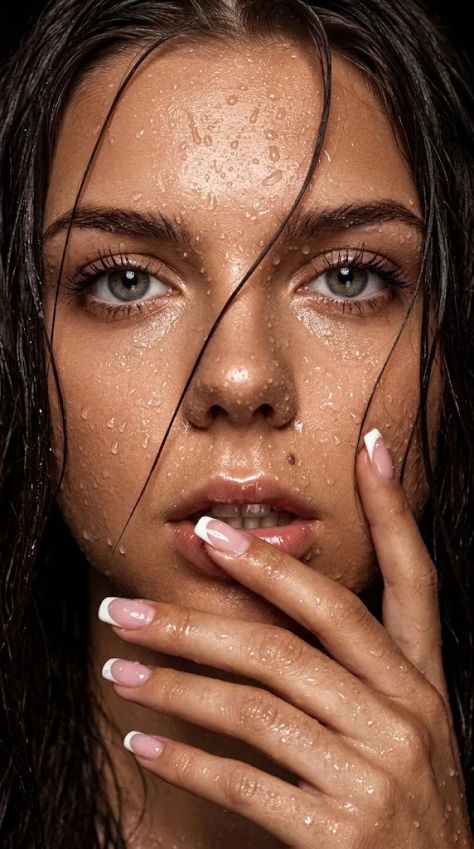
Use the uploaded image as the main visual reference. Recreate the same extreme wet-look beauty macro portrait with the same facial identity, facial proportions, direct eye contact, drenched hair, glossy water-covered skin, hand placement across the lips and cheek, French manicure, framing, black background, lighting direction, color treatment, and high-specular luxury editorial finish. Do not invent a new face, dry the skin, change the eye direction, alter the hand pose, change the hair behavior, or introduce a new background. Follow the uploaded image closely and apply only the specifications below.

Generate a maximum-photorealistic wet beauty editorial portrait in a vertical 9:16 composition. Use an extreme face-only macro crop: include the forehead, both eyes, nose, lips, partial lower jaw, wet hair, and one hand filling almost the entire frame. Crop the upper forehead/hairline slightly, crop most of the chin, and allow wet hair on both sides to continue beyond the frame. Center the face with the eyes occupying the upper third, nose aligned close to the vertical center, and the hand dominating the lower-center and frame-right. Keep the camera almost exactly at eye level with minimal vertical tilt and an extremely close working distance.

Preserve the exact facial identity from the uploaded image. Maintain a soft elongated-oval facial structure with moderately prominent cheekbones and the lower jaw largely obscured by the hand and tight crop. Do not alter facial geometry, eye spacing, nose structure, lip ratio, cheek projection, or brow placement.

Render the skin as a medium warm caramel-beige material centered around H 24–28° with moderate saturation and a golden-amber undertone. Keep illuminated skin around H 27°, S 42–48%, B 75–82%, while shadowed skin remains around H 20–24°, S 45–50%, B 35–48%. Maintain a warm bronze tonal relationship rather than neutralizing or cooling the complexion.

Make the entire visible complexion intensely wet, glassy, and high-specular. Cover the forehead, cheeks, under-eye zones, nose, lips, fingers, and back of the hand with dense micro-droplets interspersed with larger water beads. Each bead must retain rounded surface tension, sharply defined edges, realistic refraction, and point-like highlights. Allow selected neighboring droplets to merge naturally into thin glossy trails. Preserve irregular droplet size and spacing rather than creating a uniform spray pattern.

Keep underlying skin retouching at approximately 7/10 beneath the water layer. Smooth broad tonal variation and soften most visible pore structure on the forehead and cheeks while preserving the physical contours of the nose, eyelids, brows, lips, and cheek transitions. The wet surface must remain extremely detailed even where underlying skin is polished. Do not convert the complexion into dry matte skin. Do not blur away water droplets. Do not create waxy or plastic skin.

Preserve the same almond-shaped eyes with slightly lifted outer corners and medium spacing. Keep both eyelids fully open but relaxed. Maintain direct camera-facing eye contact with only extremely slight natural lateral asymmetry between the two eyes. Do not redirect the gaze upward, downward, or sideways.

Keep the irises muted olive-gray to hazel-green around H 75–90° with low-to-medium saturation. Add a darker charcoal limbal ring and visible radial olive-brown fibers around medium-size pupils. Preserve small bright white catchlights near the upper-central iris/pupil region, shaped as compact round-to-slightly-rectangular reflections. Do not enlarge the pupils excessively or turn the irises bright emerald, blue, or amber.

Preserve the thick, dense brows in very dark brown. Keep a softly angled shape with visible individual brow hairs, high definition, and feathered inner sections. Do not render the brows as solid block-filled shapes or excessively sharpen the edges.

Maintain warm brown-to-taupe eyeshadow concentrated along the upper lids and outer corners. Preserve dark upper-lash definition, slightly stronger toward the outer eye without converting it into a dramatic wing. Keep the upper lashes long, black, curled, separated, and slightly clumped in selected areas by moisture. Define individual lower lashes clearly. Do not remove the eye definition and do not add unrelated eyeshadow colors, glitter, colored liner, or exaggerated false-lash volume.

Preserve the nose with a narrow-to-medium bridge, rounded tip, and a strong narrow wet highlight running down the central ridge. Maintain realistic shadow transitions along both sidewalls and around the nostrils. Do not narrow, shorten, lift, or otherwise redesign the nose.

Preserve full lips with the lower lip approximately 1.25–1.35 times the volume of the upper lip and a softly defined cupid's bow. Use a warm peach-terra nude / terracotta-rose lip tone centered around H 15–20°. Keep the lips intensely glossy and visibly wet with strong specular reflections. Leave the lips slightly parted so only a narrow central strip of teeth is visible. Do not close the mouth completely, enlarge the opening, create a broad smile, or change the lip color to vivid red, pink, brown, or mauve.

Maintain relaxed frontalis activity, stable brows, lightly engaged orbicularis oculi, neutral mouth corners, slightly parted lips, and no exaggerated lower-face tension. Preserve the same facial muscle configuration rather than introducing a different expression.

Preserve the near-black espresso-brown hair around H 20°, S 35–45%, B 8–15%. The hair must be completely saturated with water. Collapse the fibers into narrow separated ribbons and wet clumps with very low volume. Give the hair an extremely glossy surface with sharp white linear specular streaks.

Reproduce the same irregular wet-strand placement across the face: several narrow strands crossing the forehead, brow region, nose bridge, cheek, and outer face. Allow selected strands to adhere directly to the skin through water tension. Keep the hair part indistinct because of wet displacement. Dry flyaways are absent. Do not create fluffy, dry, brushed, voluminous, or styled hair.

Keep the head nearly frontal with only a very slight tilt close to level. Shoulders and clothing remain outside the crop. Do not expand the frame to reveal the body or outfit.

Show exactly one hand. Position it across the lower face and viewer-right cheek with the palm facing inward toward the subject. Arrange the fingers as elongated vertical elements through the lower half of the composition, slightly separated, with fingertips touching the cheek and lip zone. Maintain one central finger overlapping/contacting the upper-to-lower lip region. Preserve realistic pressure and skin contact without deforming the mouth unnaturally.

Render the entire visible hand and fingers as fully wet, covered in dense water beads and thin glossy trails. Maintain individual droplets along finger edges, knuckles, cuticles, and the back of the hand, with sharp specular pinpoints and realistic rounded surface tension.

Preserve short-to-medium squoval nails with a classic French manicure. Use a translucent nude-to-pale-pink nail bed and thin opaque white tips. Give the nails a high-gloss finish amplified by moisture. Do not lengthen them into dramatic extensions, change them to almond or stiletto shapes, add decorative nail art, or alter the white-tip structure.

No visible rings. No bracelet. No watch. No glasses. No headwear. No visible necklace. No visible tattoos. No additional props. No other people.

Keep the background essentially black/deep shadow and largely formed by wet near-black hair surrounding the face. Do not introduce environmental context, scenery, fabric backdrops, lights, or identifiable objects. Maintain approximately three depth layers: foreground hand/fingers, central facial plane/eyes, and wet dark hair merging into deep black background. No circular bokeh.

Maintain strong subject-to-background contrast: warm luminous caramel-bronze skin and white wet-specular reflections against near-black hair and background. Keep the outer hair regions near a deep/crushed black point while preserving enough strand separation to avoid a flat silhouette.

Use a directional beauty key from front-right/top-right at approximately the 1–2 o'clock position relative to the subject. Use a small-to-medium relatively hard beauty source around 4300–4700 K. The source must create numerous intense point-like and elongated reflections across the water film.

Keep the strongest illumination on the viewer-right cheek, central forehead, nose ridge, wet fingers, lip gloss, and selected wet hair strands. Maintain medium-to-hard shadow transitions around the nose, finger edges, eye sockets, and outer face.

Use only a weak warm frontal fill around 25–35% relative to the key. Keep the shadow side readable but allow it to fall rapidly toward deep warm brown and near-black. Use warm skin-toned bounce across the lower face and hand.

Do not add a separate obvious rim light. Rim illumination should be minimal or absent. The visual emphasis must come from direct wet-specular reflections rather than glowing edge light.

Use a short/broad hybrid directional beauty-light pattern rather than flat beauty lighting. Preserve dimensionality across the nose, cheekbones, fingers, and eye sockets.

Create hundreds of small high-intensity specular reflections across the wet skin and hand. Use highlight values approaching B 90–100% with saturation near 0–5%, but preserve the underlying skin below clipping. Allow aggressive white water highlights while maintaining smooth roll-off into the warm skin base.

Maintain the dominant palette relationship: warm caramel skin around H 25°, S 45%, B 68–80%; near-black espresso hair around H 20°, S 40%, B 8–15%; peach-terra lips around H 16°, S 45–55%, B 60–70%; olive-gray irises around H 80°, S 20–30%, B 40–48%; and near-neutral white specular reflections around S 0–5%, B 90–100%.

Apply a warm bronze luxury beauty grade with deep blacks and extremely high wet-specular contrast. Keep highlights warm-neutral white and shadows deep warm brown-to-near-black. Maintain an overall visual temperature around 4500 K. Preserve moderately rich warm skin saturation against highly desaturated dark surroundings.

Use approximately an 85–105 mm macro/portrait-equivalent lens with an extremely close beauty working distance and minimal perspective distortion. Do not use a wide-angle lens.

Use approximately f/2.8–f/4 depth behavior. Maintain selective-to-moderately shallow depth of field: both eyes, central facial plane, primary fingers, lashes, and major water droplets should remain sharply resolved while peripheral wet hair gradually softens.

Set focus priority on the irises, eyelashes, water droplets across the central cheek, glossy lips, fingertips, French manicure, and sharp wet hair strands crossing the central face. Maintain very high micro-contrast on droplets, lashes, nail edges, and water-coated strands.

Keep digital grain around 1–2/10 for a very clean high-end beauty image. Apply post-processing around 8/10 with strong underlying skin cleanup, controlled contrast shaping, subtle iris enhancement, warm bronze color grading, precise black-point control, and detailed specular refinement. Preserve realistic water physics instead of making the moisture look like glitter, oil paint, glass coating, or synthetic plastic.

Render at maximum photorealistic beauty quality. Follow the uploaded image as the primary reference. Preserve the exact facial identity, facial proportions, eye shape, direct gaze, muted olive-gray/hazel irises, dark dense brows, long separated lashes, warm caramel skin, water coverage, peach-terra glossy lips, near-black wet hair, face-crossing strand placement, hand position, French manicure, crop, black background, lighting direction, and extreme wet-specular finish.

Do not change the subject's identity. Do not make the subject look like a different person. Do not redirect or partially close the eyes. Do not remove the warm taupe-brown eye definition. Do not make the skin dry or matte. Do not reduce the amount of water. Do not turn the water into sweat haze or an even oil coating. Do not remove the fingers from the mouth and cheek. Do not change the manicure. Do not replace the black background.

No extra people. No second hand. No extra fingers. No malformed fingers. No fused nails. No rings. No props. No visible clothing. No readable text. No watermark. No dry hair. No beauty-filter blur. No plastic skin. No artificial glitter. No colored water. No motion blur. No lens flare. No fog. No airborne particles. No chromatic aberration. No wide-angle facial distortion.

Ultra-high resolution. Sharp iris fibers. Sharp lashes. Sharp French-manicure edges. Sharp individual water beads. Realistic wet skin refraction and reflection. Realistic water surface tension. Realistic glossy lip material. Realistic saturated wet hair fibers. Deep controlled blacks. Photorealistic high-gloss wet beauty editorial only.

·
Photo Prompts

レビュー

レビューするにはログインしてください。

まだレビューはありません。最初のレビューを書きましょう。

どのデバイスでも PromptLabHub を。

アプリをインストールしてすばやく開くか、Chrome 拡張機能をダウンロードしてブラウザに読み込めます。

プロンプトを見る

  • すべての Prompt
  • 写真 Prompt
  • 動画 Prompt
  • フード Prompt

作成

  • Prompt を投稿

コミュニティ

  • フォーラム
  • クリエイター
  • リーダーボード
  • ウィークリーチャレンジ

サポート

  • よくある質問
  • お問い合わせ
  • プライバシーポリシー
  • 利用規約

フォローする

Midjourney、DALL-E 3、Sora、Runway など向けの厳選 AI Prompt を発見してコピー。毎週更新。

プライバシーポリシー利用規約Cookie ポリシー

© 2026 PromptLabHub. All rights reserved.

© 2026 PromptLabHub. All rights reserved.

·
プライバシーポリシー·利用規約·Cookie ポリシー
Home
PromptLabHub
Editorial Portrait Rim Light Dramatic Bokeh
0
Prompt

Editorial Portrait Rim Light Dramatic Bokeh

Use the uploaded image as the main visual reference. Recreate the same extreme wet-look beauty macro portrait with the same facial identity, facial proportions, direct eye contact, drenched hair, glossy water-covered skin, hand placement across the lips and cheek, French manicure, framing, black background, lighting direction, color treatment, and high-specular luxury editorial finish. Do not invent a new face, dry the skin, change the eye direction, alter the hand pose, change the hair behavior, or introduce a new background. Follow the uploaded image closely and apply only the specifications below.

Generate a maximum-photorealistic wet beauty editorial portrait in a vertical 9:16 composition. Use an extreme face-only macro crop: include the forehead, both eyes, nose, lips, partial lower jaw, wet hair, and one hand filling almost the entire frame. Crop the upper forehead/hairline slightly, crop most of the chin, and allow wet hair on both sides to continue beyond the frame. Center the face with the eyes occupying the upper third, nose aligned close to the vertical center, and the hand dominating the lower-center and frame-right. Keep the camera almost exactly at eye level with minimal vertical tilt and an extremely close working distance.

Preserve the exact facial identity from the uploaded image. Maintain a soft elongated-oval facial structure with moderately prominent cheekbones and the lower jaw largely obscured by the hand and tight crop. Do not alter facial geometry, eye spacing, nose structure, lip ratio, cheek projection, or brow placement.

Render the skin as a medium warm caramel-beige material centered around H 24–28° with moderate saturation and a golden-amber undertone. Keep illuminated skin around H 27°, S 42–48%, B 75–82%, while shadowed skin remains around H 20–24°, S 45–50%, B 35–48%. Maintain a warm bronze tonal relationship rather than neutralizing or cooling the complexion.

Make the entire visible complexion intensely wet, glassy, and high-specular. Cover the forehead, cheeks, under-eye zones, nose, lips, fingers, and back of the hand with dense micro-droplets interspersed with larger water beads. Each bead must retain rounded surface tension, sharply defined edges, realistic refraction, and point-like highlights. Allow selected neighboring droplets to merge naturally into thin glossy trails. Preserve irregular droplet size and spacing rather than creating a uniform spray pattern.

Keep underlying skin retouching at approximately 7/10 beneath the water layer. Smooth broad tonal variation and soften most visible pore structure on the forehead and cheeks while preserving the physical contours of the nose, eyelids, brows, lips, and cheek transitions. The wet surface must remain extremely detailed even where underlying skin is polished. Do not convert the complexion into dry matte skin. Do not blur away water droplets. Do not create waxy or plastic skin.

Preserve the same almond-shaped eyes with slightly lifted outer corners and medium spacing. Keep both eyelids fully open but relaxed. Maintain direct camera-facing eye contact with only extremely slight natural lateral asymmetry between the two eyes. Do not redirect the gaze upward, downward, or sideways.

Keep the irises muted olive-gray to hazel-green around H 75–90° with low-to-medium saturation. Add a darker charcoal limbal ring and visible radial olive-brown fibers around medium-size pupils. Preserve small bright white catchlights near the upper-central iris/pupil region, shaped as compact round-to-slightly-rectangular reflections. Do not enlarge the pupils excessively or turn the irises bright emerald, blue, or amber.

Preserve the thick, dense brows in very dark brown. Keep a softly angled shape with visible individual brow hairs, high definition, and feathered inner sections. Do not render the brows as solid block-filled shapes or excessively sharpen the edges.

Maintain warm brown-to-taupe eyeshadow concentrated along the upper lids and outer corners. Preserve dark upper-lash definition, slightly stronger toward the outer eye without converting it into a dramatic wing. Keep the upper lashes long, black, curled, separated, and slightly clumped in selected areas by moisture. Define individual lower lashes clearly. Do not remove the eye definition and do not add unrelated eyeshadow colors, glitter, colored liner, or exaggerated false-lash volume.

Preserve the nose with a narrow-to-medium bridge, rounded tip, and a strong narrow wet highlight running down the central ridge. Maintain realistic shadow transitions along both sidewalls and around the nostrils. Do not narrow, shorten, lift, or otherwise redesign the nose.

Preserve full lips with the lower lip approximately 1.25–1.35 times the volume of the upper lip and a softly defined cupid's bow. Use a warm peach-terra nude / terracotta-rose lip tone centered around H 15–20°. Keep the lips intensely glossy and visibly wet with strong specular reflections. Leave the lips slightly parted so only a narrow central strip of teeth is visible. Do not close the mouth completely, enlarge the opening, create a broad smile, or change the lip color to vivid red, pink, brown, or mauve.

Maintain relaxed frontalis activity, stable brows, lightly engaged orbicularis oculi, neutral mouth corners, slightly parted lips, and no exaggerated lower-face tension. Preserve the same facial muscle configuration rather than introducing a different expression.

Preserve the near-black espresso-brown hair around H 20°, S 35–45%, B 8–15%. The hair must be completely saturated with water. Collapse the fibers into narrow separated ribbons and wet clumps with very low volume. Give the hair an extremely glossy surface with sharp white linear specular streaks.

Reproduce the same irregular wet-strand placement across the face: several narrow strands crossing the forehead, brow region, nose bridge, cheek, and outer face. Allow selected strands to adhere directly to the skin through water tension. Keep the hair part indistinct because of wet displacement. Dry flyaways are absent. Do not create fluffy, dry, brushed, voluminous, or styled hair.

Keep the head nearly frontal with only a very slight tilt close to level. Shoulders and clothing remain outside the crop. Do not expand the frame to reveal the body or outfit.

Show exactly one hand. Position it across the lower face and viewer-right cheek with the palm facing inward toward the subject. Arrange the fingers as elongated vertical elements through the lower half of the composition, slightly separated, with fingertips touching the cheek and lip zone. Maintain one central finger overlapping/contacting the upper-to-lower lip region. Preserve realistic pressure and skin contact without deforming the mouth unnaturally.

Render the entire visible hand and fingers as fully wet, covered in dense water beads and thin glossy trails. Maintain individual droplets along finger edges, knuckles, cuticles, and the back of the hand, with sharp specular pinpoints and realistic rounded surface tension.

Preserve short-to-medium squoval nails with a classic French manicure. Use a translucent nude-to-pale-pink nail bed and thin opaque white tips. Give the nails a high-gloss finish amplified by moisture. Do not lengthen them into dramatic extensions, change them to almond or stiletto shapes, add decorative nail art, or alter the white-tip structure.

No visible rings. No bracelet. No watch. No glasses. No headwear. No visible necklace. No visible tattoos. No additional props. No other people.

Keep the background essentially black/deep shadow and largely formed by wet near-black hair surrounding the face. Do not introduce environmental context, scenery, fabric backdrops, lights, or identifiable objects. Maintain approximately three depth layers: foreground hand/fingers, central facial plane/eyes, and wet dark hair merging into deep black background. No circular bokeh.

Maintain strong subject-to-background contrast: warm luminous caramel-bronze skin and white wet-specular reflections against near-black hair and background. Keep the outer hair regions near a deep/crushed black point while preserving enough strand separation to avoid a flat silhouette.

Use a directional beauty key from front-right/top-right at approximately the 1–2 o'clock position relative to the subject. Use a small-to-medium relatively hard beauty source around 4300–4700 K. The source must create numerous intense point-like and elongated reflections across the water film.

Keep the strongest illumination on the viewer-right cheek, central forehead, nose ridge, wet fingers, lip gloss, and selected wet hair strands. Maintain medium-to-hard shadow transitions around the nose, finger edges, eye sockets, and outer face.

Use only a weak warm frontal fill around 25–35% relative to the key. Keep the shadow side readable but allow it to fall rapidly toward deep warm brown and near-black. Use warm skin-toned bounce across the lower face and hand.

Do not add a separate obvious rim light. Rim illumination should be minimal or absent. The visual emphasis must come from direct wet-specular reflections rather than glowing edge light.

Use a short/broad hybrid directional beauty-light pattern rather than flat beauty lighting. Preserve dimensionality across the nose, cheekbones, fingers, and eye sockets.

Create hundreds of small high-intensity specular reflections across the wet skin and hand. Use highlight values approaching B 90–100% with saturation near 0–5%, but preserve the underlying skin below clipping. Allow aggressive white water highlights while maintaining smooth roll-off into the warm skin base.

Maintain the dominant palette relationship: warm caramel skin around H 25°, S 45%, B 68–80%; near-black espresso hair around H 20°, S 40%, B 8–15%; peach-terra lips around H 16°, S 45–55%, B 60–70%; olive-gray irises around H 80°, S 20–30%, B 40–48%; and near-neutral white specular reflections around S 0–5%, B 90–100%.

Apply a warm bronze luxury beauty grade with deep blacks and extremely high wet-specular contrast. Keep highlights warm-neutral white and shadows deep warm brown-to-near-black. Maintain an overall visual temperature around 4500 K. Preserve moderately rich warm skin saturation against highly desaturated dark surroundings.

Use approximately an 85–105 mm macro/portrait-equivalent lens with an extremely close beauty working distance and minimal perspective distortion. Do not use a wide-angle lens.

Use approximately f/2.8–f/4 depth behavior. Maintain selective-to-moderately shallow depth of field: both eyes, central facial plane, primary fingers, lashes, and major water droplets should remain sharply resolved while peripheral wet hair gradually softens.

Set focus priority on the irises, eyelashes, water droplets across the central cheek, glossy lips, fingertips, French manicure, and sharp wet hair strands crossing the central face. Maintain very high micro-contrast on droplets, lashes, nail edges, and water-coated strands.

Keep digital grain around 1–2/10 for a very clean high-end beauty image. Apply post-processing around 8/10 with strong underlying skin cleanup, controlled contrast shaping, subtle iris enhancement, warm bronze color grading, precise black-point control, and detailed specular refinement. Preserve realistic water physics instead of making the moisture look like glitter, oil paint, glass coating, or synthetic plastic.

Render at maximum photorealistic beauty quality. Follow the uploaded image as the primary reference. Preserve the exact facial identity, facial proportions, eye shape, direct gaze, muted olive-gray/hazel irises, dark dense brows, long separated lashes, warm caramel skin, water coverage, peach-terra glossy lips, near-black wet hair, face-crossing strand placement, hand position, French manicure, crop, black background, lighting direction, and extreme wet-specular finish.

Do not change the subject's identity. Do not make the subject look like a different person. Do not redirect or partially close the eyes. Do not remove the warm taupe-brown eye definition. Do not make the skin dry or matte. Do not reduce the amount of water. Do not turn the water into sweat haze or an even oil coating. Do not remove the fingers from the mouth and cheek. Do not change the manicure. Do not replace the black background.

No extra people. No second hand. No extra fingers. No malformed fingers. No fused nails. No rings. No props. No visible clothing. No readable text. No watermark. No dry hair. No beauty-filter blur. No plastic skin. No artificial glitter. No colored water. No motion blur. No lens flare. No fog. No airborne particles. No chromatic aberration. No wide-angle facial distortion.

Ultra-high resolution. Sharp iris fibers. Sharp lashes. Sharp French-manicure edges. Sharp individual water beads. Realistic wet skin refraction and reflection. Realistic water surface tension. Realistic glossy lip material. Realistic saturated wet hair fibers. Deep controlled blacks. Photorealistic high-gloss wet beauty editorial only.

·
Photo Prompts

レビュー

レビューするにはログインしてください。

まだレビューはありません。最初のレビューを書きましょう。

どのデバイスでも PromptLabHub を。

アプリをインストールしてすばやく開くか、Chrome 拡張機能をダウンロードしてブラウザに読み込めます。

プロンプトを見る

  • すべての Prompt
  • 写真 Prompt
  • 動画 Prompt
  • フード Prompt

作成

  • Prompt を投稿

コミュニティ

  • フォーラム
  • クリエイター
  • リーダーボード
  • ウィークリーチャレンジ

サポート

  • よくある質問
  • お問い合わせ
  • プライバシーポリシー
  • 利用規約

フォローする

Midjourney、DALL-E 3、Sora、Runway など向けの厳選 AI Prompt を発見してコピー。毎週更新。

プライバシーポリシー利用規約Cookie ポリシー

© 2026 PromptLabHub. All rights reserved.

© 2026 PromptLabHub. All rights reserved.

·
プライバシーポリシー·利用規約·Cookie ポリシー
Home