/
AI UI & Graphic Design Prompts — App Interfaces, Posters & Layouts
Contemporary Fashion Portrait Illustration in 9:20 Format UI & Design AI Prompt

Contemporary Fashion Portrait Illustration in 9:20 Format
[STRICTLY FOLLOW THE REFERENCE IMAGE — use the uploaded photo as the exact identity authority for the first subject ("me"). Preserve the first subject's exact face, facial structure, skin tone, age, body proportions, hairstyle characteristics, and recognizable appearance exactly as shown. Do not redesign, beautify, age, reshape, or reinterpret the first subject's identity.] Create an ultra-refined contemporary fashion portrait illustration of the first subject from the reference image, presented as a premium editorial artwork in a tall 9:20 composition. Keep the identity exact and unmistakable while translating it into a luxurious semi-realistic illustrated style with collector-grade finish, elegant glamour, and high-end beauty-campaign sophistication. Reimagine the composition as a poised three-quarter bust portrait rather than a straight studio headshot. The subject is turned slightly away from the viewer, with the head rotating back toward the camera and the gaze meeting the viewer with calm intensity. One shoulder sits slightly forward, creating graceful asymmetry and a refined fashion silhouette. Keep the body language composed, elevated, and natural, with no exaggerated pose or cluttered gesture. Style the portrait with a polished modern-editorial wardrobe direction: a sculptural navy garment with subtle black accents and soft gold detailing near the collar line, designed to frame the face rather than compete with it. Keep the styling minimal, luxurious, and clean, with no distracting accessories unless they are essential to the reference identity. Render the artwork with a hybrid finish that blends high-end advertising portraiture, refined digital painting, and elegant semi-realistic character illustration. Use rich cinematic studio lighting with one strong directional key and soft secondary fill, producing luminous highlights across the face, hair, lips, and garment edges while shaping the features with deep, controlled shadow. Add a subtle underlit glow rising softly from below to enhance the premium dreamlike mood without breaking realism. Build the color story around warm ivory, champagne cream, pale rose, soft gold, navy blue, and restrained black accents. Keep the background minimal and atmospheric, with a smooth luxury editorial backdrop that fades through soft tonal transitions rather than literal scenery. Allow the subject to remain the clear focal point. Focus on exquisite material and facial rendering: highly detailed eyes with glossy reflective depth, softly defined lips with a refined sheen, smooth painterly transitions across the cheeks and jaw, controlled blush and contour shaping, delicate hair rendering, and precise edge control around the facial silhouette. The skin should appear luminous and dimensional, with polished but believable surface treatment, not plastic or over-airbrushed. The brushwork should feel clean and intentional, combining subtle digital oil-paint richness with contemporary illustration finesse. Keep the finish crisp, elegant, and art-book worthy, with premium tonal balance, soft atmosphere, minimal visual noise, and sophisticated editorial composition. Aesthetic: luxury fashion illustration, modern glamour portrait, premium magazine-art sensibility, dreamlike but precise, polished collector-quality execution. Negative prompt: low detail, messy brushwork, cartoon simplification, anime style, exaggerated stylization, distorted anatomy, altered identity, warped facial features, extra accessories, cluttered background, muddy colors, harsh outlines, plastic skin, overexposed highlights, flat lighting, random text, logo, watermark, signature.
Category:UI & Design
Model:
1
0
PromptLabHub 3D Chrome Floating Monogram Logo Design Logo Design AI Prompt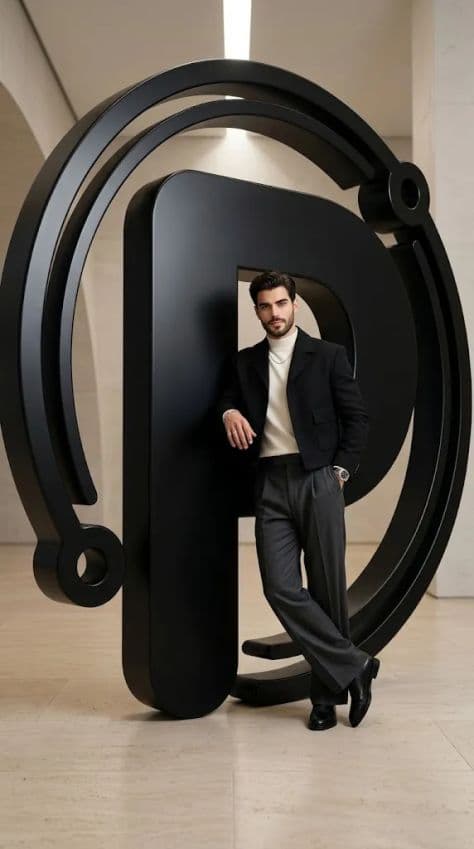

PromptLabHub 3D Chrome Floating Monogram Logo Design
[STRICTLY FOLLOW THE REFERENCE IMAGE — use the uploaded photo as the exact identity authority for the first subject ("me"). Preserve the first subject's exact face, facial structure, skin tone, age, body proportions, hairstyle characteristics, and recognizable appearance exactly as shown. Do not redesign, beautify, age, reshape, or reinterpret the first subject's identity.] [USE THE UPLOADED PROMPTLABHUB LOGO IMAGE AS THE EXACT LOGO REFERENCE. Preserve the exact “P” symbol, circular line structure, proportions, spacing, geometry, and recognizable visual identity. Do not replace it with the Threads logo, do not redesign it, and do not invent a different letterform.] Create an ultra-realistic 8K vertical high-fashion editorial built around an enormous sculptural version of the uploaded PromptLabHub “P” logo. Transform the exact PromptLabHub logo into a monumental physical installation approximately 2–3 times taller than the subject. Preserve the distinctive bold “P” letterform inside the circular orbital-style line structure exactly as shown in the uploaded reference, including the small circular detail and asymmetric line construction. Render the logo as a premium matte-black three-dimensional sculpture with softly rounded edges, subtle satin reflections, precise geometry, and realistic physical thickness. It should feel like an iconic technology-brand monument rather than a flat printed logo. Capture the subject interacting naturally with the sculpture instead of simply standing beside it. Position him inside the open negative space created by the circular PromptLabHub mark, with one shoulder leaning lightly against the outer curve while one hand rests naturally on the sculptural edge. His opposite hand stays casually inside his trouser pocket. Keep his posture relaxed, confident, editorial, and physically believable. His body is angled slightly away from the camera while his face turns toward the lens with a composed, intelligent, self-assured expression. Style him in couture-inspired monochrome menswear influenced by PromptLabHub’s clean modern technology identity: a sharply constructed black cropped jacket layered over a premium ivory high-neck knit, fluid charcoal wide-leg tailored trousers, refined black leather footwear, minimal silver jewelry, and a sophisticated watch. Keep the styling luxurious and directional rather than looking like promotional merchandise. Use contrasting textures such as matte wool, structured technical fabric, fine knit, brushed metal, and subtle leather. Place the installation inside a futuristic minimalist gallery with warm off-white stone flooring, smooth architectural walls, large open negative space, and no distracting furniture. The setting should resemble a world-class technology launch campaign merged with avant-garde fashion photography. Use sophisticated museum-style cinematic lighting. A broad soft key light shapes the face and tailoring, while a controlled overhead beam follows the circular geometry of the PromptLabHub sculpture. Add subtle rim light along the subject and logo edges, with realistic contact shadows grounding everything naturally on the floor. Photograph from a slightly low but natural full-body fashion-editorial perspective. The subject remains the main human focal point while the giant PromptLabHub “P” sculpture creates a dramatic architectural frame around him. Avoid fisheye distortion or exaggerated body proportions. The logo must remain immediately recognizable as the exact uploaded PromptLabHub mark. Do not simplify the circular line system into a generic ring. Do not change the “P” shape. Do not add extra symbols. Do not use the Threads logo or any Threads-style @ symbol. Emphasize exact facial identity, realistic skin micro-texture, individual hair strands, premium tailoring, realistic fabric weight, physically accurate reflections, sculptural depth, refined shadows, subtle professional film grain, and immaculate international campaign retouching. The final photograph should feel like PromptLabHub exists as a luxury global technology-fashion brand in another world — intelligent, futuristic, minimal, sculptural, premium, cinematic, and completely photorealistic. Vertical editorial composition, 8K UHD. Negative prompt: Threads logo, @ symbol, incorrect P logo, redesigned PromptLabHub logo, generic letter P, distorted logo geometry, missing circular lines, duplicated logo elements, random social-media symbols, floating UI, cheap branding, altered face, identity drift, generic model face, malformed hands, extra fingers, duplicated limbs, plastic skin, warped clothing, fisheye distortion, CGI appearance, cartoon look, unnecessary text, watermark, signature, username, visible AI artifacts. just consider the logo form teh screenshot
Category:Logo Design
Model:
0
Hyperreal Cyberpunk Neon Digital Art Portrait UI & Design AI Prompt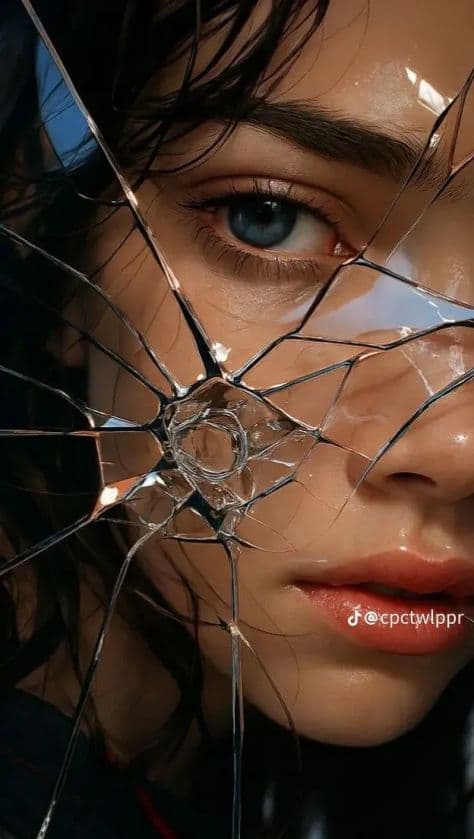

Hyperreal Cyberpunk Neon Digital Art Portrait
Use the uploaded image as the primary reference. Generate a hyperreal cinematic digital art portrait in 9:16 vertical format — NOT photographic, NOT naturalistic — rendered in the style of high-end AI-generated beauty editorial with wet-lacquer skin finish, extreme specular pooling, and hyper-detailed foreground glass. The render quality target is: skin reads as polished ceramic-glass hybrid with subsurface warmth, not human pores. One person. Face fills the entire 9:16 frame as an aggressive extreme close-up — forehead and hair cropped at top frame edge, left side of head cropped at camera-left, right facial edge cropped at camera-right, chin cropped at lower frame into dark clothing. The shattered glass pane covers the ENTIRE frame as a foreground barrier — glass is NOT confined to one side, it spans wall-to-wall and top-to-bottom with the face visible entirely through the glass surface. Head orientation: mostly frontal, subtle three-quarter rotation toward camera-right, very slight sideways tilt, chin neutral-to-slightly lowered. Preserve facial identity: oval-tapered contour, high forward-set cheekbones, narrow jaw, smooth moderately raised nose bridge with no dorsal hump, compact rounded nose tip, moderate nose-to-lip gap, cupid's bow with defined gentle M-shape, lower lip distinctly fuller than upper at 1.4:1 ratio. Expression: frontalis fully relaxed, corrugator fully released, orbicularis oculi of primary eye fully open and wide, orbicularis oris lips slightly parted with zero corner pull, mentalis neutral, neck absent from frame. Primary visible eye fully open almond-shaped with very slight outer corner upturn, medium-large, iris steel-blue hue 212° saturation 50% brightness 55% with radial texture and tonal gradient desaturating toward center, limbal ring dark navy-charcoal hard edge, pupil dark medium diameter sharp boundary, upper eyelid dark eyeliner on lash line, lashes long dark separated 8/10 mascara level, catchlight small irregular rectangle at 11-o'clock upper iris, sclera faintly warm-neutral — keep eye fully sharp and readable through the glass, gaze locked directly at camera zero lateral offset. Hair: near-black fiber shader — shadow body hue 220° saturation 10% brightness 8%, strand edges lit to deep warm brown hue 25° saturation 25% brightness 20% only where key light grazes strand ridges — clumped in 3-to-5 strand bundles damp-piecey surface, thin silver-white specular lines running along strand ridges, sweeps diagonally upper-right to lower-left across forehead at 45°, 4-to-6 flyaway strands at crown catching cool blue ambient, dense clean hairline at forehead edge. Skin: HYPERREAL WET-LACQUER FINISH — render skin as if coated in a transparent gloss layer over warm ceramic — NOT photographic pore texture, NOT matte, NOT naturalistic; forehead: broad elliptical wet specular pool bright near-white center feathering outward, subsurface warmth hue 28° saturation 40% brightness 80% beneath gloss; cheek lit zone: extreme circular specular hot spot dominating upper cheek, skin hue 30° saturation 45% brightness 88% raw-sienna-with-yellow-ochre base, gloss layer sits above creating dual-layer wet appearance; under-eye: softer specular, warm beige hue 28° saturation 35% brightness 75%; nose bridge: elongated bright specular ridge running full length plus secondary round hot spot at tip; nasolabial fold hue 20° saturation 40% brightness 55% warm shadow; all shadow zones hue 215° saturation 15% brightness 18% cool-dark; zero visible pores anywhere — skin surface reads as polished not organic; strong subsurface scatter glow at cheek edges. Makeup: medium-to-full coverage warm beige foundation with zero cake texture and hyperreal smoothness, upper eyelid warm taupe-mauve eyeshadow hue 15° saturation 20% brightness 38% blended into crease, dark brown-black eyeliner upper lash line thickening slightly at outer corner, mascara 8/10 long separated lashes, brows filled dark brown product clean lower edge natural upper texture not laminated, blush nearly imperceptible warm peach at cheekbone apex hue 25° saturation 28% brightness 72%, lips warm terracotta-coral hue 15° saturation 65% brightness 68% satin-gloss finish vertical lip lines retained fuller lower lip. Clothing: black to very deep navy smooth-glossy fabric, no logos no patterns, cropped to minimal strip at bottom frame. Foreground glass — GENERATION CRITICAL — spans the ENTIRE 9:16 frame wall-to-wall top-to-bottom as a transparent physical pane, face is visible across the whole image through glass, glass does NOT occupy only one side; impact center at approximately X 42% Y 52% of frame — tight irregular circular void approximately 2.5cm diameter; immediately surrounding impact: dense spider-web micro-fracture zone packed with short secondary fractures within 1.5cm radius of center forming concentric ring of crushed glass cells before transitioning outward; 8-to-10 primary radial fracture lines extend from impact center to all frame edges — top, bottom, left, right and diagonals; fracture edge character: NOT silver-white — edges are warm copper-bronze to dark charcoal dual-tone, thin line width approximately 1-to-2px, organic irregular path not ruler-straight; fracture panels between lines form irregular polygons and elongated triangles of varying sizes — some large spanning a quarter of the frame, some small near impact center; glass reflects warm copper-gold from skin bounce on panel undersides, cool blue-cyan on panel top faces; some panels show slight prismatic color split at sharpest edges; subtle optical distortion of face visible through glass panels — mild refraction bend; glass is 3D physical depth element not flat overlay. Background: 3 depth layers — layer 1 foreground glass plane fully sharp hard edge; layer 2 face and hair sharply rendered through glass; layer 3 rear near-black deep navy hue 215° saturation 20% brightness 5% with zero identifiable objects, no bokeh orbs, dramatically darker than face. Lighting: key light 1-o'clock upper-right camera-relative, large softbox with diffusion, close range, shadow terminator soft edge from nose bridge sweeping to jaw left side, key 5500K warm-neutral, fill 40% ratio cool 6500K from camera-left, rim light at left hair edges hard cool blue-white 7500K, glass receives warm gold bounce from skin on underside faces and cool blue from ambient on top faces, rain absent fog absent particles absent flare absent. Color grade: split-tone cinematic — highlights warm golden-peach hue 30° saturation 40% brightness 92%, shadows deep cool blue-black hue 215° saturation 35% brightness 7%, glass fracture edges warm copper-bronze hue 28° saturation 45% brightness 60%, iris steel-blue hue 210° saturation 50% brightness 55%, lips hue 15° saturation 65% brightness 68%, hair body hue 220° saturation 10% brightness 8%, overall skin grade 5200K warm bias background cool-shifted. Camera: 90mm equivalent focal length, f/3.2 aperture, 9:16 aspect ratio, grain 1/10 essentially absent, retouch 9/10, post-processing style hyperreal cinematic digital art — NOT photographic naturalism — render targets wet-lacquer skin, copper-edged glass, near-black hair, and a face that reads as hyper-polished digital illustration while maintaining photorealistic anatomical structure. Do not render photographic skin texture. Do not render matte or naturalistic skin. Do not render silver-white glass edges — edges must be warm copper-bronze. Do not confine glass to one side of frame — glass covers entire image. Do not change facial identity. No extra people. No extra objects. No text. No watermark. No motion blur. Ultra high resolution. Sharp subject detail through glass. Hyperreal wet-skin finish throughout. Cinematic digital art rendering only.
Category:Photo Prompts
Model:
41
0
Peaceful Portrait Creative with Studio Lighting Portrait AI Prompt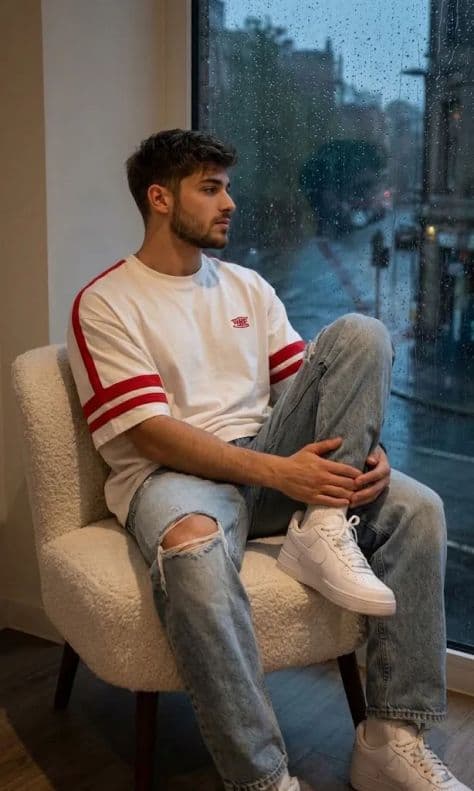

Peaceful Portrait Creative with Studio Lighting
Monsoon rainy-day stylish young man sitting casually on a mini white boucle armchair, wearing an oversized white T-shirt with red stripe details on the sleeves and a small red logo on the chest, baggy light-wash distressed jeans with a ripped knee, white Nike sneakers with visible socks. Short hair and a simple beard, relaxed pose with one leg up on the chair and hands resting on the ankle, looking away thoughtfully. Preserve the exact same face from the reference image 100%, without changing his facial identity.
Category:Logo Design
Model:
6
0
High-Altitude Skydiving Action Selfie with Open Parachute Photo Prompts AI Prompt

High-Altitude Skydiving Action Selfie with Open Parachute
Use the uploaded image as the main visual reference. Recreate the same subject, same skydiving selfie composition, same open parachute, same harness, same aircraft, same windblown hair, same clothing, and same high-altitude blurred ground environment. Do not invent a new face, new camera angle, new parachute design, or new background. Follow the uploaded image closely. Generate a photorealistic extreme-action aerial selfie portrait in a 9:16 vertical composition. Camera positioned extremely close to the subject at arm's length, looking back toward the face while capturing the parachute and sky overhead, strong wide-angle action-camera distortion throughout. Subject centrally positioned with face large and prominent in the upper-center portion of the frame. Torso fully visible through the waist and harness area. Legs partially visible toward lower-middle and lower-right. Face must remain relatively close to the camera plane. Background ground and cloud layer must remain extremely far below, conveying genuine high-altitude suspension. Subject's right arm viewer-left extends directly from the shoulder toward the camera with extreme foreshortening, upper arm beginning near viewer-left side of torso, elbow slightly bent, forearm traveling diagonally down-left toward the lens, wrist reaching the bottom-left frame boundary — right hand and selfie device completely cropped outside the lower-left frame edge. Do not generate a second visible hand at bottom-left. Dark wide wrist band-strap visible near the lower-left forearm area, partially out of focus from proximity. Subject's left arm viewer-right extends laterally outward and slightly upward, shoulder opening away from torso, elbow gently bent rather than locked, forearm extending toward upper-right. Left hand viewer-right: only clearly visible hand in the image, positioned close to the right frame edge slightly above shoulder level, palm predominantly downward-inward relative to body, back-side of hand most visible, fingers loosely curved and naturally separated with fingertips visible, no held object, short natural nails, multiple small dark beaded and banded wrist accessories immediately below the hand. One dark shoe partially visible near lower-center, the other largely outside frame. Preserve the same facial identity: oval face with gently tapered lower third, smooth moderately defined jaw, rounded slightly tapered chin, moderately prominent cheekbones lifted further by the broad smile, medium-height forehead partially framed by windblown hair. Light-to-medium warm beige skin with warm-neutral peach-golden undertone, natural satin finish with bright daylight sheen, strong illumination on forehead and nose, brightly exposed cheeks, shadow side remaining fully readable with soft gradients. Skin retouching approximately 6.5–7/10: noticeable smoothing across forehead, cheeks, under-eyes, nose and chin, natural smile folds and fine smile crease lines near mouth corners remain present, subtle tonal variation around cheeks and nose intact, polished but not fully airbrushed, outdoor skin luminosity preserved. Both eyes fully open, almond-shaped medium-large irises in brown to hazel-brown, defined upper eyelid crease, dark enhanced lashes, bright natural daylight catchlights present in both eyes, lower eyelids very slightly elevated by the smile but eyes remain clearly open, gaze directed straight into the close selfie camera lens with strong direct highly engaged eye contact. No closed eyes, no sideways glance, no downward gaze, no gaze directed toward the airplane or parachute. Mouth fully open in a broad energetic smile, upper and lower teeth bright white and prominently exposed, oral cavity darker pink-red interior visible, lip corners strongly lifted upward, cheeks raised, zygomaticus major fully contracted, orbicularis oris open, mentalis relaxed, frontalis slightly lifted, lower eyelids marginally elevated from cheek compression — overall high-energy exhilarated expression. Warm rosy-nude pink satin lips with defined cupid's bow and slightly fuller lower lip. Groomed soft-arch dark-brown brows of medium-to-full thickness, slightly raised from the smiling expression but not exaggerated. Polished natural makeup: light-to-medium satin foundation, extremely subtle warm-neutral beige-brown eye shading, fine dark upper lash line definition, mascara-enhanced defined lashes, soft warm peach-rose blush across upper cheeks, minimal contour, softly filled dark-brown brows, warm rosy-pink satin lips, bright visible teeth inside open smile. No dramatic editorial makeup. Keep the same hair: medium-to-dark warm brown with golden light-brown highlights from direct sunlight, approximately shoulder length, near-center to slightly off-center part, smooth with loose natural waves, natural glossy-satin finish, moderate volume, actively and strongly windblown — multiple strands sweeping horizontally outward toward viewer-right, hair partly pushed backward on viewer-left by airflow, loose flyaway strands clearly present around forehead and sides. Hair must appear genuinely affected by high-speed airflow, not static or perfectly styled. Keep the same clothing. Main top: muted teal dusty blue-green cotton-jersey short-sleeve crew-neck T-shirt, relaxed but not oversized fit, short sleeves extending to mid-upper arm, no pattern, very small pale-white logo mark on chest not clearly readable, fabric wrinkling around shoulders and chest under harness strap compression, airflow slightly pulling fabric. Jeans: medium washed-blue denim-like relaxed-slim trousers, waist mostly covered by harness, strong leg folds around bent knees and hips, no obvious distressing. One partially visible predominantly black closed athletic shoe near lower-center. Skydiving harness is a major structural element: full black heavy-duty woven nylon webbing system, wide black shoulder straps descending vertically on both sides of chest, horizontal black chest strap crossing torso under chest, multiple straps and buckles at waist and hip, black leg harness webbing wrapping thighs and hips, large dark parachute container and back-padding system behind torso, multiple large metallic buckles in silver-toned rectangular adjusters, metal carabiner-like connection points, small red-orange safety locking components, harness hardware catching bright daylight highlights, all straps looking functional and load-bearing. Parachute: large open ram-air rectangular canopy occupying much of upper-left, partially cropped by top and left frame edges, canopy panels in off-white cream as primary color, deep navy-black as secondary panel color, warm golden-yellow tan as accent trim sections, fabric inflated and curved with dimensional ribbed cell structure, cell openings visible along outer edges. Numerous thin pale-white suspension lines descending from canopy converging correctly into the harness connection points near the subject's shoulders, lines crossing diagonally through the sky — do not generate disconnected floating lines. Thick black riser straps visible near the subject's shoulders with metal connection hardware attached to harness. Aircraft: small single-engine propeller airplane, positioned in upper-right quadrant, flying diagonally away-rightward across frame, seen primarily from underneath, light grey-white body with warm orange-red nose accent and dark blue tail, straight light-colored wings, landing gear-wheels visible beneath aircraft, propeller rendered as rotational blur near nose. Aircraft considerably smaller than subject due to distance — do not enlarge. Thin white vapor-smoke trail extending behind the plane pointing diagonally down-left from its position, soft slightly diffuse edges. Background: dominant clear saturated blue sky (~200° hue, saturation 75%, brightness 85%) transitioning slightly lighter toward the horizon, mostly cloudless in the upper portion. Distant ground and cloud layer visible across the lower half behind the subject — extremely distant with white cloud forms, muted blue-grey land mass and possible muted green-brown terrain barely distinguishable — strong radial-directional motion blur applied to the entire ground layer creating a powerful sensation of speed and high altitude, ground detail intentionally indistinct and soft. No other people visible in the scene. Lighting: strong natural daylight at high altitude, key light from upper-right front-right at approximately 1–2 o'clock relative to the camera, bright but moderately soft due to atmospheric scattering. Viewer-right side of face receives strong daylight, forehead and nose strongly illuminated, cheeks brightly exposed, shadow side remains soft and readable, under-chin shadow present and soft, natural reflected blue-sky fill preventing deep shadows. Teal shirt brightly illuminated, black harness retaining deep tone with metal hardware catching bright highlights, extended selfie forearm strongly illuminated near foreground, outstretched left arm with sunlight across upper surface. Thin warm golden highlights along windblown hair strands toward viewer-right. Catchlights: small bright natural daylight reflections in both eyes at upper iris position. Key temperature approximately 5200–6000K impression, ambient sky fill cooler blue, warm skin against cool blue sky. Color system: bright sky blue (~200° hue, saturation 75%, brightness 85%), muted teal blue-green shirt (~185° hue, saturation 45%, brightness 60%), deep black harness (~0%, brightness 8%), warm beige-peach skin (~25° hue, saturation 22%, brightness 78% in lit zones), medium warm brown hair (~30° hue, saturation 35%, brightness 40%), off-white cream parachute panels (~40° hue, saturation 8%, brightness 92%), deep navy-black parachute panels (~220° hue, saturation 50%, brightness 15%), golden-yellow parachute trim (~45° hue, saturation 85%, brightness 80%), medium washed blue denim (~210° hue, saturation 35%, brightness 55%). Clean action-camera editorial grade, warm skin against cool blue sky, no vintage or faded treatment, deep detailed blacks, bright saturated sky. Depth and motion: subject face and harness sharp and in primary focus, extended selfie arm in sharp to slightly soft perspective, outstretched left hand sharp, parachute canopy sharp, aircraft sharp, ground and cloud layer rendered with strong radial-directional motion blur conveying speed and altitude, blur intensity increasing toward frame edges away from subject. Wide-angle distortion present throughout without anatomical deformity on the subject. No watermark. No additional people. No text. No anatomical errors on hands or arms. No disconnected parachute lines. No enlarged airplane. Preserve the dramatic wide-angle action-camera skydiving selfie perspective. Ultra high resolution. Photorealistic action-adventure quality only.
Category:Logo Design
Model:
13
0
Renaissance Oil Painting Style Intimate Interior Portrait UI & Design AI Prompt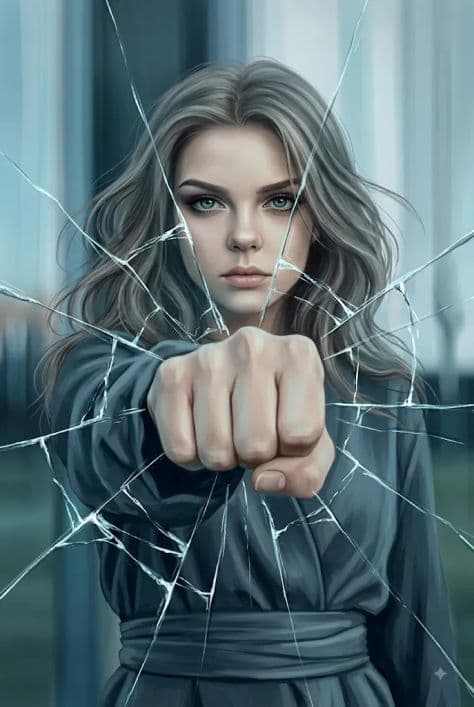
Renaissance Oil Painting Style Intimate Interior Portrait
Use the uploaded image as the main visual reference. Recreate the same subject, same setting, same outfit, same objects, same framing, and same atmosphere. Do not invent a new face, new outfit, new background, or new camera angle. Follow the uploaded image closely and apply only the corrections below. Generate a highly stylized cinematic digital painting of a single female subject in a 2:3 vertical portrait composition. Subject centered on the central axis. Face positioned upper-center. One closed fist thrusting directly toward the viewer through a shattered transparent glass surface, occupying the visual center of the composition in extreme foreground. Strong forced perspective — the fist rendered substantially larger than the face because it projects toward the viewer. Depth sequence from front to back: shattered glass layer → enlarged closed fist → face and upper torso → loose draped garment body → soft vertical architectural background plane. Keep everything close to the original uploaded image. Preserve the same facial identity: oval-to-tapered face shape, defined jawline partially obscured by shadows and glass fractures, narrow-to-rounded chin, moderately pronounced cheekbones. Skin rendered as light beige with neutral-to-cool treatment pulled by the blue color grade — rendered in a smooth painterly digital-illustration surface. Skin retouching level 8/10 — strongly blended cheeks and forehead with heavily refined digital-painting smoothness, clean luminous highlights on nose bridge and cheekbones, minimal true photographic pore texture, fine artificial brush-grain texture remaining across the surface. Shadow-to-light transition painterly and smooth rather than naturally photographic. Nose bridge retains a clean painted highlight definition. Do not render raw photographic skin — this is stylized cinematic illustration, not documentary photography. Cinematic polished makeup rendering — HARD LOCK. Subtle dark gray/charcoal shading around the eye socket area. Darkened upper lash line present. Lashes dark and visibly emphasized — enhanced beyond natural density. Very subtle cool-neutral cheek coloration. Lips muted nude-pink/pale rose — approximately 350–355° hue angle, low saturation, soft satin-matte surface finish, lips closed with minimal curvature. Brows defined, dark ash-brown, groomed and clean. Overall face: polished cinematic makeup rendering — not bare-face realism, not bright glamour. Do not remove the eye definition. Do not remove the lash emphasis. Do not introduce warm or colorful makeup tones. Eyes almond-shaped, medium-large. Iris gray-blue to blue-green — approximately 200–210° hue angle, low-to-medium saturation. Pupil medium-to-dark dilation. Upper lids defined. Dark lash line enhanced. Small bright high-contrast catchlights visible in each iris. Eye surround darkened with cool gray-charcoal shading to increase dramatic intensity. Both eyes fully open — widened enough to establish strong direct confrontational focus while chin sits slightly lowered. Gaze locked directly into the viewer/camera beneath slightly lowered brows. Eyes must remain visible and readable through the fractured glass layer crossing the face — do not eliminate eye contact. Do not generate an averted, downward or unfocused gaze. Eyebrows: softly angled, medium thickness, dark brown to ash-brown — approximately 22–25° hue angle at high darkness value. Groomed and clean. Positioned at moderate distance above eyes. Brows sitting slightly lowered toward center — corrugator creating a mild assertive set without a full frown. Lips closed, minimal curvature. Lower lip fractionally fuller than upper. Cupid's bow defined. Pale muted rose/nude color, soft satin finish. No gloss. No smile. Frontalis slightly lowered toward center — not fully furrowed but carrying mild assertive tension. Orbicularis oculi holding a widened alert state. Orbicularis oris closed and relaxed. Mentalis soft. Chin slightly lowered while eyes maintain forward lock. Overall expression: assertive, confrontational, direct — not angry, not smiling. Hair: ash brown to dark blonde-brown with grayish-cool highlights — approximately 28–32° hue angle at medium darkness, with cooler highlighted strands at approximately 200° hue angle desaturated. Medium length. Loose, tousled, softly wavy texture. Near-center to slightly off-center parting. Several strands falling loosely across forehead and temple. Hair spreading outward behind ears and around shoulders. Some strands appearing swept outward reinforcing the action motion. Soft airy painterly fiber rendering — slightly matte with cool highlighted strand catches. Do not render hair as a flat mass — individual strand groupings must be visible. Clothing: loose draped robe-like coat or wrap garment. Deep desaturated blue-gray/slate/steel navy — approximately 220–225° hue angle, low saturation, medium-low brightness. Soft heavy fabric with substantial volume and broad sleeves. Open overlapping V-like front neckline. Long loose sleeves — the extended arm sleeve bunches and folds around the forearm due to the arm projecting forward toward the camera. Painterly fabric folds with cool highlights and deep shadow pockets across all surfaces. No buttons, no zipper, no logo, no pattern. Wide matching deep blue-black fabric sash or belt tied/wrapped at the waist — same or similar fabric as the garment — cinching the otherwise loose silhouette. Dark inner layer partially visible at the open neckline. No tie, no scarf, no decorative neckwear. Fist detail: closed punching fist in extreme foreground, knuckles prominently facing the viewer. Four fingers tightly curled toward the palm. Thumb folded across/along the curled fingers. Dorsal knuckle surfaces and upper finger surfaces dominate the fist view. Palm largely hidden by the curled finger geometry. Strong extreme foreshortening on the forearm — the forearm appears compressed as it recedes from the large fist toward the elbow and torso. Fist skin is the brightest skin element in the composition because it occupies the foreground and receives the strongest direct illumination. No rings, no polish, no visible jewelry on the punching hand. Do not reduce fist size — the exaggerated scale relative to the face is essential to the composition. Shattered glass: physically present as a distinct foreground spatial layer sitting between the viewer and the subject — not a flat graphic overlay. Central impact point located at the fist/face center. Numerous long radial cracks extending outward from the impact center in nearly every direction — spiderweb fracture network. Large triangular shards remaining attached around the impact zone. Several fracture lines crossing the subject's face and clothing. Glass shard edges carrying bright white to cyan specular highlights — approximately 185–195° hue angle, very high brightness, icy metallic quality. Some shards semi-transparent with refraction effect. Central impact area more fragmented and dense than outer edges. Glass depth rendered with visible thickness — shards have transparent volume, not flat lines. Bright icy glow tracing the sharpest fracture edges. Painterly sharpening contrast along all glass edges. Do not reduce the glass — it must dominate the foreground and cross the face plane. Background: stylized soft interior architectural environment. Tall vertical bluish panels or wall/window surfaces. Pale cyan, steel blue and blue-gray tones — approximately 195–210° hue angle, low-to-medium saturation, medium-low brightness. Highly softened and painterly rendering — no sharp edges, no readable text, no people, no furniture, no signage. Four depth layers: extreme foreground glass → near foreground fist → midground face and torso → soft vertical background architecture. Background brightness: pale and slightly luminous compared with the dark garment. Lighting: soft frontal-upper key source from approximately 11–12 o'clock position. Diffused with stronger stylized specular highlights on glass edges and fist knuckles. Forehead, nose bridge, cheekbones, and fist knuckle surface receive the strongest illumination. Shadow side of face still readable through substantial cool blue ambient fill from the environment. Subtle cool rim around hair silhouette and clothing shoulder edge. Glass edges: strong white/cyan specular highlights — the brightest elements in the entire composition. Shadow transitions painterly and smooth throughout. Small bright catchlights in the eyes. Key light color temperature neutral-to-cool approximately 5500–6000K. Ambient environment: strong cool cyan/blue at approximately 7500–8500K. Contrast: medium-high across the whole image. Color grade: pronounced cool blue/cyan dominant grade throughout. Shadows lean toward navy/teal — approximately 220–225° hue angle in shadow zones. Highlights lean toward pale cyan and silver — approximately 185–200° hue angle at maximum brightness. Skin tones intentionally restrained rather than warm or orange — neutral beige pulled slightly cool by the grade. Hair: ash-cool highlight strands reinforcing the overall cold palette. Clothing and background fully absorbed into the blue-gray-cyan color world. Overall saturation: moderately desaturated with blue dominance. Skin provides the main warm-neutral counterpoint in an otherwise cold-toned image. Rendering style: highly stylized cinematic digital painting with AI-illustration quality. Strong painterly brushwork visible in hair, fabric folds, and background. Photorealistic anatomical accuracy combined with painterly surface treatment. Not a natural photograph — stylized cinematic illustration is the correct aesthetic. High artificial detail in broken-glass fracture elements. Slight luminous glow on brightest glass edges. Painterly atmospheric softness in the background layer. Render at maximum quality. Follow the uploaded image as the primary reference. Preserve exact facial proportions, fist pose and scale, shattered glass structure, garment drape, lighting, color grade, and portrait framing. Do not change the subject's identity. Do not make the subject look like a different person. Do not change the dark blue-gray draped garment. Do not reduce the fist to normal portrait scale. Do not flatten the glass into a graphic overlay — it must have physical depth and thickness. Do not remove the eye contact through the glass. No extra people. No readable text. No watermark. No anatomical errors. No motion blur. No warm color grade. Ultra high detail on glass fractures, fist knuckles, facial features, and fabric folds. Cinematic digital painting style only.
Category:Photo Prompts
Model:
26
0
Semi-Realistic Digital Fashion Illustration Beauty Portrait UI & Design AI Prompt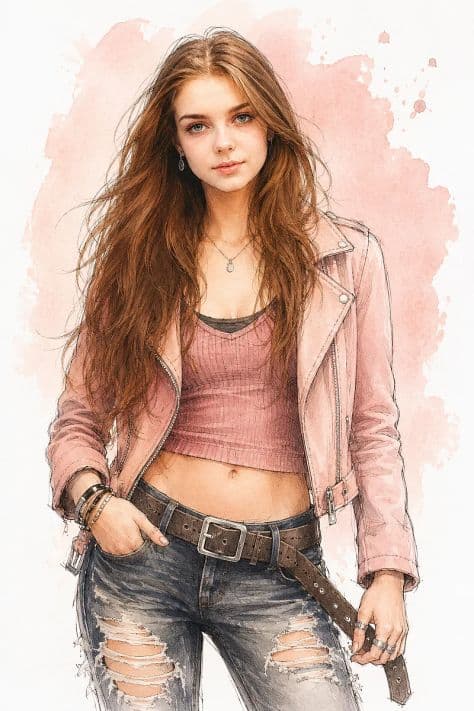

Semi-Realistic Digital Fashion Illustration Beauty Portrait
Use the uploaded image as the primary reference. Generate a semi-realistic digital fashion illustration in 2:3 vertical portrait format of a single female-presenting person, upper body to mid-thigh, centered in frame with torso facing forward and a slight rightward body tilt, head tilted left with gaze directed toward the viewer. Preserve facial identity: soft oval face shape with high-set rounded cheekbones, wide-set dark brown almond eyes with thin arched dark brows set close to the orbital ridge, short straight nose with minimal nose-to-lip gap, full lips with soft cupid's bow and rounded lower lip, short rounded chin, gently defined jawline with minimal angularity. Expression: orbicularis oris corners pulled laterally and upward, zygomaticus major engaged, orbicularis oculi lower portions lightly compressed creating soft under-eye lift, frontalis neutral, mentalis relaxed. Hair: dark brown (hue 25°, saturation 60%, brightness 18%) with warm chestnut undertone under light, long past-shoulder length, center-near part, loose layered volume with medium-width strand clumps, soft wave behavior at mid-length, multiple fine flyaway strands radiating around the silhouette and across the forehead, specular highlight as a narrow diffuse ribbon on the crown, matte finish on lengths, slight translucency at strand edges against light background. Skin: warm neutral base tone (hue 28°, saturation 35%, brightness 78%) with golden undertone, watercolor-wash shading technique with soft gradient shadow placed on the neck underside and jaw lateral edges, forehead catchlight from diffused overhead fill, cheek zone rendered with transparent blush-pink glaze (hue 5°, saturation 25%, brightness 88%), minimal pore texture rendered with pencil microstrokes on the nose bridge and chin, smooth luminous finish on forehead and cheekbones, no specular hotspot, highlight implied through paper-white preservation rather than painted highlight. Clothing: dusty-pink moto-inspired cropped jacket (hue 350°, saturation 28%, brightness 78%) with wide folded lapel collar, open front, long sleeves, decorative panel seams, silver metallic zipper tape and pull hardware rendered with thin ink highlight strokes, fabric texture rendered as soft washed cotton with minimal sheen and faint crease lines at elbow and lapel fold; underneath a rose-pink ribbed sleeveless fitted crop top (hue 345°, saturation 32%, brightness 72%) with horizontal rib texture rendered as fine parallel ink lines, scoop neckline, cropped above the navel, dark charcoal inner layering garment visible at neckline; dark faded denim jeans (hue 215°, saturation 22%, brightness 38%) low-rise waist, heavily distressed with large irregular tears across both upper thighs, frayed denim thread bundles rendered with fine loose ink strokes, washed gray-blue surface texture with faint whiskering lines at hip. Accessories: small teardrop dangling earrings with metallic silver finish, thin delicate chain necklace with small round oval pendant resting at collarbone level, multiple stacked bracelets and bangles on left wrist with mixed metallic and dark material finishes, multiple rings on right hand fingers, wide dark textured belt with large rectangular oversized silver metallic buckle at center front, dark gray-brown belt material with horizontal grain texture, belt strap end held loosely in right hand hanging at lower right of frame. Background: white base with a single large irregular pale peach-pink watercolor wash splash (hue 15°, saturation 30%, brightness 93%) occupying the upper center and right quadrant behind the figure, hand-painted organic edge treatment with dry-brush feathering, two to three small scattered paint splatter marks in matching tone at upper right, fully transparent at edges blending into white, zero environmental scenery, zero additional objects, zero depth layers beyond the flat wash plane. Lighting: fully diffused even illumination with no identifiable key clock position, soft ambient wrap quality, highlight on face implied through light skin tone preservation, shadow terminator rendered as transparent watercolor wash at jaw sides and neck base, no rim light present, no specular modifier shape, no cast shadows, overall color temperature approximately 5500K neutral-warm. Rendering style: semi-realistic digital painting with visible pencil and ink line art outlining the figure contour, hair strands, and fabric edges, watercolor wash shading fills within line boundaries, fine crosshatch and parallel line texture on fabrics, metallic elements rendered with sharp single-pixel highlight strokes, painterly loose quality with clean white negative space. Camera equivalent: 85mm focal length, f/2.8, no grain, retouch level 4 out of 10 preserving line art character, shallow depth of field with subject fully sharp and background wash plane out of focus. Do not change facial identity. Do not change outfit colors. Do not change background style. No extra people. No extra objects. No text. No watermark. No photorealistic skin rendering. No 3D CGI look. No beauty filter smoothing. Maintain semi-realistic illustration quality with visible line art and watercolor characteristics throughout.
Category:Photo Prompts
Model:
7
0
Editorial Fashion Studio Mysterious in Studioing Fashion AI Prompt

Editorial Fashion Studio Mysterious in Studioing
High-fashion noir editorial poster featuring a mysterious man with the exact same facial features, hairstyle, and details as the reference image, shown in side profile. He is wearing a tailored black trench coat and a dark fedora hat tilted downward to partially obscure his eyes, along with dark amber Ray-Ban aviator sunglasses. Minimalist graphic design layout with massive, bold white vertical background typography reading “PROMPTLABHUB” filling the entire right side of the frame, visually layered behind the man’s head. A small white poetic text block is positioned on the left side. Pure black-and-white monochrome aesthetic with a smooth gray gradient studio background, sharp shadows, elegant minimalist graphic-art styling, and a sophisticated high-fashion editorial atmosphere. Key Visual Elements: Subject & Style: Mysterious man in classic noir attire—fedora and tailored overcoat—posed in side profile, creating an enigmatic, sophisticated, cinematic high-fashion editorial look. Typography & Layout: Massive vertical sans-serif lettering reading “PROMPTLABHUB” spanning from top to bottom along the right side, paired with a small left-aligned sans-serif text block featuring elegant quote-style typography. Color Palette: Predominantly pure black and white grayscale with high contrast between the solid black clothing, bright white typography, and medium-gray studio background. Dark amber sunglasses may retain a subtle amber tint as the only color accent. Composition: Asymmetrical composition with the subject positioned center-left, balancing the dominant oversized vertical graphic typography on the right. Maintain generous negative space, clean editorial spacing, sharp silhouette definition, and premium magazine-poster aesthetics. No watermark, artist signature, logo, social-media icons, username, branding mark, or additional corner text.
Category:UI & Design
Model:
0
Vintage Portrait Urban Playful Natural in Studioing Fashion AI Prompt

Vintage Portrait Urban Playful Natural in Studioing
A vertical lifestyle shot taken on the summer terrace of an urban café: a young woman with long, voluminous curls is lounging on a huge cobalt-blue beanbag cushion on the wooden decking, resting her head against a pine tree trunk. She is wearing round black sunglasses, a form-fitting black crop top, light-blue baggy jeans with a large rip at the knee, and white-and-grey retro sneakers; her lips are pursed in a playful pout, and her head is tilted. One hand is raised near her face Nearby on the decking sits a black sports duffel bag with a white logo; a blue-and-white paper cup rests on a black table. The terrace background features: a dark fabric sail-style canopy with a string of round lights along the edge, camping chairs with leather seats and wooden frames, blue beanbags, planters with dark burgundy foliage, pine trunks, the blurred figures of other guests and waitstaff, and a white armchair with a red jacket tossed over it. The lighting is bright daylight but softly diffused, with muted tones; the color palette consists of cobalt blue, black, light denim, and warm wood. The mood evokes a carefree summer weekend and a street-style blog; a natural smartphone photo featuring realistic textures of denim, the beanbag's nylon, and wood. Vertical 3:4 format. iPhone 15 Pro, reduced exposure and contrast.
Category:Logo Design
Model:
0
Large Elegant Uppercase Serif Editorial Portrait with Studio Portrait AI Prompt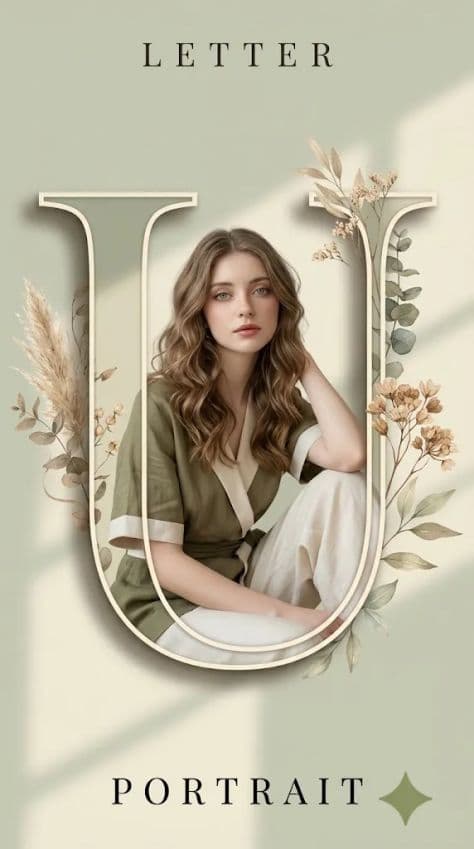
Large Elegant Uppercase Serif Editorial Portrait with Studio
Create a large elegant uppercase serif letter “U” in the center of the composition. The portrait should be creatively integrated inside the shape of the U, while the letter remains clearly recognizable and visually dominant. Use a completely different model/photo and a unique pose. Do NOT copy the pose from the reference design and do NOT use a side-profile pose. Choose a professional, natural pose that works beautifully with the shape of the letter U — for example, sitting gracefully within the curve of the U, facing mostly toward the camera, one arm resting naturally on the knee and the other relaxed. Make the pose elegant, confident and editorial. Choose a completely different outfit and photo setting that suits the person naturally. Use colors from the outfit/photo to create a matching background color palette. Keep the background soft, sophisticated and complementary to the portrait. Add subtle botanical elements, soft natural sunlight, delicate flowers, gentle shadows and a few minimal decorative details around the letter. Use a thin warm-cream/ivory outline around the U with a subtle realistic 3D shadow so it looks professionally designed. Add minimal spaced typography: “LETTER” at the top “PORTRAIT” at the bottom Keep the overall design premium, clean, feminine, artistic and professional, like a high-end Pinterest/Instagram editorial poster. The portrait must look realistic and naturally blended into the letter. No logo, no watermark, no extra letters and no unnecessary text. Vertical high-resolution composition.
Category:UI & Design
Model:
2
0
Salton Footwear Deodorant Spray Modern Floating Product Ad Product Photography AI Prompt

Salton Footwear Deodorant Spray Modern Floating Product Ad
A product photo in a premium advertising style. Two tall matte bottles of Salton Shoe Deodorant levitate in the air in a dynamic, balanced composition. The bottles are positioned at an angle to each other, creating a striking diagonal composition. One bottle is slightly forward, the other is slightly behind, creating depth and hierarchy. Both bottles are elegantly wrapped with a wide black and brown satin ribbon featuring the repeating "Salton" branding. The lettering is executed in a neat, contrasting font, legible without distortion, and is repeated evenly along the entire length of the ribbon. The ribbon flows smoothly between the bottles, uniting them into a single composition, without obscuring key messages on the packaging or clashing with the main branding on the bottles. Shot from a slightly lower angle, the bottles are slightly tilted, enhancing a sense of confidence, strength, and premium quality. The background is a solid studio color, a deep warm shade (chocolate, dark caramel or soft terracotta), clean and minimalist, without distracting details.
Category:UI & Design
Model:
4
Vous êtes à jour
Supercharge your design inspiration with our curated library of UI and graphic design prompts. Explore cutting-edge digital aesthetics—from sleek dark-mode SaaS dashboards and neo-brutalist landing pages to clean iOS mobile app flows and geometric brand identity systems.
Bridge design systems with AI prompting: instruct the engine with precise UI conventions like Bento grid layouts, glassmorphic cards, typography hierarchy, micro-interactions, subtle drop shadows, and modern color palettes.
Built for product designers, creative agencies, and indie hackers looking to brainstorm homepage concepts, app interfaces, and pitch deck visuals in record time.