PromptLabHub
Photorealistic Portrait Interior Dark Backlit Aerial
2
2
Prompt

Photorealistic Portrait Interior Dark Backlit Aerial

Use the attached photograph as the primary governing reference. Recreate its structure exactly without reinterpreting it.

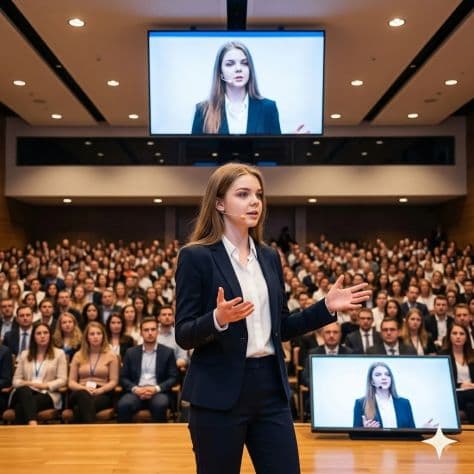
This is a conference keynote event photograph built on a dominant foreground presenter with recursive subject repetition across three planes: the physical foreground speaker, a large overhead live-feed screen above, and a smaller confidence monitor at lower-right. The foreground presenter is the sharpest and most visually dominant version. A large seated audience fills the background. The layout grammar is vertically stacked recursive speaker hierarchy with the presenter slightly right of the mathematical canvas centre.

Square 1:1 composition, 3000 × 3000 pixels, sRGB. Artwork fills the full canvas edge to edge. No device frame, no mockup, no rounded corners, no border.

Background system constructed bottom upward.

The base layer is a continuous-tone photographic large indoor conference auditorium. The ceiling occupies approximately 0–100% width, 0–12% height. The ceiling surface is pale warm-neutral matte panels with dark linear structural channels running across the width, and approximately 10 visible circular recessed ceiling lights producing small warm-white highlight blooms. A dark horizontal architectural band runs at approximately 0–100% width, 9–15% height separating the ceiling from the screen below.

The large overhead live-feed display screen occupies approximately 15–86% width, 13–38% height. This is a bright landscape-format digital display with a hard rectangular edge. Along the very top edge of the screen at approximately 15–86% width, 12.5–14.5% height runs a narrow saturated electric-blue accent strip. The screen image is cooler and brighter than the surrounding auditorium. On the screen is displayed the same foreground presenter from a tighter upper-body camera angle — the displayed presenter occupies approximately 28–69% width, 15–38% height within the screen area, showing the same person, the same navy blazer and white shirt, the same headset microphone, from bust upward. The screen has white and cool-blue highlights, luminosity 88, hex #E6E8ED at brightest points. The screen separates clearly from the dark architectural band above it by a luminosity delta of approximately 40–60.

The audience field occupies approximately 0–100% width, 22–94% height, filling the full width behind the foreground presenter across the entire vertical midrange of the canvas. The audience is a large dense crowd of seated people, hundreds of individuals visible, varying in clothing from dark to light. The audience produces a mottled organic high-frequency pattern of light and dark. Apply optical depth-of-field softening to the audience at approximately 1.5–3% canvas width blur radius, strongest in the deepest rows, softening individual audience faces while retaining the overall crowd density, light-dark rhythm and sense of scale. The nearest front-row audience members at approximately 0–100% width, 72–94% height retain marginally more detail than deep background rows. No individual audience member's identity is relevant to reconstruction.

The stage floor occupies approximately 0–100% width, 93–100% height as a warm honey-amber polished or matte wood surface, colour #E1A25D, luminosity 69. A lower-right landscape confidence monitor occupies approximately 64–96% width, 72–90% height. This smaller screen is a bright rectangular display showing the same presenter again in upper-body framing. The monitor screen luminosity is substantially above the blurred audience immediately behind it, creating a luminosity delta of approximately 35–55 against that region.

A small pale four-point star sparkle decorative mark is visible at approximately 91–98% width, 93–98% height at the lower-right corner of the stage area. Render it as a small opaque pale warm-white graphic accent.

Apply a global warm-cool colour grade at 10–20% strength across the full canvas maintaining deliberate warm-cool tension. Warm regions: skin, audience crowd, stage wood. Cool regions: navy tailoring, screen imagery, blue display strip. Neutral regions: white shirt, ceiling lights.

Apply ceiling recessed-light bloom at low strength from each of the approximately 10 circular ceiling fixtures. Apply warm stage-floor highlight lift at approximately 10–20% strength across 0–100% width, 90–100% height.

Corner luminosity targets: top-left ≈45, top-right ≈47, bottom-left ≈72, bottom-right ≈72. Lower corners are brighter because the warm wooden stage reaches both lower edges. No strong artificial vignette — edge darkness originates from auditorium architecture rather than a graphic vignette layer.

Primary visual element — foreground presenter.

One standing person occupies approximately 26–92% width, 29–100% height, optical centre (56%, 64%). Full-colour photographic figure, sharpest element in the entire composition. No cutout, no mask, no silhouette simplification, natural photographic edges throughout. Treatment chain: full-colour photography, warm-cool colour grade, naturalistic skin rendering, foreground depth-of-field separation from crowd. No duotone, no halftone, no painterly rendering, no artificial glow, no cutout drop shadow.

Do not lock the subject's identity, skin tone, facial features, age, ethnicity, nationality, gender, body type or any other demographic characteristic. Preserve only composition, pose, wardrobe contrast system, object placement, lighting hierarchy and camera framing.

Pose — exact.

The presenter stands upright in a keynote public-speaking posture. Torso is approximately frontal with a small rotational offset. Head is slightly turned, gaze directed toward the audience or camera with a natural engaged speaking expression, mouth slightly open mid-sentence or mid-emphasis. Both arms are bent at the elbows and separated from the torso in an open explanatory gesture — palms open rather than clenched, creating broad horizontal width around the upper torso. The viewer-left hand is located at approximately 42–58% width, 54–65% height, palm open and slightly cupped. The viewer-right hand is located at approximately 74–92% width, 51–64% height, also open with fingers extended in an expressive gesture. The lower legs exit the bottom canvas edge — the feet and ankle area are not visible.

The presenter wears a formal dark-light-dark speaker wardrobe system. Dark navy tailored blazer, luminosity 11, hex #0F1C36, occupying approximately 27–80% width, 43–83% height. A bright white or off-white collared shirt, luminosity 91, hex #F1EFEA, visible as a narrow central vertical band at approximately 44–58% width, 45–70% height. Dark navy or near-black tailored trousers at approximately 34–68% width, 78–100% height. The white-shirt-to-navy-blazer luminosity separation is approximately 80 points. A thin headset microphone boom follows the cheek toward the mouth at approximately 55–59% width, 36–44% height.

Face bounding box approximately 42–61% width, 33–46% height. Face centre approximately (51.5%, 39.5%). Face height approximately 13% canvas height. Head and hair mass approximately 39–64% width, 29–48% height. Head height approximately 19% canvas height. Visible subject height approximately 71% canvas height.

Recursive subject consistency rule — critical.

The same chosen presenter subject must appear identically on the large overhead screen at 15–86% width, 13–38% height in upper-body framing, and again on the lower-right monitor at 64–96% width, 72–90% height in upper-body framing. Never generate a different person on the screens. The foreground version is the sharpest. The screen versions are the same face, same wardrobe, rendered as live digital display imagery with a cooler and slightly brighter screen colour treatment.

Surface finish.

The surface carries no added film grain, no digital noise, no paper tooth, no halftone, no scanlines, no distress, no chromatic aberration, and no geometric decorative overlay beyond the single sparkle mark described above. No strong artificial portrait glow. Foreground/background depth separation is the primary isolation technique.

Typography.

There is no designed primary title anywhere on this canvas. Title cap-height is 0% of canvas height. Render no title text, no speaker name, no conference name, no event branding, no session title, no date, no location, no sponsor text, no URL, no social handle. The large overhead screen and lower monitor carry only the presenter image — no caption, no lower-third text, no event logo on screen. No readable words anywhere on the canvas.

Closed palette — 13 photographic control families.

#0A0A0E deep structural near-black, #0F1C36 dark navy tailoring, #3D5B88 cool screen blue, #1599DA saturated electric-blue screen accent strip, #463534 dark warm audience tone, #746166 taupe-mauve audience midtone, #B0908D light dusty audience field, warm natural skin colours adapted to the chosen subject while preserving equivalent luminance separation — not a demographic lock, #F1EFEA white and off-white shirt, #C9B9B2 ceiling warm grey-neutral, #E1A25D warm amber stage wood, #E6E8ED cool screen white highlights. Skin colour references are adaptive and must never be used as a demographic style lock. Continuous photographic tonal interpolation within these families. No additional hue families introduced. White-shirt-to-navy luminosity separation must remain approximately 80 points. Strong foreground-to-background depth separation must be preserved.

Layout and reading order.

Compositional primary axis at x≈52%. Overhead screen occupies the upper zone. Foreground presenter occupies the central-lower zone. Audience fills the background across full width. Stage anchors the bottom. Reading order: foreground face first driven by sharpest focus, facial recognition and skin-to-dark-suit contrast; large overhead screen second as a large bright luminous rectangle with repeated face; open hand gestures third as wide foreground movement; audience fourth establishing event scale through crowd density and repetition; lower-right monitor fifth as a bright secondary screen rectangle. Negative space approximately 8–12%, concentrated in the ceiling zone and narrow zones around the screen edges. Minimum element-to-edge distance is 0% — auditorium scene, audience, stage, presenter legs and sparkle reach or bleed all edges. Face is safely positioned at least 33% from the top edge and 40% from both lateral edges. Lower 8% of canvas carries only stage floor — no critical identity information placed there.

At 55 pixels wide this cover must read as: a formally dressed standing figure in navy and white in the foreground with a large bright screen overhead showing the same person above a dense crowd of audience members in an auditorium. The navy standing figure and white shirt centre remain the primary foreground silhouette. The overhead screen reads as a distinct luminous rectangle. The crowd reads as a dense mottled background field. The lower monitor becomes a bright secondary rectangle. All individual audience identities, headset wire, glasses detail, hand finger separation and lower monitor facial detail may collapse to colour mass at 55 pixels.

Genre register is public speaking, keynote and conference presentation carried by the standing presenter with open explanatory hand gestures, the headset microphone, the large live-feed overhead screen, the large seated audience and the auditorium architecture. Secondary register is business, education and leadership carried by the formal navy tailored wardrobe, the large audience scale, the professional AV display system and the structured formal presentation setup. The most distinctive structural feature is recursive subject repetition — the same presenter appears simultaneously as the physical foreground figure, as the enlarged overhead screen image, and as the smaller lower-right monitor image. Brand personality is corporate-systematic: navy-white wardrobe system, organised auditorium, professional multi-display AV environment.

Do not lock the identity of the depicted person. Any subject can occupy this composition. Preserve pose, wardrobe contrast system, conference architecture, crowd scale, live-screen duplication and lighting hierarchy. Palette is closed to the 13 colour families listed above with skin tones adapting naturally to the chosen subject. No readable text anywhere. Surface is full-colour photographic with no illustrative, graphic, or dimensional conversion. Lower 8% of canvas carries only stage floor — no critical element placed there.

·
Social Media Banners

Avis

Connectez-vous pour laisser un avis.

Pas encore d'avis. Soyez le premier.

PromptLabHub sur tous vos appareils.

Installez l’application pour un accès plus rapide, ou téléchargez l’extension Chrome et chargez-la dans le navigateur.

Parcourir les prompts

  • Tous les prompts
  • Prompts photo
  • Prompts vidéo
  • Prompts cuisine

Créer

  • Soumettre un prompt

Communauté

  • Forum
  • Créateurs
  • Classement
  • Défi hebdomadaire

Assistance

  • FAQ
  • Nous contacter
  • Politique de confidentialité
  • Conditions d'utilisation

Suivez-nous

Découvrez et copiez des prompts IA sélectionnés pour Midjourney, DALL-E 3, Sora, Runway et plus encore. Mis à jour chaque semaine.

Politique de confidentialitéConditions d'utilisationPolitique de cookies

© 2026 PromptLabHub. All rights reserved.

© 2026 PromptLabHub. All rights reserved.

·
Politique de confidentialité·Conditions d'utilisation·Politique de cookies
Home
PromptLabHub
Photorealistic Portrait Interior Dark Backlit Aerial
2
2
Prompt

Photorealistic Portrait Interior Dark Backlit Aerial

Use the attached photograph as the primary governing reference. Recreate its structure exactly without reinterpreting it.

This is a conference keynote event photograph built on a dominant foreground presenter with recursive subject repetition across three planes: the physical foreground speaker, a large overhead live-feed screen above, and a smaller confidence monitor at lower-right. The foreground presenter is the sharpest and most visually dominant version. A large seated audience fills the background. The layout grammar is vertically stacked recursive speaker hierarchy with the presenter slightly right of the mathematical canvas centre.

Square 1:1 composition, 3000 × 3000 pixels, sRGB. Artwork fills the full canvas edge to edge. No device frame, no mockup, no rounded corners, no border.

Background system constructed bottom upward.

The base layer is a continuous-tone photographic large indoor conference auditorium. The ceiling occupies approximately 0–100% width, 0–12% height. The ceiling surface is pale warm-neutral matte panels with dark linear structural channels running across the width, and approximately 10 visible circular recessed ceiling lights producing small warm-white highlight blooms. A dark horizontal architectural band runs at approximately 0–100% width, 9–15% height separating the ceiling from the screen below.

The large overhead live-feed display screen occupies approximately 15–86% width, 13–38% height. This is a bright landscape-format digital display with a hard rectangular edge. Along the very top edge of the screen at approximately 15–86% width, 12.5–14.5% height runs a narrow saturated electric-blue accent strip. The screen image is cooler and brighter than the surrounding auditorium. On the screen is displayed the same foreground presenter from a tighter upper-body camera angle — the displayed presenter occupies approximately 28–69% width, 15–38% height within the screen area, showing the same person, the same navy blazer and white shirt, the same headset microphone, from bust upward. The screen has white and cool-blue highlights, luminosity 88, hex #E6E8ED at brightest points. The screen separates clearly from the dark architectural band above it by a luminosity delta of approximately 40–60.

The audience field occupies approximately 0–100% width, 22–94% height, filling the full width behind the foreground presenter across the entire vertical midrange of the canvas. The audience is a large dense crowd of seated people, hundreds of individuals visible, varying in clothing from dark to light. The audience produces a mottled organic high-frequency pattern of light and dark. Apply optical depth-of-field softening to the audience at approximately 1.5–3% canvas width blur radius, strongest in the deepest rows, softening individual audience faces while retaining the overall crowd density, light-dark rhythm and sense of scale. The nearest front-row audience members at approximately 0–100% width, 72–94% height retain marginally more detail than deep background rows. No individual audience member's identity is relevant to reconstruction.

The stage floor occupies approximately 0–100% width, 93–100% height as a warm honey-amber polished or matte wood surface, colour #E1A25D, luminosity 69. A lower-right landscape confidence monitor occupies approximately 64–96% width, 72–90% height. This smaller screen is a bright rectangular display showing the same presenter again in upper-body framing. The monitor screen luminosity is substantially above the blurred audience immediately behind it, creating a luminosity delta of approximately 35–55 against that region.

A small pale four-point star sparkle decorative mark is visible at approximately 91–98% width, 93–98% height at the lower-right corner of the stage area. Render it as a small opaque pale warm-white graphic accent.

Apply a global warm-cool colour grade at 10–20% strength across the full canvas maintaining deliberate warm-cool tension. Warm regions: skin, audience crowd, stage wood. Cool regions: navy tailoring, screen imagery, blue display strip. Neutral regions: white shirt, ceiling lights.

Apply ceiling recessed-light bloom at low strength from each of the approximately 10 circular ceiling fixtures. Apply warm stage-floor highlight lift at approximately 10–20% strength across 0–100% width, 90–100% height.

Corner luminosity targets: top-left ≈45, top-right ≈47, bottom-left ≈72, bottom-right ≈72. Lower corners are brighter because the warm wooden stage reaches both lower edges. No strong artificial vignette — edge darkness originates from auditorium architecture rather than a graphic vignette layer.

Primary visual element — foreground presenter.

One standing person occupies approximately 26–92% width, 29–100% height, optical centre (56%, 64%). Full-colour photographic figure, sharpest element in the entire composition. No cutout, no mask, no silhouette simplification, natural photographic edges throughout. Treatment chain: full-colour photography, warm-cool colour grade, naturalistic skin rendering, foreground depth-of-field separation from crowd. No duotone, no halftone, no painterly rendering, no artificial glow, no cutout drop shadow.

Do not lock the subject's identity, skin tone, facial features, age, ethnicity, nationality, gender, body type or any other demographic characteristic. Preserve only composition, pose, wardrobe contrast system, object placement, lighting hierarchy and camera framing.

Pose — exact.

The presenter stands upright in a keynote public-speaking posture. Torso is approximately frontal with a small rotational offset. Head is slightly turned, gaze directed toward the audience or camera with a natural engaged speaking expression, mouth slightly open mid-sentence or mid-emphasis. Both arms are bent at the elbows and separated from the torso in an open explanatory gesture — palms open rather than clenched, creating broad horizontal width around the upper torso. The viewer-left hand is located at approximately 42–58% width, 54–65% height, palm open and slightly cupped. The viewer-right hand is located at approximately 74–92% width, 51–64% height, also open with fingers extended in an expressive gesture. The lower legs exit the bottom canvas edge — the feet and ankle area are not visible.

The presenter wears a formal dark-light-dark speaker wardrobe system. Dark navy tailored blazer, luminosity 11, hex #0F1C36, occupying approximately 27–80% width, 43–83% height. A bright white or off-white collared shirt, luminosity 91, hex #F1EFEA, visible as a narrow central vertical band at approximately 44–58% width, 45–70% height. Dark navy or near-black tailored trousers at approximately 34–68% width, 78–100% height. The white-shirt-to-navy-blazer luminosity separation is approximately 80 points. A thin headset microphone boom follows the cheek toward the mouth at approximately 55–59% width, 36–44% height.

Face bounding box approximately 42–61% width, 33–46% height. Face centre approximately (51.5%, 39.5%). Face height approximately 13% canvas height. Head and hair mass approximately 39–64% width, 29–48% height. Head height approximately 19% canvas height. Visible subject height approximately 71% canvas height.

Recursive subject consistency rule — critical.

The same chosen presenter subject must appear identically on the large overhead screen at 15–86% width, 13–38% height in upper-body framing, and again on the lower-right monitor at 64–96% width, 72–90% height in upper-body framing. Never generate a different person on the screens. The foreground version is the sharpest. The screen versions are the same face, same wardrobe, rendered as live digital display imagery with a cooler and slightly brighter screen colour treatment.

Surface finish.

The surface carries no added film grain, no digital noise, no paper tooth, no halftone, no scanlines, no distress, no chromatic aberration, and no geometric decorative overlay beyond the single sparkle mark described above. No strong artificial portrait glow. Foreground/background depth separation is the primary isolation technique.

Typography.

There is no designed primary title anywhere on this canvas. Title cap-height is 0% of canvas height. Render no title text, no speaker name, no conference name, no event branding, no session title, no date, no location, no sponsor text, no URL, no social handle. The large overhead screen and lower monitor carry only the presenter image — no caption, no lower-third text, no event logo on screen. No readable words anywhere on the canvas.

Closed palette — 13 photographic control families.

#0A0A0E deep structural near-black, #0F1C36 dark navy tailoring, #3D5B88 cool screen blue, #1599DA saturated electric-blue screen accent strip, #463534 dark warm audience tone, #746166 taupe-mauve audience midtone, #B0908D light dusty audience field, warm natural skin colours adapted to the chosen subject while preserving equivalent luminance separation — not a demographic lock, #F1EFEA white and off-white shirt, #C9B9B2 ceiling warm grey-neutral, #E1A25D warm amber stage wood, #E6E8ED cool screen white highlights. Skin colour references are adaptive and must never be used as a demographic style lock. Continuous photographic tonal interpolation within these families. No additional hue families introduced. White-shirt-to-navy luminosity separation must remain approximately 80 points. Strong foreground-to-background depth separation must be preserved.

Layout and reading order.

Compositional primary axis at x≈52%. Overhead screen occupies the upper zone. Foreground presenter occupies the central-lower zone. Audience fills the background across full width. Stage anchors the bottom. Reading order: foreground face first driven by sharpest focus, facial recognition and skin-to-dark-suit contrast; large overhead screen second as a large bright luminous rectangle with repeated face; open hand gestures third as wide foreground movement; audience fourth establishing event scale through crowd density and repetition; lower-right monitor fifth as a bright secondary screen rectangle. Negative space approximately 8–12%, concentrated in the ceiling zone and narrow zones around the screen edges. Minimum element-to-edge distance is 0% — auditorium scene, audience, stage, presenter legs and sparkle reach or bleed all edges. Face is safely positioned at least 33% from the top edge and 40% from both lateral edges. Lower 8% of canvas carries only stage floor — no critical identity information placed there.

At 55 pixels wide this cover must read as: a formally dressed standing figure in navy and white in the foreground with a large bright screen overhead showing the same person above a dense crowd of audience members in an auditorium. The navy standing figure and white shirt centre remain the primary foreground silhouette. The overhead screen reads as a distinct luminous rectangle. The crowd reads as a dense mottled background field. The lower monitor becomes a bright secondary rectangle. All individual audience identities, headset wire, glasses detail, hand finger separation and lower monitor facial detail may collapse to colour mass at 55 pixels.

Genre register is public speaking, keynote and conference presentation carried by the standing presenter with open explanatory hand gestures, the headset microphone, the large live-feed overhead screen, the large seated audience and the auditorium architecture. Secondary register is business, education and leadership carried by the formal navy tailored wardrobe, the large audience scale, the professional AV display system and the structured formal presentation setup. The most distinctive structural feature is recursive subject repetition — the same presenter appears simultaneously as the physical foreground figure, as the enlarged overhead screen image, and as the smaller lower-right monitor image. Brand personality is corporate-systematic: navy-white wardrobe system, organised auditorium, professional multi-display AV environment.

Do not lock the identity of the depicted person. Any subject can occupy this composition. Preserve pose, wardrobe contrast system, conference architecture, crowd scale, live-screen duplication and lighting hierarchy. Palette is closed to the 13 colour families listed above with skin tones adapting naturally to the chosen subject. No readable text anywhere. Surface is full-colour photographic with no illustrative, graphic, or dimensional conversion. Lower 8% of canvas carries only stage floor — no critical element placed there.

·
Social Media Banners

Avis

Connectez-vous pour laisser un avis.

Pas encore d'avis. Soyez le premier.

PromptLabHub sur tous vos appareils.

Installez l’application pour un accès plus rapide, ou téléchargez l’extension Chrome et chargez-la dans le navigateur.

Parcourir les prompts

  • Tous les prompts
  • Prompts photo
  • Prompts vidéo
  • Prompts cuisine

Créer

  • Soumettre un prompt

Communauté

  • Forum
  • Créateurs
  • Classement
  • Défi hebdomadaire

Assistance

  • FAQ
  • Nous contacter
  • Politique de confidentialité
  • Conditions d'utilisation

Suivez-nous

Découvrez et copiez des prompts IA sélectionnés pour Midjourney, DALL-E 3, Sora, Runway et plus encore. Mis à jour chaque semaine.

Politique de confidentialitéConditions d'utilisationPolitique de cookies

© 2026 PromptLabHub. All rights reserved.

© 2026 PromptLabHub. All rights reserved.

·
Politique de confidentialité·Conditions d'utilisation·Politique de cookies
Home