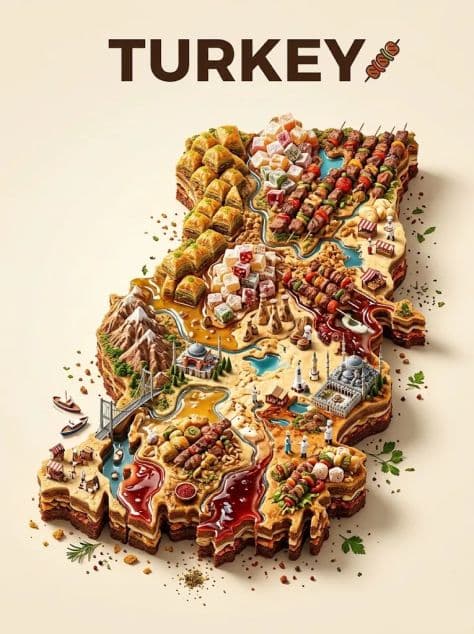

3D Isometric Culinary Floating Island World Map
Create an extraordinary ultra-realistic 3D isometric culinary world-map poster depicting [COUNTRY] as if its entire geography exists inside a miniature food universe.
The landmass must follow the recognizable geographic silhouette of [COUNTRY] with clean, accurate borders and believable regional proportions. Instead of ordinary terrain, construct the country from its iconic cuisine: [DISH 1], [DISH 2], and [DISH 3], seamlessly transformed into mountains, valleys, farmland, coastlines, towns, and geological formations.
Treat the food as actual geography rather than simply placing dishes on top of a map.
Use layers of ingredients to create elevation:
— stacked breads, pastries, rice, noodles, vegetables, meats, herbs, spices, and regional ingredients forming hills and mountain ranges
— crisp edges, crumbs, grains, sauces, steam, glaze, and tiny food textures visible at miniature scale
— ingredients transitioning naturally between different regions instead of appearing as separate food piles
Transform rivers and waterways into glossy streams of culturally appropriate sauces, broths, soups, or syrups, flowing naturally through valleys and gathering into miniature lakes and coastal inlets. Their reflections, viscosity, depth, and direction must feel physically convincing.
Build mountain ranges from towering ingredient formations: layered slices, stacked dumplings, folded breads, sculpted rice, spice ridges, or other elements derived from the cuisine of [COUNTRY]. Make the terrain feel enormous despite being created from food.
Integrate tiny architectural landmarks, monuments, bridges, cultural buildings, markets, and regional structures across the landscape at realistic miniature scale. These landmarks should emerge naturally from the edible terrain rather than looking randomly placed. Keep them recognizable but refined enough to belong to the same handcrafted miniature world.
Introduce tiny human-scale details for a sense of life: miniature market stalls, chefs, diners, delivery bicycles, lanterns, picnic tables, boats, or food carts where culturally appropriate. Keep these elements subtle and secondary to the geographic composition.
Design the scene like a premium museum-quality miniature photographed in a studio from a high three-quarter isometric angle. The country should appear as a thick dimensional landform floating slightly above the surface, revealing beautiful cutaway edges with layered ingredients visible along the sides.
Use a clean warm-cream seamless background with generous negative space. Allow a few carefully chosen ingredients, herbs, crumbs, or spice particles to appear around the base of the map as restrained visual accents, never clutter.
Lighting should feel luxurious and almost otherworldly: large soft studio illumination from one side, warm golden highlights across the edible terrain, subtle cool fill inside valleys, delicate rim light around the country's silhouette, realistic contact shadows beneath the floating landmass, and tiny specular highlights on sauces and glazed ingredients.
Use rich but sophisticated colors inspired by real food photography—deep roasted browns, vivid herbs, golden pastry tones, saturated sauces, creamy highlights, and subtle spice colors. Avoid cartoonish saturation.
Composition:
vertical premium poster layout;
country centered in the lower-middle portion;
strong isometric depth;
clear silhouette;
luxury negative space around the map;
no cropped edges;
high visual hierarchy.
At the top, place the country name exactly as:
"[COUNTRY]"
Use bold, beautifully kerned contemporary display typography. Add one small elegant food icon beside the title derived from the cuisine, keeping it minimal and premium.
The final image should feel like an impossible culinary planet discovered in another world—part geographic atlas, part Michelin-level food photography, part handcrafted miniature environment. Every region should reward close inspection with tiny stories, ingredients, landmarks, textures, steam, sauces, and architectural details.
Ultra-detailed miniature photography, hyper-realistic food textures, physically accurate shadows, realistic ingredient scale, cinematic depth, premium commercial retouching, sophisticated isometric perspective, photorealistic 3D realism, immaculate poster finish, 8K.
Negative prompt: inaccurate country silhouette, distorted borders, flat map, ordinary food placed randomly on map, repetitive ingredients, duplicated landmarks, floating objects without support, impossible scale, plastic food, toy-like textures, cartoon appearance, excessive saturation, messy composition, unreadable title, misspelled country name, garbled typography, duplicated text, random logos, watermark, low detail, flat lighting, malformed architecture, visible AI artifacts.
Mind-bending 3D isometric culinary diorama depicting a floating topographic nation crafted entirely out of authentic gourmet dishes, artisanal breads, sauces, and miniature food landscapes with tilt-shift depth of field.