
PromptLabHub
Vibrant Portrait Studio Dramatic Backlit Bokeh
3
3
Prompt

Vibrant Portrait Studio Dramatic Backlit Bokeh

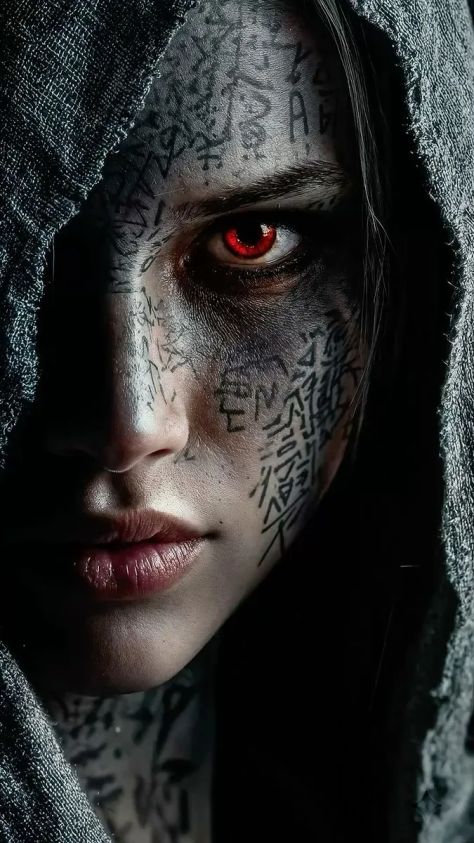
Use the uploaded image as the main visual reference. Recreate the same single-subject dark-fantasy beauty portrait, the same distressed enclosing hood, the same abstract occult-style facial glyph markings, the same extreme close-up framing, and the same low-key studio atmosphere. Do not invent a new face, color system, background, camera angle, hairstyle, garment, accessories, or additional elements. Follow the uploaded image closely and apply only the specifications below.

Generate a maximum-photorealistic dark-fantasy editorial portrait in a 9:16 vertical composition. Frame the face in an extreme close-up so the forehead approaches the top edge, one side of the face disappears into near-black shadow and crop, and the chin remains visible while the shoulders remain outside the frame. Position the face slightly toward viewer-right, with the fully visible eye near the upper-right rule-of-thirds intersection. Keep the camera at eye level, nearly frontal, with only a subtle three-quarter rotation toward viewer-left and an almost level head with a very slight downward inclination. Use approximately 90–120 mm equivalent portrait compression at f/2.8–f/4, shallow-to-moderate depth of field, grain level 2/10, and retouching level 6/10.

Preserve the same facial identity and exact facial structure from the uploaded reference: an oval-to-tapered facial silhouette, narrow lower jaw, softly pointed chin, moderate jaw definition that fades into shadow, and moderately prominent cheekbones emphasized on the illuminated side. Preserve the exact nose, brow-to-eye relationships, nose-to-lip spacing, mouth shape, and lip proportions from the reference. Keep the lower lip approximately 1.35–1.45 times the fullness of the upper lip, with a soft-to-moderately defined Cupid's bow. Keep the frontalis relaxed, visible brow close to the orbital ridge, orbicularis oculi only mildly engaged, closed lips with minimal orbicularis oris contraction, and relaxed mentalis. Do not introduce a smile, grimace, widened eyes, raised brows, or altered facial tension.

Render the skin as a pale desaturated beige-stone material with a cool olive-gray undertone. In illuminated zones, target approximately H 35–45°, S 10–20%, B 65–82%; in deep shadow zones, shift toward H 200–220°, S 8–18%, B 8–28%. Maintain satin-natural skin reflectance with localized sheen on the nose bridge, nose tip, upper cheek, lip center, and chin. Smooth broad forehead and cheek planes moderately while preserving visible pores and fine microtexture around the nose, cheek, under-eye area, and mouth. Preserve natural lip ridges and fine facial detail. Do not produce raw unretouched skin, but do not flatten the face into plastic or airbrushed skin.

Preserve the exact visible eye treatment. The fully visible eye must remain almond-shaped with a subtly elevated outer corner, fully open without appearing widened, and the upper eyelid must overlap a small portion of the iris. Aim the gaze directly into the camera. Render the iris as an intensely luminous crimson spectral accent at approximately H 350–5°, S 90–100%, B 65–95%, with a darker perimeter ring, near-black round medium-sized pupil, and fine radial red-orange iris fibers around the pupil. Place a strong small white rectangular-to-irregular catchlight at approximately the 1–2 o'clock position with only tiny secondary reflections nearby. The opposite eye must remain largely concealed inside deep shadow; do not generate two equally visible eyes and do not substitute a natural-colored second iris.

Keep the brows dark at approximately H 20–35°, S 15–30%, B 8–18%, medium-thick to thick, relatively straight with a soft arch, and composed of individually visible brow hairs rather than a painted block. Maintain grooming at approximately 6/10 with a defined overall shape and retained natural fiber texture. Preserve dark upper lashes with moderate separation and slight clumping, short lower lashes partially obscured by orbital shadow, and no exaggerated false-lash effect.

Apply medium-to-full coverage foundation using the same cool desaturated beige-gray skin treatment. Apply dense smoky orbital shading in near-black charcoal at approximately H 210–225°, S 8–18%, B 2–12%, extending over the upper lid, outer eye, and lower orbital region. Add heavy near-black eyeliner concentrated around the visible eye and moderate dark mascara on the upper lashes. Keep blush completely absent. Shape the cheek and nose using cool low-saturation gray-brown contour rather than warm bronzing. Render the lips in muted dusty mauve-brown, approximately H 345–5°, low-to-moderate saturation and medium-low brightness, with a satin-gloss surface and strongly preserved vertical lip texture. Do not invent additional makeup.

Keep the hair extremely dark, approximately H 210–230°, S 10–20%, B 3–12%. Show only the limited hair visible in the reference: a narrow set of straight strands descending vertically beside the viewer-right temple and cheek. Use a smooth semi-gloss fiber response, low apparent volume, restrained specular streaks, and no broad flyaway cloud. Do not invent a visible parting, added volume, curls, bangs, or a new hairstyle.

Cover the forehead, temple, cheek, nose-side, and visible neck with dense matte charcoal abstract glyph markings. Treat every marking as hand-applied, non-linguistic graphic ink with irregular angular construction, inconsistent stroke width, and a dry matte finish. Make the forehead the highest-density marking zone, extending irregular symbols from viewer-left across the central forehead. Place additional vertical and diagonal clusters beneath and beside the visible eye, with the highest cheek density on viewer-right. Continue similar markings onto the visible neck. Do not convert these markings into a recognizable alphabet, readable phrase, logo, branded symbol, or coherent written language.

Keep the same oversized hood or cloak surrounding the face. Render the material as a coarse open-weave linen/burlap/gauze-like textile with a cool low-saturation charcoal-gray response around H 195–215°, S 8–18%, B 15–45%. Show clearly separated crosshatched threads, uneven woven thickness, exposed fibers, and intentionally distressed irregular fraying along the hood edge. The garment must sit loosely and envelop the head, approaching the forehead and cheek closely while falling into near-black folds below. Keep the neckline concealed. No fasteners, logos, printed pattern, jewelry, earrings, necklace, glasses, hat, or held objects.

The background must follow the uploaded image as a three-layer depth stack: first, coarse hood fibers forming the immediate enclosing foreground; second, the face and central markings occupying the sharp focal plane; third, a nearly featureless studio-black background at approximately 1–6% relative luminance. Keep the deepest hood folds softly out of focus while retaining strong fiber texture along the illuminated edges. No bokeh orbs, no additional people, no environmental props, no fog, no rain, no airborne particles, no lens flare, and no readable background text.

Use a narrow cool-neutral key source from approximately 10–11 o'clock/front-left at approximately 5000–5600 K. Direct the strongest exposure onto the viewer-left forehead plane, nose bridge, nose tip, upper cheek, lip center, and chin. Allow the opposite facial half, peripheral eye socket, lower jaw, and hood interior to approach near-black. Keep the shadow terminator moderately hard, particularly across the nose and under-eye region. Maintain only approximately 8–15% fill so shadow texture is barely but deliberately retained. Use an extremely faint cool edge response only on raised hood fibers; do not add a visible facial rim light. Add subtle cool-gray bounce from the hood onto adjacent skin. Use a dramatic split/short-light hybrid pattern. Render hood micro-highlights as low-saturation silver-gray thread reflections. Preserve the eye's red spectral accent as substantially brighter and more saturated than the surrounding skin without blooming across the face.

Grade the image with a strongly desaturated cool-charcoal cinematic treatment. Keep shadows around H 200–220° at very low brightness, skin highlights around H 35–45° with low saturation, near-black structural zones at B 1–8%, the iris at H 350–5° with very high saturation, and the lips near H 345–5° with restrained saturation. Use cool blue-gray split toning in shadows and neutral-to-slightly warm desaturated skin highlights. Maintain an overall visual temperature of approximately 4700–5200 K.

Render at maximum photorealistic quality. Follow the uploaded image as the primary visual reference. Preserve exact facial proportions, identity, one-eye visibility pattern, direct gaze, crimson iris treatment, facial glyph placement density, hair visibility, distressed hood construction, portrait crop, lighting geometry, black-point shaping, color temperature, and three-layer depth structure. Apply post-processing at approximately 8/10 with strong but controlled black-point shaping, global desaturation, selective skin smoothing, precise eye-color enhancement, localized microcontrast, controlled highlights, and negligible chromatic aberration.

Do not change the subject's identity. Do not reveal the shadow-concealed eye to the same degree as the visible eye. Do not alter the hood's cool low-saturation charcoal textile response. Do not replace the abstract facial markings with readable writing. Do not add accessories, hands, shoulders, props, people, scars, extra tattoos, logos, or background elements. No readable text. No watermark. No obvious CGI appearance. No plastic skin. No beauty-filter look. No anatomical errors. No motion blur. No lens distortion. Ultra-high resolution. Keep the visible eye, nose, lips, central glyphs, skin microtexture, and illuminated hood fibers sharply resolved while deep hood folds remain softly separated by depth of field. Photorealistic dark-fantasy editorial portrait only.

·
Photo Prompts

Avis

Connectez-vous pour laisser un avis.

Pas encore d'avis. Soyez le premier.

PromptLabHub sur tous vos appareils.

Installez l’application pour un accès plus rapide, ou téléchargez l’extension Chrome et chargez-la dans le navigateur.

Parcourir les prompts

  • Tous les prompts
  • Prompts photo
  • Prompts vidéo
  • Prompts cuisine

Créer

  • Soumettre un prompt

Communauté

  • Forum
  • Créateurs
  • Classement
  • Défi hebdomadaire

Assistance

  • FAQ
  • Nous contacter
  • Politique de confidentialité
  • Conditions d'utilisation

Suivez-nous

Découvrez et copiez des prompts IA sélectionnés pour Midjourney, DALL-E 3, Sora, Runway et plus encore. Mis à jour chaque semaine.

Politique de confidentialitéConditions d'utilisationPolitique de cookies

© 2026 PromptLabHub. All rights reserved.

© 2026 PromptLabHub. All rights reserved.

·
Politique de confidentialité·Conditions d'utilisation·Politique de cookies
Home
PromptLabHub
Vibrant Portrait Studio Dramatic Backlit Bokeh
3
3
Prompt

Vibrant Portrait Studio Dramatic Backlit Bokeh

Use the uploaded image as the main visual reference. Recreate the same single-subject dark-fantasy beauty portrait, the same distressed enclosing hood, the same abstract occult-style facial glyph markings, the same extreme close-up framing, and the same low-key studio atmosphere. Do not invent a new face, color system, background, camera angle, hairstyle, garment, accessories, or additional elements. Follow the uploaded image closely and apply only the specifications below.

Generate a maximum-photorealistic dark-fantasy editorial portrait in a 9:16 vertical composition. Frame the face in an extreme close-up so the forehead approaches the top edge, one side of the face disappears into near-black shadow and crop, and the chin remains visible while the shoulders remain outside the frame. Position the face slightly toward viewer-right, with the fully visible eye near the upper-right rule-of-thirds intersection. Keep the camera at eye level, nearly frontal, with only a subtle three-quarter rotation toward viewer-left and an almost level head with a very slight downward inclination. Use approximately 90–120 mm equivalent portrait compression at f/2.8–f/4, shallow-to-moderate depth of field, grain level 2/10, and retouching level 6/10.

Preserve the same facial identity and exact facial structure from the uploaded reference: an oval-to-tapered facial silhouette, narrow lower jaw, softly pointed chin, moderate jaw definition that fades into shadow, and moderately prominent cheekbones emphasized on the illuminated side. Preserve the exact nose, brow-to-eye relationships, nose-to-lip spacing, mouth shape, and lip proportions from the reference. Keep the lower lip approximately 1.35–1.45 times the fullness of the upper lip, with a soft-to-moderately defined Cupid's bow. Keep the frontalis relaxed, visible brow close to the orbital ridge, orbicularis oculi only mildly engaged, closed lips with minimal orbicularis oris contraction, and relaxed mentalis. Do not introduce a smile, grimace, widened eyes, raised brows, or altered facial tension.

Render the skin as a pale desaturated beige-stone material with a cool olive-gray undertone. In illuminated zones, target approximately H 35–45°, S 10–20%, B 65–82%; in deep shadow zones, shift toward H 200–220°, S 8–18%, B 8–28%. Maintain satin-natural skin reflectance with localized sheen on the nose bridge, nose tip, upper cheek, lip center, and chin. Smooth broad forehead and cheek planes moderately while preserving visible pores and fine microtexture around the nose, cheek, under-eye area, and mouth. Preserve natural lip ridges and fine facial detail. Do not produce raw unretouched skin, but do not flatten the face into plastic or airbrushed skin.

Preserve the exact visible eye treatment. The fully visible eye must remain almond-shaped with a subtly elevated outer corner, fully open without appearing widened, and the upper eyelid must overlap a small portion of the iris. Aim the gaze directly into the camera. Render the iris as an intensely luminous crimson spectral accent at approximately H 350–5°, S 90–100%, B 65–95%, with a darker perimeter ring, near-black round medium-sized pupil, and fine radial red-orange iris fibers around the pupil. Place a strong small white rectangular-to-irregular catchlight at approximately the 1–2 o'clock position with only tiny secondary reflections nearby. The opposite eye must remain largely concealed inside deep shadow; do not generate two equally visible eyes and do not substitute a natural-colored second iris.

Keep the brows dark at approximately H 20–35°, S 15–30%, B 8–18%, medium-thick to thick, relatively straight with a soft arch, and composed of individually visible brow hairs rather than a painted block. Maintain grooming at approximately 6/10 with a defined overall shape and retained natural fiber texture. Preserve dark upper lashes with moderate separation and slight clumping, short lower lashes partially obscured by orbital shadow, and no exaggerated false-lash effect.

Apply medium-to-full coverage foundation using the same cool desaturated beige-gray skin treatment. Apply dense smoky orbital shading in near-black charcoal at approximately H 210–225°, S 8–18%, B 2–12%, extending over the upper lid, outer eye, and lower orbital region. Add heavy near-black eyeliner concentrated around the visible eye and moderate dark mascara on the upper lashes. Keep blush completely absent. Shape the cheek and nose using cool low-saturation gray-brown contour rather than warm bronzing. Render the lips in muted dusty mauve-brown, approximately H 345–5°, low-to-moderate saturation and medium-low brightness, with a satin-gloss surface and strongly preserved vertical lip texture. Do not invent additional makeup.

Keep the hair extremely dark, approximately H 210–230°, S 10–20%, B 3–12%. Show only the limited hair visible in the reference: a narrow set of straight strands descending vertically beside the viewer-right temple and cheek. Use a smooth semi-gloss fiber response, low apparent volume, restrained specular streaks, and no broad flyaway cloud. Do not invent a visible parting, added volume, curls, bangs, or a new hairstyle.

Cover the forehead, temple, cheek, nose-side, and visible neck with dense matte charcoal abstract glyph markings. Treat every marking as hand-applied, non-linguistic graphic ink with irregular angular construction, inconsistent stroke width, and a dry matte finish. Make the forehead the highest-density marking zone, extending irregular symbols from viewer-left across the central forehead. Place additional vertical and diagonal clusters beneath and beside the visible eye, with the highest cheek density on viewer-right. Continue similar markings onto the visible neck. Do not convert these markings into a recognizable alphabet, readable phrase, logo, branded symbol, or coherent written language.

Keep the same oversized hood or cloak surrounding the face. Render the material as a coarse open-weave linen/burlap/gauze-like textile with a cool low-saturation charcoal-gray response around H 195–215°, S 8–18%, B 15–45%. Show clearly separated crosshatched threads, uneven woven thickness, exposed fibers, and intentionally distressed irregular fraying along the hood edge. The garment must sit loosely and envelop the head, approaching the forehead and cheek closely while falling into near-black folds below. Keep the neckline concealed. No fasteners, logos, printed pattern, jewelry, earrings, necklace, glasses, hat, or held objects.

The background must follow the uploaded image as a three-layer depth stack: first, coarse hood fibers forming the immediate enclosing foreground; second, the face and central markings occupying the sharp focal plane; third, a nearly featureless studio-black background at approximately 1–6% relative luminance. Keep the deepest hood folds softly out of focus while retaining strong fiber texture along the illuminated edges. No bokeh orbs, no additional people, no environmental props, no fog, no rain, no airborne particles, no lens flare, and no readable background text.

Use a narrow cool-neutral key source from approximately 10–11 o'clock/front-left at approximately 5000–5600 K. Direct the strongest exposure onto the viewer-left forehead plane, nose bridge, nose tip, upper cheek, lip center, and chin. Allow the opposite facial half, peripheral eye socket, lower jaw, and hood interior to approach near-black. Keep the shadow terminator moderately hard, particularly across the nose and under-eye region. Maintain only approximately 8–15% fill so shadow texture is barely but deliberately retained. Use an extremely faint cool edge response only on raised hood fibers; do not add a visible facial rim light. Add subtle cool-gray bounce from the hood onto adjacent skin. Use a dramatic split/short-light hybrid pattern. Render hood micro-highlights as low-saturation silver-gray thread reflections. Preserve the eye's red spectral accent as substantially brighter and more saturated than the surrounding skin without blooming across the face.

Grade the image with a strongly desaturated cool-charcoal cinematic treatment. Keep shadows around H 200–220° at very low brightness, skin highlights around H 35–45° with low saturation, near-black structural zones at B 1–8%, the iris at H 350–5° with very high saturation, and the lips near H 345–5° with restrained saturation. Use cool blue-gray split toning in shadows and neutral-to-slightly warm desaturated skin highlights. Maintain an overall visual temperature of approximately 4700–5200 K.

Render at maximum photorealistic quality. Follow the uploaded image as the primary visual reference. Preserve exact facial proportions, identity, one-eye visibility pattern, direct gaze, crimson iris treatment, facial glyph placement density, hair visibility, distressed hood construction, portrait crop, lighting geometry, black-point shaping, color temperature, and three-layer depth structure. Apply post-processing at approximately 8/10 with strong but controlled black-point shaping, global desaturation, selective skin smoothing, precise eye-color enhancement, localized microcontrast, controlled highlights, and negligible chromatic aberration.

Do not change the subject's identity. Do not reveal the shadow-concealed eye to the same degree as the visible eye. Do not alter the hood's cool low-saturation charcoal textile response. Do not replace the abstract facial markings with readable writing. Do not add accessories, hands, shoulders, props, people, scars, extra tattoos, logos, or background elements. No readable text. No watermark. No obvious CGI appearance. No plastic skin. No beauty-filter look. No anatomical errors. No motion blur. No lens distortion. Ultra-high resolution. Keep the visible eye, nose, lips, central glyphs, skin microtexture, and illuminated hood fibers sharply resolved while deep hood folds remain softly separated by depth of field. Photorealistic dark-fantasy editorial portrait only.

·
Photo Prompts

Avis

Connectez-vous pour laisser un avis.

Pas encore d'avis. Soyez le premier.

PromptLabHub sur tous vos appareils.

Installez l’application pour un accès plus rapide, ou téléchargez l’extension Chrome et chargez-la dans le navigateur.

Parcourir les prompts

  • Tous les prompts
  • Prompts photo
  • Prompts vidéo
  • Prompts cuisine

Créer

  • Soumettre un prompt

Communauté

  • Forum
  • Créateurs
  • Classement
  • Défi hebdomadaire

Assistance

  • FAQ
  • Nous contacter
  • Politique de confidentialité
  • Conditions d'utilisation

Suivez-nous

Découvrez et copiez des prompts IA sélectionnés pour Midjourney, DALL-E 3, Sora, Runway et plus encore. Mis à jour chaque semaine.

Politique de confidentialitéConditions d'utilisationPolitique de cookies

© 2026 PromptLabHub. All rights reserved.

© 2026 PromptLabHub. All rights reserved.

·
Politique de confidentialité·Conditions d'utilisation·Politique de cookies
Home