
PromptLabHub
Vibrant Landscape Interior Elegant Natural Bokeh
10
10
Prompt

Vibrant Landscape Interior Elegant Natural Bokeh

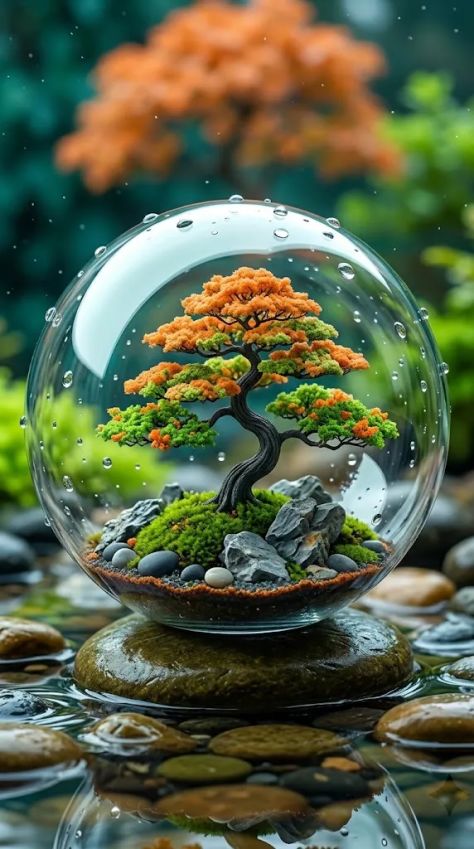
Use the uploaded image as the main visual reference. Recreate the same transparent spherical terrarium, same miniature ornamental tree, same orange-and-fresh-green layered foliage, same dark curved trunk, same moss-covered rocky terrain, same water droplets on the outer glass, same wet river-stone setting, same reflective shallow water, same blurred garden background, same orange background canopy, same vertical framing, and same vivid enchanted botanical atmosphere. Do not invent a different tree species, different sphere geometry, different interior landscape, new color palette, new environment, or new camera angle. Follow the uploaded image closely and apply only the corrections below.

Generate a hyperrealistic fantasy macro architectural/botanical still-life image of the same miniature tree ecosystem enclosed inside a crystal-clear spherical glass vessel in a 9:16 vertical composition. Make the glass globe occupy approximately 65–70% of the frame height. Center the sphere horizontally and place its visual center slightly above the vertical midpoint. Align the main tree trunk approximately with the central vertical axis while preserving the asymmetrical spreading canopy. Position the camera near eye level with the sphere, with only a very slight downward view onto the miniature terrain. Use approximately 95 mm macro-equivalent optics, f/3.2–f/3.6 aperture behavior, strong close-up magnification, selective depth of field, grain level 1/10, and post-processing intensity approximately 9/10.

Preserve the exact compositional hierarchy from the uploaded image. Keep reflective shallow water and wet foreground stones across the lower frame. Place the broad dark olive-brown support stone directly beneath the globe. Keep the crystal sphere as the dominant central subject. Inside it, preserve the miniature rocky moss-covered mound and tree. Behind the sphere, maintain a heavily blurred garden/forest environment with deep teal vegetation, bright lime-green patches, and the large soft orange foliage mass in the upper-center background.

Render the glass sphere as a nearly perfect transparent globe with only a slight flattening/contact zone at the bottom where it rests on the support stone. Keep the shell visually thin, smooth, continuous, and optically clear. Do not make it faceted, thick-walled, frosted, milky, cracked, or plastic.

Give the sphere an extremely polished high-gloss optical-glass finish with strong physically coherent refraction, reflection, and edge distortion. Preserve pronounced bending of the background and miniature terrain near the lower-left, lower-right, and outer perimeter of the sphere. Keep the central viewing region clearer while increasing optical distortion toward the edges.

Add a large pale cyan-white curved reflection sweeping across the upper-left and upper surface of the sphere. Use cool neutral highlights around H 190–205° with extremely low saturation and very high brightness. Keep this reflection broad and smooth, warped naturally by the spherical surface rather than appearing painted onto the glass.

Preserve additional narrow edge reflections along the sphere perimeter, especially the upper-left, upper arc, frame-right rim, and lower-right edge. Keep these highlights crisp enough to define the sphere boundary against the blurred environment while remaining transparent rather than forming a white outline.

Cover the exterior glass with numerous discrete water droplets. Use a mixture of tiny spherical beads and medium rounded droplets, distributed irregularly across the upper half, side regions, and selected lower areas of the sphere. Most droplets should remain near-spherical because of strong surface tension rather than forming long streaks.

Render every droplet as optically transparent water with hard pinpoint neutral-white highlights, miniature reflected environmental colors, narrow bright rims, and slightly distorted views through each bead. Vary droplet size, focus, and highlight intensity naturally. Do not arrange droplets uniformly or create condensation haze across the glass.

Keep active rainfall absent. The glass should appear wet from residual moisture only. Do not add falling rain streaks, water streams, or running rivulets.

Inside the sphere, preserve the same single bonsai-like ornamental tree. Maintain the broad triangular overall canopy, layered horizontal branching structure, open gaps between foliage pads, and asymmetrical organic silhouette. Do not replace it with a conifer, palm, flowering shrub, symmetrical topiary, or oversized forest tree.

Preserve the trunk as a dark charcoal-brown form following a strong S-like upward curve from the terrain into the canopy. Use H 25–35° at extremely low saturation and very low brightness, with cool charcoal contamination in shadow. Keep the trunk thicker at the base, tapering gradually upward, and splitting naturally into multiple lateral and ascending branches.

Render the trunk and major branches with fine ridged bark texture, subtle longitudinal grooves, small irregular fissures, and organic taper. Give the bark a matte-to-satin finish with restrained localized wet-looking highlights where environmental light strikes raised ridges. Do not smooth it into polished wood or exaggerate the bark into heavy fantasy scales.

Preserve numerous thin dark branches extending laterally and upward through the foliage. Maintain readable branch silhouettes between foliage pads, especially through the central and lower canopy. Branches should appear naturally integrated, with decreasing diameter toward the tips.

Build the foliage as dense sculpted cloud-like pads arranged in several horizontal tiers. Preserve the strongest orange foliage through the upper canopy, a mixture of orange and fresh green through the middle branches, and predominantly vivid fresh-green foliage with smaller orange clusters through the lower canopy.

Render the upper foliage around H 25–35°, very high saturation and high brightness, transitioning from saturated orange bases into yellow-orange tips around H 35–45°. Preserve individual small leaf or needle-like masses rather than treating each foliage pad as one smooth blob. Maintain warm red-orange shadow pockets between overlapping clusters.

Use fresh green foliage around H 85–105°, high saturation and medium-high brightness, and emerald regions around H 110–135°, high saturation and medium brightness. Keep lighter yellow-green tips around H 80–95° where the top light and daylight strike leaves directly.

Preserve the orange-versus-green distribution exactly: the upper crown should read predominantly orange, middle layers should intermix orange and bright green, and lower foliage should become greener while retaining several distinct orange accents. Do not recolor the entire tree uniformly orange or green.

Render foliage surfaces with fine branching microstructure, thousands of small organic elements, soft clustered volume, and localized directional highlights. Keep edges crisp within the focal plane and allow only the farthest canopy edges to soften slightly. Do not create flat graphic leaves, artificial plastic foliage, or excessive leaf gloss.

Preserve the interior terrain as a miniature raised mound built from vivid moss, multiple rough stones, small smooth pebbles, dark soil, and a thin rust-brown granular perimeter. Keep the terrain fully enclosed within the lower portion of the sphere.

Render the moss as dense cushion-like growth using bright fresh green around H 95–110° and emerald around H 110–130°, high saturation and medium-to-high brightness. Show extremely fine granular or filament-like texture, subtle mound variation, small dark crevices, and gentle moisture sheen. Do not turn it into smooth turf or artificial carpet.

Place multiple irregular gray rocks around the tree base. Use cool gray, slate-gray, and muted blue-gray values around H 205–220° at very low saturation and medium-low brightness. Keep the rocks naturally fractured with sharp and rounded edges mixed together, rough surface pits, subtle mineral grain, and darker recessed cracks.

Preserve the larger irregular rock positioned toward the lower-left interior and the secondary angular rocks around frame-right of the trunk. Keep the arrangement asymmetrical and integrated into the moss rather than evenly spaced.

Scatter several small smooth rounded pebbles over the moss. Use charcoal gray, cool gray, pale gray, and muted blue-gray values with low saturation. Let some pebbles remain partially embedded in the moss and others sit visibly on top.

Preserve a thin dark brown-to-black soil layer beneath the moss and stones. Along the lower interior perimeter, retain the warm rust/red-brown granular substrate band around H 15–25°, medium saturation and low-to-medium brightness. Keep this band narrow and textural rather than forming a thick decorative stripe.

Preserve the broad smooth river stone supporting the glass sphere. Render it in dark olive-brown around H 45–65° at low saturation and low-to-medium brightness, with a wet satin-to-gloss finish. Maintain slight natural flattening, rounded edges, small surface irregularities, and dark moss growth along portions of its upper edge.

Keep the sphere physically resting on the support stone. Create a soft realistic contact shadow and small compressed reflection zone at the contact point. Do not make the globe float.

Build the foreground environment as shallow clear water containing numerous smooth river stones. Use brown, olive, charcoal, gray, and muted tan pebbles with rounded natural forms. Keep all stones visibly wet with satin-to-gloss highlights and darker saturated tones below the water line.

Render the foreground water as a shallow transparent layer with small natural ripples, irregular reflective pools, and thin highlights around submerged stones. Preserve reflections of the sphere, tree, and orange foliage in the lower water surface.

Include a partial inverted reflection of the glass sphere and tree in the lower-center foreground. Keep the reflection slightly distorted by water ripples and cropped naturally by the bottom frame. Do not create a perfect mirror duplicate.

Preserve broad smooth wet stones across the lower-left, lower-center, and lower-right regions. Vary their size and shape. Add thin water films, small bright neutral-white highlights, and subtle green/orange environmental reflections across their curved surfaces.

Keep the water reflective but not metallic. Maintain transparent brown-green shallows, subtle depth around stone edges, and darker gaps between pebbles. Do not turn the foreground into a deep pool.

Build the background as a heavily defocused garden/forest environment with several depth layers. Use deep teal-green vegetation around H 165–185°, medium saturation and low brightness as the principal shadow color. Add brighter fresh-green and lime-green patches around H 85–110° where light penetrates the foliage.

Preserve the large blurred orange canopy or floral mass extending across the upper-center background. Use H 25–35°, high saturation and medium-to-high brightness. Keep it broad, organic, and strongly out of focus, visually echoing the orange miniature foliage without becoming a second sharp tree.

Allow the farthest background to transition into soft teal and green atmospheric haze with strongly reduced detail. Keep large organic blur regions rather than identifiable leaves. Do not introduce architecture, sky detail, people, pathways, furniture, or artificial garden objects.

Add numerous tiny suspended bright particles across the upper and middle background only. Keep them sparse, small, and irregularly distributed. Render them as tiny neutral-white or pale cyan points with varied focus. They should read as atmospheric moisture/dust-like suspended points rather than magical glowing sparks.

Maintain mild environmental haze exclusively in the background. Keep the sphere interior, glass surface, foreground water, and nearby stones optically clear. Do not fill the scene with dense fog.

Use a broad directional daylight key from approximately the 10–11 o’clock position at upper-left-front. Set the source around 5800 K, within the 5400–6200 K range. Keep the source soft but directional enough to create crisp specular highlights on glass and droplets.

Illuminate the upper-left region of the sphere strongly, producing the broad pale cyan-white reflection. Allow the light to travel through the glass and illuminate the upper orange canopy, selected green foliage, moss, wet stones, and shallow water.

Maintain additional weak daylight from frame-right to create secondary transparent edge highlights on the sphere, delicate foliage separation, and subtle reflections on wet rocks. Keep this secondary source significantly weaker than the upper-left key.

Use strong top illumination across the upper foliage. Let orange leaves receive bright yellow-orange edge highlights and fresh green foliage receive lime-green tips. Preserve deeper dark shadows under each foliage pad and in the central branch structure.

Keep fill around 45%. Preserve readable detail inside the sphere, beneath foliage, between rocks, and across the darker trunk while maintaining dimensional shadows. Do not flatten the miniature landscape with uniform ambient illumination.

Add environmental bounce from the miniature moss, orange canopy, wet stones, and shallow water. Let fresh green bounce subtly illuminate lower trunk and rocks, and warm amber-orange bounce lightly contaminate selected undersides of foliage and nearby glass surfaces.

Maintain a bright transparent rim around the glass sphere, strongest along upper-left and frame-right boundaries. Use physically coherent refraction and reflection rather than an artificial glowing outline.

Shape highlights precisely by material. On the glass shell, use broad curved specular bands and clean edge reflections. On droplets, use hard pinpoint highlights. On wet river stones, use softer broad reflections with bright small hotspots. On moss, keep reflectivity very low with only tiny moisture points. On gray rocks, use mostly diffuse highlights. On bark, use restrained narrow satin highlights following ridges. On foliage, use small directional highlights on illuminated leaf clusters.

Maintain the dominant palette exactly: saturated orange foliage around H 25–35°, very high saturation and high brightness; fresh green around H 85–115°, high saturation and medium-high brightness; emerald around H 110–135°, high saturation and medium brightness; dark teal shadows around H 165–185°, medium saturation and low brightness; cool gray/slate rocks at very low saturation; dark charcoal-brown bark; and pale cyan-white glass highlights around H 190–205° at extremely low saturation and very high brightness.

Apply a vivid enchanted-botanical fantasy macro grade with strong orange-green complementary separation, deep teal environmental shadows, crisp cool glass highlights, saturated moss, warm foliage accents, and controlled neutral stone values. Keep overall saturation high, especially in vegetation, while maintaining physically believable material differentiation.

Use cool cyan-teal shadow toning against warm orange foliage. Keep the overall environmental temperature neutral-to-cool while allowing the miniature canopy to provide strong warm accents. Do not introduce purple, magenta, red-heavy grading, or neon cyan.

Use selective depth of field. Keep the entire glass sphere boundary, central tree trunk, main foliage pads, interior terrain, moss, primary interior rocks, and most droplets on the central sphere sharply defined. Allow the extreme foreground stones and their reflection to soften moderately, and blur the garden background very strongly.

Maintain enough depth of field that the tree interior remains coherent from front foliage to most rear foliage despite the macro presentation. Do not blur half of the miniature landscape beyond recognition.

Use approximately 85–110 mm macro-equivalent optics with natural compression and no wide-angle stretching. Maintain realistic spherical geometry, unwarped tree proportions, and correct stone relationships. No fisheye distortion.

Render at maximum hyperrealistic CGI / fantasy macro illustration quality with photoreal optical glass, physically plausible refraction, realistic water-bead surface tension, fine tree bark, intricate foliage, cushion-like moss, fractured stone texture, wet river-rock reflections, clear shallow water, realistic mirror/reflection behavior, and controlled atmospheric depth.

Maintain an exceptionally clean polished rendering with grain around 1/10. Apply selective micro-sharpening to droplets, glass edge detail, tree branches, foliage tips, moss texture, interior rocks, and nearby wet stone surfaces. Keep blurred background regions smooth rather than globally sharpened.

Maintain post-processing around 9/10. Enhance sphere clarity, refraction, droplet detail, orange-green saturation, moss microcontrast, wet reflections, background separation, and cyan-white glass highlights. Keep highlight clipping under control and preserve transparent detail inside bright reflected areas.

Follow the uploaded image as the primary reference. Preserve the same centered glass globe, slight bottom contact flattening, broad upper-left reflection, discrete surface droplets, dark S-curved trunk, tiered orange-and-green canopy, moss mound, cool gray interior rocks, scattered smooth pebbles, rust-brown substrate edge, wet support stone, shallow reflective foreground water, river stones, partial inverted reflection, teal-green blurred garden, upper orange background canopy, suspended tiny particles, and 9:16 vertical composition.

Preserve the locked surface-finish relationships exactly: crystal-clear glossy spherical glass with strong refraction and discrete water beads; finely ridged matte-to-satin tree bark; dense soft granular moss; rough matte gray interior rocks; smooth wet satin-to-gloss river stones; transparent shallow reflective water; and delicately reflective foliage. Do not flatten all materials into the same gloss or roughness.

Preserve the locked color system exactly: orange foliage around H 25–35°, fresh green around H 85–115°, emerald around H 110–135°, dark teal shadows around H 165–185°, cool low-saturation gray rocks, charcoal-brown bark, rust-brown substrate, olive-brown wet support stone, and pale cyan-white glass highlights. Do not shift the scene toward pastel, desaturated, monochrome, or unrelated fantasy colors.

Preserve the locked lighting model exactly: soft directional daylight from upper-left around 5400–6200 K, broad pale cyan-white curved glass reflections, crisp water-droplet highlights, weaker secondary illumination from frame-right, strong top illumination across the canopy, approximately 40–50% fill, subtle green and amber environmental bounce, bright transparent sphere edges, soft contact shadow beneath the globe, and a strongly blurred garden background.

No people. No animals. No insects. No additional trees inside the sphere. No buildings. No artificial miniature furniture. No text. No logo. No watermark. No glowing runes. No fantasy energy. No floating globe. No cracked glass. No milky glass. No thick distorted glass wall. No artificial plastic moss. No smooth plastic rocks. No impossible reflections. No active rain. No water streams down the sphere. No heavy fog inside the globe. No lens flare. No chromatic aberration. No excessive bloom. No motion blur. No fisheye distortion. Ultra-high resolution. Crystal-clear spherical optics. Precise water droplets. Intricate orange-and-green miniature foliage. Detailed bark. Dense moss microtexture. Natural gray rocks. Wet river stones. Accurate shallow-water reflections. Hyperrealistic enchanted botanical terrarium macro CGI only.

·
Photo Prompts

Avis

Connectez-vous pour laisser un avis.

Pas encore d'avis. Soyez le premier.

PromptLabHub sur tous vos appareils.

Installez l’application pour un accès plus rapide, ou téléchargez l’extension Chrome et chargez-la dans le navigateur.

Parcourir les prompts

  • Tous les prompts
  • Prompts photo
  • Prompts vidéo
  • Prompts cuisine

Créer

  • Soumettre un prompt

Communauté

  • Forum
  • Créateurs
  • Classement
  • Défi hebdomadaire

Assistance

  • FAQ
  • Nous contacter
  • Politique de confidentialité
  • Conditions d'utilisation

Suivez-nous

Découvrez et copiez des prompts IA sélectionnés pour Midjourney, DALL-E 3, Sora, Runway et plus encore. Mis à jour chaque semaine.

Politique de confidentialitéConditions d'utilisationPolitique de cookies

© 2026 PromptLabHub. All rights reserved.

© 2026 PromptLabHub. All rights reserved.

·
Politique de confidentialité·Conditions d'utilisation·Politique de cookies
Home
PromptLabHub
Vibrant Landscape Interior Elegant Natural Bokeh
10
10
Prompt

Vibrant Landscape Interior Elegant Natural Bokeh

Use the uploaded image as the main visual reference. Recreate the same transparent spherical terrarium, same miniature ornamental tree, same orange-and-fresh-green layered foliage, same dark curved trunk, same moss-covered rocky terrain, same water droplets on the outer glass, same wet river-stone setting, same reflective shallow water, same blurred garden background, same orange background canopy, same vertical framing, and same vivid enchanted botanical atmosphere. Do not invent a different tree species, different sphere geometry, different interior landscape, new color palette, new environment, or new camera angle. Follow the uploaded image closely and apply only the corrections below.

Generate a hyperrealistic fantasy macro architectural/botanical still-life image of the same miniature tree ecosystem enclosed inside a crystal-clear spherical glass vessel in a 9:16 vertical composition. Make the glass globe occupy approximately 65–70% of the frame height. Center the sphere horizontally and place its visual center slightly above the vertical midpoint. Align the main tree trunk approximately with the central vertical axis while preserving the asymmetrical spreading canopy. Position the camera near eye level with the sphere, with only a very slight downward view onto the miniature terrain. Use approximately 95 mm macro-equivalent optics, f/3.2–f/3.6 aperture behavior, strong close-up magnification, selective depth of field, grain level 1/10, and post-processing intensity approximately 9/10.

Preserve the exact compositional hierarchy from the uploaded image. Keep reflective shallow water and wet foreground stones across the lower frame. Place the broad dark olive-brown support stone directly beneath the globe. Keep the crystal sphere as the dominant central subject. Inside it, preserve the miniature rocky moss-covered mound and tree. Behind the sphere, maintain a heavily blurred garden/forest environment with deep teal vegetation, bright lime-green patches, and the large soft orange foliage mass in the upper-center background.

Render the glass sphere as a nearly perfect transparent globe with only a slight flattening/contact zone at the bottom where it rests on the support stone. Keep the shell visually thin, smooth, continuous, and optically clear. Do not make it faceted, thick-walled, frosted, milky, cracked, or plastic.

Give the sphere an extremely polished high-gloss optical-glass finish with strong physically coherent refraction, reflection, and edge distortion. Preserve pronounced bending of the background and miniature terrain near the lower-left, lower-right, and outer perimeter of the sphere. Keep the central viewing region clearer while increasing optical distortion toward the edges.

Add a large pale cyan-white curved reflection sweeping across the upper-left and upper surface of the sphere. Use cool neutral highlights around H 190–205° with extremely low saturation and very high brightness. Keep this reflection broad and smooth, warped naturally by the spherical surface rather than appearing painted onto the glass.

Preserve additional narrow edge reflections along the sphere perimeter, especially the upper-left, upper arc, frame-right rim, and lower-right edge. Keep these highlights crisp enough to define the sphere boundary against the blurred environment while remaining transparent rather than forming a white outline.

Cover the exterior glass with numerous discrete water droplets. Use a mixture of tiny spherical beads and medium rounded droplets, distributed irregularly across the upper half, side regions, and selected lower areas of the sphere. Most droplets should remain near-spherical because of strong surface tension rather than forming long streaks.

Render every droplet as optically transparent water with hard pinpoint neutral-white highlights, miniature reflected environmental colors, narrow bright rims, and slightly distorted views through each bead. Vary droplet size, focus, and highlight intensity naturally. Do not arrange droplets uniformly or create condensation haze across the glass.

Keep active rainfall absent. The glass should appear wet from residual moisture only. Do not add falling rain streaks, water streams, or running rivulets.

Inside the sphere, preserve the same single bonsai-like ornamental tree. Maintain the broad triangular overall canopy, layered horizontal branching structure, open gaps between foliage pads, and asymmetrical organic silhouette. Do not replace it with a conifer, palm, flowering shrub, symmetrical topiary, or oversized forest tree.

Preserve the trunk as a dark charcoal-brown form following a strong S-like upward curve from the terrain into the canopy. Use H 25–35° at extremely low saturation and very low brightness, with cool charcoal contamination in shadow. Keep the trunk thicker at the base, tapering gradually upward, and splitting naturally into multiple lateral and ascending branches.

Render the trunk and major branches with fine ridged bark texture, subtle longitudinal grooves, small irregular fissures, and organic taper. Give the bark a matte-to-satin finish with restrained localized wet-looking highlights where environmental light strikes raised ridges. Do not smooth it into polished wood or exaggerate the bark into heavy fantasy scales.

Preserve numerous thin dark branches extending laterally and upward through the foliage. Maintain readable branch silhouettes between foliage pads, especially through the central and lower canopy. Branches should appear naturally integrated, with decreasing diameter toward the tips.

Build the foliage as dense sculpted cloud-like pads arranged in several horizontal tiers. Preserve the strongest orange foliage through the upper canopy, a mixture of orange and fresh green through the middle branches, and predominantly vivid fresh-green foliage with smaller orange clusters through the lower canopy.

Render the upper foliage around H 25–35°, very high saturation and high brightness, transitioning from saturated orange bases into yellow-orange tips around H 35–45°. Preserve individual small leaf or needle-like masses rather than treating each foliage pad as one smooth blob. Maintain warm red-orange shadow pockets between overlapping clusters.

Use fresh green foliage around H 85–105°, high saturation and medium-high brightness, and emerald regions around H 110–135°, high saturation and medium brightness. Keep lighter yellow-green tips around H 80–95° where the top light and daylight strike leaves directly.

Preserve the orange-versus-green distribution exactly: the upper crown should read predominantly orange, middle layers should intermix orange and bright green, and lower foliage should become greener while retaining several distinct orange accents. Do not recolor the entire tree uniformly orange or green.

Render foliage surfaces with fine branching microstructure, thousands of small organic elements, soft clustered volume, and localized directional highlights. Keep edges crisp within the focal plane and allow only the farthest canopy edges to soften slightly. Do not create flat graphic leaves, artificial plastic foliage, or excessive leaf gloss.

Preserve the interior terrain as a miniature raised mound built from vivid moss, multiple rough stones, small smooth pebbles, dark soil, and a thin rust-brown granular perimeter. Keep the terrain fully enclosed within the lower portion of the sphere.

Render the moss as dense cushion-like growth using bright fresh green around H 95–110° and emerald around H 110–130°, high saturation and medium-to-high brightness. Show extremely fine granular or filament-like texture, subtle mound variation, small dark crevices, and gentle moisture sheen. Do not turn it into smooth turf or artificial carpet.

Place multiple irregular gray rocks around the tree base. Use cool gray, slate-gray, and muted blue-gray values around H 205–220° at very low saturation and medium-low brightness. Keep the rocks naturally fractured with sharp and rounded edges mixed together, rough surface pits, subtle mineral grain, and darker recessed cracks.

Preserve the larger irregular rock positioned toward the lower-left interior and the secondary angular rocks around frame-right of the trunk. Keep the arrangement asymmetrical and integrated into the moss rather than evenly spaced.

Scatter several small smooth rounded pebbles over the moss. Use charcoal gray, cool gray, pale gray, and muted blue-gray values with low saturation. Let some pebbles remain partially embedded in the moss and others sit visibly on top.

Preserve a thin dark brown-to-black soil layer beneath the moss and stones. Along the lower interior perimeter, retain the warm rust/red-brown granular substrate band around H 15–25°, medium saturation and low-to-medium brightness. Keep this band narrow and textural rather than forming a thick decorative stripe.

Preserve the broad smooth river stone supporting the glass sphere. Render it in dark olive-brown around H 45–65° at low saturation and low-to-medium brightness, with a wet satin-to-gloss finish. Maintain slight natural flattening, rounded edges, small surface irregularities, and dark moss growth along portions of its upper edge.

Keep the sphere physically resting on the support stone. Create a soft realistic contact shadow and small compressed reflection zone at the contact point. Do not make the globe float.

Build the foreground environment as shallow clear water containing numerous smooth river stones. Use brown, olive, charcoal, gray, and muted tan pebbles with rounded natural forms. Keep all stones visibly wet with satin-to-gloss highlights and darker saturated tones below the water line.

Render the foreground water as a shallow transparent layer with small natural ripples, irregular reflective pools, and thin highlights around submerged stones. Preserve reflections of the sphere, tree, and orange foliage in the lower water surface.

Include a partial inverted reflection of the glass sphere and tree in the lower-center foreground. Keep the reflection slightly distorted by water ripples and cropped naturally by the bottom frame. Do not create a perfect mirror duplicate.

Preserve broad smooth wet stones across the lower-left, lower-center, and lower-right regions. Vary their size and shape. Add thin water films, small bright neutral-white highlights, and subtle green/orange environmental reflections across their curved surfaces.

Keep the water reflective but not metallic. Maintain transparent brown-green shallows, subtle depth around stone edges, and darker gaps between pebbles. Do not turn the foreground into a deep pool.

Build the background as a heavily defocused garden/forest environment with several depth layers. Use deep teal-green vegetation around H 165–185°, medium saturation and low brightness as the principal shadow color. Add brighter fresh-green and lime-green patches around H 85–110° where light penetrates the foliage.

Preserve the large blurred orange canopy or floral mass extending across the upper-center background. Use H 25–35°, high saturation and medium-to-high brightness. Keep it broad, organic, and strongly out of focus, visually echoing the orange miniature foliage without becoming a second sharp tree.

Allow the farthest background to transition into soft teal and green atmospheric haze with strongly reduced detail. Keep large organic blur regions rather than identifiable leaves. Do not introduce architecture, sky detail, people, pathways, furniture, or artificial garden objects.

Add numerous tiny suspended bright particles across the upper and middle background only. Keep them sparse, small, and irregularly distributed. Render them as tiny neutral-white or pale cyan points with varied focus. They should read as atmospheric moisture/dust-like suspended points rather than magical glowing sparks.

Maintain mild environmental haze exclusively in the background. Keep the sphere interior, glass surface, foreground water, and nearby stones optically clear. Do not fill the scene with dense fog.

Use a broad directional daylight key from approximately the 10–11 o’clock position at upper-left-front. Set the source around 5800 K, within the 5400–6200 K range. Keep the source soft but directional enough to create crisp specular highlights on glass and droplets.

Illuminate the upper-left region of the sphere strongly, producing the broad pale cyan-white reflection. Allow the light to travel through the glass and illuminate the upper orange canopy, selected green foliage, moss, wet stones, and shallow water.

Maintain additional weak daylight from frame-right to create secondary transparent edge highlights on the sphere, delicate foliage separation, and subtle reflections on wet rocks. Keep this secondary source significantly weaker than the upper-left key.

Use strong top illumination across the upper foliage. Let orange leaves receive bright yellow-orange edge highlights and fresh green foliage receive lime-green tips. Preserve deeper dark shadows under each foliage pad and in the central branch structure.

Keep fill around 45%. Preserve readable detail inside the sphere, beneath foliage, between rocks, and across the darker trunk while maintaining dimensional shadows. Do not flatten the miniature landscape with uniform ambient illumination.

Add environmental bounce from the miniature moss, orange canopy, wet stones, and shallow water. Let fresh green bounce subtly illuminate lower trunk and rocks, and warm amber-orange bounce lightly contaminate selected undersides of foliage and nearby glass surfaces.

Maintain a bright transparent rim around the glass sphere, strongest along upper-left and frame-right boundaries. Use physically coherent refraction and reflection rather than an artificial glowing outline.

Shape highlights precisely by material. On the glass shell, use broad curved specular bands and clean edge reflections. On droplets, use hard pinpoint highlights. On wet river stones, use softer broad reflections with bright small hotspots. On moss, keep reflectivity very low with only tiny moisture points. On gray rocks, use mostly diffuse highlights. On bark, use restrained narrow satin highlights following ridges. On foliage, use small directional highlights on illuminated leaf clusters.

Maintain the dominant palette exactly: saturated orange foliage around H 25–35°, very high saturation and high brightness; fresh green around H 85–115°, high saturation and medium-high brightness; emerald around H 110–135°, high saturation and medium brightness; dark teal shadows around H 165–185°, medium saturation and low brightness; cool gray/slate rocks at very low saturation; dark charcoal-brown bark; and pale cyan-white glass highlights around H 190–205° at extremely low saturation and very high brightness.

Apply a vivid enchanted-botanical fantasy macro grade with strong orange-green complementary separation, deep teal environmental shadows, crisp cool glass highlights, saturated moss, warm foliage accents, and controlled neutral stone values. Keep overall saturation high, especially in vegetation, while maintaining physically believable material differentiation.

Use cool cyan-teal shadow toning against warm orange foliage. Keep the overall environmental temperature neutral-to-cool while allowing the miniature canopy to provide strong warm accents. Do not introduce purple, magenta, red-heavy grading, or neon cyan.

Use selective depth of field. Keep the entire glass sphere boundary, central tree trunk, main foliage pads, interior terrain, moss, primary interior rocks, and most droplets on the central sphere sharply defined. Allow the extreme foreground stones and their reflection to soften moderately, and blur the garden background very strongly.

Maintain enough depth of field that the tree interior remains coherent from front foliage to most rear foliage despite the macro presentation. Do not blur half of the miniature landscape beyond recognition.

Use approximately 85–110 mm macro-equivalent optics with natural compression and no wide-angle stretching. Maintain realistic spherical geometry, unwarped tree proportions, and correct stone relationships. No fisheye distortion.

Render at maximum hyperrealistic CGI / fantasy macro illustration quality with photoreal optical glass, physically plausible refraction, realistic water-bead surface tension, fine tree bark, intricate foliage, cushion-like moss, fractured stone texture, wet river-rock reflections, clear shallow water, realistic mirror/reflection behavior, and controlled atmospheric depth.

Maintain an exceptionally clean polished rendering with grain around 1/10. Apply selective micro-sharpening to droplets, glass edge detail, tree branches, foliage tips, moss texture, interior rocks, and nearby wet stone surfaces. Keep blurred background regions smooth rather than globally sharpened.

Maintain post-processing around 9/10. Enhance sphere clarity, refraction, droplet detail, orange-green saturation, moss microcontrast, wet reflections, background separation, and cyan-white glass highlights. Keep highlight clipping under control and preserve transparent detail inside bright reflected areas.

Follow the uploaded image as the primary reference. Preserve the same centered glass globe, slight bottom contact flattening, broad upper-left reflection, discrete surface droplets, dark S-curved trunk, tiered orange-and-green canopy, moss mound, cool gray interior rocks, scattered smooth pebbles, rust-brown substrate edge, wet support stone, shallow reflective foreground water, river stones, partial inverted reflection, teal-green blurred garden, upper orange background canopy, suspended tiny particles, and 9:16 vertical composition.

Preserve the locked surface-finish relationships exactly: crystal-clear glossy spherical glass with strong refraction and discrete water beads; finely ridged matte-to-satin tree bark; dense soft granular moss; rough matte gray interior rocks; smooth wet satin-to-gloss river stones; transparent shallow reflective water; and delicately reflective foliage. Do not flatten all materials into the same gloss or roughness.

Preserve the locked color system exactly: orange foliage around H 25–35°, fresh green around H 85–115°, emerald around H 110–135°, dark teal shadows around H 165–185°, cool low-saturation gray rocks, charcoal-brown bark, rust-brown substrate, olive-brown wet support stone, and pale cyan-white glass highlights. Do not shift the scene toward pastel, desaturated, monochrome, or unrelated fantasy colors.

Preserve the locked lighting model exactly: soft directional daylight from upper-left around 5400–6200 K, broad pale cyan-white curved glass reflections, crisp water-droplet highlights, weaker secondary illumination from frame-right, strong top illumination across the canopy, approximately 40–50% fill, subtle green and amber environmental bounce, bright transparent sphere edges, soft contact shadow beneath the globe, and a strongly blurred garden background.

No people. No animals. No insects. No additional trees inside the sphere. No buildings. No artificial miniature furniture. No text. No logo. No watermark. No glowing runes. No fantasy energy. No floating globe. No cracked glass. No milky glass. No thick distorted glass wall. No artificial plastic moss. No smooth plastic rocks. No impossible reflections. No active rain. No water streams down the sphere. No heavy fog inside the globe. No lens flare. No chromatic aberration. No excessive bloom. No motion blur. No fisheye distortion. Ultra-high resolution. Crystal-clear spherical optics. Precise water droplets. Intricate orange-and-green miniature foliage. Detailed bark. Dense moss microtexture. Natural gray rocks. Wet river stones. Accurate shallow-water reflections. Hyperrealistic enchanted botanical terrarium macro CGI only.

·
Photo Prompts

Avis

Connectez-vous pour laisser un avis.

Pas encore d'avis. Soyez le premier.

PromptLabHub sur tous vos appareils.

Installez l’application pour un accès plus rapide, ou téléchargez l’extension Chrome et chargez-la dans le navigateur.

Parcourir les prompts

  • Tous les prompts
  • Prompts photo
  • Prompts vidéo
  • Prompts cuisine

Créer

  • Soumettre un prompt

Communauté

  • Forum
  • Créateurs
  • Classement
  • Défi hebdomadaire

Assistance

  • FAQ
  • Nous contacter
  • Politique de confidentialité
  • Conditions d'utilisation

Suivez-nous

Découvrez et copiez des prompts IA sélectionnés pour Midjourney, DALL-E 3, Sora, Runway et plus encore. Mis à jour chaque semaine.

Politique de confidentialitéConditions d'utilisationPolitique de cookies

© 2026 PromptLabHub. All rights reserved.

© 2026 PromptLabHub. All rights reserved.

·
Politique de confidentialité·Conditions d'utilisation·Politique de cookies
Home