
PromptLabHub
Sketch Abstract Studio Elegant Rim Light
1
1
Prompt

Sketch Abstract Studio Elegant Rim Light

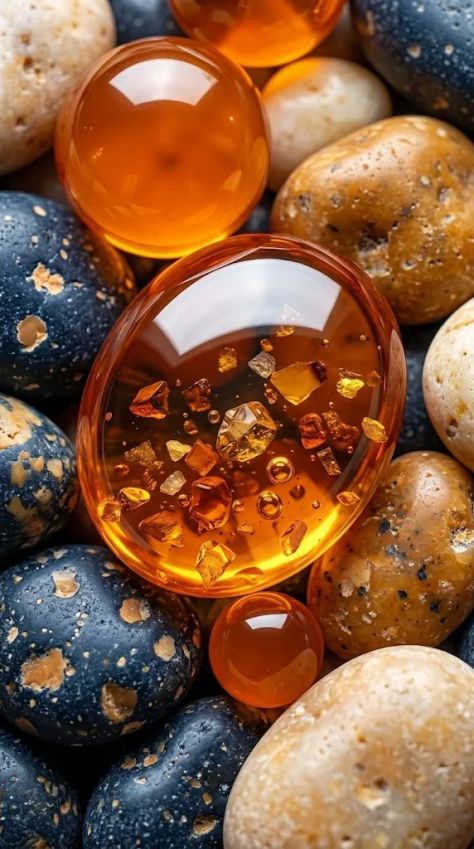
Use the uploaded image as the main visual reference. Recreate the same tightly packed macro still life of luminous amber-orange transparent spheres and oval cabochon forms nestled among natural rounded pebbles, same central translucent oval, same smaller orange spheres, same cool blue-charcoal stones, same warm tan and cream stones, same strong internal inclusions, same polished optical surfaces, same warm/cool color contrast, same tight frame-filling composition, and same moderately hard upper-right illumination. Do not invent a new arrangement, different object materials, different palette, empty background, additional decorative elements, or a new camera angle. Follow the uploaded image closely and apply only the corrections below.

Generate a hyperreal photorealistic macro still-life image in a 9:16 vertical composition. Use a tight top-down-to-oblique camera angle with the entire frame filled edge-to-edge by rounded natural stones and polished translucent amber forms. Position the dominant large transparent amber-orange oval slightly below the center of the composition. Keep one larger orange sphere in the upper-left-to-upper-center region, one smaller orange sphere below the main oval near the lower-center, and a partially visible orange form close to the upper edge. Surround these objects densely with irregular rounded pebbles so no empty environmental background is visible. Use approximately 105 mm macro-equivalent optics, f/5 aperture behavior, strong close-up magnification, moderate-selective macro depth of field, grain level 1/10, and post-processing intensity approximately 8.5/10.

Preserve the exact visual hierarchy from the uploaded reference. Keep the main translucent oval as the strongest focal object, surrounded by smaller orange spheres and contrasting opaque stones. Maintain a densely interlocked composition in which every major form overlaps or touches nearby stones. Keep the large cream/tan pebble entering the lower-right foreground, clustered dark blue-charcoal stones across the lower-left and left side, several warm ochre and cream stones through frame-right, and mixed dark stones behind the translucent objects.

Render the main amber object as a smooth rounded oval cabochon with a strongly convex upper surface, slightly flattened underside where it rests among the surrounding stones, and clean continuous curvature. Do not convert it into a perfect sphere. Maintain the same broad oval proportions, polished edge profile, and apparent optical mass from the reference.

Render the secondary orange objects as polished near-spherical forms with subtle natural differences in diameter and curvature. Keep their geometry smooth and highly refined, but do not make every secondary object mathematically identical. Preserve the upper larger sphere and lower smaller sphere as visually subordinate companions to the central oval.

Treat the orange material as highly transparent-to-translucent amber-like glass or resin without claiming a specific physical substance. Use an exterior body color around H 25–35°, extremely high saturation and medium-high brightness. Build deeper internal regions toward burnt orange around H 20–28° with slightly reduced brightness, and use concentrated golden transmission around H 38–48° at high saturation and very high brightness near illuminated edges and internal caustic zones.

Give every orange object an extremely polished, mirror-like surface with essentially no visible surface roughness. Preserve crisp environmental reflections, hard white highlights, warm reflected stone shapes, and strong refractive distortion. The surface must appear smooth, dense, optically clear, and glass-like rather than waxy, cloudy, matte, scratched, frosted, or plastic.

Inside the main oval, preserve numerous suspended inclusions at multiple depths. Include irregular angular amber fragments, small crystalline-looking pieces, rounded bubble-like inclusions, tiny suspended particulate elements, and several larger translucent fragment clusters. Concentrate the densest inclusion structure through the lower and central regions while leaving a relatively clearer transparent zone near the upper-center. Do not distribute inclusions uniformly.

Render the internal fragments with physically coherent depth cues. Nearer fragments should appear sharper and slightly larger; deeper inclusions should soften subtly through the transparent material. Use bright golden-orange edges where light strikes the fragments, deeper burnt-orange interiors, and small dark internal boundaries to separate adjacent pieces.

Preserve multiple small enclosed spherical bubbles inside the central oval and secondary orange forms. Render these as genuinely internal transparent bubbles with circular-to-elliptical outlines distorted by viewing angle and material curvature. Give each bubble a narrow bright edge, darker opposite rim, and slight optical magnification of the background inclusions. Do not confuse them with surface water droplets.

Keep the broad white polygonal/window-like reflection across the upper section of the central oval. Render this reflection as a large soft-edged but clearly defined bright neutral-white geometric patch following the curvature of the polished surface. Allow the reflection to warp naturally over the convex oval. Preserve additional narrower white reflection streaks and small bright spots across the upper and side regions.

Add hard curved neutral-white specular reflections along the edges and top surfaces of the smaller orange spheres. Use very high brightness without broad clipping, maintaining readable curvature within the highlight shapes. Let some reflections include faint warm cream or cool-blue environmental contamination from nearby stones.

Create strong glowing edge behavior around every translucent amber object. Concentrate golden-orange transmission along curved lower edges, side rims, and contact-adjacent regions where light travels through the transparent material. Preserve internal caustic-like bright zones, especially near the lower edge of the central oval and lower portions of the secondary spheres.

Maintain strong physically plausible refraction through all amber objects. Nearby stones, light patches, dark cavities, and warm reflections must bend and compress according to each curved surface. Distortion should be strongest toward the outer perimeter and somewhat clearer toward the central optical axis. Do not render the amber objects as simple flat-tinted transparent shapes.

Preserve warm internal light concentration within the central oval. Use brighter golden zones around H 40–48° near the lower-left and lower-central interior, transitioning into saturated amber around H 25–35° across the body and deeper burnt-orange toward shadowed upper or lateral zones.

Render the surrounding pebbles as naturally irregular rounded stones rather than manufactured spheres. Vary their shapes between ovoid, rounded, slightly flattened, and asymmetric forms. Maintain subtle surface imperfections, mineral flecks, small pits, granular texture, and weathered transitions.

For the dark stones, use blue-charcoal to graphite values around H 205–220°, low saturation and low brightness. Add scattered tan, cream, pale gray, and muted ochre mineral-like flecks across selected surfaces. Keep some stones darker and smoother while others show stronger speckling and granular weathering.

For the warm pebbles, use ochre, caramel, tan, and beige values around H 25–40°, low-to-medium saturation and medium brightness. Include mottled pale mineral patches, soft speckling, subtle tonal clouds, and irregular surface variation.

For the pale cream stones, use warm-neutral values around H 35–45°, extremely low saturation and high brightness, with beige-gray mottling, pale speckles, and occasional slightly darker mineral inclusions. Keep them warm-neutral rather than stark white.

Maintain matte-to-satin surface finishes on all natural stones. Use broad subdued reflections with soft edge transitions and low-to-moderate specularity. Preserve clear material separation between the opaque granular pebbles and the mirror-like transparent amber objects. Do not make the stones glossy like polished glass.

Where small glossy spots or droplets appear on selected warm stones, retain them as subtle localized moisture-like highlights or surface reflections. Keep them sparse and physically plausible. Do not cover the stones in heavy condensation or turn the still life into a wet-surface scene.

Preserve the large warm tan/orange pebble on frame-right adjacent to the main oval. Render it with a matte-to-satin ochre surface, dense fine speckling, small pale mineral marks, subtle shallow pits, and localized warm highlights. Keep it visually softer and less reflective than the central amber object.

Preserve the large cream/tan pebble entering the lower-right foreground. Keep it partially cropped by the frame and render it slightly softer due to its position relative to the main focal plane. Use pale warm-neutral tones, broad mottled patterning, and fine granular texture.

Keep the clustered dark blue-charcoal stones around the lower-left and center-left. Preserve strong cool contrast against the amber objects. Render several stones with tan chips, cream flecks, fine weathered pits, and slightly different graphite-blue values to avoid repetition.

Build the depth structure as three primary planes. The first plane contains the nearest cropped stones at the lower-right, lower-left, and extreme frame edges, some slightly softened by macro depth. The second and critical focal plane contains the large central oval, lower orange sphere, and immediately adjacent pebbles. The third plane contains the upper orange sphere and densely packed rear stones, with modest progressive softening rather than complete blur.

Do not introduce an independent environmental background. The entire frame must remain filled by interlocking stones and translucent amber objects. No visible table, tray, soil, fabric, container wall, horizon, or studio backdrop.

Use only mild optical softness toward the outer and farthest regions. Do not create large decorative bokeh circles. Allow small specular points on distant stones or amber surfaces to soften naturally into compact circular highlights.

Use a strong directional key from approximately the 1–2 o’clock position at upper-right. Set the light around 4800–5000 K for a warm-neutral macro source. Keep it moderately hard, producing crisp white reflections on the amber surfaces, pronounced stone microtexture, strong internal transparency, and controlled cast/contact shadows.

Aim the key obliquely across the scene so the upper and right-facing surfaces receive the strongest direct illumination. Concentrate hard highlights on the upper-right zones of the main oval and secondary spheres. Allow pale stones on frame-right to receive broader bright illumination while the dark stones retain strong local contrast.

Maintain fill at approximately 35%. Preserve readable texture in blue-charcoal pebbles and amber interiors without eliminating deep shadow pockets between tightly packed stones. Let narrow interstitial gaps descend into very dark values to increase depth and object separation.

Create strong warm orange-gold transmitted illumination through the amber forms. Allow this transmitted light to produce localized golden bounce on nearby tan, cream, and dark stones, especially immediately below and beside the central oval and lower sphere. Keep the bounce concentrated rather than washing the full scene orange.

Preserve bright golden rim illumination around the curved edges of the orange objects. The lower and side edges should appear particularly luminous where internal light travels through the material. Use H 38–48° highlights at high saturation and very high brightness while retaining fine edge structure.

Maintain deep localized contact shadows between every tightly packed object. Shadows should be strongest in narrow stone-to-stone crevices, underneath the central oval, below the lower sphere, and around recessed overlapping forms. Keep these shadows clean and high contrast rather than hazy.

Shape highlights according to material. On amber glass/resin-like forms, use hard mirror-like white highlights, sharp curved reflections, bright edge transmission, internal caustic concentrations, and refracted environment shapes. On matte stones, use broad diffused highlights and microtexture-dependent reflection. On any small moisture spots, use tiny crisp highlights without turning the whole stone glossy.

Maintain the dominant palette exactly: saturated amber-orange around H 25–35° at very high saturation and medium-high brightness; golden highlights around H 38–48° at high saturation and very high brightness; dark blue-charcoal stones around H 205–220° at low saturation and low brightness; warm tan stones around H 25–40° at low-to-medium saturation and medium brightness; and pale cream neutrals around H 35–45° at extremely low saturation and high brightness.

Apply a warm macro/editorial grade emphasizing intense amber-gold transparency against cooler blue-charcoal stone values. Keep the orange subjects highly saturated while surrounding natural stones remain substantially more muted. Maintain strong warm/cool separation without adding cyan, magenta, green, or vivid unrelated hues.

Use warm highlights throughout the amber forms while preserving neutral-white direct specular reflections. Let the cooler graphite-blue stones create the principal complementary shadow contrast. Keep overall scene temperature warm without making every object uniformly orange.

Use moderate-selective macro depth of field. Keep the main oval, its internal bubbles and fragments, adjacent stone textures, and portions of the lower orange sphere highly detailed. Keep the upper sphere readable but permit mild depth softening. Allow extreme foreground edges and far rear stones to soften gradually while retaining recognizable materials.

Use approximately 90–120 mm macro-equivalent optics with strong close-up magnification. Preserve natural compression, smooth rounded geometry, and realistic size relationships. Do not introduce fisheye distortion, wide-angle stretching, or exaggerated perspective.

Render at maximum hyperreal macro photography quality with physically plausible transparency, internal refraction, realistic suspended inclusions, accurate bubble optics, polished convex surfaces, convincing natural-stone microtexture, precise hard highlights, believable edge transmission, and strong macro depth cues.

Maintain an exceptionally clean output with grain around 1/10. Apply strong micro-contrast and selective sharpening to the main amber oval, internal fragments, bubbles, polished highlight boundaries, and nearby pebble texture. Keep out-of-plane objects appropriately soft rather than sharpening the entire image uniformly.

Maintain post-processing around 8–9/10. Intensify amber saturation, golden edge glow, internal depth, reflection clarity, local stone texture, and warm/cool separation. Control highlight clipping and deep shadows carefully so both glass-like surfaces and dark stone textures remain readable.

Follow the uploaded image as the primary reference. Preserve the exact large amber-orange oval slightly below center, upper orange sphere, lower orange sphere, partially visible upper orange form, packed blue-charcoal stones, warm tan pebbles, pale cream stones, internal bubbles, irregular fragments, broad polygonal white reflection, edge glow, top-down-oblique macro angle, full-frame stone coverage, and 9:16 vertical framing.

Preserve the locked surface finishes exactly: highly polished transparent amber-orange spheres and oval with hard mirror-like highlights, visible internal bubbles and suspended fragments, strong spherical/convex refraction, and luminous golden edges; surrounding pebbles must remain opaque, granular, irregularly mottled, matte-to-satin, and naturally weathered.

Preserve the locked color system exactly: amber-orange around H 25–35°, golden highlights around H 38–48°, cool charcoal-blue stones around H 205–220°, warm tan around H 25–40°, and pale cream warm neutrals around H 35–45°. Do not shift the translucent subjects toward red, yellow, pink, green, or colorless glass. Do not neutralize the cool blue-charcoal stones.

Preserve the locked lighting model exactly: moderately hard warm-neutral key from the upper-right around 4500–5200 K, crisp neutral-white reflections on polished surfaces, intense golden internal transmission, localized warm bounce onto neighboring stones, bright curved edge illumination, approximately 30–40% fill, and deep clean contact shadows between tightly packed pebbles.

No people. No hands. No animals. No plants. No jewelry. No text. No logos. No watermark. No empty backdrop. No atmospheric particles. No smoke. No fog. No rain. No lens flare. No chromatic aberration. No large artificial bokeh. No milky transparency. No cloudy amber. No scratched glass. No plastic surface response. No metallic amber objects. No perfectly uniform manufactured pebbles. No floating objects. No impossible refraction. No excessive bloom. No motion blur. Ultra-high resolution. Precise polished convex optics. Sharp internal bubbles and inclusions. Realistic natural-stone grain. Strong amber-gold transmission. Hyperreal macro still-life photography only.

·
Photo Prompts

Avis

Connectez-vous pour laisser un avis.

Pas encore d'avis. Soyez le premier.

PromptLabHub sur tous vos appareils.

Installez l’application pour un accès plus rapide, ou téléchargez l’extension Chrome et chargez-la dans le navigateur.

Parcourir les prompts

  • Tous les prompts
  • Prompts photo
  • Prompts vidéo
  • Prompts cuisine

Créer

  • Soumettre un prompt

Communauté

  • Forum
  • Créateurs
  • Classement
  • Défi hebdomadaire

Assistance

  • FAQ
  • Nous contacter
  • Politique de confidentialité
  • Conditions d'utilisation

Suivez-nous

Découvrez et copiez des prompts IA sélectionnés pour Midjourney, DALL-E 3, Sora, Runway et plus encore. Mis à jour chaque semaine.

Politique de confidentialitéConditions d'utilisationPolitique de cookies

© 2026 PromptLabHub. All rights reserved.

© 2026 PromptLabHub. All rights reserved.

·
Politique de confidentialité·Conditions d'utilisation·Politique de cookies
Home
PromptLabHub
Sketch Abstract Studio Elegant Rim Light
1
1
Prompt

Sketch Abstract Studio Elegant Rim Light

Use the uploaded image as the main visual reference. Recreate the same tightly packed macro still life of luminous amber-orange transparent spheres and oval cabochon forms nestled among natural rounded pebbles, same central translucent oval, same smaller orange spheres, same cool blue-charcoal stones, same warm tan and cream stones, same strong internal inclusions, same polished optical surfaces, same warm/cool color contrast, same tight frame-filling composition, and same moderately hard upper-right illumination. Do not invent a new arrangement, different object materials, different palette, empty background, additional decorative elements, or a new camera angle. Follow the uploaded image closely and apply only the corrections below.

Generate a hyperreal photorealistic macro still-life image in a 9:16 vertical composition. Use a tight top-down-to-oblique camera angle with the entire frame filled edge-to-edge by rounded natural stones and polished translucent amber forms. Position the dominant large transparent amber-orange oval slightly below the center of the composition. Keep one larger orange sphere in the upper-left-to-upper-center region, one smaller orange sphere below the main oval near the lower-center, and a partially visible orange form close to the upper edge. Surround these objects densely with irregular rounded pebbles so no empty environmental background is visible. Use approximately 105 mm macro-equivalent optics, f/5 aperture behavior, strong close-up magnification, moderate-selective macro depth of field, grain level 1/10, and post-processing intensity approximately 8.5/10.

Preserve the exact visual hierarchy from the uploaded reference. Keep the main translucent oval as the strongest focal object, surrounded by smaller orange spheres and contrasting opaque stones. Maintain a densely interlocked composition in which every major form overlaps or touches nearby stones. Keep the large cream/tan pebble entering the lower-right foreground, clustered dark blue-charcoal stones across the lower-left and left side, several warm ochre and cream stones through frame-right, and mixed dark stones behind the translucent objects.

Render the main amber object as a smooth rounded oval cabochon with a strongly convex upper surface, slightly flattened underside where it rests among the surrounding stones, and clean continuous curvature. Do not convert it into a perfect sphere. Maintain the same broad oval proportions, polished edge profile, and apparent optical mass from the reference.

Render the secondary orange objects as polished near-spherical forms with subtle natural differences in diameter and curvature. Keep their geometry smooth and highly refined, but do not make every secondary object mathematically identical. Preserve the upper larger sphere and lower smaller sphere as visually subordinate companions to the central oval.

Treat the orange material as highly transparent-to-translucent amber-like glass or resin without claiming a specific physical substance. Use an exterior body color around H 25–35°, extremely high saturation and medium-high brightness. Build deeper internal regions toward burnt orange around H 20–28° with slightly reduced brightness, and use concentrated golden transmission around H 38–48° at high saturation and very high brightness near illuminated edges and internal caustic zones.

Give every orange object an extremely polished, mirror-like surface with essentially no visible surface roughness. Preserve crisp environmental reflections, hard white highlights, warm reflected stone shapes, and strong refractive distortion. The surface must appear smooth, dense, optically clear, and glass-like rather than waxy, cloudy, matte, scratched, frosted, or plastic.

Inside the main oval, preserve numerous suspended inclusions at multiple depths. Include irregular angular amber fragments, small crystalline-looking pieces, rounded bubble-like inclusions, tiny suspended particulate elements, and several larger translucent fragment clusters. Concentrate the densest inclusion structure through the lower and central regions while leaving a relatively clearer transparent zone near the upper-center. Do not distribute inclusions uniformly.

Render the internal fragments with physically coherent depth cues. Nearer fragments should appear sharper and slightly larger; deeper inclusions should soften subtly through the transparent material. Use bright golden-orange edges where light strikes the fragments, deeper burnt-orange interiors, and small dark internal boundaries to separate adjacent pieces.

Preserve multiple small enclosed spherical bubbles inside the central oval and secondary orange forms. Render these as genuinely internal transparent bubbles with circular-to-elliptical outlines distorted by viewing angle and material curvature. Give each bubble a narrow bright edge, darker opposite rim, and slight optical magnification of the background inclusions. Do not confuse them with surface water droplets.

Keep the broad white polygonal/window-like reflection across the upper section of the central oval. Render this reflection as a large soft-edged but clearly defined bright neutral-white geometric patch following the curvature of the polished surface. Allow the reflection to warp naturally over the convex oval. Preserve additional narrower white reflection streaks and small bright spots across the upper and side regions.

Add hard curved neutral-white specular reflections along the edges and top surfaces of the smaller orange spheres. Use very high brightness without broad clipping, maintaining readable curvature within the highlight shapes. Let some reflections include faint warm cream or cool-blue environmental contamination from nearby stones.

Create strong glowing edge behavior around every translucent amber object. Concentrate golden-orange transmission along curved lower edges, side rims, and contact-adjacent regions where light travels through the transparent material. Preserve internal caustic-like bright zones, especially near the lower edge of the central oval and lower portions of the secondary spheres.

Maintain strong physically plausible refraction through all amber objects. Nearby stones, light patches, dark cavities, and warm reflections must bend and compress according to each curved surface. Distortion should be strongest toward the outer perimeter and somewhat clearer toward the central optical axis. Do not render the amber objects as simple flat-tinted transparent shapes.

Preserve warm internal light concentration within the central oval. Use brighter golden zones around H 40–48° near the lower-left and lower-central interior, transitioning into saturated amber around H 25–35° across the body and deeper burnt-orange toward shadowed upper or lateral zones.

Render the surrounding pebbles as naturally irregular rounded stones rather than manufactured spheres. Vary their shapes between ovoid, rounded, slightly flattened, and asymmetric forms. Maintain subtle surface imperfections, mineral flecks, small pits, granular texture, and weathered transitions.

For the dark stones, use blue-charcoal to graphite values around H 205–220°, low saturation and low brightness. Add scattered tan, cream, pale gray, and muted ochre mineral-like flecks across selected surfaces. Keep some stones darker and smoother while others show stronger speckling and granular weathering.

For the warm pebbles, use ochre, caramel, tan, and beige values around H 25–40°, low-to-medium saturation and medium brightness. Include mottled pale mineral patches, soft speckling, subtle tonal clouds, and irregular surface variation.

For the pale cream stones, use warm-neutral values around H 35–45°, extremely low saturation and high brightness, with beige-gray mottling, pale speckles, and occasional slightly darker mineral inclusions. Keep them warm-neutral rather than stark white.

Maintain matte-to-satin surface finishes on all natural stones. Use broad subdued reflections with soft edge transitions and low-to-moderate specularity. Preserve clear material separation between the opaque granular pebbles and the mirror-like transparent amber objects. Do not make the stones glossy like polished glass.

Where small glossy spots or droplets appear on selected warm stones, retain them as subtle localized moisture-like highlights or surface reflections. Keep them sparse and physically plausible. Do not cover the stones in heavy condensation or turn the still life into a wet-surface scene.

Preserve the large warm tan/orange pebble on frame-right adjacent to the main oval. Render it with a matte-to-satin ochre surface, dense fine speckling, small pale mineral marks, subtle shallow pits, and localized warm highlights. Keep it visually softer and less reflective than the central amber object.

Preserve the large cream/tan pebble entering the lower-right foreground. Keep it partially cropped by the frame and render it slightly softer due to its position relative to the main focal plane. Use pale warm-neutral tones, broad mottled patterning, and fine granular texture.

Keep the clustered dark blue-charcoal stones around the lower-left and center-left. Preserve strong cool contrast against the amber objects. Render several stones with tan chips, cream flecks, fine weathered pits, and slightly different graphite-blue values to avoid repetition.

Build the depth structure as three primary planes. The first plane contains the nearest cropped stones at the lower-right, lower-left, and extreme frame edges, some slightly softened by macro depth. The second and critical focal plane contains the large central oval, lower orange sphere, and immediately adjacent pebbles. The third plane contains the upper orange sphere and densely packed rear stones, with modest progressive softening rather than complete blur.

Do not introduce an independent environmental background. The entire frame must remain filled by interlocking stones and translucent amber objects. No visible table, tray, soil, fabric, container wall, horizon, or studio backdrop.

Use only mild optical softness toward the outer and farthest regions. Do not create large decorative bokeh circles. Allow small specular points on distant stones or amber surfaces to soften naturally into compact circular highlights.

Use a strong directional key from approximately the 1–2 o’clock position at upper-right. Set the light around 4800–5000 K for a warm-neutral macro source. Keep it moderately hard, producing crisp white reflections on the amber surfaces, pronounced stone microtexture, strong internal transparency, and controlled cast/contact shadows.

Aim the key obliquely across the scene so the upper and right-facing surfaces receive the strongest direct illumination. Concentrate hard highlights on the upper-right zones of the main oval and secondary spheres. Allow pale stones on frame-right to receive broader bright illumination while the dark stones retain strong local contrast.

Maintain fill at approximately 35%. Preserve readable texture in blue-charcoal pebbles and amber interiors without eliminating deep shadow pockets between tightly packed stones. Let narrow interstitial gaps descend into very dark values to increase depth and object separation.

Create strong warm orange-gold transmitted illumination through the amber forms. Allow this transmitted light to produce localized golden bounce on nearby tan, cream, and dark stones, especially immediately below and beside the central oval and lower sphere. Keep the bounce concentrated rather than washing the full scene orange.

Preserve bright golden rim illumination around the curved edges of the orange objects. The lower and side edges should appear particularly luminous where internal light travels through the material. Use H 38–48° highlights at high saturation and very high brightness while retaining fine edge structure.

Maintain deep localized contact shadows between every tightly packed object. Shadows should be strongest in narrow stone-to-stone crevices, underneath the central oval, below the lower sphere, and around recessed overlapping forms. Keep these shadows clean and high contrast rather than hazy.

Shape highlights according to material. On amber glass/resin-like forms, use hard mirror-like white highlights, sharp curved reflections, bright edge transmission, internal caustic concentrations, and refracted environment shapes. On matte stones, use broad diffused highlights and microtexture-dependent reflection. On any small moisture spots, use tiny crisp highlights without turning the whole stone glossy.

Maintain the dominant palette exactly: saturated amber-orange around H 25–35° at very high saturation and medium-high brightness; golden highlights around H 38–48° at high saturation and very high brightness; dark blue-charcoal stones around H 205–220° at low saturation and low brightness; warm tan stones around H 25–40° at low-to-medium saturation and medium brightness; and pale cream neutrals around H 35–45° at extremely low saturation and high brightness.

Apply a warm macro/editorial grade emphasizing intense amber-gold transparency against cooler blue-charcoal stone values. Keep the orange subjects highly saturated while surrounding natural stones remain substantially more muted. Maintain strong warm/cool separation without adding cyan, magenta, green, or vivid unrelated hues.

Use warm highlights throughout the amber forms while preserving neutral-white direct specular reflections. Let the cooler graphite-blue stones create the principal complementary shadow contrast. Keep overall scene temperature warm without making every object uniformly orange.

Use moderate-selective macro depth of field. Keep the main oval, its internal bubbles and fragments, adjacent stone textures, and portions of the lower orange sphere highly detailed. Keep the upper sphere readable but permit mild depth softening. Allow extreme foreground edges and far rear stones to soften gradually while retaining recognizable materials.

Use approximately 90–120 mm macro-equivalent optics with strong close-up magnification. Preserve natural compression, smooth rounded geometry, and realistic size relationships. Do not introduce fisheye distortion, wide-angle stretching, or exaggerated perspective.

Render at maximum hyperreal macro photography quality with physically plausible transparency, internal refraction, realistic suspended inclusions, accurate bubble optics, polished convex surfaces, convincing natural-stone microtexture, precise hard highlights, believable edge transmission, and strong macro depth cues.

Maintain an exceptionally clean output with grain around 1/10. Apply strong micro-contrast and selective sharpening to the main amber oval, internal fragments, bubbles, polished highlight boundaries, and nearby pebble texture. Keep out-of-plane objects appropriately soft rather than sharpening the entire image uniformly.

Maintain post-processing around 8–9/10. Intensify amber saturation, golden edge glow, internal depth, reflection clarity, local stone texture, and warm/cool separation. Control highlight clipping and deep shadows carefully so both glass-like surfaces and dark stone textures remain readable.

Follow the uploaded image as the primary reference. Preserve the exact large amber-orange oval slightly below center, upper orange sphere, lower orange sphere, partially visible upper orange form, packed blue-charcoal stones, warm tan pebbles, pale cream stones, internal bubbles, irregular fragments, broad polygonal white reflection, edge glow, top-down-oblique macro angle, full-frame stone coverage, and 9:16 vertical framing.

Preserve the locked surface finishes exactly: highly polished transparent amber-orange spheres and oval with hard mirror-like highlights, visible internal bubbles and suspended fragments, strong spherical/convex refraction, and luminous golden edges; surrounding pebbles must remain opaque, granular, irregularly mottled, matte-to-satin, and naturally weathered.

Preserve the locked color system exactly: amber-orange around H 25–35°, golden highlights around H 38–48°, cool charcoal-blue stones around H 205–220°, warm tan around H 25–40°, and pale cream warm neutrals around H 35–45°. Do not shift the translucent subjects toward red, yellow, pink, green, or colorless glass. Do not neutralize the cool blue-charcoal stones.

Preserve the locked lighting model exactly: moderately hard warm-neutral key from the upper-right around 4500–5200 K, crisp neutral-white reflections on polished surfaces, intense golden internal transmission, localized warm bounce onto neighboring stones, bright curved edge illumination, approximately 30–40% fill, and deep clean contact shadows between tightly packed pebbles.

No people. No hands. No animals. No plants. No jewelry. No text. No logos. No watermark. No empty backdrop. No atmospheric particles. No smoke. No fog. No rain. No lens flare. No chromatic aberration. No large artificial bokeh. No milky transparency. No cloudy amber. No scratched glass. No plastic surface response. No metallic amber objects. No perfectly uniform manufactured pebbles. No floating objects. No impossible refraction. No excessive bloom. No motion blur. Ultra-high resolution. Precise polished convex optics. Sharp internal bubbles and inclusions. Realistic natural-stone grain. Strong amber-gold transmission. Hyperreal macro still-life photography only.

·
Photo Prompts

Avis

Connectez-vous pour laisser un avis.

Pas encore d'avis. Soyez le premier.

PromptLabHub sur tous vos appareils.

Installez l’application pour un accès plus rapide, ou téléchargez l’extension Chrome et chargez-la dans le navigateur.

Parcourir les prompts

  • Tous les prompts
  • Prompts photo
  • Prompts vidéo
  • Prompts cuisine

Créer

  • Soumettre un prompt

Communauté

  • Forum
  • Créateurs
  • Classement
  • Défi hebdomadaire

Assistance

  • FAQ
  • Nous contacter
  • Politique de confidentialité
  • Conditions d'utilisation

Suivez-nous

Découvrez et copiez des prompts IA sélectionnés pour Midjourney, DALL-E 3, Sora, Runway et plus encore. Mis à jour chaque semaine.

Politique de confidentialitéConditions d'utilisationPolitique de cookies

© 2026 PromptLabHub. All rights reserved.

© 2026 PromptLabHub. All rights reserved.

·
Politique de confidentialité·Conditions d'utilisation·Politique de cookies
Home