
PromptLabHub
Editorial Product Interior Elegant Natural Bokeh
1
1
Prompt

Editorial Product Interior Elegant Natural Bokeh

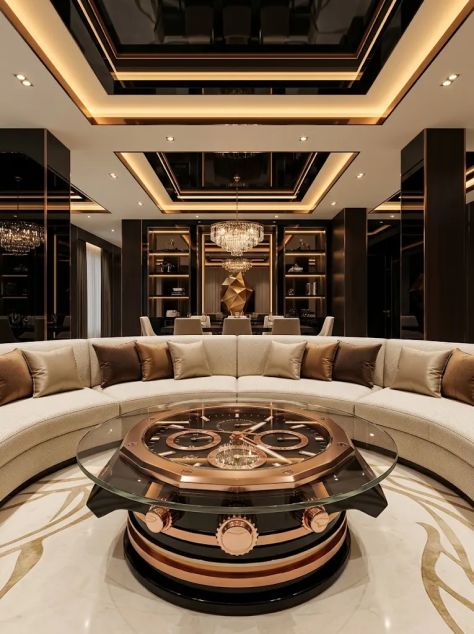
Use the uploaded image as the main visual reference. Recreate the same ultra-luxury lounge, same monumental circular horology-inspired coffee table, same giant exposed mechanical-watch motif beneath clear glass, same curved cream sectional sofa, same warm metallic detailing, same mirrored black architectural surfaces, same chandeliers, same rear dining/lounge furniture, same illuminated cabinetry, same symmetrical composition, and same dark warm high-gloss atmosphere. Do not invent a new room layout, different furniture geometry, different centerpiece, cooler metallic palette, additional people, or a new camera angle. Follow the uploaded image closely and apply only the corrections below.

Generate a maximum-quality photorealistic luxury interior visualization / high-end editorial architectural photograph of the same opulent contemporary lounge in a 3:4 vertical composition. Position the camera slightly above normal seated eye level and aim forward toward the center of the lounge. Keep the oversized circular table dominating the lower half of the frame and the curved sectional sofa wrapping around it through the middle plane. Preserve the dining furniture, decorative sculpture, mirrored walls, chandeliers, columns, illuminated shelving, and reflective ceiling through the upper and rear portions of the composition. Use strong central symmetry organized around the circular table and giant watch dial. Use approximately 27 mm equivalent architectural perspective, approximately f/5 depth behavior, deep depth of field, grain level 1/10, and post-processing intensity approximately 8/10.

Preserve the exact architectural geometry and furniture proportions from the uploaded image. Maintain the primary depth stack as statement table in the immediate foreground, curved sectional seating directly behind it, dining/lounge furniture in the rear middle plane, and black mirrored walls, lacquered columns, shelving, ceiling structures, and lighting forming the final architectural layer. Do not expand the room unrealistically, change ceiling height, move the sofa away from the table, alter the circular composition, or redesign the rear architectural structure.

Preserve the floor as a light cream polished stone or marble-like surface around H 38–45°, low saturation and high brightness. Reproduce large flowing abstract motifs in beige, champagne, and restrained metallic-gold tones. Keep the floor glossy-to-satin with clean reflected points from downlights, warm metallic furniture, chandeliers, and table surfaces. Preserve subtle natural stone depth beneath the patterned design. Do not replace the floor with timber, carpet, plain white marble, gray stone, or highly veined cool marble.

Preserve the architectural walls as a combination of mirror-like near-black panels, deep espresso-brown lacquered surfaces, and warm metallic trim. Keep the darkest black surfaces near-zero brightness with controlled warm reflected highlights rather than featureless black. Render the espresso-brown architectural sections around H 20–30°, low-to-medium saturation and very low brightness, with polished warm reflections. Do not shift these surfaces toward cool gray, silver, navy, white, or matte minimalism.

Maintain the tall architectural columns as dark brown-to-bronze vertical elements with highly polished reflective faces and narrow metallic trim. Preserve their rectangular geometry, strong vertical alignment, and warm reflected streaks from the ceiling lighting. Use deep espresso bases around H 20–30° with bronze/copper highlights around H 25–35°. Do not redesign the columns as stone, pale wood, raw concrete, or matte black posts.

Preserve the multi-level luxury ceiling with a central field of high-gloss black reflective panels, lighter surrounding cream/satin planes, deep architectural borders, recessed circular downlights, concealed amber strips, and crystal chandeliers. Keep the black ceiling sections mirror-polished so they reflect chandeliers, furniture, decorative lighting, and architectural geometry with believable perspective. Use cream surrounding planes around H 35–45° at low saturation and medium-high brightness, with satin rather than mirror gloss.

Preserve the concealed linear lighting tracing ceiling edges and selected horizontal architectural lines. Set these sources around 2800–3000 K and keep them as warm amber-gold strips with clean continuous geometry. Do not introduce RGB LEDs, blue lighting, cool-white strips, or brightly exposed light sources.

Preserve the repeated recessed circular ceiling downlights. Keep them compact and warm-neutral around 2900–3200 K, with soft controlled pools of light and bright circular reflections on glass, lacquer, and polished metal. Maintain their spacing and subordinate role relative to the room’s decorative chandeliers and concealed lighting.

Preserve the crystal-style chandeliers visible in the upper-left and deeper rear zones. Render them with transparent faceted crystal/glass elements, warm metallic support structures, multiple small warm point sources, and sharp sparkling specular reflections. Keep their light around 2700–3000 K. Do not enlarge them into dominant ballroom fixtures or replace them with contemporary pendants.

Preserve the large curved sectional sofa wrapping around the central table. Render the upholstery as warm cream-to-pale champagne beige around H 35–45°, low saturation and high brightness. Use a fine woven or suede-like textile with matte-to-soft-satin material response, subtle fiber texture, deep broad seat cushions, structured low-to-medium backrests, and clean luxury seams. Do not make the sofa glossy, leather-like, stark white, gray, or cool beige.

Maintain the sofa’s curved geometry so it visually echoes the circular statement table. Preserve substantial cushion volume, soft compression at seams, slight creasing at seating transitions, and broad understated highlights from overhead illumination. Keep the sectional form continuous and visually balanced on both sides of the center axis.

Preserve the dense but organized pillow arrangement distributed across the sofa. Use multiple square accent cushions in champagne beige around H 35–45°, caramel brown around H 25–32°, bronze around H 25–35°, and deep warm brown around H 20–28°. Mix matte fine-weave textile surfaces with selective velvet-like satin sheen. Maintain approximately symmetrical visual weight without making the placement mechanically identical. Do not introduce bright colors, patterned graphics, cool-gray pillows, logos, or excessive decorative embroidery.

Make the monumental circular statement coffee table the primary foreground focal point. Preserve its exact oversized diameter, low sculptural profile, circular glass top, wide reflective rim, mechanical layered base, and central giant watch-dial feature. Keep it centered on the main compositional axis. Do not reduce it to a conventional coffee table or replace the watch motif with another object.

Render the tabletop as a thick clear polished glass disc with clean transparency, realistic refraction, a crisp polished perimeter, and high-strength reflections of ceiling lights, chandeliers, sofa highlights, and metallic structures. Maintain slight perspective compression through the glass without cloudiness or green-heavy glass tint. Do not make the glass frosted, smoky, opaque, scratched, or plastic.

Preserve the outer table rim as a broad layered combination of mirror-black material and rose-gold/bronze metal. Render the metallic zones around H 20–30°, medium-high saturation and medium-high brightness, with extremely polished surfaces and sharp warm specular highlights. Keep darker reflective sections almost black with visible amber reflections. Preserve accurate circular symmetry and clean machining.

Maintain the cylindrical table base as a complex mechanical housing built from stacked black, copper, bronze, rose-gold, and polished warm-metal layers. Use alternating glossy black panels, brushed/polished copper bands, deep warm metallic recesses, exposed structural seams, and large crown/pusher-inspired hardware forms around the perimeter. Keep every component mechanically precise and aligned. Do not turn the base into generic furniture cabinetry.

Preserve the giant exposed watch dial beneath the glass as the central centerpiece. Maintain its circular multi-layer structure with a dark black-to-deep-brown core, radial champagne-gold hour markers, bright metallic hands, mechanical sub-dial structures, exposed gear-like forms, concentric tracks, and polished copper/gold detailing. Keep the dial oriented flat within the table plane and centered perfectly below the glass.

Render the watch dial with extremely high material precision. Use deep black and warm brown central fields with glossy reflections, champagne-gold around H 35–45°, copper/rose-gold around H 20–30°, and pale metallic highlights approaching warm silver-gold brightness. Give hour markers and hands crisp machined edges with narrow specular streaks. Keep darker mechanical recesses visible between brighter components.

Preserve the thick polygonal/octagonal warm-metal bezel surrounding the watch dial. Maintain its faceted geometry, broad copper/rose-gold surfaces, exposed screw-like details, angular corners, layered depth, and polished metal response. Use extremely sharp highlight transitions on bevels and softer reflected amber gradients on broad planes. Do not simplify it into a plain circular bezel.

Preserve the crown/pusher-like hardware around the lower table housing. Keep these pieces oversized relative to a real wristwatch but mechanically believable as architectural furniture detailing. Render them with mixed brushed and polished warm-metal finishes, dark recesses, grooves, and crisp machining.

Include fine watch-style dial markings and micro-indices where visible, but keep them generic and too small to read reliably. Do not generate brand names, model names, logos, identifiable trademark text, or large readable lettering. Preserve the impression of precision horology without inventing specific watch branding.

Preserve the small mechanical complications, radial divisions, sub-dials, gear structures, hands, screws, tracks, and concentric dial layers as present design elements. Keep them visually organized and mechanically coherent. Do not create random steampunk clutter, floating parts, impossible gears, or misaligned hands.

Preserve the formal high-back dining/lounge chairs visible in the rear. Render them in warm beige upholstery around H 35–45°, low saturation and medium-high brightness, with tall rectangular backs, slim luxury proportions, dark structural legs, and understated textile highlights. Keep these elements secondary to the main sofa and statement table.

Preserve the warm illuminated shelving and bar/cabinet zone at rear-left. Use dark mirror-like shelves and cabinetry with integrated linear illumination around 2600–2900 K. Keep displayed objects visually small, warm-highlighted, and subordinate. Do not populate the shelving with readable labels, branded bottles, books, or clutter.

Preserve the large angular decorative sculpture behind the sofa near the center. Render it as a warm bronze/gold sculptural object around H 30–40°, medium-high saturation and medium-high brightness, with faceted polished surfaces and strong warm highlights. Maintain the reference silhouette and scale. Do not replace it with flowers, statues, artwork, or figurative sculpture.

Maintain extensive environmental reflections throughout the interior. On the mirror-polished black ceiling, reflect chandeliers, downlights, architectural lines, furniture, and warm metallic surfaces with physically plausible inversion and perspective. On the black wall panels, preserve elongated reflections and localized light points. On the table glass, show ceiling and chandelier reflections without obscuring the mechanical centerpiece. On copper/rose-gold surfaces, produce strong warm specular gradients and dark reflected shapes.

Avoid impossible or duplicated reflections. Every reflection must remain consistent with the actual object positions, lighting direction, camera angle, and room geometry. Do not create phantom furniture, additional chandeliers, duplicated tables, mirrored people, or incoherent watch-dial repetition.

Use predominantly warm architectural illumination rather than natural daylight. Keep any exterior glazing or distant exterior views very dark and visually subordinate. Do not introduce strong daylight from windows.

Use overhead and perimeter architectural illumination as the primary light system, approximately 2900 K overall, with individual sources between 2700–3200 K. Let recessed downlights softly illuminate cream upholstery, pale floor surfaces, the top of the statement table, and selected background furniture. Use concealed strips to trace ceiling edges and architectural borders with strong warm linear reflections.

Keep fill around 50%, largely generated by light bouncing from the polished cream floor, glass tabletop, metallic table base, mirrored walls, and reflective ceiling. Preserve deep black architectural regions while maintaining readable surface reflections rather than allowing them to collapse into flat darkness.

Use chandelier and decorative-light reflections as small sparkling highlights distributed across crystal, glass, lacquer, metal, and ceiling surfaces. Maintain bright points with controlled bloom only. Do not add pronounced lens flare, starburst effects, haze, or excessive glow.

Shape highlights by material. On sofa textiles and pillows, use broad soft low-intensity highlights. On polished glass, create crisp bright reflected light shapes and clean edge reflections. On black lacquer and mirrored surfaces, use high-contrast reflected architectural geometry. On copper, bronze, and rose-gold surfaces, create intense warm narrow specular highlights with rich amber transitions. On the crystal chandeliers, use tiny sharp point reflections. On the floor, use broader softened reflections with slight material diffusion.

Maintain the dominant palette exactly: warm cream and champagne beige around H 35–45°, low saturation and high brightness; copper and rose-gold around H 20–30°, medium-high saturation and medium-high brightness; amber-gold illumination around H 30–40°, high saturation; espresso brown around H 20–30°, low-to-medium saturation and very low brightness; and near-black reflective surfaces with warm environmental highlights.

Apply a warm luxury/editorial color grade with deep controlled blacks, champagne upholstery, amber lighting, copper and rose-gold metallic enhancement, rich espresso reflections, strong material separation, and high micro-contrast in the mechanical table. Keep shadows neutral-black to warm-brown rather than introducing cool cyan or blue toning. Do not shift the scene toward white-minimalist, cool silver, neutral gray, blue-black, or Scandinavian styling.

Maintain high overall contrast between the cream sectional and pale floor against the mirror-black architectural shell. Preserve broad soft highlight rolloff on textiles while allowing hard specular peaks on metal, crystal, glass, and lacquer. Do not flatten the scene with excessive HDR.

Use deep depth of field. Keep the giant table dial, glass edge, table housing, sofa upholstery, pillows, nearby dining chairs, architectural columns, ceiling details, chandeliers, and major rear elements sharply readable. Permit only very slight distance softening in the deepest background. Do not use portrait-style shallow focus.

Use approximately 27 mm equivalent architectural optics with corrected verticals and restrained wide-angle behavior. Maintain circular table geometry without stretching it into an oval beyond natural perspective. Keep sofa and rear chairs proportionally believable. No fisheye distortion, warped walls, leaning columns, stretched cushions, or curved vertical lines.

Render at maximum photorealistic interior quality with physically plausible global illumination, ray-traced reflections, accurate glass transmission, realistic polished metals, convincing black lacquer, detailed woven upholstery, precise mechanical components, crystal refraction, polished stone flooring, and controlled warm illumination. The result should resemble premium bespoke-residence editorial photography or a top-tier architectural visualization rather than obvious CGI.

Follow the uploaded image as the primary reference. Preserve the exact central composition, oversized horology-inspired circular table, clear glass top, black-and-rose-gold rim, cylindrical mechanical base, giant exposed dial, polygonal bezel, watch-inspired hardware, cream curved sofa, warm pillows, black mirrored architecture, espresso columns, light patterned floor, crystal chandeliers, rear furniture, bronze sculpture, illuminated shelving, warm ceiling strips, and 3:4 vertical framing.

Preserve the locked surface-finish relationships exactly: clear polished glass tabletop; mirror-like black lacquer and ceiling panels; highly polished copper, rose-gold and bronze metal; glossy exposed mechanical-watch dial; matte-to-satin cream sofa upholstery; mixed matte and velvet-like pillows; faceted transparent crystal chandeliers; and glossy-to-satin polished light flooring. Do not flatten all materials into the same roughness level.

Preserve the locked color system exactly: warm cream around H 35–45°, copper/rose-gold around H 20–30°, amber illumination around H 30–40°, espresso brown around H 20–30°, and near-black reflective architecture. Do not introduce dominant cool silver, chrome-blue, white minimalist surfaces, concrete gray, or cold neutral lighting.

Preserve the locked lighting model exactly: predominantly warm overhead and concealed architectural illumination around 2700–3200 K, strong reflected fill generated by glass, polished metal, floor and lacquer, controlled soft shadows, sparkling chandelier points, and bright amber-gold specular highlights. Maintain the dark warm high-gloss luxury atmosphere.

No people. No pets. No extra furniture. No readable brand text. No logos. No watermark. No screens with readable content. No additional clocks. No duplicated watch components. No random gears. No impossible reflections. No cool daylight dominance. No blue LED lighting. No excessive bloom. No fog. No rain. No particles. No strong lens flare. No chromatic aberration. No fisheye distortion. No tilted verticals. No warped circular geometry. No washed-out blacks. No excessive HDR. No plastic upholstery. No flat metallic materials. Ultra-high resolution. Precise architecture. Accurate glass optics. Highly polished copper and rose-gold. Mechanically coherent watch detailing. Realistic upholstery. Physically plausible reflections. Photorealistic ultra-luxury horology-inspired interior visualization only.

·
Photo Prompts

Avis

Connectez-vous pour laisser un avis.

Pas encore d'avis. Soyez le premier.

PromptLabHub sur tous vos appareils.

Installez l’application pour un accès plus rapide, ou téléchargez l’extension Chrome et chargez-la dans le navigateur.

Parcourir les prompts

  • Tous les prompts
  • Prompts photo
  • Prompts vidéo
  • Prompts cuisine

Créer

  • Soumettre un prompt

Communauté

  • Forum
  • Créateurs
  • Classement
  • Défi hebdomadaire

Assistance

  • FAQ
  • Nous contacter
  • Politique de confidentialité
  • Conditions d'utilisation

Suivez-nous

Découvrez et copiez des prompts IA sélectionnés pour Midjourney, DALL-E 3, Sora, Runway et plus encore. Mis à jour chaque semaine.

Politique de confidentialitéConditions d'utilisationPolitique de cookies

© 2026 PromptLabHub. All rights reserved.

© 2026 PromptLabHub. All rights reserved.

·
Politique de confidentialité·Conditions d'utilisation·Politique de cookies
Home
PromptLabHub
Editorial Product Interior Elegant Natural Bokeh
1
1
Prompt

Editorial Product Interior Elegant Natural Bokeh

Use the uploaded image as the main visual reference. Recreate the same ultra-luxury lounge, same monumental circular horology-inspired coffee table, same giant exposed mechanical-watch motif beneath clear glass, same curved cream sectional sofa, same warm metallic detailing, same mirrored black architectural surfaces, same chandeliers, same rear dining/lounge furniture, same illuminated cabinetry, same symmetrical composition, and same dark warm high-gloss atmosphere. Do not invent a new room layout, different furniture geometry, different centerpiece, cooler metallic palette, additional people, or a new camera angle. Follow the uploaded image closely and apply only the corrections below.

Generate a maximum-quality photorealistic luxury interior visualization / high-end editorial architectural photograph of the same opulent contemporary lounge in a 3:4 vertical composition. Position the camera slightly above normal seated eye level and aim forward toward the center of the lounge. Keep the oversized circular table dominating the lower half of the frame and the curved sectional sofa wrapping around it through the middle plane. Preserve the dining furniture, decorative sculpture, mirrored walls, chandeliers, columns, illuminated shelving, and reflective ceiling through the upper and rear portions of the composition. Use strong central symmetry organized around the circular table and giant watch dial. Use approximately 27 mm equivalent architectural perspective, approximately f/5 depth behavior, deep depth of field, grain level 1/10, and post-processing intensity approximately 8/10.

Preserve the exact architectural geometry and furniture proportions from the uploaded image. Maintain the primary depth stack as statement table in the immediate foreground, curved sectional seating directly behind it, dining/lounge furniture in the rear middle plane, and black mirrored walls, lacquered columns, shelving, ceiling structures, and lighting forming the final architectural layer. Do not expand the room unrealistically, change ceiling height, move the sofa away from the table, alter the circular composition, or redesign the rear architectural structure.

Preserve the floor as a light cream polished stone or marble-like surface around H 38–45°, low saturation and high brightness. Reproduce large flowing abstract motifs in beige, champagne, and restrained metallic-gold tones. Keep the floor glossy-to-satin with clean reflected points from downlights, warm metallic furniture, chandeliers, and table surfaces. Preserve subtle natural stone depth beneath the patterned design. Do not replace the floor with timber, carpet, plain white marble, gray stone, or highly veined cool marble.

Preserve the architectural walls as a combination of mirror-like near-black panels, deep espresso-brown lacquered surfaces, and warm metallic trim. Keep the darkest black surfaces near-zero brightness with controlled warm reflected highlights rather than featureless black. Render the espresso-brown architectural sections around H 20–30°, low-to-medium saturation and very low brightness, with polished warm reflections. Do not shift these surfaces toward cool gray, silver, navy, white, or matte minimalism.

Maintain the tall architectural columns as dark brown-to-bronze vertical elements with highly polished reflective faces and narrow metallic trim. Preserve their rectangular geometry, strong vertical alignment, and warm reflected streaks from the ceiling lighting. Use deep espresso bases around H 20–30° with bronze/copper highlights around H 25–35°. Do not redesign the columns as stone, pale wood, raw concrete, or matte black posts.

Preserve the multi-level luxury ceiling with a central field of high-gloss black reflective panels, lighter surrounding cream/satin planes, deep architectural borders, recessed circular downlights, concealed amber strips, and crystal chandeliers. Keep the black ceiling sections mirror-polished so they reflect chandeliers, furniture, decorative lighting, and architectural geometry with believable perspective. Use cream surrounding planes around H 35–45° at low saturation and medium-high brightness, with satin rather than mirror gloss.

Preserve the concealed linear lighting tracing ceiling edges and selected horizontal architectural lines. Set these sources around 2800–3000 K and keep them as warm amber-gold strips with clean continuous geometry. Do not introduce RGB LEDs, blue lighting, cool-white strips, or brightly exposed light sources.

Preserve the repeated recessed circular ceiling downlights. Keep them compact and warm-neutral around 2900–3200 K, with soft controlled pools of light and bright circular reflections on glass, lacquer, and polished metal. Maintain their spacing and subordinate role relative to the room’s decorative chandeliers and concealed lighting.

Preserve the crystal-style chandeliers visible in the upper-left and deeper rear zones. Render them with transparent faceted crystal/glass elements, warm metallic support structures, multiple small warm point sources, and sharp sparkling specular reflections. Keep their light around 2700–3000 K. Do not enlarge them into dominant ballroom fixtures or replace them with contemporary pendants.

Preserve the large curved sectional sofa wrapping around the central table. Render the upholstery as warm cream-to-pale champagne beige around H 35–45°, low saturation and high brightness. Use a fine woven or suede-like textile with matte-to-soft-satin material response, subtle fiber texture, deep broad seat cushions, structured low-to-medium backrests, and clean luxury seams. Do not make the sofa glossy, leather-like, stark white, gray, or cool beige.

Maintain the sofa’s curved geometry so it visually echoes the circular statement table. Preserve substantial cushion volume, soft compression at seams, slight creasing at seating transitions, and broad understated highlights from overhead illumination. Keep the sectional form continuous and visually balanced on both sides of the center axis.

Preserve the dense but organized pillow arrangement distributed across the sofa. Use multiple square accent cushions in champagne beige around H 35–45°, caramel brown around H 25–32°, bronze around H 25–35°, and deep warm brown around H 20–28°. Mix matte fine-weave textile surfaces with selective velvet-like satin sheen. Maintain approximately symmetrical visual weight without making the placement mechanically identical. Do not introduce bright colors, patterned graphics, cool-gray pillows, logos, or excessive decorative embroidery.

Make the monumental circular statement coffee table the primary foreground focal point. Preserve its exact oversized diameter, low sculptural profile, circular glass top, wide reflective rim, mechanical layered base, and central giant watch-dial feature. Keep it centered on the main compositional axis. Do not reduce it to a conventional coffee table or replace the watch motif with another object.

Render the tabletop as a thick clear polished glass disc with clean transparency, realistic refraction, a crisp polished perimeter, and high-strength reflections of ceiling lights, chandeliers, sofa highlights, and metallic structures. Maintain slight perspective compression through the glass without cloudiness or green-heavy glass tint. Do not make the glass frosted, smoky, opaque, scratched, or plastic.

Preserve the outer table rim as a broad layered combination of mirror-black material and rose-gold/bronze metal. Render the metallic zones around H 20–30°, medium-high saturation and medium-high brightness, with extremely polished surfaces and sharp warm specular highlights. Keep darker reflective sections almost black with visible amber reflections. Preserve accurate circular symmetry and clean machining.

Maintain the cylindrical table base as a complex mechanical housing built from stacked black, copper, bronze, rose-gold, and polished warm-metal layers. Use alternating glossy black panels, brushed/polished copper bands, deep warm metallic recesses, exposed structural seams, and large crown/pusher-inspired hardware forms around the perimeter. Keep every component mechanically precise and aligned. Do not turn the base into generic furniture cabinetry.

Preserve the giant exposed watch dial beneath the glass as the central centerpiece. Maintain its circular multi-layer structure with a dark black-to-deep-brown core, radial champagne-gold hour markers, bright metallic hands, mechanical sub-dial structures, exposed gear-like forms, concentric tracks, and polished copper/gold detailing. Keep the dial oriented flat within the table plane and centered perfectly below the glass.

Render the watch dial with extremely high material precision. Use deep black and warm brown central fields with glossy reflections, champagne-gold around H 35–45°, copper/rose-gold around H 20–30°, and pale metallic highlights approaching warm silver-gold brightness. Give hour markers and hands crisp machined edges with narrow specular streaks. Keep darker mechanical recesses visible between brighter components.

Preserve the thick polygonal/octagonal warm-metal bezel surrounding the watch dial. Maintain its faceted geometry, broad copper/rose-gold surfaces, exposed screw-like details, angular corners, layered depth, and polished metal response. Use extremely sharp highlight transitions on bevels and softer reflected amber gradients on broad planes. Do not simplify it into a plain circular bezel.

Preserve the crown/pusher-like hardware around the lower table housing. Keep these pieces oversized relative to a real wristwatch but mechanically believable as architectural furniture detailing. Render them with mixed brushed and polished warm-metal finishes, dark recesses, grooves, and crisp machining.

Include fine watch-style dial markings and micro-indices where visible, but keep them generic and too small to read reliably. Do not generate brand names, model names, logos, identifiable trademark text, or large readable lettering. Preserve the impression of precision horology without inventing specific watch branding.

Preserve the small mechanical complications, radial divisions, sub-dials, gear structures, hands, screws, tracks, and concentric dial layers as present design elements. Keep them visually organized and mechanically coherent. Do not create random steampunk clutter, floating parts, impossible gears, or misaligned hands.

Preserve the formal high-back dining/lounge chairs visible in the rear. Render them in warm beige upholstery around H 35–45°, low saturation and medium-high brightness, with tall rectangular backs, slim luxury proportions, dark structural legs, and understated textile highlights. Keep these elements secondary to the main sofa and statement table.

Preserve the warm illuminated shelving and bar/cabinet zone at rear-left. Use dark mirror-like shelves and cabinetry with integrated linear illumination around 2600–2900 K. Keep displayed objects visually small, warm-highlighted, and subordinate. Do not populate the shelving with readable labels, branded bottles, books, or clutter.

Preserve the large angular decorative sculpture behind the sofa near the center. Render it as a warm bronze/gold sculptural object around H 30–40°, medium-high saturation and medium-high brightness, with faceted polished surfaces and strong warm highlights. Maintain the reference silhouette and scale. Do not replace it with flowers, statues, artwork, or figurative sculpture.

Maintain extensive environmental reflections throughout the interior. On the mirror-polished black ceiling, reflect chandeliers, downlights, architectural lines, furniture, and warm metallic surfaces with physically plausible inversion and perspective. On the black wall panels, preserve elongated reflections and localized light points. On the table glass, show ceiling and chandelier reflections without obscuring the mechanical centerpiece. On copper/rose-gold surfaces, produce strong warm specular gradients and dark reflected shapes.

Avoid impossible or duplicated reflections. Every reflection must remain consistent with the actual object positions, lighting direction, camera angle, and room geometry. Do not create phantom furniture, additional chandeliers, duplicated tables, mirrored people, or incoherent watch-dial repetition.

Use predominantly warm architectural illumination rather than natural daylight. Keep any exterior glazing or distant exterior views very dark and visually subordinate. Do not introduce strong daylight from windows.

Use overhead and perimeter architectural illumination as the primary light system, approximately 2900 K overall, with individual sources between 2700–3200 K. Let recessed downlights softly illuminate cream upholstery, pale floor surfaces, the top of the statement table, and selected background furniture. Use concealed strips to trace ceiling edges and architectural borders with strong warm linear reflections.

Keep fill around 50%, largely generated by light bouncing from the polished cream floor, glass tabletop, metallic table base, mirrored walls, and reflective ceiling. Preserve deep black architectural regions while maintaining readable surface reflections rather than allowing them to collapse into flat darkness.

Use chandelier and decorative-light reflections as small sparkling highlights distributed across crystal, glass, lacquer, metal, and ceiling surfaces. Maintain bright points with controlled bloom only. Do not add pronounced lens flare, starburst effects, haze, or excessive glow.

Shape highlights by material. On sofa textiles and pillows, use broad soft low-intensity highlights. On polished glass, create crisp bright reflected light shapes and clean edge reflections. On black lacquer and mirrored surfaces, use high-contrast reflected architectural geometry. On copper, bronze, and rose-gold surfaces, create intense warm narrow specular highlights with rich amber transitions. On the crystal chandeliers, use tiny sharp point reflections. On the floor, use broader softened reflections with slight material diffusion.

Maintain the dominant palette exactly: warm cream and champagne beige around H 35–45°, low saturation and high brightness; copper and rose-gold around H 20–30°, medium-high saturation and medium-high brightness; amber-gold illumination around H 30–40°, high saturation; espresso brown around H 20–30°, low-to-medium saturation and very low brightness; and near-black reflective surfaces with warm environmental highlights.

Apply a warm luxury/editorial color grade with deep controlled blacks, champagne upholstery, amber lighting, copper and rose-gold metallic enhancement, rich espresso reflections, strong material separation, and high micro-contrast in the mechanical table. Keep shadows neutral-black to warm-brown rather than introducing cool cyan or blue toning. Do not shift the scene toward white-minimalist, cool silver, neutral gray, blue-black, or Scandinavian styling.

Maintain high overall contrast between the cream sectional and pale floor against the mirror-black architectural shell. Preserve broad soft highlight rolloff on textiles while allowing hard specular peaks on metal, crystal, glass, and lacquer. Do not flatten the scene with excessive HDR.

Use deep depth of field. Keep the giant table dial, glass edge, table housing, sofa upholstery, pillows, nearby dining chairs, architectural columns, ceiling details, chandeliers, and major rear elements sharply readable. Permit only very slight distance softening in the deepest background. Do not use portrait-style shallow focus.

Use approximately 27 mm equivalent architectural optics with corrected verticals and restrained wide-angle behavior. Maintain circular table geometry without stretching it into an oval beyond natural perspective. Keep sofa and rear chairs proportionally believable. No fisheye distortion, warped walls, leaning columns, stretched cushions, or curved vertical lines.

Render at maximum photorealistic interior quality with physically plausible global illumination, ray-traced reflections, accurate glass transmission, realistic polished metals, convincing black lacquer, detailed woven upholstery, precise mechanical components, crystal refraction, polished stone flooring, and controlled warm illumination. The result should resemble premium bespoke-residence editorial photography or a top-tier architectural visualization rather than obvious CGI.

Follow the uploaded image as the primary reference. Preserve the exact central composition, oversized horology-inspired circular table, clear glass top, black-and-rose-gold rim, cylindrical mechanical base, giant exposed dial, polygonal bezel, watch-inspired hardware, cream curved sofa, warm pillows, black mirrored architecture, espresso columns, light patterned floor, crystal chandeliers, rear furniture, bronze sculpture, illuminated shelving, warm ceiling strips, and 3:4 vertical framing.

Preserve the locked surface-finish relationships exactly: clear polished glass tabletop; mirror-like black lacquer and ceiling panels; highly polished copper, rose-gold and bronze metal; glossy exposed mechanical-watch dial; matte-to-satin cream sofa upholstery; mixed matte and velvet-like pillows; faceted transparent crystal chandeliers; and glossy-to-satin polished light flooring. Do not flatten all materials into the same roughness level.

Preserve the locked color system exactly: warm cream around H 35–45°, copper/rose-gold around H 20–30°, amber illumination around H 30–40°, espresso brown around H 20–30°, and near-black reflective architecture. Do not introduce dominant cool silver, chrome-blue, white minimalist surfaces, concrete gray, or cold neutral lighting.

Preserve the locked lighting model exactly: predominantly warm overhead and concealed architectural illumination around 2700–3200 K, strong reflected fill generated by glass, polished metal, floor and lacquer, controlled soft shadows, sparkling chandelier points, and bright amber-gold specular highlights. Maintain the dark warm high-gloss luxury atmosphere.

No people. No pets. No extra furniture. No readable brand text. No logos. No watermark. No screens with readable content. No additional clocks. No duplicated watch components. No random gears. No impossible reflections. No cool daylight dominance. No blue LED lighting. No excessive bloom. No fog. No rain. No particles. No strong lens flare. No chromatic aberration. No fisheye distortion. No tilted verticals. No warped circular geometry. No washed-out blacks. No excessive HDR. No plastic upholstery. No flat metallic materials. Ultra-high resolution. Precise architecture. Accurate glass optics. Highly polished copper and rose-gold. Mechanically coherent watch detailing. Realistic upholstery. Physically plausible reflections. Photorealistic ultra-luxury horology-inspired interior visualization only.

·
Photo Prompts

Avis

Connectez-vous pour laisser un avis.

Pas encore d'avis. Soyez le premier.

PromptLabHub sur tous vos appareils.

Installez l’application pour un accès plus rapide, ou téléchargez l’extension Chrome et chargez-la dans le navigateur.

Parcourir les prompts

  • Tous les prompts
  • Prompts photo
  • Prompts vidéo
  • Prompts cuisine

Créer

  • Soumettre un prompt

Communauté

  • Forum
  • Créateurs
  • Classement
  • Défi hebdomadaire

Assistance

  • FAQ
  • Nous contacter
  • Politique de confidentialité
  • Conditions d'utilisation

Suivez-nous

Découvrez et copiez des prompts IA sélectionnés pour Midjourney, DALL-E 3, Sora, Runway et plus encore. Mis à jour chaque semaine.

Politique de confidentialitéConditions d'utilisationPolitique de cookies

© 2026 PromptLabHub. All rights reserved.

© 2026 PromptLabHub. All rights reserved.

·
Politique de confidentialité·Conditions d'utilisation·Politique de cookies
Home