
PromptLabHub
Editorial Portrait Rim Light Elegant Bokeh
1
1
Prompt

Editorial Portrait Rim Light Elegant Bokeh

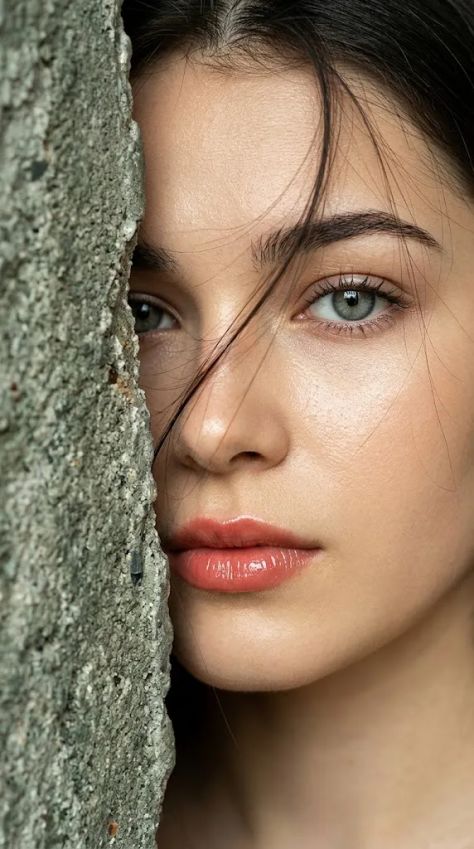
Use the uploaded image as the primary visual reference. Recreate the same extreme close-up beauty portrait, the same jagged weathered stone/concrete foreground obstruction, the same facial identity, the same loose strand-level hair behavior, the same eye state and gaze, the same luminous cosmetic finish, the same shallow depth of field, and the same neutral-warm skin highlights against cooler gray-green environmental neutrals. Do not invent a new face, new eye color, new hairstyle, new makeup, new background, or new camera angle. Apply only the instructions below and follow the uploaded image for every physical identity detail.

Generate a highly polished photorealistic beauty-editorial portrait in an approximately 9:16 vertical frame. Compose an extreme close-up in which the face fills roughly the right two-thirds of the image while a rough, jagged vertical slab of weathered stone or concrete occupies approximately the left quarter to one-third of the frame. Crop tightly through the forehead, eyes, nose, lips, lower chin edge, and a small portion of neck and shoulder. Allow the stone to physically obscure part of the frame-left eye, cheek, and mouth contour. Use a near eye-level camera with a very slight three-quarter perspective. Direct the face mostly toward the lens with a subtle rotation toward frame-left. Keep the head approximately level with a slight lean toward the stone. Use shallow selective focus so the primary eye, nose, lips, adjacent stone edge, eyelashes, iris texture, and nearby loose hairs are highly resolved while the limited lower background falls rapidly out of focus.

Preserve the same facial identity exactly as shown. Do not modify skin tone, facial structure, hair texture, eye geometry, lip geometry, nose geometry, or any other physical feature. Maintain the softly tapered lower facial contour, narrow softly rounded chin, moderately prominent cheek structure, compact-to-moderate brow-to-eye distance, short-to-moderate nose-to-lip spacing, and the same jaw geometry visible around the crop. Preserve the lower lip at approximately 1.3–1.5 times the fullness of the upper lip, with a softly defined Cupid’s bow rather than sharply peaked contours. Do not reshape, slim, enlarge, sharpen, or idealize any feature.

Skin: create a polished luminous dewy-satin surface with retouching around 7–8/10. Across the central forehead, nose bridge, nose tip, upper exposed cheek, and philtrum, use warm cream-to-peach optical highlights around 28–38° hue, low-to-moderate saturation, and approximately 80–95% brightness. Retain cooler muted shadow transitions around the temple, eye socket, frame-left side near the obstruction, lower jaw, and neck. Strongly smooth the forehead, central cheek, and nose without erasing fine pores. Preserve subtle periocular texture, faint lower-cheek micro-texture, natural lip lines, individual lash roots, and fine hair contacts. Avoid raw unretouched texture, but also avoid plastic skin or beauty-filter flattening. Use medium-to-full foundation coverage with a highly even luminous finish.

Eyes: keep both eyes fully open. Maintain the same large almond-to-rounded visible eye geometry and moderate bilateral spacing, with the frame-left eye partly hidden by the stone. Preserve the primary visible iris as pale low-saturation gray-green with approximately 170–200° hue, dark radial spokes, a darker limbal boundary, and a small-to-medium pupil appropriate for bright illumination. Do not substitute blue, brown, amber, or exaggerated synthetic iris colors. Keep the stone-shadowed eye perceptually darker because of reduced exposure rather than changing the iris itself. Direct the gaze almost straight toward the camera with only a slight lateral offset. Preserve the upper eyelid crease. Add a bright irregular window/sky-like catchlight across approximately the 11–1 o’clock region of the unobstructed eye, with smaller reflective microstructure visible through the iris. In the partially occluded eye, retain only a smaller dimmer upper-iris catchlight suppressed by stone shadow. Do not close the eyes, change gaze direction, enlarge pupils dramatically, or create ring-light catchlights.

Brows: preserve dark medium-thick brows with a mostly straight trajectory and a gentle arch. Keep individual hairs clearly visible and slightly irregular. Groom and fill lightly without creating sharply carved edges or block-like cosmetic brows. Maintain the same compact-to-moderate brow-to-eye spacing.

Expression: keep the frontalis relaxed with no forehead lift, corrugator relaxed with no brow compression, orbicularis oculi only mildly engaged by open-eye fixation, orbicularis oris relaxed with a small natural lip separation, and mentalis relaxed. Keep the mouth slightly parted so only a narrow strip of upper teeth is visible. Do not exaggerate the mouth opening, expose the full teeth, add a smile, furrow the brow, or increase neck tension.

Makeup: preserve medium-to-full luminous foundation coverage. Apply a muted mauve-to-plum wash across the upper lids, concentrated slightly more toward the outer corners. Use dark thin-to-medium definition along the upper lash line with a subtle outward extension. Darken and separate the upper lashes with moderate added length, emphasizing the outer lashes slightly, while leaving lower lashes only lightly defined. Diffuse soft rose-peach blush across the upper cheek plane. Render the lips with warm coral-rose pigmentation around approximately 350–10° hue, moderate saturation, and 65–80% brightness, finished with a high-shine wet gloss while preserving natural vertical lip lines. Keep brows only lightly filled and groomed. Do not add contour, heavy highlighter stripes, false-lash density, glitter, graphic liner, dark lipstick, overlined lips, or makeup not visible in the reference.

Hair: preserve very dark brown-to-near-black fiber appearance with a base response around 20–30° hue at extremely low saturation and approximately 5–20% brightness. Allow cooler charcoal reflections across shaded hair and occasional warm brown edge reflections where directly lit. Use fine-to-medium strand thickness with slightly damp or deliberately separated strand behavior. Keep numerous loose disordered strands crossing the forehead, cheek, nose region, eye area, and stone boundary. Preserve the heavier locks descending along frame-right. Maintain high visible density at the hairline and frame-right edge. Render directly illuminated strands semi-gloss to glossy with narrow filamentary highlights while shadowed masses remain dense and near-black. Preserve numerous flyaways; do not clean them away, turn the hair into a smooth salon shape, introduce curls not shown, or change the strand texture.

Keep the upper torso angled slightly away from the camera while the head rotates back toward the lens. Show only the small amount of lower-right neck and shoulder present in the reference, with the shoulder line sloping down toward frame-right. Hands are absent. Wrists are absent. Legs are absent. No clearly identifiable garment should be invented within the usable crop. Do not add earrings, necklace, rings, watch, bracelet, glasses, headwear, bag, held object, tattoo, scar, or decorative accessory that is not visibly present.

Foreground: place a large rough vertical slab of weathered stone or concrete at frame-left. Make its edge jagged, chipped, asymmetrical, and irregular so it creates a strong vertical negative boundary beside the eye, cheek, and mouth. Preserve the stone as an active foreground obstruction rather than a background wall. Render its surface with extremely coarse granular mineral structure, pits, weather erosion, fine fractures, and irregular abrasion. Use a muted mineral palette containing light gray, desaturated green-gray undertones around 80–110° hue, charcoal deposits, and sandy beige patches, all at very low saturation and roughly 35–60% brightness. Preserve sharp tactile texture at the stone edge closest to the face. Do not make the slab smooth, polished, uniformly colored, tiled, brick-like, or artificially clean.

Depth stack: Layer 1 is the sharply resolved stone/concrete foreground at frame-left with an irregular chipped edge. Layer 2 is the sharply resolved face and loose hair strands, positioned directly behind and beside the stone. Layer 3 is a very limited dark background visible behind the lower face, neck, and stone opening, with no identifiable objects and rapid optical blur. Keep the background substantially darker than the central facial highlights. No circular bokeh orbs. No other people. No readable text. No graphic overlay. No watermark.

Lighting: use one large soft source from approximately 10–11 o’clock, slightly frontal, at an estimated 4800–5400 K. Keep the strongest illumination on the nose bridge and tip, central forehead, upper exposed cheek, glossy lower lip, and primary iris reflection. Produce very soft facial shadow transitions across the cheek, nose, temple, and jaw. Create a distinctly harder tonal transition only where the stone physically blocks the light. Place deeper shadow at frame-left behind the stone, around the inner eye socket nearest the obstruction, beneath the nose, along the lower jaw and neck, and underneath the heavy hair mass at frame-right. Maintain moderate-to-high fill so approximately 65–75% of shadow detail remains visible on the exposed face. Use subtle neutral-warm environmental bounce from the stone and surrounding surfaces. A dedicated rim light is absent. Use soft broad/short portrait lighting modified by the foreground occlusion rather than butterfly, split, hard Rembrandt, or flat ring-light illumination.

Surface highlights: skin carries broad soft luminous reflections with a controlled dewy-satin finish. The lower lip carries narrow wet gloss streaks and high-intensity specular reflections that preserve underlying vertical lip texture. The primary iris carries crisp reflected sky/window detail. Hair receives filamentary semi-gloss streaks only where illuminated. The stone remains dominantly diffuse and granular, with tiny scattered mineral reflections rather than broad shine.

Color: keep facial highlight hues approximately 28–38° with low-to-moderate saturation and 80–95% brightness. Keep lip pigmentation approximately 350–10° hue with moderate saturation and 65–80% brightness. Keep the primary iris approximately 170–200° hue with low saturation and 50–70% brightness. Maintain the stone around 80–110° undertone with extremely low saturation and 35–60% brightness, plus neutral gray, charcoal, and sandy mineral variations. Keep hair around 20–30° hue at extremely low saturation and 5–20% brightness. Grade the image with neutral-warm facial highlights against cooler gray-green environmental neutrals. Use subtle split toning with warm highlights and cooler green-gray shadows. Maintain an overall approximately 5000 K visual temperature. Keep saturation moderately restrained except for the lips and iris, which may carry slightly greater chromatic separation.

Camera: use an approximately 85–105 mm full-frame-equivalent portrait perspective to compress facial depth and avoid wide-angle feature distortion. Use approximately f/2–f/2.8. Maintain the 9:16 vertical format. Keep the depth of field shallow and selective: the unobstructed eye, adjacent eyelashes, nose, lips, nearby stone edge, and close hair strands should resolve strongly while the lower dark background drops quickly into blur. Grain level 1–2/10. Retouching/post-processing level 7–8/10 with polished editorial beauty processing while maintaining iris spokes, lashes, lip-line texture, pores, and individual hair strands. Add only mild natural edge darkening, strongest near the lower-right. Lens flare absent. Chromatic aberration absent or negligible. Fog absent. Mist absent. Rain absent. Particles absent.

Render at maximum photorealistic beauty-editorial quality. Follow the uploaded image as the primary visual reference. Preserve exact facial proportions, physical appearance, stone-to-face spatial relationship, eye geometry, eye gaze, iris color, catchlights, lip proportions, makeup placement, hair-strand arrangement, close crop, shallow focus, lighting geometry, color temperature, and environmental framing.

DO NOT change the subject's identity. DO NOT alter skin tone, facial structure, hair texture, eye shape, iris coloration, gaze, lip shape, nose shape, jaw, cheek structure, or any physical feature. DO NOT shift the stone material, makeup scheme, hair finish, skin-retouching level, lighting model, color values, or camera angle. DO NOT add hands, jewelry, garments, accessories, objects, people, architecture, or text not present in the original.

No extra people. No extra objects. No text overlay. No watermark. No CGI plastic look. No anatomical errors. No asymmetrical eye deformation. No cross-eyed gaze. No oversized pupils. No fake ring-light catchlights. No artificial glass-skin flattening. No poreless beauty filter. No excessive sharpening halos. No wide-angle distortion. No motion blur. No lens flare. No fog, mist, rain, or particles. Ultra-high resolution. Razor-sharp iris, eyelash, lip, hair-strand, pore, and mineral-surface micro-detail. Photorealistic beauty editorial only.

·
Photo Prompts

Avis

Connectez-vous pour laisser un avis.

Pas encore d'avis. Soyez le premier.

PromptLabHub sur tous vos appareils.

Installez l’application pour un accès plus rapide, ou téléchargez l’extension Chrome et chargez-la dans le navigateur.

Parcourir les prompts

  • Tous les prompts
  • Prompts photo
  • Prompts vidéo
  • Prompts cuisine

Créer

  • Soumettre un prompt

Communauté

  • Forum
  • Créateurs
  • Classement
  • Défi hebdomadaire

Assistance

  • FAQ
  • Nous contacter
  • Politique de confidentialité
  • Conditions d'utilisation

Suivez-nous

Découvrez et copiez des prompts IA sélectionnés pour Midjourney, DALL-E 3, Sora, Runway et plus encore. Mis à jour chaque semaine.

Politique de confidentialitéConditions d'utilisationPolitique de cookies

© 2026 PromptLabHub. All rights reserved.

© 2026 PromptLabHub. All rights reserved.

·
Politique de confidentialité·Conditions d'utilisation·Politique de cookies
Home
PromptLabHub
Editorial Portrait Rim Light Elegant Bokeh
1
1
Prompt

Editorial Portrait Rim Light Elegant Bokeh

Use the uploaded image as the primary visual reference. Recreate the same extreme close-up beauty portrait, the same jagged weathered stone/concrete foreground obstruction, the same facial identity, the same loose strand-level hair behavior, the same eye state and gaze, the same luminous cosmetic finish, the same shallow depth of field, and the same neutral-warm skin highlights against cooler gray-green environmental neutrals. Do not invent a new face, new eye color, new hairstyle, new makeup, new background, or new camera angle. Apply only the instructions below and follow the uploaded image for every physical identity detail.

Generate a highly polished photorealistic beauty-editorial portrait in an approximately 9:16 vertical frame. Compose an extreme close-up in which the face fills roughly the right two-thirds of the image while a rough, jagged vertical slab of weathered stone or concrete occupies approximately the left quarter to one-third of the frame. Crop tightly through the forehead, eyes, nose, lips, lower chin edge, and a small portion of neck and shoulder. Allow the stone to physically obscure part of the frame-left eye, cheek, and mouth contour. Use a near eye-level camera with a very slight three-quarter perspective. Direct the face mostly toward the lens with a subtle rotation toward frame-left. Keep the head approximately level with a slight lean toward the stone. Use shallow selective focus so the primary eye, nose, lips, adjacent stone edge, eyelashes, iris texture, and nearby loose hairs are highly resolved while the limited lower background falls rapidly out of focus.

Preserve the same facial identity exactly as shown. Do not modify skin tone, facial structure, hair texture, eye geometry, lip geometry, nose geometry, or any other physical feature. Maintain the softly tapered lower facial contour, narrow softly rounded chin, moderately prominent cheek structure, compact-to-moderate brow-to-eye distance, short-to-moderate nose-to-lip spacing, and the same jaw geometry visible around the crop. Preserve the lower lip at approximately 1.3–1.5 times the fullness of the upper lip, with a softly defined Cupid’s bow rather than sharply peaked contours. Do not reshape, slim, enlarge, sharpen, or idealize any feature.

Skin: create a polished luminous dewy-satin surface with retouching around 7–8/10. Across the central forehead, nose bridge, nose tip, upper exposed cheek, and philtrum, use warm cream-to-peach optical highlights around 28–38° hue, low-to-moderate saturation, and approximately 80–95% brightness. Retain cooler muted shadow transitions around the temple, eye socket, frame-left side near the obstruction, lower jaw, and neck. Strongly smooth the forehead, central cheek, and nose without erasing fine pores. Preserve subtle periocular texture, faint lower-cheek micro-texture, natural lip lines, individual lash roots, and fine hair contacts. Avoid raw unretouched texture, but also avoid plastic skin or beauty-filter flattening. Use medium-to-full foundation coverage with a highly even luminous finish.

Eyes: keep both eyes fully open. Maintain the same large almond-to-rounded visible eye geometry and moderate bilateral spacing, with the frame-left eye partly hidden by the stone. Preserve the primary visible iris as pale low-saturation gray-green with approximately 170–200° hue, dark radial spokes, a darker limbal boundary, and a small-to-medium pupil appropriate for bright illumination. Do not substitute blue, brown, amber, or exaggerated synthetic iris colors. Keep the stone-shadowed eye perceptually darker because of reduced exposure rather than changing the iris itself. Direct the gaze almost straight toward the camera with only a slight lateral offset. Preserve the upper eyelid crease. Add a bright irregular window/sky-like catchlight across approximately the 11–1 o’clock region of the unobstructed eye, with smaller reflective microstructure visible through the iris. In the partially occluded eye, retain only a smaller dimmer upper-iris catchlight suppressed by stone shadow. Do not close the eyes, change gaze direction, enlarge pupils dramatically, or create ring-light catchlights.

Brows: preserve dark medium-thick brows with a mostly straight trajectory and a gentle arch. Keep individual hairs clearly visible and slightly irregular. Groom and fill lightly without creating sharply carved edges or block-like cosmetic brows. Maintain the same compact-to-moderate brow-to-eye spacing.

Expression: keep the frontalis relaxed with no forehead lift, corrugator relaxed with no brow compression, orbicularis oculi only mildly engaged by open-eye fixation, orbicularis oris relaxed with a small natural lip separation, and mentalis relaxed. Keep the mouth slightly parted so only a narrow strip of upper teeth is visible. Do not exaggerate the mouth opening, expose the full teeth, add a smile, furrow the brow, or increase neck tension.

Makeup: preserve medium-to-full luminous foundation coverage. Apply a muted mauve-to-plum wash across the upper lids, concentrated slightly more toward the outer corners. Use dark thin-to-medium definition along the upper lash line with a subtle outward extension. Darken and separate the upper lashes with moderate added length, emphasizing the outer lashes slightly, while leaving lower lashes only lightly defined. Diffuse soft rose-peach blush across the upper cheek plane. Render the lips with warm coral-rose pigmentation around approximately 350–10° hue, moderate saturation, and 65–80% brightness, finished with a high-shine wet gloss while preserving natural vertical lip lines. Keep brows only lightly filled and groomed. Do not add contour, heavy highlighter stripes, false-lash density, glitter, graphic liner, dark lipstick, overlined lips, or makeup not visible in the reference.

Hair: preserve very dark brown-to-near-black fiber appearance with a base response around 20–30° hue at extremely low saturation and approximately 5–20% brightness. Allow cooler charcoal reflections across shaded hair and occasional warm brown edge reflections where directly lit. Use fine-to-medium strand thickness with slightly damp or deliberately separated strand behavior. Keep numerous loose disordered strands crossing the forehead, cheek, nose region, eye area, and stone boundary. Preserve the heavier locks descending along frame-right. Maintain high visible density at the hairline and frame-right edge. Render directly illuminated strands semi-gloss to glossy with narrow filamentary highlights while shadowed masses remain dense and near-black. Preserve numerous flyaways; do not clean them away, turn the hair into a smooth salon shape, introduce curls not shown, or change the strand texture.

Keep the upper torso angled slightly away from the camera while the head rotates back toward the lens. Show only the small amount of lower-right neck and shoulder present in the reference, with the shoulder line sloping down toward frame-right. Hands are absent. Wrists are absent. Legs are absent. No clearly identifiable garment should be invented within the usable crop. Do not add earrings, necklace, rings, watch, bracelet, glasses, headwear, bag, held object, tattoo, scar, or decorative accessory that is not visibly present.

Foreground: place a large rough vertical slab of weathered stone or concrete at frame-left. Make its edge jagged, chipped, asymmetrical, and irregular so it creates a strong vertical negative boundary beside the eye, cheek, and mouth. Preserve the stone as an active foreground obstruction rather than a background wall. Render its surface with extremely coarse granular mineral structure, pits, weather erosion, fine fractures, and irregular abrasion. Use a muted mineral palette containing light gray, desaturated green-gray undertones around 80–110° hue, charcoal deposits, and sandy beige patches, all at very low saturation and roughly 35–60% brightness. Preserve sharp tactile texture at the stone edge closest to the face. Do not make the slab smooth, polished, uniformly colored, tiled, brick-like, or artificially clean.

Depth stack: Layer 1 is the sharply resolved stone/concrete foreground at frame-left with an irregular chipped edge. Layer 2 is the sharply resolved face and loose hair strands, positioned directly behind and beside the stone. Layer 3 is a very limited dark background visible behind the lower face, neck, and stone opening, with no identifiable objects and rapid optical blur. Keep the background substantially darker than the central facial highlights. No circular bokeh orbs. No other people. No readable text. No graphic overlay. No watermark.

Lighting: use one large soft source from approximately 10–11 o’clock, slightly frontal, at an estimated 4800–5400 K. Keep the strongest illumination on the nose bridge and tip, central forehead, upper exposed cheek, glossy lower lip, and primary iris reflection. Produce very soft facial shadow transitions across the cheek, nose, temple, and jaw. Create a distinctly harder tonal transition only where the stone physically blocks the light. Place deeper shadow at frame-left behind the stone, around the inner eye socket nearest the obstruction, beneath the nose, along the lower jaw and neck, and underneath the heavy hair mass at frame-right. Maintain moderate-to-high fill so approximately 65–75% of shadow detail remains visible on the exposed face. Use subtle neutral-warm environmental bounce from the stone and surrounding surfaces. A dedicated rim light is absent. Use soft broad/short portrait lighting modified by the foreground occlusion rather than butterfly, split, hard Rembrandt, or flat ring-light illumination.

Surface highlights: skin carries broad soft luminous reflections with a controlled dewy-satin finish. The lower lip carries narrow wet gloss streaks and high-intensity specular reflections that preserve underlying vertical lip texture. The primary iris carries crisp reflected sky/window detail. Hair receives filamentary semi-gloss streaks only where illuminated. The stone remains dominantly diffuse and granular, with tiny scattered mineral reflections rather than broad shine.

Color: keep facial highlight hues approximately 28–38° with low-to-moderate saturation and 80–95% brightness. Keep lip pigmentation approximately 350–10° hue with moderate saturation and 65–80% brightness. Keep the primary iris approximately 170–200° hue with low saturation and 50–70% brightness. Maintain the stone around 80–110° undertone with extremely low saturation and 35–60% brightness, plus neutral gray, charcoal, and sandy mineral variations. Keep hair around 20–30° hue at extremely low saturation and 5–20% brightness. Grade the image with neutral-warm facial highlights against cooler gray-green environmental neutrals. Use subtle split toning with warm highlights and cooler green-gray shadows. Maintain an overall approximately 5000 K visual temperature. Keep saturation moderately restrained except for the lips and iris, which may carry slightly greater chromatic separation.

Camera: use an approximately 85–105 mm full-frame-equivalent portrait perspective to compress facial depth and avoid wide-angle feature distortion. Use approximately f/2–f/2.8. Maintain the 9:16 vertical format. Keep the depth of field shallow and selective: the unobstructed eye, adjacent eyelashes, nose, lips, nearby stone edge, and close hair strands should resolve strongly while the lower dark background drops quickly into blur. Grain level 1–2/10. Retouching/post-processing level 7–8/10 with polished editorial beauty processing while maintaining iris spokes, lashes, lip-line texture, pores, and individual hair strands. Add only mild natural edge darkening, strongest near the lower-right. Lens flare absent. Chromatic aberration absent or negligible. Fog absent. Mist absent. Rain absent. Particles absent.

Render at maximum photorealistic beauty-editorial quality. Follow the uploaded image as the primary visual reference. Preserve exact facial proportions, physical appearance, stone-to-face spatial relationship, eye geometry, eye gaze, iris color, catchlights, lip proportions, makeup placement, hair-strand arrangement, close crop, shallow focus, lighting geometry, color temperature, and environmental framing.

DO NOT change the subject's identity. DO NOT alter skin tone, facial structure, hair texture, eye shape, iris coloration, gaze, lip shape, nose shape, jaw, cheek structure, or any physical feature. DO NOT shift the stone material, makeup scheme, hair finish, skin-retouching level, lighting model, color values, or camera angle. DO NOT add hands, jewelry, garments, accessories, objects, people, architecture, or text not present in the original.

No extra people. No extra objects. No text overlay. No watermark. No CGI plastic look. No anatomical errors. No asymmetrical eye deformation. No cross-eyed gaze. No oversized pupils. No fake ring-light catchlights. No artificial glass-skin flattening. No poreless beauty filter. No excessive sharpening halos. No wide-angle distortion. No motion blur. No lens flare. No fog, mist, rain, or particles. Ultra-high resolution. Razor-sharp iris, eyelash, lip, hair-strand, pore, and mineral-surface micro-detail. Photorealistic beauty editorial only.

·
Photo Prompts

Avis

Connectez-vous pour laisser un avis.

Pas encore d'avis. Soyez le premier.

PromptLabHub sur tous vos appareils.

Installez l’application pour un accès plus rapide, ou téléchargez l’extension Chrome et chargez-la dans le navigateur.

Parcourir les prompts

  • Tous les prompts
  • Prompts photo
  • Prompts vidéo
  • Prompts cuisine

Créer

  • Soumettre un prompt

Communauté

  • Forum
  • Créateurs
  • Classement
  • Défi hebdomadaire

Assistance

  • FAQ
  • Nous contacter
  • Politique de confidentialité
  • Conditions d'utilisation

Suivez-nous

Découvrez et copiez des prompts IA sélectionnés pour Midjourney, DALL-E 3, Sora, Runway et plus encore. Mis à jour chaque semaine.

Politique de confidentialitéConditions d'utilisationPolitique de cookies

© 2026 PromptLabHub. All rights reserved.

© 2026 PromptLabHub. All rights reserved.

·
Politique de confidentialité·Conditions d'utilisation·Politique de cookies
Home