
PromptLabHub
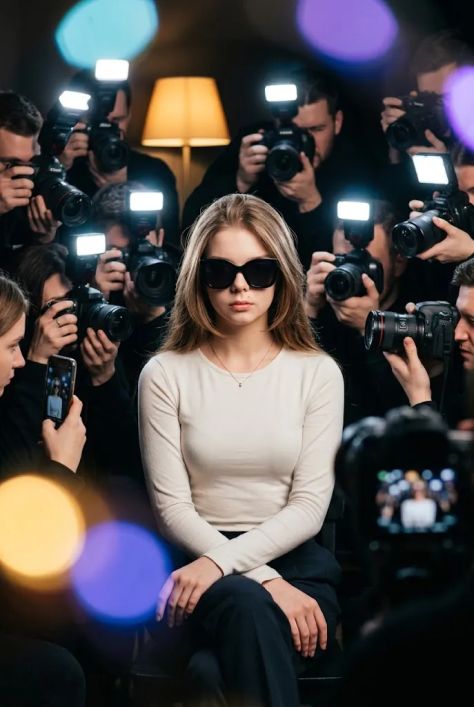
Editorial Portrait Rim Light Dramatic Bokeh
1
1
Prompt

Editorial Portrait Rim Light Dramatic Bokeh

Use the uploaded image as the main visual reference. Recreate the same cinematic fashion-editorial press-scrum portrait: the same centrally seated subject, same oversized opaque black sunglasses, same warm off-white fitted long-sleeve top, same dark trousers, same medium-brown layered hair with warm caramel-beige highlights, same crossed/overlapping hands in the lap, same dense ring of photographers aiming cameras inward, same repeated rectangular flash units, same warm background lamp, same colored foreground bokeh, same defocused live-view screen at lower-right, same framing, and same mixed warm/cool editorial lighting. Do not introduce any age-based, ethnicity-based, nationality-based, or region-based description or styling. Follow only the visible physical, clothing, pose, lighting, material, composition, and environmental details from the reference.

Generate an ultra-photorealistic cinematic fashion editorial portrait / staged paparazzi press-scrum photograph in a 2:3 vertical composition matching approximately 736 × 1104 framing.

COMPOSITION — LOCK FIRST

Place one seated subject exactly along the horizontal center axis.

Use a seated three-quarter crop from the head through approximately the upper thighs, with the lower legs continuing beyond the bottom edge.

The main subject should occupy roughly 38–42% of the frame width.

Keep the head around the central vertical third.

Use an approximately eye-level camera angle and a compressed portrait perspective.

Build strong central symmetry around the subject while surrounding them with irregularly positioned photographers and camera lenses.

The photographers should create a dense visual frame along:

viewer-left;

viewer-right;

directly behind;

upper-left;

upper-right.

Keep the main subject’s face completely unobstructed.

Preserve large out-of-focus colored light shapes in the extreme foreground, especially:

one warm yellow/orange orb near lower-left;

one blue-violet orb near lower-center/left;

one cyan-blue orb near upper-left;

one purple/violet orb near upper-right;

several smaller amber/yellow circles higher in the frame.

Include a strongly defocused smartphone/camera display in the lower-right foreground showing a tiny recognizable live image of the same seated subject.

FACE — PRESERVE VISIBLE STRUCTURE

Preserve the same visible facial structure from the uploaded reference.

Use:

soft oval facial geometry;

moderately tapered lower face;

smooth lightly defined jawline;

small rounded-to-tapered chin;

moderately prominent cheekbones defined primarily through light rather than heavy makeup contour;

straight narrow-to-medium nose bridge;

softly rounded nose tip;

subtle frontal nostril visibility.

Keep the head frontal and aligned with the torso.

Keep the head essentially level with the chin slightly lowered.

SKIN

Render the visible skin as light neutral beige around H 20–30° with a subtle warm peach undertone, using low-to-medium saturation.

Use a matte-to-soft-satin finish with approximately 6/10 editorial retouching.

Preserve:

fine natural skin texture across cheeks;

visible microtexture around the nose;

subtle texture around lips and lower face;

gently smoothed larger cheek and forehead planes;

soft low-intensity skin highlights.

Do not create poreless or plastic skin.

Keep shadowed skin in muted beige-taupe with a slightly cooler brown-gray influence.

SUNGLASSES — EYES MUST REMAIN HIDDEN

Preserve oversized rounded-rectangular / soft-square sunglasses.

Use:

glossy black acetate-like frames;

medium-to-thick frame width;

extremely dark charcoal-black lenses;

extremely low lens transparency;

narrow black bridge.

The lenses should reflect subtle rectangular white flash shapes.

Both eyes must remain completely concealed.

Do not reveal:

iris color;

pupils;

eyelids;

lashes;

eye makeup;

gaze direction.

Do not make the lenses transparent.

Do not invent visible eyes behind them.

MOUTH + EXPRESSION GEOMETRY

Use medium-full lips with approximately 0.8:1 upper-to-lower fullness ratio.

Keep:

softly defined cupid’s bow;

muted natural rose-brown color;

matte-to-soft-satin finish;

mouth fully closed;

corners approximately level.

No teeth visible.

Expression geometry should remain controlled:

forehead relaxed;

jaw relaxed;

lips lightly closed without pursing;

no strong smile contraction;

no strong cheek lift;

no visible brow contraction.

Do not exaggerate expression.

MAKEUP

Keep makeup restrained and editorial.

Use:

light natural complexion correction;

muted neutral rose/nude lip color;

at most extremely subtle warm-neutral cheek coloration.

Do not invent dramatic contour.

Because the sunglasses obscure the eye region, do not invent visible:

eyeshadow;

eyeliner;

mascara;

brows.

HAIR

Preserve shoulder-to-upper-chest-length layered hair.

Use a medium brown base around H 25–35° with warm beige/caramel-gold highlights and deep neutral-brown shadow sections.

Maintain:

near-center part;

smooth fiber structure;

loose soft bends/waves;

moderate crown volume;

long face-framing sections beside the sunglasses and cheekbones;

feathered ends;

slightly outward-curving lower layers;

minimal fine flyaways around the crown.

Use a soft satin hair finish with naturally elongated specular streaks.

Add thin warm champagne-gold edge illumination to selected outer strands.

Do not change the hairstyle into tight curls, straight blunt hair, an updo, or a short cut.

CLOTHING

Preserve the fitted long-sleeve crew-neck top.

Use a warm off-white / cream around H 35–45° with very low saturation.

Construct it from fine matte jersey/knit fabric.

Keep:

close fit through torso and sleeves;

rounded crew neckline;

full sleeves extending to wrists;

no buttons;

no fasteners;

no visible pattern;

no logo.

Show realistic fine tension folds around:

elbows;

waist;

forearms.

Pair it with deep navy-charcoal to near-black trousers/jeans in dense matte woven fabric.

No visible belt.

NECKLACE

Preserve one very thin delicate metallic necklace in pale gold.

Place a tiny minimal round/dot-like pendant centered near the collarbone.

Keep it extremely understated.

No large jewelry.

No visible watch.

No bracelet.

No clearly visible rings.

POSE

Keep the torso frontal.

Maintain an upright seated posture.

Shoulders should remain almost level with a slight natural downward slope.

Upper arms stay close to the torso.

Angle both forearms downward and inward toward the lap.

Preserve two visible hands, overlapping/crossing at the lower center.

One hand should sit slightly lower/forward with relaxed fingers extending downward.

The other should rest across or above the opposite wrist/hand area.

Use:

naturally curved relaxed fingers;

short-to-medium natural nails;

no strong nail polish;

palms oriented mostly inward/downward.

Do not change to crossed arms, hands on hips, waving, or standing.

PHOTOGRAPHER CROWD

Create approximately 12–14 surrounding photographers/onlookers, many partially cropped or obscured by their cameras.

Dress the crowd predominantly in:

black;

charcoal;

navy;

dark gray.

Each active photographer should hold a black DSLR/mirrorless-style camera aimed toward the main subject.

Use predominantly medium-to-large cylindrical zoom lenses.

Most cameras should be held in horizontal/landscape shooting orientation.

Keep elbows bent and cameras raised to eye level.

Faces should often be partially obscured by:

camera bodies;

lenses;

darkness;

shallow focus.

Do not allow the crowd to cover the main subject’s face.

CAMERA FLASHES

Distribute approximately 9–11 clearly visible bright rectangular flash panels around the subject, plus a few partially obscured units.

Position flashes at varied heights around:

head level;

shoulder level;

upper background;

left/right crowd.

Some units should appear actively firing as bright clipped white rectangles.

Use mostly cool-white flash light around approximately 5000–6500 K.

Do not create one giant central flash.

The flashes must appear as multiple independent practical sources.

SMARTPHONE

On viewer-left, include one surrounding person holding a smartphone vertically.

Keep it secondary and partially obscured.

BACKGROUND LAMP

Place one warm table/floor lamp in the upper-left-center background behind the photographers.

Use:

cream/beige conical shade;

tungsten glow around 2800–3200 K;

moderate blur.

The warm lamp must contrast against the cool-white flashes.

FOREGROUND LIVE-VIEW SCREEN

Place a strongly defocused device screen near the lower-right edge.

Display a tiny central live-view image of the seated subject.

Allow several unreadable white/cyan/red interface points around it.

Keep the device body partially cropped and strongly blurred.

The screen must not show an unrelated person or scene.

BACKGROUND DEPTH

Build the environment in five depth layers:

Layer 1: main subject — sharpest.

Layer 2: nearest photographers and cameras — moderately sharp.

Layer 3: photographers immediately behind — progressively softer.

Layer 4: warm lamp and dark room environment — strongly softened.

Layer 5: extreme foreground bokeh/device edges — heavily defocused.

The room itself should remain dark and largely undefined.

Do not introduce readable signs, banners, logos, architecture, or event branding.

LIGHTING — CRITICAL

Light the main subject with a soft frontal/top key from approximately 11–12 o’clock, around 4700–5200 K.

Use medium-soft quality.

Illuminate:

nose bridge;

central cheeks;

lips;

neck;

chest;

upper cream garment.

Keep:

hair sides;

jaw edges;

torso sides;

lower arms

slightly darker.

Maintain approximately 35–45% fill with soft shadow transitions.

Add subtle warm champagne/gold rim light around the hair and selected shoulder edges to separate the subject from the dark crowd.

Combine this with multiple surrounding cool-white camera flashes.

Use this mixed lighting structure:

neutral/warm key on subject + warm tungsten lamp + cool-white practical camera flashes.

Keep the subject more evenly exposed than the crowd.

SURFACE-SPECIFIC HIGHLIGHTS

Skin: soft low-intensity satin reflections.

Sunglasses: restrained rectangular white flash reflections.

Hair: narrow warm-gold edge streaks.

Cream knit: soft broad fabric highlights with visible fine folds.

Camera bodies: hard white flash glints over matte-black surfaces.

Lens rings: narrow metallic reflections.

Flash panels: high-intensity clipped white rectangles.

COLOR SYSTEM

Lock the palette to:

near-black/charcoal environment: H 220–250°, very low saturation, B 3–15%;

cream garment: H 35–45°, S 8–15%, B 75–88%;

medium brown hair: H 25–35°, S 30–45%;

neutral warm beige skin: H 20–30°, S 15–25%;

cool-white flash rectangles;

cyan-blue accent around H 195–220°;

violet accents around H 250–270°;

amber practical lights around H 35–45°.

Apply a dark cinematic fashion-editorial grade with cool charcoal shadows and warm central skin/hair highlights.

Keep overall saturation restrained except for the deliberately saturated blue/violet/amber bokeh.

CAMERA / DEPTH OF FIELD

Simulate approximately a 70–100 mm portrait lens at around f/1.8–f/2.8.

Use shallow depth of field.

Keep the sharpest plane on:

face;

sunglasses;

central hair;

upper torso.

Keep closest photographers moderately sharp.

Allow rear photographers to soften progressively.

Make foreground colored bokeh and the lower-right live-view screen extremely soft.

Use:

grain approximately 2/10;

post-processing approximately 8/10;

high contrast;

natural edge darkening;

mild bloom around bright flash panels and bokeh;

minimal localized flare near intense flashes;

essentially no chromatic aberration;

zero motion blur.

VISUAL HIERARCHY

Maintain this order:

central face + oversized black sunglasses → cream fitted top → repeated white flashes → surrounding cameras → warm-highlighted hair → colored foreground bokeh → defocused live-view screen.

Maintain central alignment:

head → nose → tiny necklace pendant → torso center → overlapping hands.

Arrange the cameras radially so multiple lenses visually point inward toward the main subject.

STRICT PRESERVATION RULES

Do not use age-based language or styling.

Do not use ethnicity-based language.

Do not use nationality-based language.

Do not use region-based language.

Do not reveal the eyes through the sunglasses.

Do not invent iris color or gaze.

Do not change the sunglasses into clear glasses.

Do not remove the black sunglasses.

Do not change the cream top color.

Do not add logos or patterns to the clothing.

Do not make the subject stand.

Do not convert to full-body framing.

Do not alter the centered seated posture.

Do not separate the hands from the lap pose.

Do not add dramatic makeup.

Do not add large jewelry.

Do not create a smile with visible teeth.

Do not make the hair very curly, very short, or tied up.

Do not reduce the photographer crowd to only two or three people.

Do not create a dense crowd that obscures the subject.

Do not remove the repeated rectangular flash units.

Do not replace professional cameras with smartphones only.

Do not remove the warm background lamp.

Do not remove the blue, violet and yellow foreground bokeh.

Do not remove the lower-right live-view screen.

Do not sharpen every background photographer equally.

Do not evenly illuminate the entire environment.

Do not introduce red-carpet signage, logos, branding or readable text.

No extra main subjects. No visible eyes. No text. No watermark. No fog. No smoke. No rain. No dramatic atmospheric particle field. No motion blur. No wide-angle distortion. No plastic skin.

Ultra-high resolution. Preserve natural skin microtexture, realistic hair fibers, opaque glossy sunglasses, fine cream-knit texture, authentic camera bodies and lenses, intense practical flash panels, mixed-temperature illumination, shallow depth separation, and realistic optical bokeh.

Photorealistic cinematic fashion-editorial press photography only.

·
Photo Prompts

Avis

Connectez-vous pour laisser un avis.

Pas encore d'avis. Soyez le premier.

PromptLabHub sur tous vos appareils.

Installez l’application pour un accès plus rapide, ou téléchargez l’extension Chrome et chargez-la dans le navigateur.

Parcourir les prompts

  • Tous les prompts
  • Prompts photo
  • Prompts vidéo
  • Prompts cuisine

Créer

  • Soumettre un prompt

Communauté

  • Forum
  • Créateurs
  • Classement
  • Défi hebdomadaire

Assistance

  • FAQ
  • Nous contacter
  • Politique de confidentialité
  • Conditions d'utilisation

Suivez-nous

Découvrez et copiez des prompts IA sélectionnés pour Midjourney, DALL-E 3, Sora, Runway et plus encore. Mis à jour chaque semaine.

Politique de confidentialitéConditions d'utilisationPolitique de cookies

© 2026 PromptLabHub. All rights reserved.

© 2026 PromptLabHub. All rights reserved.

·
Politique de confidentialité·Conditions d'utilisation·Politique de cookies
Home
PromptLabHub
Editorial Portrait Rim Light Dramatic Bokeh
1
1
Prompt

Editorial Portrait Rim Light Dramatic Bokeh

Use the uploaded image as the main visual reference. Recreate the same cinematic fashion-editorial press-scrum portrait: the same centrally seated subject, same oversized opaque black sunglasses, same warm off-white fitted long-sleeve top, same dark trousers, same medium-brown layered hair with warm caramel-beige highlights, same crossed/overlapping hands in the lap, same dense ring of photographers aiming cameras inward, same repeated rectangular flash units, same warm background lamp, same colored foreground bokeh, same defocused live-view screen at lower-right, same framing, and same mixed warm/cool editorial lighting. Do not introduce any age-based, ethnicity-based, nationality-based, or region-based description or styling. Follow only the visible physical, clothing, pose, lighting, material, composition, and environmental details from the reference.

Generate an ultra-photorealistic cinematic fashion editorial portrait / staged paparazzi press-scrum photograph in a 2:3 vertical composition matching approximately 736 × 1104 framing.

COMPOSITION — LOCK FIRST

Place one seated subject exactly along the horizontal center axis.

Use a seated three-quarter crop from the head through approximately the upper thighs, with the lower legs continuing beyond the bottom edge.

The main subject should occupy roughly 38–42% of the frame width.

Keep the head around the central vertical third.

Use an approximately eye-level camera angle and a compressed portrait perspective.

Build strong central symmetry around the subject while surrounding them with irregularly positioned photographers and camera lenses.

The photographers should create a dense visual frame along:

viewer-left;

viewer-right;

directly behind;

upper-left;

upper-right.

Keep the main subject’s face completely unobstructed.

Preserve large out-of-focus colored light shapes in the extreme foreground, especially:

one warm yellow/orange orb near lower-left;

one blue-violet orb near lower-center/left;

one cyan-blue orb near upper-left;

one purple/violet orb near upper-right;

several smaller amber/yellow circles higher in the frame.

Include a strongly defocused smartphone/camera display in the lower-right foreground showing a tiny recognizable live image of the same seated subject.

FACE — PRESERVE VISIBLE STRUCTURE

Preserve the same visible facial structure from the uploaded reference.

Use:

soft oval facial geometry;

moderately tapered lower face;

smooth lightly defined jawline;

small rounded-to-tapered chin;

moderately prominent cheekbones defined primarily through light rather than heavy makeup contour;

straight narrow-to-medium nose bridge;

softly rounded nose tip;

subtle frontal nostril visibility.

Keep the head frontal and aligned with the torso.

Keep the head essentially level with the chin slightly lowered.

SKIN

Render the visible skin as light neutral beige around H 20–30° with a subtle warm peach undertone, using low-to-medium saturation.

Use a matte-to-soft-satin finish with approximately 6/10 editorial retouching.

Preserve:

fine natural skin texture across cheeks;

visible microtexture around the nose;

subtle texture around lips and lower face;

gently smoothed larger cheek and forehead planes;

soft low-intensity skin highlights.

Do not create poreless or plastic skin.

Keep shadowed skin in muted beige-taupe with a slightly cooler brown-gray influence.

SUNGLASSES — EYES MUST REMAIN HIDDEN

Preserve oversized rounded-rectangular / soft-square sunglasses.

Use:

glossy black acetate-like frames;

medium-to-thick frame width;

extremely dark charcoal-black lenses;

extremely low lens transparency;

narrow black bridge.

The lenses should reflect subtle rectangular white flash shapes.

Both eyes must remain completely concealed.

Do not reveal:

iris color;

pupils;

eyelids;

lashes;

eye makeup;

gaze direction.

Do not make the lenses transparent.

Do not invent visible eyes behind them.

MOUTH + EXPRESSION GEOMETRY

Use medium-full lips with approximately 0.8:1 upper-to-lower fullness ratio.

Keep:

softly defined cupid’s bow;

muted natural rose-brown color;

matte-to-soft-satin finish;

mouth fully closed;

corners approximately level.

No teeth visible.

Expression geometry should remain controlled:

forehead relaxed;

jaw relaxed;

lips lightly closed without pursing;

no strong smile contraction;

no strong cheek lift;

no visible brow contraction.

Do not exaggerate expression.

MAKEUP

Keep makeup restrained and editorial.

Use:

light natural complexion correction;

muted neutral rose/nude lip color;

at most extremely subtle warm-neutral cheek coloration.

Do not invent dramatic contour.

Because the sunglasses obscure the eye region, do not invent visible:

eyeshadow;

eyeliner;

mascara;

brows.

HAIR

Preserve shoulder-to-upper-chest-length layered hair.

Use a medium brown base around H 25–35° with warm beige/caramel-gold highlights and deep neutral-brown shadow sections.

Maintain:

near-center part;

smooth fiber structure;

loose soft bends/waves;

moderate crown volume;

long face-framing sections beside the sunglasses and cheekbones;

feathered ends;

slightly outward-curving lower layers;

minimal fine flyaways around the crown.

Use a soft satin hair finish with naturally elongated specular streaks.

Add thin warm champagne-gold edge illumination to selected outer strands.

Do not change the hairstyle into tight curls, straight blunt hair, an updo, or a short cut.

CLOTHING

Preserve the fitted long-sleeve crew-neck top.

Use a warm off-white / cream around H 35–45° with very low saturation.

Construct it from fine matte jersey/knit fabric.

Keep:

close fit through torso and sleeves;

rounded crew neckline;

full sleeves extending to wrists;

no buttons;

no fasteners;

no visible pattern;

no logo.

Show realistic fine tension folds around:

elbows;

waist;

forearms.

Pair it with deep navy-charcoal to near-black trousers/jeans in dense matte woven fabric.

No visible belt.

NECKLACE

Preserve one very thin delicate metallic necklace in pale gold.

Place a tiny minimal round/dot-like pendant centered near the collarbone.

Keep it extremely understated.

No large jewelry.

No visible watch.

No bracelet.

No clearly visible rings.

POSE

Keep the torso frontal.

Maintain an upright seated posture.

Shoulders should remain almost level with a slight natural downward slope.

Upper arms stay close to the torso.

Angle both forearms downward and inward toward the lap.

Preserve two visible hands, overlapping/crossing at the lower center.

One hand should sit slightly lower/forward with relaxed fingers extending downward.

The other should rest across or above the opposite wrist/hand area.

Use:

naturally curved relaxed fingers;

short-to-medium natural nails;

no strong nail polish;

palms oriented mostly inward/downward.

Do not change to crossed arms, hands on hips, waving, or standing.

PHOTOGRAPHER CROWD

Create approximately 12–14 surrounding photographers/onlookers, many partially cropped or obscured by their cameras.

Dress the crowd predominantly in:

black;

charcoal;

navy;

dark gray.

Each active photographer should hold a black DSLR/mirrorless-style camera aimed toward the main subject.

Use predominantly medium-to-large cylindrical zoom lenses.

Most cameras should be held in horizontal/landscape shooting orientation.

Keep elbows bent and cameras raised to eye level.

Faces should often be partially obscured by:

camera bodies;

lenses;

darkness;

shallow focus.

Do not allow the crowd to cover the main subject’s face.

CAMERA FLASHES

Distribute approximately 9–11 clearly visible bright rectangular flash panels around the subject, plus a few partially obscured units.

Position flashes at varied heights around:

head level;

shoulder level;

upper background;

left/right crowd.

Some units should appear actively firing as bright clipped white rectangles.

Use mostly cool-white flash light around approximately 5000–6500 K.

Do not create one giant central flash.

The flashes must appear as multiple independent practical sources.

SMARTPHONE

On viewer-left, include one surrounding person holding a smartphone vertically.

Keep it secondary and partially obscured.

BACKGROUND LAMP

Place one warm table/floor lamp in the upper-left-center background behind the photographers.

Use:

cream/beige conical shade;

tungsten glow around 2800–3200 K;

moderate blur.

The warm lamp must contrast against the cool-white flashes.

FOREGROUND LIVE-VIEW SCREEN

Place a strongly defocused device screen near the lower-right edge.

Display a tiny central live-view image of the seated subject.

Allow several unreadable white/cyan/red interface points around it.

Keep the device body partially cropped and strongly blurred.

The screen must not show an unrelated person or scene.

BACKGROUND DEPTH

Build the environment in five depth layers:

Layer 1: main subject — sharpest.

Layer 2: nearest photographers and cameras — moderately sharp.

Layer 3: photographers immediately behind — progressively softer.

Layer 4: warm lamp and dark room environment — strongly softened.

Layer 5: extreme foreground bokeh/device edges — heavily defocused.

The room itself should remain dark and largely undefined.

Do not introduce readable signs, banners, logos, architecture, or event branding.

LIGHTING — CRITICAL

Light the main subject with a soft frontal/top key from approximately 11–12 o’clock, around 4700–5200 K.

Use medium-soft quality.

Illuminate:

nose bridge;

central cheeks;

lips;

neck;

chest;

upper cream garment.

Keep:

hair sides;

jaw edges;

torso sides;

lower arms

slightly darker.

Maintain approximately 35–45% fill with soft shadow transitions.

Add subtle warm champagne/gold rim light around the hair and selected shoulder edges to separate the subject from the dark crowd.

Combine this with multiple surrounding cool-white camera flashes.

Use this mixed lighting structure:

neutral/warm key on subject + warm tungsten lamp + cool-white practical camera flashes.

Keep the subject more evenly exposed than the crowd.

SURFACE-SPECIFIC HIGHLIGHTS

Skin: soft low-intensity satin reflections.

Sunglasses: restrained rectangular white flash reflections.

Hair: narrow warm-gold edge streaks.

Cream knit: soft broad fabric highlights with visible fine folds.

Camera bodies: hard white flash glints over matte-black surfaces.

Lens rings: narrow metallic reflections.

Flash panels: high-intensity clipped white rectangles.

COLOR SYSTEM

Lock the palette to:

near-black/charcoal environment: H 220–250°, very low saturation, B 3–15%;

cream garment: H 35–45°, S 8–15%, B 75–88%;

medium brown hair: H 25–35°, S 30–45%;

neutral warm beige skin: H 20–30°, S 15–25%;

cool-white flash rectangles;

cyan-blue accent around H 195–220°;

violet accents around H 250–270°;

amber practical lights around H 35–45°.

Apply a dark cinematic fashion-editorial grade with cool charcoal shadows and warm central skin/hair highlights.

Keep overall saturation restrained except for the deliberately saturated blue/violet/amber bokeh.

CAMERA / DEPTH OF FIELD

Simulate approximately a 70–100 mm portrait lens at around f/1.8–f/2.8.

Use shallow depth of field.

Keep the sharpest plane on:

face;

sunglasses;

central hair;

upper torso.

Keep closest photographers moderately sharp.

Allow rear photographers to soften progressively.

Make foreground colored bokeh and the lower-right live-view screen extremely soft.

Use:

grain approximately 2/10;

post-processing approximately 8/10;

high contrast;

natural edge darkening;

mild bloom around bright flash panels and bokeh;

minimal localized flare near intense flashes;

essentially no chromatic aberration;

zero motion blur.

VISUAL HIERARCHY

Maintain this order:

central face + oversized black sunglasses → cream fitted top → repeated white flashes → surrounding cameras → warm-highlighted hair → colored foreground bokeh → defocused live-view screen.

Maintain central alignment:

head → nose → tiny necklace pendant → torso center → overlapping hands.

Arrange the cameras radially so multiple lenses visually point inward toward the main subject.

STRICT PRESERVATION RULES

Do not use age-based language or styling.

Do not use ethnicity-based language.

Do not use nationality-based language.

Do not use region-based language.

Do not reveal the eyes through the sunglasses.

Do not invent iris color or gaze.

Do not change the sunglasses into clear glasses.

Do not remove the black sunglasses.

Do not change the cream top color.

Do not add logos or patterns to the clothing.

Do not make the subject stand.

Do not convert to full-body framing.

Do not alter the centered seated posture.

Do not separate the hands from the lap pose.

Do not add dramatic makeup.

Do not add large jewelry.

Do not create a smile with visible teeth.

Do not make the hair very curly, very short, or tied up.

Do not reduce the photographer crowd to only two or three people.

Do not create a dense crowd that obscures the subject.

Do not remove the repeated rectangular flash units.

Do not replace professional cameras with smartphones only.

Do not remove the warm background lamp.

Do not remove the blue, violet and yellow foreground bokeh.

Do not remove the lower-right live-view screen.

Do not sharpen every background photographer equally.

Do not evenly illuminate the entire environment.

Do not introduce red-carpet signage, logos, branding or readable text.

No extra main subjects. No visible eyes. No text. No watermark. No fog. No smoke. No rain. No dramatic atmospheric particle field. No motion blur. No wide-angle distortion. No plastic skin.

Ultra-high resolution. Preserve natural skin microtexture, realistic hair fibers, opaque glossy sunglasses, fine cream-knit texture, authentic camera bodies and lenses, intense practical flash panels, mixed-temperature illumination, shallow depth separation, and realistic optical bokeh.

Photorealistic cinematic fashion-editorial press photography only.

·
Photo Prompts

Avis

Connectez-vous pour laisser un avis.

Pas encore d'avis. Soyez le premier.

PromptLabHub sur tous vos appareils.

Installez l’application pour un accès plus rapide, ou téléchargez l’extension Chrome et chargez-la dans le navigateur.

Parcourir les prompts

  • Tous les prompts
  • Prompts photo
  • Prompts vidéo
  • Prompts cuisine

Créer

  • Soumettre un prompt

Communauté

  • Forum
  • Créateurs
  • Classement
  • Défi hebdomadaire

Assistance

  • FAQ
  • Nous contacter
  • Politique de confidentialité
  • Conditions d'utilisation

Suivez-nous

Découvrez et copiez des prompts IA sélectionnés pour Midjourney, DALL-E 3, Sora, Runway et plus encore. Mis à jour chaque semaine.

Politique de confidentialitéConditions d'utilisationPolitique de cookies

© 2026 PromptLabHub. All rights reserved.

© 2026 PromptLabHub. All rights reserved.

·
Politique de confidentialité·Conditions d'utilisation·Politique de cookies
Home