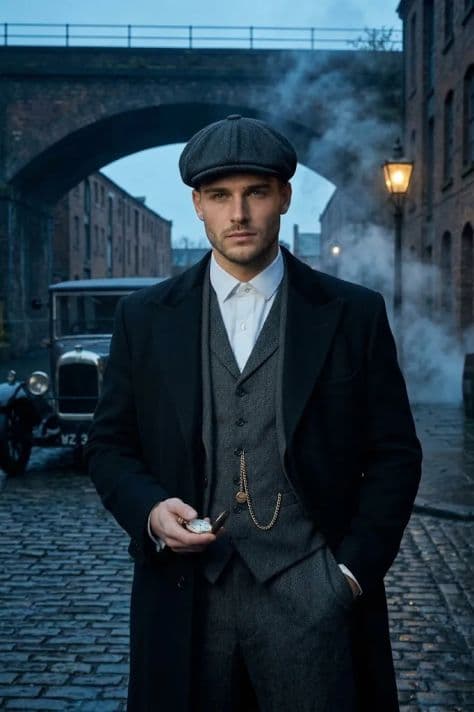

Peaky Blinders Thomas Shelby 1920s Birmingham Gangster Portrait
[STRICTLY FOLLOW THE REFERENCE IMAGE — use the uploaded photo as the exact identity authority for the first subject ("me"). Preserve the first subject's exact face, facial structure, skin tone, age, body proportions, hairstyle characteristics, and recognizable appearance exactly as shown. Do not redesign, beautify, age, reshape, or reinterpret the first subject's identity.]
Create an ultra-realistic 8K cinematic period portrait of the first subject reimagined as Thomas “Tommy” Shelby from Peaky Blinders, while preserving the uploaded face, facial structure, hairstyle characteristics, body proportions, expression qualities, and recognizable identity exactly. Do not replace the face with any actor or reinterpret the reference identity.
Reimagine the photograph as a tense private moment beside an industrial canal at dusk rather than a conventional foggy-street gangster portrait. Place the first subject beneath a soot-darkened railway arch beside a narrow cobbled towpath, captured just after stepping away from a waiting vintage motorcar. His body remains angled toward the canal while his head turns directly toward the camera with a restrained, calculating expression — composed, unreadable, and quietly intimidating.
One hand holds an open gold pocket watch low near the waist, with its chain running naturally into the waistcoat pocket, while the opposite hand adjusts the cuff of the long overcoat. Avoid cigarettes and generic hands-in-pockets posing; let the watch become the narrative object, suggesting that he is waiting for a precise moment.
Dress him in a perfectly tailored charcoal-gray three-piece tweed suit with a subtle herringbone weave, crisp white high-collar shirt, narrow black silk tie, fully buttoned waistcoat, polished black leather boots, and a long black wool overcoat with a dark velvet collar. Add the characteristic 1920s flat newsboy cap, worn slightly forward. Every garment should feel authentic to the period, with visible wool fibers, natural weight, proper drape, and understated tailoring.
Use the environment to build the story: wet cobblestones, black canal water, brick warehouses, iron bridges, distant factory chimneys, a dim gas lamp, and faint steam drifting from the industrial background. A period motorcar should sit partially visible under the arch behind him, softly out of focus, reinforcing status without becoming the focal point.
Photograph from a slightly low three-quarter position with a 50–65mm full-frame perspective, framing from approximately the knees upward. Place the first subject off-center so the arch, canal edge, and receding towpath create strong leading lines and negative space.
Light the scene with cold blue-gray ambient dusk from the canal side, balanced by one warm gas lamp farther behind the subject. Let the cool light shape the face, suit, and cap while the warmer source creates a subtle rim along the coat collar and shoulders. Add restrained volumetric haze beneath the railway arch so the light has depth without becoming theatrical.
Emphasize exact facial fidelity, realistic skin pores, natural hair and facial-hair detail from the reference, fine tweed texture, polished leather, gold pocket-watch reflections, damp brick, wet cobblestones, atmospheric mist, and believable period materials. Use deep blacks, cool desaturated blues and grays, restrained amber highlights, subtle film grain, and rich cinematic shadow detail.
The final image should feel like a lost frame from a premium 1920s British crime drama — controlled, intelligent, dangerous, melancholic, and historically grounded — with the first subject unmistakably remaining the same person from the uploaded reference rather than resembling any actor.
No text, no watermark, no modern objects, no actor-face substitution, no distorted anatomy, no artificial skin smoothing, no costume-like fabric, no exaggerated fog, no CGI appearance.
Evocative 1920s post-WWI Birmingham period portrait inspired by Thomas Shelby of Peaky Blinders. Depicts a rugged mob leader in a heavy tweed herringbone overcoat and newsboy flat cap amid industrial smoke, wet brick alleys, and vintage lanterns.