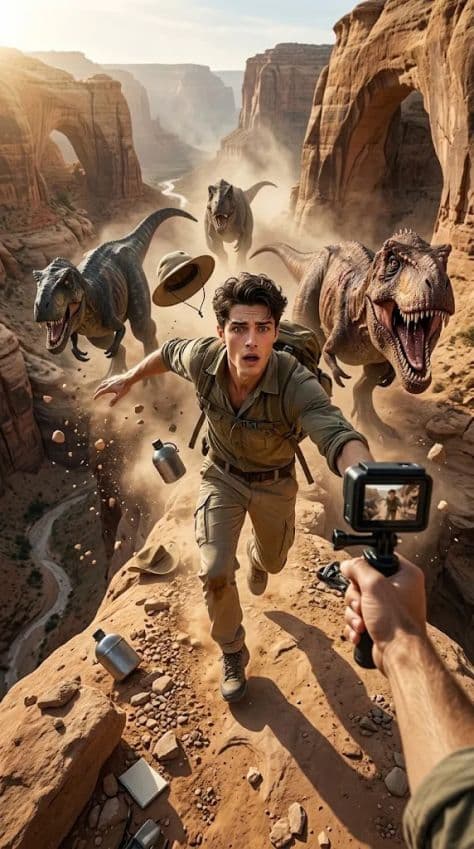

Cinematic Desert Sandstone Ridge Sprint Action Photography
Ultra-realistic cinematic live-action adventure photograph in vertical 9:16, designed as a high-budget survival blockbuster frame with extreme physical realism, natural environmental detail, and convincing action photography.
CHARACTER:
An athletic adult male explorer dominates the lower foreground while sprinting across a narrow sandstone ridge. If an uploaded reference image is provided, use it only as the facial-identity authority for the human subject, preserving the exact recognizable face, facial proportions, eyes, brows, nose, mouth, jawline, skin tone, hairstyle, apparent age, body proportions, and any distinctive facial hair such as a goatee with individual gray strands. Do not beautify, redesign, or substitute the face. If no reference image is supplied, create an original adult male explorer.
Dress him in a weathered olive-khaki expedition shirt with sleeves rolled to the forearms, dark sand-colored technical cargo trousers, rugged brown hiking boots, and a worn chest harness fitted with practical expedition pouches. A compact canvas-and-leather field backpack moves naturally with his stride. Clothing should show authentic dust, sweat-darkened areas, realistic stitching, wrinkles, abrasion, and fabric texture.
POSE AND ACTION:
Instead of a conventional straight-on selfie, capture the scene from a compact action camera mounted on a short handheld grip in his extended right hand. The camera is slightly below face level and angled upward, producing an urgent wide-angle perspective while keeping his facial proportions believable.
He is caught mid-stride while leaping across a broken section of the ridge. His free arm reaches outward for balance, one foot has just left the rock, and the other is about to land. His face turns toward the camera with wide eyes, raised brows, and an uncontrolled expression of shock and adrenaline.
His abandoned safari hat is airborne behind him rather than lying still on the ground, caught by the turbulence of the chase. A metal canteen and a small field notebook have fallen from his gear and tumble across the rocky path.
PREDATORS:
Behind him, three enormous biologically plausible carnivorous dinosaurs are pursuing him through the canyon, but give each predator a clearly different position, scale, gait, coloration, and surface texture.
The nearest dinosaur bursts through a collapsing sandstone arch on the right side of the frame. Its head is lowered into the chase, jaws open wide enough to reveal individually modeled teeth, wet gums, tongue, saliva strands, and realistic oral tissue. Give it dark rust-brown reptilian skin with scars, irregular pigmentation, thick musculature, and dust accumulating between scales.
The second predator is slightly farther back on the left, charging down a sloped ledge with one foot throwing loose rocks into the air. Give it a darker charcoal-and-ochre pattern and a slightly narrower skull, preventing any cloned appearance.
The third is deepest in the scene, emerging through a plume of dust from the canyon entrance, partially obscured by atmospheric haze but still clearly recognizable as another giant carnivorous dinosaur.
All three should have physically convincing anatomy: massive hind limbs, heavy tails used for balance, muscular necks, small forelimbs, realistic weight distribution, natural joint articulation, individualized teeth, and believable interaction with the terrain.
ENVIRONMENT:
Move the chase away from the mouth of a single prehistoric cave and into a vast desert canyon system filled with towering layered sandstone walls, eroded arches, narrow rock bridges, steep drops, and distant mesas.
The explorer is crossing a narrow elevated ridge suspended above a deep ravine. Loose gravel, fractured stone, dry scrub, thorny desert plants, and scattered expedition equipment cover the path.
Every dinosaur footfall sends dust, pebbles, and fragments of sandstone into the air. Some rocks are frozen sharply in mid-flight while others show extremely subtle directional motion blur appropriate to their speed.
Far below, a dry riverbed snakes through the canyon. Several distant birds circle in the warm rising air near the cliffs.
LIGHTING:
Use late-afternoon desert sunlight rather than midday light. The sun sits low outside the frame on camera-left, casting long warm highlights across the explorer, dinosaur scales, canyon walls, and airborne dust.
Deep canyon shadows remain cool and desaturated, creating cinematic separation between sunlit ochre rock and blue-gray shadow.
Sunlight passes through the suspended dust, producing realistic volumetric shafts and glowing particles without becoming artificial or overly dramatic.
CAMERA AND COMPOSITION:
Vertical 9:16.
Dynamic first-person action-camera perspective with the explorer’s extended arm entering strongly from the lower-right foreground.
Use a 32mm full-frame equivalent lens at approximately f/5.6, enough to preserve environmental context and keep the explorer and nearest predators readable while maintaining natural spatial depth.
Camera positioned slightly below the subject’s face, tilted upward enough to exaggerate the canyon scale without distorting the human head or limbs.
Layer the image clearly:
camera grip, hand, and forearm in extreme foreground;
explorer in sharp foreground action;
falling equipment and airborne debris;
first and second dinosaurs;
third dinosaur in dusty atmospheric depth;
monumental canyon walls and distant desert landscape.
Keep the explorer’s face extremely sharp and recognizable. Maintain sufficient depth of field so the nearest dinosaurs remain detailed while the far canyon gradually softens through natural atmospheric perspective.
ACTION REALISM:
Capture the scene as a single frozen instant rather than a staged pose. Use a shutter speed fast enough to preserve facial detail, teeth, scales, and flying debris, with only minimal physically appropriate motion blur on the fastest extremities and airborne particles.
Dust should interact correctly with footsteps, wind, and sunlight. Dinosaur shadows must align with the sun direction. Their weight should visibly compress loose ground and displace gravel.
PHOTOGRAPHIC AESTHETIC:
Hyper-realistic live-action cinematography.
Professional full-frame RAW photography.
Natural HDR.
Extremely high dynamic range.
Natural skin pores, sweat, dust, and small imperfections.
Individual hair strands.
Realistic fabric fibers and seams.
Weathered leather grain.
Organic dinosaur skin with scales, scars, pigmentation variation, pores, dirt, and subtle moisture.
Physically convincing saliva, oral tissue, teeth, and gums.
Photographic sandstone, gravel, dust, vegetation, and atmospheric haze.
Accurate shadows, reflections, perspective, and scale.
Subtle filmic contrast.
Premium adventure-blockbuster color grading with restrained saturation.
8K quality.
35mm–40mm equivalent visual character.
Low ISO.
Daylight white balance near 5500K.
High shutter speed.
Extremely precise focus.
The final image should feel like a dangerous unscripted moment captured during a real expedition, with authentic depth, speed, fear, monumental scale, and physical interaction between the explorer, terrain, debris, and predators.
Negative prompt: text, watermark, logo, signature, username, handle, caption, brand name, date stamp, CGI look, 3D render, illustration, painting, videogame aesthetic, cartoon dinosaurs, cloned dinosaurs, identical dinosaur faces, plastic skin, waxy skin, oversmoothed face, generic face, altered identity, face swap artifacts, malformed hands, extra fingers, duplicate limbs, distorted arm perspective, impossible dinosaur anatomy, floating feet, weightless dinosaurs, fake teeth, plastic scales, excessive motion blur, fisheye distortion, warped canyon geometry, inconsistent shadows, unrealistic dust, oversaturated colors, low resolution, blurry face.
Blockbuster cinematic live-action survival frame of an athletic explorer sprinting across a knife-edge desert sandstone ridge. Kicked-up sand, billowing technical tactical jacket, blazing midday desert sun, and dizzying canyon depth create an adrenaline-fueled action scene.