
PromptLabHub
Sketch Portrait Studio Dramatic Backlit Bokeh
164
164
Prompt

Sketch Portrait Studio Dramatic Backlit Bokeh

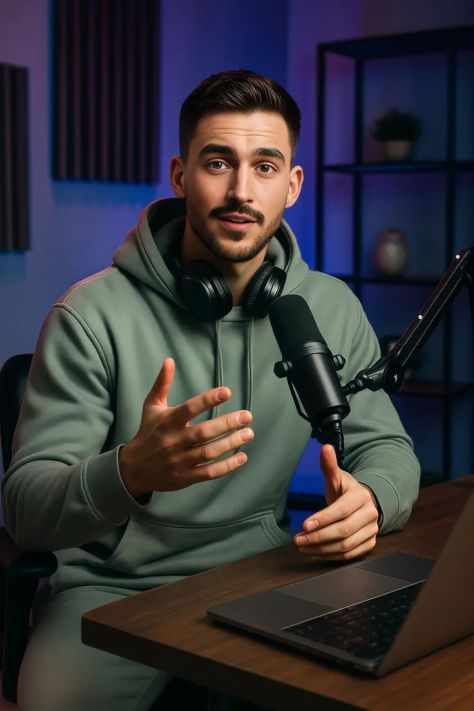
Use the attached source image as the governing visual reference. Recreate its photographic hierarchy, subject identity, lighting architecture, studio environment, equipment placement, colour relationships, and depth rather than reinterpreting the scene. The reference is a vertical 736 × 1104 portrait image, so rebuild it natively as a square without stretching the man, face, microphone, headphones, hands, laptop, furniture, or background objects. Treat the original portrait field as a centred structural region occupying approximately x=16.7–83.3% of the new square and extend the recording-room environment naturally into the additional left and right areas, continuing architectural surfaces, lighting, shelving, desk geometry, and cropped objects where physically appropriate.

This is a portrait-photographic, dominance-primary podcast cover: one seated male presenter carries the recognition hierarchy, while the microphone, headphones, laptop, desk, acoustic treatment, and shelving establish the recording environment. The artwork contains zero typography; human recognition and microphone silhouette carry the design.

Create a square 1:1 composition at 3000 × 3000 pixels in sRGB using the highest resolution tier available. Produce flat full-bleed photographic artwork filling the square edge to edge.

Build the photographic environment from the bottom upward. Start with an indoor recording studio dominated by low-luminosity charcoal, navy, blue-violet, dark wood, and muted sage values. Place dark ribbed acoustic treatment toward the upper-left and left-rear background, with the original acoustic-panel region translated to approximately x=22.7–40.0%, y=0–35%. Continue additional dark acoustic architecture naturally through the expanded left side. Place a black open-frame shelving structure in the right background, beginning around x=60.7%, y=3% and continuing toward the right side of the square, with small blurred decorative objects such as a plant and ceramic vessel kept visually subordinate. The studio must feel like one continuous photographed room rather than a vertical image pasted onto a wider canvas.

Keep the background substantially darker than the presenter. Target approximate corner luminosities of 24 at the upper-left, 10 at the upper-right, 9 at the lower-left, and 22 at the lower-right. Maintain the dominant rear-environment value range around luminosity 10–30, with blue-violet illuminated regions reaching roughly 25–35. The central face and sage hoodie should remain clearly brighter than the rear wall and shelving.

Apply shallow photographic depth of field to the rear acoustic panels, shelving, wall surfaces, and decorative objects, with an effective blur radius equivalent to approximately 1.5–3% of canvas width. Keep the presenter, microphone, headphones, raised hand, and principal foreground surfaces sharply resolved. Use a cool blue-violet environmental grade at approximately 20–30% strength, strongest across the rear wall, shelving, shadow fields, and peripheral architecture. Preserve warm skin and warm desk wood against the cool room.

Add narrow warm orange-red edge illumination around selected contours of the presenter, especially portions of the hair, ear, shoulder, and selected skin edges. Target the rim-light family around #B75B42 at low coverage below roughly 2% of the image, with approximately 15–25% perceived treatment strength. It should act as photographic subject separation rather than as a graphic outline. Finish the image with a near-black/navy peripheral luminance falloff at approximately 20–30% strength, concentrated within roughly the outer 8–15% of the square while retaining the brighter face and central clothing mass.

Recreate the depicted man as the dominant photographic subject and preserve his identity exactly from the uploaded reference; do not change his facial identity, facial proportions, skin characteristics, hairline, beard structure, eye shape, nose, mouth, or overall likeness. Keep his dark brown hair short at the sides and swept backward through the top, with a closely maintained beard and moustache. Preserve the nearly frontal head direction with a slight three-quarter offset and slight head tilt. Keep his gaze directed toward the viewer.

Dress him in the same muted sage-green hooded sweatshirt with realistic fabric folds and tonal variation between approximately #4D5149 in shadow and #758574 in highlights. Keep black over-ear headphones resting around his neck. Maintain natural warm skin values, with skin highlights around #DFA686 and midtones around #A36A4B, while the environment remains substantially cooler.

Translate the source portrait into the square while preserving its original human proportions. Target the main visible subject approximately within x=16.7–76.0%, y=9–100%, with the body continuing naturally into the lower and leftward outpainted regions where the source crop originally interrupted it. Keep the subject optical centre around x=45.3%, y=57%. Position the head approximately x=39.3–59.3%, y=9–38%, with a head height close to 29% of canvas height. Position the face approximately x=41.3–58.7%, y=15–37%, centred near x=50%, y=26%. Preserve a total visible subject height of approximately 91% of the canvas.

Keep the seated torso only slightly rotated from frontal. Preserve the raised gesturing hand in front of the body, translated approximately to x=31.3–52.7%, y=50–71%, with the palm and fingers projecting toward the viewer. Preserve the opposite hand near the desk, approximately x=57.3–70.7%, y=63–79%. Maintain realistic finger proportions and perspective rather than enlarging the hands beyond the reference.

Place the black headphones around the neck approximately within x=40.7–58.7%, y=36–48%, centred near x=49.7%, y=42%. Keep their circular earcups and headband readable at medium scale but subordinate to the face.

Place the large dark cylindrical studio microphone at approximately x=54.7–66.7%, y=40–64%, centred around x=60.7%, y=52%. Use a charcoal-to-near-black photographic finish governed by #0C0F11, with realistic cylindrical body, grille, mount hardware, and subtle edge reflections. Keep it in the foreground crossing the lighter sage hoodie so its silhouette remains immediately distinguishable.

Continue the microphone boom arm diagonally from the microphone toward the upper-right. The source structural region begins around x=63.3–83.3%, y=34–60%; extend that same boom-arm geometry naturally through the additional right-side outpainting until it exits the final square through the right edge. Preserve its black metal construction, joints, tension hardware, and diagonal reading direction without allowing it to dominate the face.

Keep the warm dark-wood desk beginning around x=28.7%, y=67% and extending across the lower-right portion of the square. Continue the desk naturally to the right edge so it remains a full photographed furniture surface. Govern its dominant dark warm-brown family around #3D2D20 with luminosity near 19, allowing realistic wood highlights and grain inside that hue family.

Place the laptop in the foreground-right beginning approximately around x=45.3%, y=75%. Preserve the same cropped perspective, dark keyboard area, trackpad, and open display edge from the reference. Continue it naturally into the expanded right-hand canvas where required by perspective, but keep the laptop subordinate to the presenter and microphone. Every visible laptop surface remains unbranded and unlettered.

The photographic surface uses only photographed material detail from skin, hair, fabric, wood, plastic, metal, acoustic panels, and shelving. Keep the finish continuous-tone digital photography. Synthetic film grain, digital-noise texture, halftone, paper texture, print distress, scanlines, chromatic misregistration, graphic glow halos, illustrated brushwork, geometric decoration, and dimensional graphic treatments are absent.

The artwork contains exactly zero text characters. Every wall, acoustic panel, microphone, headphone, laptop, desk, shelf object, clothing surface, and background region remains unlettered and unbranded. Do not introduce a title, host name, subtitle, episode identifier, season number, logo, URL, social handle, decorative lettering, device branding, or readable environmental text. Title cap-height remains exactly 0% of canvas height because typography is not part of this design.

Control the entire photographic colour architecture with these nine reconstruction anchors: deep charcoal #0C0F11 at luminosity about 6; dark wood brown #3D2D20 at about 19; navy background #181E34 at about 12; blue-violet environmental light #303671 at about 22; muted sage shadow #4D5149 at about 31; sage highlight #758574 at about 50; warm peach skin highlight #DFA686 at about 69; terracotta-peach skin midtone #A36A4B at about 45; and warm orange-red rim-light accent #B75B42. Treat these nine colour families as the closed hue architecture while allowing continuous photographic interpolation within them. Preserve the deliberate warm-skin and warm-wood separation against cool navy and blue-violet surroundings. Keep near-black charcoal as the dominant value and dark navy/blue as the dominant chromatic field.

Organise the square around a single centred dominant human element with asymmetric foreground equipment. Keep the primary face axis around x=50%. Maintain the boom arm as a secondary diagonal descending from the upper-right toward the microphone at centre-right. Reading order must be face first, microphone second, raised hand third, headphones fourth. Keep approximately 12–18% negative space, concentrated mainly in the top-left/top-centre background and in the dark spaces around the subject and shelving. Preserve full photographic bleed on all four edges. The lower portion may contain body, desk, chair, and laptop, but keep the lower 8% free of any critical identification element or text.

At approximately 55 pixels wide, the acceptance test is that the image immediately reads as a recognisable male upper-body portrait in a muted sage hoodie speaking at a dark microphone against a low-luminosity blue studio. The face and microphone silhouette must remain the two strongest surviving elements. The headphones may merge partially into the hoodie and shadows, the raised hand may simplify into a warm gesture shape, and background décor and laptop detail may disappear without damaging recognition. At approximately 150 pixels, the face, sage hoodie, dark microphone, raised hand, blue room, headphones, and general desk structure should remain separable.

Use the genre language of a host-led interview and conversation podcast with secondary technology, business, and education cues. Carry that language physically through the direct-to-camera presenter, large studio microphone, visible headphones, foreground laptop, desk-based recording environment, acoustic treatment, controlled blue-violet room lighting, warm skin separation, and asymmetric broadcast-equipment composition.

Keep the depicted man’s identity and proportions locked to the uploaded reference. Keep the portrait photographic rather than illustrated. Keep the warm-skin/cool-background separation, muted sage hoodie, black microphone and headphones, dark wood desk, shallow rear depth of field, narrow warm rim light, and moderate vignette. Keep the artwork completely free of text and logos. Preserve the source hierarchy while rebuilding it as a native 3000 × 3000 square composition through lateral environmental extension rather than horizontal stretching.

·
ChatGPT Prompts

Avis

Connectez-vous pour laisser un avis.

Pas encore d'avis. Soyez le premier.

PromptLabHub sur tous vos appareils.

Installez l’application pour un accès plus rapide, ou téléchargez l’extension Chrome et chargez-la dans le navigateur.

Parcourir les prompts

  • Tous les prompts
  • Prompts photo
  • Prompts vidéo
  • Prompts cuisine

Créer

  • Soumettre un prompt

Communauté

  • Forum
  • Créateurs
  • Classement
  • Défi hebdomadaire

Assistance

  • FAQ
  • Nous contacter
  • Politique de confidentialité
  • Conditions d'utilisation

Suivez-nous

Découvrez et copiez des prompts IA sélectionnés pour Midjourney, DALL-E 3, Sora, Runway et plus encore. Mis à jour chaque semaine.

Politique de confidentialitéConditions d'utilisationPolitique de cookies

© 2026 PromptLabHub. All rights reserved.

© 2026 PromptLabHub. All rights reserved.

·
Politique de confidentialité·Conditions d'utilisation·Politique de cookies
Home
PromptLabHub
Sketch Portrait Studio Dramatic Backlit Bokeh
164
164
Prompt

Sketch Portrait Studio Dramatic Backlit Bokeh

Use the attached source image as the governing visual reference. Recreate its photographic hierarchy, subject identity, lighting architecture, studio environment, equipment placement, colour relationships, and depth rather than reinterpreting the scene. The reference is a vertical 736 × 1104 portrait image, so rebuild it natively as a square without stretching the man, face, microphone, headphones, hands, laptop, furniture, or background objects. Treat the original portrait field as a centred structural region occupying approximately x=16.7–83.3% of the new square and extend the recording-room environment naturally into the additional left and right areas, continuing architectural surfaces, lighting, shelving, desk geometry, and cropped objects where physically appropriate.

This is a portrait-photographic, dominance-primary podcast cover: one seated male presenter carries the recognition hierarchy, while the microphone, headphones, laptop, desk, acoustic treatment, and shelving establish the recording environment. The artwork contains zero typography; human recognition and microphone silhouette carry the design.

Create a square 1:1 composition at 3000 × 3000 pixels in sRGB using the highest resolution tier available. Produce flat full-bleed photographic artwork filling the square edge to edge.

Build the photographic environment from the bottom upward. Start with an indoor recording studio dominated by low-luminosity charcoal, navy, blue-violet, dark wood, and muted sage values. Place dark ribbed acoustic treatment toward the upper-left and left-rear background, with the original acoustic-panel region translated to approximately x=22.7–40.0%, y=0–35%. Continue additional dark acoustic architecture naturally through the expanded left side. Place a black open-frame shelving structure in the right background, beginning around x=60.7%, y=3% and continuing toward the right side of the square, with small blurred decorative objects such as a plant and ceramic vessel kept visually subordinate. The studio must feel like one continuous photographed room rather than a vertical image pasted onto a wider canvas.

Keep the background substantially darker than the presenter. Target approximate corner luminosities of 24 at the upper-left, 10 at the upper-right, 9 at the lower-left, and 22 at the lower-right. Maintain the dominant rear-environment value range around luminosity 10–30, with blue-violet illuminated regions reaching roughly 25–35. The central face and sage hoodie should remain clearly brighter than the rear wall and shelving.

Apply shallow photographic depth of field to the rear acoustic panels, shelving, wall surfaces, and decorative objects, with an effective blur radius equivalent to approximately 1.5–3% of canvas width. Keep the presenter, microphone, headphones, raised hand, and principal foreground surfaces sharply resolved. Use a cool blue-violet environmental grade at approximately 20–30% strength, strongest across the rear wall, shelving, shadow fields, and peripheral architecture. Preserve warm skin and warm desk wood against the cool room.

Add narrow warm orange-red edge illumination around selected contours of the presenter, especially portions of the hair, ear, shoulder, and selected skin edges. Target the rim-light family around #B75B42 at low coverage below roughly 2% of the image, with approximately 15–25% perceived treatment strength. It should act as photographic subject separation rather than as a graphic outline. Finish the image with a near-black/navy peripheral luminance falloff at approximately 20–30% strength, concentrated within roughly the outer 8–15% of the square while retaining the brighter face and central clothing mass.

Recreate the depicted man as the dominant photographic subject and preserve his identity exactly from the uploaded reference; do not change his facial identity, facial proportions, skin characteristics, hairline, beard structure, eye shape, nose, mouth, or overall likeness. Keep his dark brown hair short at the sides and swept backward through the top, with a closely maintained beard and moustache. Preserve the nearly frontal head direction with a slight three-quarter offset and slight head tilt. Keep his gaze directed toward the viewer.

Dress him in the same muted sage-green hooded sweatshirt with realistic fabric folds and tonal variation between approximately #4D5149 in shadow and #758574 in highlights. Keep black over-ear headphones resting around his neck. Maintain natural warm skin values, with skin highlights around #DFA686 and midtones around #A36A4B, while the environment remains substantially cooler.

Translate the source portrait into the square while preserving its original human proportions. Target the main visible subject approximately within x=16.7–76.0%, y=9–100%, with the body continuing naturally into the lower and leftward outpainted regions where the source crop originally interrupted it. Keep the subject optical centre around x=45.3%, y=57%. Position the head approximately x=39.3–59.3%, y=9–38%, with a head height close to 29% of canvas height. Position the face approximately x=41.3–58.7%, y=15–37%, centred near x=50%, y=26%. Preserve a total visible subject height of approximately 91% of the canvas.

Keep the seated torso only slightly rotated from frontal. Preserve the raised gesturing hand in front of the body, translated approximately to x=31.3–52.7%, y=50–71%, with the palm and fingers projecting toward the viewer. Preserve the opposite hand near the desk, approximately x=57.3–70.7%, y=63–79%. Maintain realistic finger proportions and perspective rather than enlarging the hands beyond the reference.

Place the black headphones around the neck approximately within x=40.7–58.7%, y=36–48%, centred near x=49.7%, y=42%. Keep their circular earcups and headband readable at medium scale but subordinate to the face.

Place the large dark cylindrical studio microphone at approximately x=54.7–66.7%, y=40–64%, centred around x=60.7%, y=52%. Use a charcoal-to-near-black photographic finish governed by #0C0F11, with realistic cylindrical body, grille, mount hardware, and subtle edge reflections. Keep it in the foreground crossing the lighter sage hoodie so its silhouette remains immediately distinguishable.

Continue the microphone boom arm diagonally from the microphone toward the upper-right. The source structural region begins around x=63.3–83.3%, y=34–60%; extend that same boom-arm geometry naturally through the additional right-side outpainting until it exits the final square through the right edge. Preserve its black metal construction, joints, tension hardware, and diagonal reading direction without allowing it to dominate the face.

Keep the warm dark-wood desk beginning around x=28.7%, y=67% and extending across the lower-right portion of the square. Continue the desk naturally to the right edge so it remains a full photographed furniture surface. Govern its dominant dark warm-brown family around #3D2D20 with luminosity near 19, allowing realistic wood highlights and grain inside that hue family.

Place the laptop in the foreground-right beginning approximately around x=45.3%, y=75%. Preserve the same cropped perspective, dark keyboard area, trackpad, and open display edge from the reference. Continue it naturally into the expanded right-hand canvas where required by perspective, but keep the laptop subordinate to the presenter and microphone. Every visible laptop surface remains unbranded and unlettered.

The photographic surface uses only photographed material detail from skin, hair, fabric, wood, plastic, metal, acoustic panels, and shelving. Keep the finish continuous-tone digital photography. Synthetic film grain, digital-noise texture, halftone, paper texture, print distress, scanlines, chromatic misregistration, graphic glow halos, illustrated brushwork, geometric decoration, and dimensional graphic treatments are absent.

The artwork contains exactly zero text characters. Every wall, acoustic panel, microphone, headphone, laptop, desk, shelf object, clothing surface, and background region remains unlettered and unbranded. Do not introduce a title, host name, subtitle, episode identifier, season number, logo, URL, social handle, decorative lettering, device branding, or readable environmental text. Title cap-height remains exactly 0% of canvas height because typography is not part of this design.

Control the entire photographic colour architecture with these nine reconstruction anchors: deep charcoal #0C0F11 at luminosity about 6; dark wood brown #3D2D20 at about 19; navy background #181E34 at about 12; blue-violet environmental light #303671 at about 22; muted sage shadow #4D5149 at about 31; sage highlight #758574 at about 50; warm peach skin highlight #DFA686 at about 69; terracotta-peach skin midtone #A36A4B at about 45; and warm orange-red rim-light accent #B75B42. Treat these nine colour families as the closed hue architecture while allowing continuous photographic interpolation within them. Preserve the deliberate warm-skin and warm-wood separation against cool navy and blue-violet surroundings. Keep near-black charcoal as the dominant value and dark navy/blue as the dominant chromatic field.

Organise the square around a single centred dominant human element with asymmetric foreground equipment. Keep the primary face axis around x=50%. Maintain the boom arm as a secondary diagonal descending from the upper-right toward the microphone at centre-right. Reading order must be face first, microphone second, raised hand third, headphones fourth. Keep approximately 12–18% negative space, concentrated mainly in the top-left/top-centre background and in the dark spaces around the subject and shelving. Preserve full photographic bleed on all four edges. The lower portion may contain body, desk, chair, and laptop, but keep the lower 8% free of any critical identification element or text.

At approximately 55 pixels wide, the acceptance test is that the image immediately reads as a recognisable male upper-body portrait in a muted sage hoodie speaking at a dark microphone against a low-luminosity blue studio. The face and microphone silhouette must remain the two strongest surviving elements. The headphones may merge partially into the hoodie and shadows, the raised hand may simplify into a warm gesture shape, and background décor and laptop detail may disappear without damaging recognition. At approximately 150 pixels, the face, sage hoodie, dark microphone, raised hand, blue room, headphones, and general desk structure should remain separable.

Use the genre language of a host-led interview and conversation podcast with secondary technology, business, and education cues. Carry that language physically through the direct-to-camera presenter, large studio microphone, visible headphones, foreground laptop, desk-based recording environment, acoustic treatment, controlled blue-violet room lighting, warm skin separation, and asymmetric broadcast-equipment composition.

Keep the depicted man’s identity and proportions locked to the uploaded reference. Keep the portrait photographic rather than illustrated. Keep the warm-skin/cool-background separation, muted sage hoodie, black microphone and headphones, dark wood desk, shallow rear depth of field, narrow warm rim light, and moderate vignette. Keep the artwork completely free of text and logos. Preserve the source hierarchy while rebuilding it as a native 3000 × 3000 square composition through lateral environmental extension rather than horizontal stretching.

·
ChatGPT Prompts

Avis

Connectez-vous pour laisser un avis.

Pas encore d'avis. Soyez le premier.

PromptLabHub sur tous vos appareils.

Installez l’application pour un accès plus rapide, ou téléchargez l’extension Chrome et chargez-la dans le navigateur.

Parcourir les prompts

  • Tous les prompts
  • Prompts photo
  • Prompts vidéo
  • Prompts cuisine

Créer

  • Soumettre un prompt

Communauté

  • Forum
  • Créateurs
  • Classement
  • Défi hebdomadaire

Assistance

  • FAQ
  • Nous contacter
  • Politique de confidentialité
  • Conditions d'utilisation

Suivez-nous

Découvrez et copiez des prompts IA sélectionnés pour Midjourney, DALL-E 3, Sora, Runway et plus encore. Mis à jour chaque semaine.

Politique de confidentialitéConditions d'utilisationPolitique de cookies

© 2026 PromptLabHub. All rights reserved.

© 2026 PromptLabHub. All rights reserved.

·
Politique de confidentialité·Conditions d'utilisation·Politique de cookies
Home