PromptLabHub
Vibrant Portrait Studio Peaceful Light
26
26
Prompt

Vibrant Portrait Studio Peaceful Light

Use the attached photograph as the primary governing reference. Recreate its structure exactly without reinterpreting it.

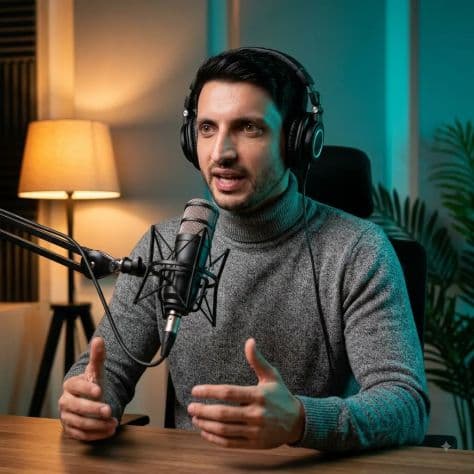
This is a portrait-photographic dominant-figure cover. One seated presenter occupies the central-left vertical mass, face as the primary recognition anchor, large broadcast microphone with shock mount beside the mouth, over-ear headphones on the head, both hands visible in conversational gesture above a wooden desk. The defining visual identity is a deliberate opposing colour-temperature split: warm amber practical lamp on the left versus saturated teal-cyan environmental lighting on the right, with the neutral-grey subject bridging both fields.

Square 1:1 composition, 3000 × 3000 pixels, sRGB. Artwork fills the full canvas edge to edge. No device frame, no mockup, no rounded corners, no border.

Background system constructed bottom upward.

The base layer is a continuous-tone photographic podcast studio interior with a split warm-cool lighting architecture. The background is not a uniform colour — it transitions from warm amber-orange on the left to saturated teal-cyan on the right, with a neutral transition zone behind the subject's centre.

The left wall zone at approximately 0–53% width, 5–43% height carries large rectangular acoustic treatment panels — muted grey-taupe fabric or foam panels mounted on the wall surface. Under the warm left lighting the panels read as warm grey-taupe, luminosity approximately 25–38. The left wall behind the lamp reads as warm amber-brown. Apply optical depth-of-field softening to the acoustic panels at approximately 1.5–3% canvas width blur radius, retaining the rectangular panel geometry and fabric surface as broad blurred shapes.

The right wall zone at approximately 53–100% width, 0–74% height is lit by strong saturated teal-cyan environmental lighting, dominant colour #1B5958 and saturated accent #059B9C. This warm-to-cool transition is the primary background identity of the scene. Do not flatten it to a single colour — it must read as a photographed room where the right side is bathed in a broad saturated teal-cyan light source. The right background also carries plant foliage at approximately 62–100% width, 21–66% height — large tropical plant leaves (monstera and palm-like forms) silhouetted and partially lit by the teal lighting. The foliage reads as dark olive-green shapes against the cyan-lit wall. A wicker or rattan chair back is partially visible at approximately 65–90% width, 55–75% height, warm beige chair material lit by the teal environment.

Additional foliage at approximately 0–19% width, 47–69% height on the left side, smaller darker green forms, partially lit by the warm lamp.

The practical table lamp occupies approximately 0–24% width, 29–52% height on the left side. It is a floor or table lamp with a cream fabric drum shade, producing a warm yellow-orange emissive core at luminosity approximately 84–92, colour #F9D191. The lamp produces strong warm bloom radiating approximately 2–3% canvas width from the shade, washing the left wall and desk edge in warm amber-orange light. The lamp stand is partially visible below the shade.

Apply background depth-of-field softening across all rear elements — acoustic panels, plants, wall surfaces, chair and lamp shade — at approximately 1.5–3% canvas width blur radius. The subject and microphone remain the sharpest elements in the composition.

Apply the warm-cool split environmental grade: left half of canvas receives amber-yellow warming at 20–30% strength, right half receives cyan-teal cooling at 30–45% strength. The transition zone at approximately 48–60% width behind the subject blends both temperatures. This is the most important lighting characteristic of this scene — preserve it at full strength.

Apply subject key-light and exposure lift at 15–25% strength concentrated on the face, glasses, hands and upper torso at approximately 9–91% width, 25–81% height, lifting the subject above the darker studio background values.

Apply practical lamp bloom at 25–40% strength radiating from the lamp at 0–24% width, 29–52% height, warm cream-amber colour, spreading into the left wall and desk.

Apply peripheral shadow falloff at 10–20% strength strongest at outer 8–12% of each edge, darker near-black-brown-teal vignette. Corner luminosity targets: top-left ≈27, top-right ≈22, bottom-left ≈24, bottom-right ≈7. The bottom-right is darkest because the desk edge and equipment shadows occupy that zone.

Primary visual element — presenter.

One seated person occupies approximately 8–92% width, 25–81% height, optical centre (47%, 54%). Full-colour photographic figure, sharpest element in the scene. No cutout, no mask, no silhouette simplification, natural photographic edges. Treatment chain: full-colour photography, warm-cool split grade, naturalistic skin rendering retained, optical depth-of-field background separation. No duotone, no halftone, no painterly rendering, no artificial glow, no cutout drop shadow.

Do not lock the subject's identity, skin tone, facial features, age, ethnicity, nationality, gender or body type. Preserve only composition, pose, wardrobe value structure, object placement and lighting hierarchy.

Pose — exact.

The person is seated behind a wooden desk, torso angled slightly toward viewer-right, not perfectly frontal. Head is slightly turned, gaze directed slightly right of the camera axis — not looking directly into lens but toward a conversational point just off-camera. Mouth is open in active speech, mid-sentence, natural animated expression. Both hands are visible above the desk surface: the left/forward hand is positioned at approximately 43–72% width, 67–80% height with fingers open in a conversational explanatory gesture, palm partially visible; the right hand is at approximately 78–94% width, 65–77% height, also open with relaxed fingers. The gesture reads as someone making a point while speaking, not clenched or pointing. Shoulders are relaxed with a slight rotation toward the microphone side. Body approaches the left canvas edge.

The person wears a medium-grey high-neck turtleneck knit sweater. Garment bounding box approximately 8–88% width, 44–81% height. Dominant colour neutral grey #595D59, luminosity 36, near-zero saturation. The sweater has a visible fine knit texture, fitted through the torso and shoulders. The turtleneck collar sits high at the neck. This low-saturation mid-value garment allows the black microphone and coloured environment to carry the contrast. If the user's own wardrobe is substituted, preserve equivalent neutral saturation and mid-value so the microphone and background colours remain visually separated.

Over-ear headphones are worn on the head, sitting over the ears and across the crown. Headphone bounding box approximately 30–63% width, 29–48% height, optical centre (46.5%, 38.5%). Headphone construction: padded over-ear cups, dark headband crossing the crown, charcoal-black with muted metallic or brown accent rings on the earcup edges. Luminosity approximately 5–14, colour near-black charcoal. The headphones partially overlap with the head/hair on both sides. Thin-frame or clear-frame rectangular eyeglasses are visible on the face — lightweight frames, not heavy or dark. These are observable styling elements and should follow the chosen subject rather than being mandatory.

Face bounding box approximately 37–62% width, 30–45% height. Face centre approximately (49.5%, 37.5%). Face height approximately 15% canvas height. Head and hair mass approximately 31–65% width, 25–46% height. Head height approximately 21% canvas height. Visible subject height approximately 56% canvas height.

Microphone and boom arm — exact geometry.

The microphone is a large black cylindrical studio broadcast microphone with a black foam windscreen at the top and a prominent shock mount or spider mount assembly supporting the microphone body. Microphone bounding box approximately 55–80% width, 45–67% height, optical centre (67.5%, 56%). The shock mount is a geometric wire-and-ring structure in dark metal, visually distinctive as an open skeletal cradle holding the microphone capsule. Microphone body and mount colour near-black charcoal #191D18, luminosity 11, matte-satin surface. The microphone is oriented vertically or with a very slight diagonal angle, positioned immediately to the right of the presenter's mouth and face. Microphone-to-face distance approximately 5–9% canvas width. Microphone height approximately 22% canvas height including mount. The boom arm enters from the right canvas edge at approximately 73–100% width, 40–60% height and angles inward toward the microphone, constructed as an articulated dark metal arm with visible joint hardware, luminosity 3–9. A short cable runs from the microphone mount downward. The boom arm bleeds off the right canvas edge.

Desk.

The wooden desk surface occupies approximately 0–100% width, 76–100% height, optical centre (50%, 88%). Material is medium warm wood with visible grain, dominant colour #6E4C31 in shadow areas and #895A38 in lighter grain areas, luminosity 22–38. The desk surface has a mild diagonal wood grain pattern. The desk bleeds off the left, right and bottom canvas edges. No objects other than the presenter's hands are visible on the desk surface — it is a clean empty warm wood plane.

Surface finish.

The surface carries no added film grain, no digital noise, no paper tooth, no halftone, no scanlines, no distress, no chromatic aberration, and no graphic decorative overlay. Sweater knit texture is natural photographic fabric. Wood grain is natural photographic tabletop. Acoustic panel surface texture is present but softened by depth-of-field. Plant leaves are softened by depth-of-field. All these read as photographed materials, not graphic additions.

Typography.

There is no designed primary title anywhere on this canvas. Title cap-height is 0% of canvas height. Render no title text, no show name, no episode label, no host name, no tagline, no wall lettering, no equipment branding, no social handle and no demographic label. No readable words anywhere on the canvas.

Closed palette — 12 photographic control families.

#1B5958 teal background base, #191D18 charcoal equipment and deep shadow, #595D59 neutral-grey sweater, #6E4C31 dark desk wood, #966949 warm brown and skin-light family — adaptive to chosen subject not a demographic lock, #895A38 secondary warm wood, #53331E deep warm brown, #D8A669 warm skin highlight — adaptive to chosen subject, #059B9C saturated teal accent, #8E8E93 grey highlight, #F9D191 lamp cream warm highlight, #08D7D6 cyan practical accent. Skin colour references are adaptive and must never be used as a demographic style lock. Continuous photographic tonal interpolation within these families. No additional hue families introduced. The warm-left versus cyan-right lighting contrast must be preserved at full strength as the primary scene identity. The microphone must remain materially darker than the grey torso.

Layout and reading order.

Compositional primary axis at x≈50%, optical centre approximately (51%, 53%). Subject mass is centre-left. Equipment counterweight is centre-right. Wooden desk fills the lower quarter. Reading order: face first driven by facial recognition and local sharpness; microphone second as the large near-black object adjacent to the mouth; cyan background field third as highest chromatic contrast in the scene; hands fourth as foreground gesture and skin-to-desk contrast; warm lamp fifth as isolated high-luminosity shape on the left. Negative space approximately 14–18%, largest pool in the upper wall above the head at approximately 0–100% width, 0–25% height. Minimum element-to-edge distance is 0% — boom arm bleeds right, desk bleeds left, right and bottom, photographic environment reaches all edges. Face is safely centred above 25% from the top edge and at least 37% from the left edge.

At 55 pixels wide this cover must read as: a seated podcast speaker in a grey turtleneck at a black microphone with a warm amber lamp on the left side and saturated teal-cyan studio lighting on the right side. The warm-left versus cyan-right temperature split remains the most distinctive element at thumbnail scale. The grey torso and warm face form the central figure silhouette. The black microphone reads as a dark mass to the right of the face. The wooden desk reads as a warm horizontal rectangle at the bottom. All glasses detail, headphone surface markings, shock-mount wire construction, individual fingers, knit texture, plant leaves and acoustic-panel surface may collapse to colour mass at 55 pixels.

Genre register is podcast interview and conversation carried by the large broadcast microphone with shock mount, the articulated boom arm, the over-ear headphones, the direct seated speaking posture and the acoustic wall treatment. Secondary register is technology, education and business commentary carried by the controlled studio environment, the neutral grey wardrobe, the cyan accent lighting and the conversational hand gesture. Brand personality is premium-restrained: limited neutral grey and black wardrobe, controlled warm-versus-cyan split, matte materials, shallow background separation, no decorative typography.

Do not lock the identity of the depicted person. Preserve pose, wardrobe value structure, microphone and headphone placement, warm-cool lighting architecture, acoustic panel position, plant silhouettes, lamp placement and desk geometry. Palette is closed to the 12 control families listed above with skin tones adapting naturally to the chosen subject. No readable text anywhere. Surface is full-colour photographic with no illustrative, graphic, or dimensional conversion. Lower 8% of canvas carries only desk surface — no critical element placed there.

·
Social Media Banners

Reseñas

Inicia sesión para dejar una reseña.

Aún no hay reseñas. Sé el primero.

Lleva PromptLabHub a cualquier dispositivo.

Instala la app para acceder más rápido o descarga la extensión de Chrome y cárgala en el navegador.

Explorar prompts

  • Todos los prompts
  • Prompts de fotos
  • Prompts de video
  • Prompts de comida

Crear

  • Enviar un prompt

Comunidad

  • Foro
  • Creadores
  • Ranking
  • Desafío semanal

Soporte

  • FAQ
  • Contáctanos
  • Política de privacidad
  • Términos de servicio

Síguenos

Descubre y copia prompts de IA seleccionados para Midjourney, DALL-E 3, Sora, Runway y más. Actualizado cada semana.

Política de privacidadTérminos de servicioPolítica de cookies

© 2026 PromptLabHub. All rights reserved.

© 2026 PromptLabHub. All rights reserved.

·
Política de privacidad·Términos de servicio·Política de cookies
Home
PromptLabHub
Vibrant Portrait Studio Peaceful Light
26
26
Prompt

Vibrant Portrait Studio Peaceful Light

Use the attached photograph as the primary governing reference. Recreate its structure exactly without reinterpreting it.

This is a portrait-photographic dominant-figure cover. One seated presenter occupies the central-left vertical mass, face as the primary recognition anchor, large broadcast microphone with shock mount beside the mouth, over-ear headphones on the head, both hands visible in conversational gesture above a wooden desk. The defining visual identity is a deliberate opposing colour-temperature split: warm amber practical lamp on the left versus saturated teal-cyan environmental lighting on the right, with the neutral-grey subject bridging both fields.

Square 1:1 composition, 3000 × 3000 pixels, sRGB. Artwork fills the full canvas edge to edge. No device frame, no mockup, no rounded corners, no border.

Background system constructed bottom upward.

The base layer is a continuous-tone photographic podcast studio interior with a split warm-cool lighting architecture. The background is not a uniform colour — it transitions from warm amber-orange on the left to saturated teal-cyan on the right, with a neutral transition zone behind the subject's centre.

The left wall zone at approximately 0–53% width, 5–43% height carries large rectangular acoustic treatment panels — muted grey-taupe fabric or foam panels mounted on the wall surface. Under the warm left lighting the panels read as warm grey-taupe, luminosity approximately 25–38. The left wall behind the lamp reads as warm amber-brown. Apply optical depth-of-field softening to the acoustic panels at approximately 1.5–3% canvas width blur radius, retaining the rectangular panel geometry and fabric surface as broad blurred shapes.

The right wall zone at approximately 53–100% width, 0–74% height is lit by strong saturated teal-cyan environmental lighting, dominant colour #1B5958 and saturated accent #059B9C. This warm-to-cool transition is the primary background identity of the scene. Do not flatten it to a single colour — it must read as a photographed room where the right side is bathed in a broad saturated teal-cyan light source. The right background also carries plant foliage at approximately 62–100% width, 21–66% height — large tropical plant leaves (monstera and palm-like forms) silhouetted and partially lit by the teal lighting. The foliage reads as dark olive-green shapes against the cyan-lit wall. A wicker or rattan chair back is partially visible at approximately 65–90% width, 55–75% height, warm beige chair material lit by the teal environment.

Additional foliage at approximately 0–19% width, 47–69% height on the left side, smaller darker green forms, partially lit by the warm lamp.

The practical table lamp occupies approximately 0–24% width, 29–52% height on the left side. It is a floor or table lamp with a cream fabric drum shade, producing a warm yellow-orange emissive core at luminosity approximately 84–92, colour #F9D191. The lamp produces strong warm bloom radiating approximately 2–3% canvas width from the shade, washing the left wall and desk edge in warm amber-orange light. The lamp stand is partially visible below the shade.

Apply background depth-of-field softening across all rear elements — acoustic panels, plants, wall surfaces, chair and lamp shade — at approximately 1.5–3% canvas width blur radius. The subject and microphone remain the sharpest elements in the composition.

Apply the warm-cool split environmental grade: left half of canvas receives amber-yellow warming at 20–30% strength, right half receives cyan-teal cooling at 30–45% strength. The transition zone at approximately 48–60% width behind the subject blends both temperatures. This is the most important lighting characteristic of this scene — preserve it at full strength.

Apply subject key-light and exposure lift at 15–25% strength concentrated on the face, glasses, hands and upper torso at approximately 9–91% width, 25–81% height, lifting the subject above the darker studio background values.

Apply practical lamp bloom at 25–40% strength radiating from the lamp at 0–24% width, 29–52% height, warm cream-amber colour, spreading into the left wall and desk.

Apply peripheral shadow falloff at 10–20% strength strongest at outer 8–12% of each edge, darker near-black-brown-teal vignette. Corner luminosity targets: top-left ≈27, top-right ≈22, bottom-left ≈24, bottom-right ≈7. The bottom-right is darkest because the desk edge and equipment shadows occupy that zone.

Primary visual element — presenter.

One seated person occupies approximately 8–92% width, 25–81% height, optical centre (47%, 54%). Full-colour photographic figure, sharpest element in the scene. No cutout, no mask, no silhouette simplification, natural photographic edges. Treatment chain: full-colour photography, warm-cool split grade, naturalistic skin rendering retained, optical depth-of-field background separation. No duotone, no halftone, no painterly rendering, no artificial glow, no cutout drop shadow.

Do not lock the subject's identity, skin tone, facial features, age, ethnicity, nationality, gender or body type. Preserve only composition, pose, wardrobe value structure, object placement and lighting hierarchy.

Pose — exact.

The person is seated behind a wooden desk, torso angled slightly toward viewer-right, not perfectly frontal. Head is slightly turned, gaze directed slightly right of the camera axis — not looking directly into lens but toward a conversational point just off-camera. Mouth is open in active speech, mid-sentence, natural animated expression. Both hands are visible above the desk surface: the left/forward hand is positioned at approximately 43–72% width, 67–80% height with fingers open in a conversational explanatory gesture, palm partially visible; the right hand is at approximately 78–94% width, 65–77% height, also open with relaxed fingers. The gesture reads as someone making a point while speaking, not clenched or pointing. Shoulders are relaxed with a slight rotation toward the microphone side. Body approaches the left canvas edge.

The person wears a medium-grey high-neck turtleneck knit sweater. Garment bounding box approximately 8–88% width, 44–81% height. Dominant colour neutral grey #595D59, luminosity 36, near-zero saturation. The sweater has a visible fine knit texture, fitted through the torso and shoulders. The turtleneck collar sits high at the neck. This low-saturation mid-value garment allows the black microphone and coloured environment to carry the contrast. If the user's own wardrobe is substituted, preserve equivalent neutral saturation and mid-value so the microphone and background colours remain visually separated.

Over-ear headphones are worn on the head, sitting over the ears and across the crown. Headphone bounding box approximately 30–63% width, 29–48% height, optical centre (46.5%, 38.5%). Headphone construction: padded over-ear cups, dark headband crossing the crown, charcoal-black with muted metallic or brown accent rings on the earcup edges. Luminosity approximately 5–14, colour near-black charcoal. The headphones partially overlap with the head/hair on both sides. Thin-frame or clear-frame rectangular eyeglasses are visible on the face — lightweight frames, not heavy or dark. These are observable styling elements and should follow the chosen subject rather than being mandatory.

Face bounding box approximately 37–62% width, 30–45% height. Face centre approximately (49.5%, 37.5%). Face height approximately 15% canvas height. Head and hair mass approximately 31–65% width, 25–46% height. Head height approximately 21% canvas height. Visible subject height approximately 56% canvas height.

Microphone and boom arm — exact geometry.

The microphone is a large black cylindrical studio broadcast microphone with a black foam windscreen at the top and a prominent shock mount or spider mount assembly supporting the microphone body. Microphone bounding box approximately 55–80% width, 45–67% height, optical centre (67.5%, 56%). The shock mount is a geometric wire-and-ring structure in dark metal, visually distinctive as an open skeletal cradle holding the microphone capsule. Microphone body and mount colour near-black charcoal #191D18, luminosity 11, matte-satin surface. The microphone is oriented vertically or with a very slight diagonal angle, positioned immediately to the right of the presenter's mouth and face. Microphone-to-face distance approximately 5–9% canvas width. Microphone height approximately 22% canvas height including mount. The boom arm enters from the right canvas edge at approximately 73–100% width, 40–60% height and angles inward toward the microphone, constructed as an articulated dark metal arm with visible joint hardware, luminosity 3–9. A short cable runs from the microphone mount downward. The boom arm bleeds off the right canvas edge.

Desk.

The wooden desk surface occupies approximately 0–100% width, 76–100% height, optical centre (50%, 88%). Material is medium warm wood with visible grain, dominant colour #6E4C31 in shadow areas and #895A38 in lighter grain areas, luminosity 22–38. The desk surface has a mild diagonal wood grain pattern. The desk bleeds off the left, right and bottom canvas edges. No objects other than the presenter's hands are visible on the desk surface — it is a clean empty warm wood plane.

Surface finish.

The surface carries no added film grain, no digital noise, no paper tooth, no halftone, no scanlines, no distress, no chromatic aberration, and no graphic decorative overlay. Sweater knit texture is natural photographic fabric. Wood grain is natural photographic tabletop. Acoustic panel surface texture is present but softened by depth-of-field. Plant leaves are softened by depth-of-field. All these read as photographed materials, not graphic additions.

Typography.

There is no designed primary title anywhere on this canvas. Title cap-height is 0% of canvas height. Render no title text, no show name, no episode label, no host name, no tagline, no wall lettering, no equipment branding, no social handle and no demographic label. No readable words anywhere on the canvas.

Closed palette — 12 photographic control families.

#1B5958 teal background base, #191D18 charcoal equipment and deep shadow, #595D59 neutral-grey sweater, #6E4C31 dark desk wood, #966949 warm brown and skin-light family — adaptive to chosen subject not a demographic lock, #895A38 secondary warm wood, #53331E deep warm brown, #D8A669 warm skin highlight — adaptive to chosen subject, #059B9C saturated teal accent, #8E8E93 grey highlight, #F9D191 lamp cream warm highlight, #08D7D6 cyan practical accent. Skin colour references are adaptive and must never be used as a demographic style lock. Continuous photographic tonal interpolation within these families. No additional hue families introduced. The warm-left versus cyan-right lighting contrast must be preserved at full strength as the primary scene identity. The microphone must remain materially darker than the grey torso.

Layout and reading order.

Compositional primary axis at x≈50%, optical centre approximately (51%, 53%). Subject mass is centre-left. Equipment counterweight is centre-right. Wooden desk fills the lower quarter. Reading order: face first driven by facial recognition and local sharpness; microphone second as the large near-black object adjacent to the mouth; cyan background field third as highest chromatic contrast in the scene; hands fourth as foreground gesture and skin-to-desk contrast; warm lamp fifth as isolated high-luminosity shape on the left. Negative space approximately 14–18%, largest pool in the upper wall above the head at approximately 0–100% width, 0–25% height. Minimum element-to-edge distance is 0% — boom arm bleeds right, desk bleeds left, right and bottom, photographic environment reaches all edges. Face is safely centred above 25% from the top edge and at least 37% from the left edge.

At 55 pixels wide this cover must read as: a seated podcast speaker in a grey turtleneck at a black microphone with a warm amber lamp on the left side and saturated teal-cyan studio lighting on the right side. The warm-left versus cyan-right temperature split remains the most distinctive element at thumbnail scale. The grey torso and warm face form the central figure silhouette. The black microphone reads as a dark mass to the right of the face. The wooden desk reads as a warm horizontal rectangle at the bottom. All glasses detail, headphone surface markings, shock-mount wire construction, individual fingers, knit texture, plant leaves and acoustic-panel surface may collapse to colour mass at 55 pixels.

Genre register is podcast interview and conversation carried by the large broadcast microphone with shock mount, the articulated boom arm, the over-ear headphones, the direct seated speaking posture and the acoustic wall treatment. Secondary register is technology, education and business commentary carried by the controlled studio environment, the neutral grey wardrobe, the cyan accent lighting and the conversational hand gesture. Brand personality is premium-restrained: limited neutral grey and black wardrobe, controlled warm-versus-cyan split, matte materials, shallow background separation, no decorative typography.

Do not lock the identity of the depicted person. Preserve pose, wardrobe value structure, microphone and headphone placement, warm-cool lighting architecture, acoustic panel position, plant silhouettes, lamp placement and desk geometry. Palette is closed to the 12 control families listed above with skin tones adapting naturally to the chosen subject. No readable text anywhere. Surface is full-colour photographic with no illustrative, graphic, or dimensional conversion. Lower 8% of canvas carries only desk surface — no critical element placed there.

·
Social Media Banners

Reseñas

Inicia sesión para dejar una reseña.

Aún no hay reseñas. Sé el primero.

Lleva PromptLabHub a cualquier dispositivo.

Instala la app para acceder más rápido o descarga la extensión de Chrome y cárgala en el navegador.

Explorar prompts

  • Todos los prompts
  • Prompts de fotos
  • Prompts de video
  • Prompts de comida

Crear

  • Enviar un prompt

Comunidad

  • Foro
  • Creadores
  • Ranking
  • Desafío semanal

Soporte

  • FAQ
  • Contáctanos
  • Política de privacidad
  • Términos de servicio

Síguenos

Descubre y copia prompts de IA seleccionados para Midjourney, DALL-E 3, Sora, Runway y más. Actualizado cada semana.

Política de privacidadTérminos de servicioPolítica de cookies

© 2026 PromptLabHub. All rights reserved.

© 2026 PromptLabHub. All rights reserved.

·
Política de privacidad·Términos de servicio·Política de cookies
Home