
PromptLabHub
Sketch Portrait Studio Peaceful Backlit Bokeh
0
Prompt

Sketch Portrait Studio Peaceful Backlit Bokeh

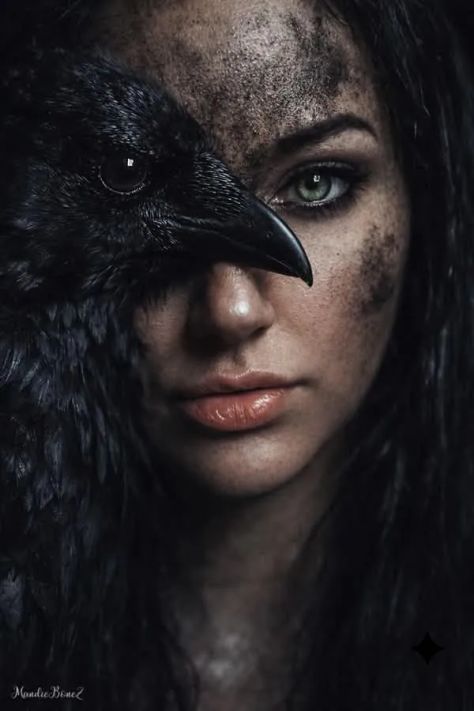
Use the uploaded image as the main visual reference. Recreate the same single-subject dark-fantasy portrait, the same large black raven pressed directly against the face, the same soot- and earth-marked skin, the same long near-black hair, the same frontal composition, and the same near-black studio atmosphere. Do not invent a new face, new color scheme, new background, new bird position, or new camera angle. Follow the uploaded image closely and apply only the corrections below.

Generate a maximum-photorealistic dark-fantasy editorial portrait of the same human subject with the same large black raven in a vertical 2:3 composition. Use an extremely tight head-and-upper-neck crop. Place the face almost centrally, slightly toward viewer-right, facing nearly straight into the camera with minimal rotation and no significant head tilt. Keep the forehead close to the upper frame edge, the chin around the lower-middle portion of the composition, and the long dark hair falling vertically along both sides of the face before merging into the black background. Position the raven in the immediate foreground on viewer-left, filling approximately the left third to nearly half of the frame. Its head must overlap the subject's viewer-left eye and upper cheek, while its long beak travels diagonally from viewer-left toward the center-right, crossing directly in front of the nose bridge and terminating near the viewer-right cheek-side of the nose. Preserve this exact face-and-raven overlap.

Preserve the same facial identity, facial proportions, eye shape, nose structure, mouth shape, jaw contour, cheek structure, skin coloration, hair color, hairstyle, and overall look from the uploaded image. Keep an oval-to-tapered facial silhouette with moderately defined cheekbones, a narrow lower face, softly rounded-to-tapered chin, straight-to-gently sculpted nose bridge, compact nose tip, and naturally proportioned closed lips. Keep the lower lip approximately 1.3–1.4 times fuller than the upper lip, with a softly defined Cupid's bow. Maintain relaxed frontalis and mentalis, minimal corrugator contraction, gently engaged orbicularis oculi around the visible eye, and relaxed closed lips with no smile or lip separation.

The viewer-right eye must remain fully visible and directly camera-facing. Render it as an almond-shaped eye with a subtly lifted outer corner, medium upper-lid exposure, and a cool desaturated green-gray iris approximately H 155–175°, S 18–35%, B 48–68%. Add a darker gray-green limbal ring and fine radial iris fibers around a round near-black pupil. Keep a small bright rectangular-to-irregular catchlight near approximately 11–1 o'clock in the iris with a tiny secondary reflection. Do not widen the visible eye unnaturally. The viewer-left human eye must remain almost completely hidden behind the raven's head and feathers; do not generate two equally visible human eyes.

Keep the brows dark brown-black, approximately H 20–35°, S 15–30%, B 10–20%, medium-thick, strongly defined, and gently arched. Preserve individual brow hairs rather than a solid painted shape. Apply dense smoky eye makeup around the visible eye using near-black charcoal at approximately H 210–225°, S 8–18%, B 3–15%. Concentrate the darkest pigment across the upper eyelid, outer orbital area, and lower lash line. Add dark eyeliner tightly around the visible eye and moderate black mascara on the upper lashes. Keep blush absent. Use restrained cool brown-gray contour around the cheekbone and nose. Render the lips in a muted warm nude-peach tone approximately H 12–22°, S 25–38%, B 55–68%, with a moist satin-gloss finish, visible vertical lip texture, and a soft specular band along the lower lip.

Render the skin as a muted beige-olive material with warm neutral highlights and cool dirt-darkened shadows. In cleaner illuminated zones, target approximately H 25–38°, S 15–27%, B 50–72%. In shadow and heavily soiled zones, transition toward H 25–45°, S 10–24%, B 10–32%. Maintain natural pore structure across the forehead, nose, cheeks, and chin. Use retouching level approximately 4/10: preserve pronounced microtexture, visible pores, tiny tonal irregularities, and localized surface roughness while keeping facial anatomy clean and photographic. Do not produce plastic, porcelain, or aggressively smoothed skin.

Cover significant portions of the forehead, temples, outer cheeks, jaw-side, and visible upper neck with irregular soot, ash, soil, and grime. Make the forehead especially textured with dense dark speckling and mottled particulate residue, leaving uneven cleaner skin islands between marks. Place heavier charcoal-black smudging around the viewer-left forehead and along areas adjacent to the raven. Add irregular dark patches along the viewer-right temple and cheek without forming readable symbols or decorative tattoo patterns. Continue subtle dirt mottling downward onto the neck. The grime must appear physically deposited into pores and skin texture, not painted as a flat digital overlay.

Keep the hair very dark brown to black, approximately H 215–235°, S 8–18%, B 2–12%. Render it as long, mostly straight-to-gently irregular strands with low-to-medium volume, slightly separated fiber clumps, and a predominantly matte-to-semi-gloss finish. Allow narrow cool specular streaks on a few strands near the temples. Let the hair fall along both frame edges and dissolve into the near-black background. Do not add curls, elaborate styling, visible hair accessories, or a different parting.

Preserve the raven as the dominant foreground object. Render it as a large black corvid with anatomically accurate proportions, a broad head, dense layered plumage, and a long powerful slightly arched beak. The raven's head must be positioned extremely close to the subject's face, with the crown and facial feathers obscuring the viewer-left human eye. Its beak must remain closed and extend diagonally across the center of the portrait, passing in front of the nose. Render the beak as smooth keratin with an almost-black cool tone approximately H 210–225°, S 15–30%, B 3–16%, carrying a narrow restrained satin highlight along the upper ridge. Preserve a sharp pointed beak tip.

Render the raven's feathers as individually resolved overlapping structures rather than a uniform black mass. Use an almost-black base around H 210–235°, S 12–28%, B 2–15%, with subtle blue-charcoal and graphite micro-reflections on raised feather edges. Around the head, use short compact feather structures following the skull contour. Along the lower-left frame, transition into longer layered neck and body feathers with irregular directional overlap. Keep feather gloss controlled and localized; do not make the bird metallic or wet.

Keep the raven's visible eye small, round, glossy, and nearly black, approximately H 210–230°, S 5–15%, B 2–8%. Place a tiny bright white rectangular catchlight near the upper portion of the eye. The raven's eye must remain visible inside the black plumage and must point approximately toward the camera. Do not enlarge or stylize the eye and do not add unnatural iris colors.

No clothing details should be introduced into the visible crop. Keep the lower frame dominated by dark hair, raven feathers, shadow, and a small amount of marked neck skin. No necklace, earrings, facial jewelry, glasses, headwear, rings, visible hands, or held objects.

The background must follow the uploaded image as a three-layer depth stack: first, the raven's head, beak, and feathers in the immediate foreground; second, the human face and visible eye in the primary focal plane; third, a featureless near-black studio background at approximately 1–5% relative luminance merging naturally with the subject's dark hair. No scenery, no architecture, no bokeh orbs, no environmental props, no additional people, no fog, no rain, no particles, and no background text. Keep the background substantially darker than both the face and the selectively illuminated feather surfaces.

Use a soft but directional frontal-upper key light from approximately 11–12 o'clock, slightly toward viewer-right, at approximately 4700–5200 K. Place the strongest skin highlights on the central forehead, viewer-right brow ridge, visible eye surround, nose bridge and nose tip, upper cheek, lip center, and central chin. Create a compact bright specular highlight on the nose tip and a softer satin highlight on the lower lip. Allow the raven and the viewer-left side of the human face to fall substantially darker while preserving enough feather microstructure to separate the bird from the background. Keep fill at approximately 12–20%. Use no obvious facial rim light. Allow only faint cool edge reflections on selected hair strands and raven feather ridges. Maintain a low-key short-light / near-frontal hybrid pattern with strong localized contrast.

Preserve the visible human-eye catchlight as a small bright upper catchlight and the raven-eye catchlight as an even smaller bright point. Keep the raven beak's highlight narrow and controlled. Avoid broad beauty-dish reflections or multiple studio-light signatures that are absent from the reference.

Use a strongly desaturated dark cinematic grade. Keep the dominant palette within near-black H 210–235° tones, muted beige-olive skin H 25–38°, charcoal-brown grime H 25–45°, green-gray iris H 155–175°, and subdued nude-peach lips H 12–22°. Keep overall saturation restrained, with the visible green-gray iris and warm lip highlights providing the clearest color separation. Use cool graphite shadows and neutral-to-slightly warm skin highlights. Maintain an overall visual temperature of approximately 4700–5100 K.

Use approximately an 85–105 mm equivalent portrait lens at approximately f/3.2–f/4.5. Keep the human visible eye, central nose plane, lips, raven eye, raven beak, and nearby feather detail sharply resolved. Allow peripheral hair, lower feathers, and deep background elements to soften gradually rather than disappearing into artificial blur. Use fine cinematic grain at approximately 3/10, controlled microcontrast, moderate black-point shaping, and post-processing around 7/10.

Render at maximum photorealistic quality. Follow the uploaded image as the primary reference. Preserve the exact facial proportions, direct visible-eye gaze, hidden opposite human eye, raven scale, raven position, beak orientation, face-to-bird overlap, grime distribution character, long dark hair, crop, depth structure, lighting geometry, skin texture, feather microstructure, and near-black tonal balance.

Do not change the subject's identity. Do not reveal the human eye hidden behind the raven. Do not move the raven away from the face. Do not shorten, widen, open, or recolor the raven's beak. Do not turn the raven into an eagle, owl, or other bird. Do not add fantasy glowing eyes, blood, facial glyphs, tattoos, scars, jewelry, weapons, hands, additional animals, people, or props. No readable text. No signature. No watermark. No obvious CGI appearance. No plastic skin. No beauty-filter smoothing. No anatomical errors. No duplicated facial features. No malformed bird anatomy. No motion blur. No lens distortion. Ultra-high resolution. Preserve natural skin microtexture, realistic deposited grime, accurate keratin beak material, and individually structured black feather detail. Photorealistic dark-fantasy editorial portrait only.

·
Photo Prompts

Reseñas

Inicia sesión para dejar una reseña.

Aún no hay reseñas. Sé el primero.

Lleva PromptLabHub a cualquier dispositivo.

Instala la app para acceder más rápido o descarga la extensión de Chrome y cárgala en el navegador.

Explorar prompts

  • Todos los prompts
  • Prompts de fotos
  • Prompts de video
  • Prompts de comida

Crear

  • Enviar un prompt

Comunidad

  • Foro
  • Creadores
  • Ranking
  • Desafío semanal

Soporte

  • FAQ
  • Contáctanos
  • Política de privacidad
  • Términos de servicio

Síguenos

Descubre y copia prompts de IA seleccionados para Midjourney, DALL-E 3, Sora, Runway y más. Actualizado cada semana.

Política de privacidadTérminos de servicioPolítica de cookies

© 2026 PromptLabHub. All rights reserved.

© 2026 PromptLabHub. All rights reserved.

·
Política de privacidad·Términos de servicio·Política de cookies
Home
PromptLabHub
Sketch Portrait Studio Peaceful Backlit Bokeh
0
Prompt

Sketch Portrait Studio Peaceful Backlit Bokeh

Use the uploaded image as the main visual reference. Recreate the same single-subject dark-fantasy portrait, the same large black raven pressed directly against the face, the same soot- and earth-marked skin, the same long near-black hair, the same frontal composition, and the same near-black studio atmosphere. Do not invent a new face, new color scheme, new background, new bird position, or new camera angle. Follow the uploaded image closely and apply only the corrections below.

Generate a maximum-photorealistic dark-fantasy editorial portrait of the same human subject with the same large black raven in a vertical 2:3 composition. Use an extremely tight head-and-upper-neck crop. Place the face almost centrally, slightly toward viewer-right, facing nearly straight into the camera with minimal rotation and no significant head tilt. Keep the forehead close to the upper frame edge, the chin around the lower-middle portion of the composition, and the long dark hair falling vertically along both sides of the face before merging into the black background. Position the raven in the immediate foreground on viewer-left, filling approximately the left third to nearly half of the frame. Its head must overlap the subject's viewer-left eye and upper cheek, while its long beak travels diagonally from viewer-left toward the center-right, crossing directly in front of the nose bridge and terminating near the viewer-right cheek-side of the nose. Preserve this exact face-and-raven overlap.

Preserve the same facial identity, facial proportions, eye shape, nose structure, mouth shape, jaw contour, cheek structure, skin coloration, hair color, hairstyle, and overall look from the uploaded image. Keep an oval-to-tapered facial silhouette with moderately defined cheekbones, a narrow lower face, softly rounded-to-tapered chin, straight-to-gently sculpted nose bridge, compact nose tip, and naturally proportioned closed lips. Keep the lower lip approximately 1.3–1.4 times fuller than the upper lip, with a softly defined Cupid's bow. Maintain relaxed frontalis and mentalis, minimal corrugator contraction, gently engaged orbicularis oculi around the visible eye, and relaxed closed lips with no smile or lip separation.

The viewer-right eye must remain fully visible and directly camera-facing. Render it as an almond-shaped eye with a subtly lifted outer corner, medium upper-lid exposure, and a cool desaturated green-gray iris approximately H 155–175°, S 18–35%, B 48–68%. Add a darker gray-green limbal ring and fine radial iris fibers around a round near-black pupil. Keep a small bright rectangular-to-irregular catchlight near approximately 11–1 o'clock in the iris with a tiny secondary reflection. Do not widen the visible eye unnaturally. The viewer-left human eye must remain almost completely hidden behind the raven's head and feathers; do not generate two equally visible human eyes.

Keep the brows dark brown-black, approximately H 20–35°, S 15–30%, B 10–20%, medium-thick, strongly defined, and gently arched. Preserve individual brow hairs rather than a solid painted shape. Apply dense smoky eye makeup around the visible eye using near-black charcoal at approximately H 210–225°, S 8–18%, B 3–15%. Concentrate the darkest pigment across the upper eyelid, outer orbital area, and lower lash line. Add dark eyeliner tightly around the visible eye and moderate black mascara on the upper lashes. Keep blush absent. Use restrained cool brown-gray contour around the cheekbone and nose. Render the lips in a muted warm nude-peach tone approximately H 12–22°, S 25–38%, B 55–68%, with a moist satin-gloss finish, visible vertical lip texture, and a soft specular band along the lower lip.

Render the skin as a muted beige-olive material with warm neutral highlights and cool dirt-darkened shadows. In cleaner illuminated zones, target approximately H 25–38°, S 15–27%, B 50–72%. In shadow and heavily soiled zones, transition toward H 25–45°, S 10–24%, B 10–32%. Maintain natural pore structure across the forehead, nose, cheeks, and chin. Use retouching level approximately 4/10: preserve pronounced microtexture, visible pores, tiny tonal irregularities, and localized surface roughness while keeping facial anatomy clean and photographic. Do not produce plastic, porcelain, or aggressively smoothed skin.

Cover significant portions of the forehead, temples, outer cheeks, jaw-side, and visible upper neck with irregular soot, ash, soil, and grime. Make the forehead especially textured with dense dark speckling and mottled particulate residue, leaving uneven cleaner skin islands between marks. Place heavier charcoal-black smudging around the viewer-left forehead and along areas adjacent to the raven. Add irregular dark patches along the viewer-right temple and cheek without forming readable symbols or decorative tattoo patterns. Continue subtle dirt mottling downward onto the neck. The grime must appear physically deposited into pores and skin texture, not painted as a flat digital overlay.

Keep the hair very dark brown to black, approximately H 215–235°, S 8–18%, B 2–12%. Render it as long, mostly straight-to-gently irregular strands with low-to-medium volume, slightly separated fiber clumps, and a predominantly matte-to-semi-gloss finish. Allow narrow cool specular streaks on a few strands near the temples. Let the hair fall along both frame edges and dissolve into the near-black background. Do not add curls, elaborate styling, visible hair accessories, or a different parting.

Preserve the raven as the dominant foreground object. Render it as a large black corvid with anatomically accurate proportions, a broad head, dense layered plumage, and a long powerful slightly arched beak. The raven's head must be positioned extremely close to the subject's face, with the crown and facial feathers obscuring the viewer-left human eye. Its beak must remain closed and extend diagonally across the center of the portrait, passing in front of the nose. Render the beak as smooth keratin with an almost-black cool tone approximately H 210–225°, S 15–30%, B 3–16%, carrying a narrow restrained satin highlight along the upper ridge. Preserve a sharp pointed beak tip.

Render the raven's feathers as individually resolved overlapping structures rather than a uniform black mass. Use an almost-black base around H 210–235°, S 12–28%, B 2–15%, with subtle blue-charcoal and graphite micro-reflections on raised feather edges. Around the head, use short compact feather structures following the skull contour. Along the lower-left frame, transition into longer layered neck and body feathers with irregular directional overlap. Keep feather gloss controlled and localized; do not make the bird metallic or wet.

Keep the raven's visible eye small, round, glossy, and nearly black, approximately H 210–230°, S 5–15%, B 2–8%. Place a tiny bright white rectangular catchlight near the upper portion of the eye. The raven's eye must remain visible inside the black plumage and must point approximately toward the camera. Do not enlarge or stylize the eye and do not add unnatural iris colors.

No clothing details should be introduced into the visible crop. Keep the lower frame dominated by dark hair, raven feathers, shadow, and a small amount of marked neck skin. No necklace, earrings, facial jewelry, glasses, headwear, rings, visible hands, or held objects.

The background must follow the uploaded image as a three-layer depth stack: first, the raven's head, beak, and feathers in the immediate foreground; second, the human face and visible eye in the primary focal plane; third, a featureless near-black studio background at approximately 1–5% relative luminance merging naturally with the subject's dark hair. No scenery, no architecture, no bokeh orbs, no environmental props, no additional people, no fog, no rain, no particles, and no background text. Keep the background substantially darker than both the face and the selectively illuminated feather surfaces.

Use a soft but directional frontal-upper key light from approximately 11–12 o'clock, slightly toward viewer-right, at approximately 4700–5200 K. Place the strongest skin highlights on the central forehead, viewer-right brow ridge, visible eye surround, nose bridge and nose tip, upper cheek, lip center, and central chin. Create a compact bright specular highlight on the nose tip and a softer satin highlight on the lower lip. Allow the raven and the viewer-left side of the human face to fall substantially darker while preserving enough feather microstructure to separate the bird from the background. Keep fill at approximately 12–20%. Use no obvious facial rim light. Allow only faint cool edge reflections on selected hair strands and raven feather ridges. Maintain a low-key short-light / near-frontal hybrid pattern with strong localized contrast.

Preserve the visible human-eye catchlight as a small bright upper catchlight and the raven-eye catchlight as an even smaller bright point. Keep the raven beak's highlight narrow and controlled. Avoid broad beauty-dish reflections or multiple studio-light signatures that are absent from the reference.

Use a strongly desaturated dark cinematic grade. Keep the dominant palette within near-black H 210–235° tones, muted beige-olive skin H 25–38°, charcoal-brown grime H 25–45°, green-gray iris H 155–175°, and subdued nude-peach lips H 12–22°. Keep overall saturation restrained, with the visible green-gray iris and warm lip highlights providing the clearest color separation. Use cool graphite shadows and neutral-to-slightly warm skin highlights. Maintain an overall visual temperature of approximately 4700–5100 K.

Use approximately an 85–105 mm equivalent portrait lens at approximately f/3.2–f/4.5. Keep the human visible eye, central nose plane, lips, raven eye, raven beak, and nearby feather detail sharply resolved. Allow peripheral hair, lower feathers, and deep background elements to soften gradually rather than disappearing into artificial blur. Use fine cinematic grain at approximately 3/10, controlled microcontrast, moderate black-point shaping, and post-processing around 7/10.

Render at maximum photorealistic quality. Follow the uploaded image as the primary reference. Preserve the exact facial proportions, direct visible-eye gaze, hidden opposite human eye, raven scale, raven position, beak orientation, face-to-bird overlap, grime distribution character, long dark hair, crop, depth structure, lighting geometry, skin texture, feather microstructure, and near-black tonal balance.

Do not change the subject's identity. Do not reveal the human eye hidden behind the raven. Do not move the raven away from the face. Do not shorten, widen, open, or recolor the raven's beak. Do not turn the raven into an eagle, owl, or other bird. Do not add fantasy glowing eyes, blood, facial glyphs, tattoos, scars, jewelry, weapons, hands, additional animals, people, or props. No readable text. No signature. No watermark. No obvious CGI appearance. No plastic skin. No beauty-filter smoothing. No anatomical errors. No duplicated facial features. No malformed bird anatomy. No motion blur. No lens distortion. Ultra-high resolution. Preserve natural skin microtexture, realistic deposited grime, accurate keratin beak material, and individually structured black feather detail. Photorealistic dark-fantasy editorial portrait only.

·
Photo Prompts

Reseñas

Inicia sesión para dejar una reseña.

Aún no hay reseñas. Sé el primero.

Lleva PromptLabHub a cualquier dispositivo.

Instala la app para acceder más rápido o descarga la extensión de Chrome y cárgala en el navegador.

Explorar prompts

  • Todos los prompts
  • Prompts de fotos
  • Prompts de video
  • Prompts de comida

Crear

  • Enviar un prompt

Comunidad

  • Foro
  • Creadores
  • Ranking
  • Desafío semanal

Soporte

  • FAQ
  • Contáctanos
  • Política de privacidad
  • Términos de servicio

Síguenos

Descubre y copia prompts de IA seleccionados para Midjourney, DALL-E 3, Sora, Runway y más. Actualizado cada semana.

Política de privacidadTérminos de servicioPolítica de cookies

© 2026 PromptLabHub. All rights reserved.

© 2026 PromptLabHub. All rights reserved.

·
Política de privacidad·Términos de servicio·Política de cookies
Home