
PromptLabHub
Monochrome Portrait Studio Dramatic Natural Bokeh
0
Prompt

Monochrome Portrait Studio Dramatic Natural Bokeh

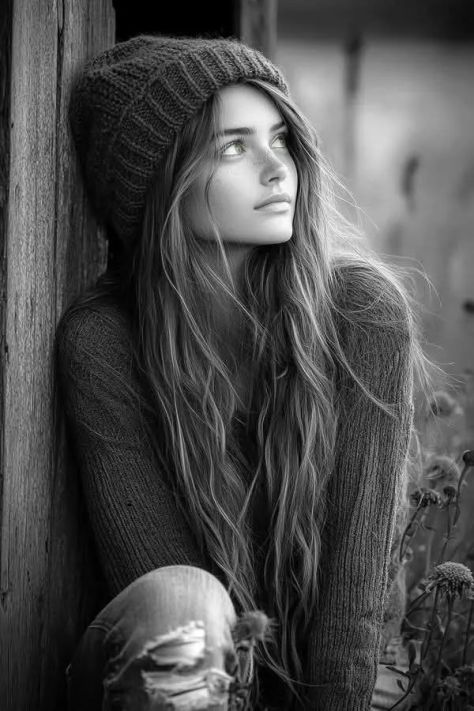
Use the uploaded image as the main visual reference. Recreate the same seated subject, same rough vertical wooden support, same outdoor rustic environment, same thick knitted beanie, same oversized knitted sweater, same distressed denim, same very long loose hair, same upward frame-right gaze, same seated three-quarter framing, same monochrome treatment, and same soft natural-light atmosphere. Do not invent a new face, new outfit, new pose, new environment, new gaze direction, new accessories, or new camera angle. Follow the uploaded image closely and apply only the corrections below.

Generate a photorealistic black-and-white fashion editorial portrait of the same subject in a 2:3 vertical composition. Frame the seated figure from approximately the raised knee upward, keeping the entire head, hair, shoulders, torso, and bent foreground knee visible while cropping the lower body below the seated three-quarter view. Place the subject across the left and central regions of the frame, with the head positioned in the upper-left-to-center area. Keep the rough vertical wooden post running along frame-left directly behind the subject. Use a slightly below-eye-level camera position with a subtle three-quarter facial view. Maintain approximately 85 mm equivalent portrait compression, f/2.2 aperture behavior, shallow depth of field, grain level approximately 2.5/10, and post-processing intensity approximately 5/10.

Preserve the same facial identity and exact visible facial proportions from the uploaded image. Maintain a soft oval facial structure tapering gently toward a rounded chin, a softly defined jawline, and moderately prominent cheekbones shaped by the side lighting. Preserve the original forehead proportions, brow-to-eye spacing, nose length, nose-to-lip distance, lip proportions, jaw angle, and chin width. Do not sharpen the jaw, widen the lower face, shorten the midface, enlarge the eyes, or alter the subject into a different person.

Render all skin in true monochrome with saturation fixed at 0%. Keep illuminated facial skin in approximately 68–82% luminance grayscale, midtone facial planes around 48–65% luminance, and the deepest facial shadows around 22–35% luminance. Maintain smooth tonal transitions rather than clipped whites or crushed blacks. Give the skin a matte-to-satin surface response with restrained soft highlights across the forehead, nose bridge, frame-right upper cheek, upper-lip ridge, and chin.

Maintain skin retouching at approximately 5/10. Keep the complexion clean and refined while preserving fine natural facial texture, subtle pore structure, and clearly visible freckles across the nose bridge and upper cheek region. Allow minor tonal irregularity to remain around the eyes, nose, and cheeks. Do not erase the freckles. Do not flatten the skin into uniform digital smoothing. Do not introduce exaggerated pores, acne texture, scars, tattoos, or artificial beauty-filter surfaces.

Preserve both eyes as almond-shaped and moderately open. Keep the upper eyelids clearly defined with a subtle natural crease and the lower lids softly modeled. Direct both eyes upward and toward frame-right exactly as in the uploaded reference. The gaze must not intersect the camera. Do not redirect the eyes forward, downward, or toward frame-left.

Render the irises in a relatively light monochrome value of approximately 55–68% luminance, clearly separated from the medium-sized dark pupils at approximately 8–15% luminance and the darker lash lines around 5–12% luminance. Keep subtle radial iris variation visible without artificial enhancement. Add small soft natural-light catchlights in the upper portions of both eyes, corresponding to the large diffuse frame-right light source. Do not add ring-light reflections, oversized catchlights, glowing irises, colored eyes, or digitally luminous eye effects.

Keep the upper eyelashes moderately dense and dark, using approximately 5–12% luminance with individually tapered strands. Keep the lower lashes restrained and significantly less prominent. Apply only light-to-moderate lash darkening consistent with subtle mascara. Eyeshadow should be absent or limited to extremely subtle natural tonal shading around the upper lash line and crease, no darker than approximately 20–30% luminance. Do not create a distinct eyeshadow block. Keep heavy eyeliner absent. Do not introduce winged liner, smoky-eye treatment, shimmer, glitter, or dramatic eye makeup.

Preserve the medium-thick naturally textured brows with a soft arch and moderate grooming. Render individual brow hairs at approximately 8–18% luminance, with visible directional variation and natural density. Keep the original brow thickness, shape, and distance from the eyes. Do not carve the brows into sharp cosmetic outlines, overfill them, laminate them, or increase the arch.

Use only light complexion coverage so the freckles and fine facial detail remain visible. No distinguishable cosmetic blush should appear in the monochrome image. Keep facial tonal modeling derived from natural lighting rather than artificial contour products. Do not add contour lines, highlighter streaks, bronzer, or dramatic complexion makeup.

Preserve the lips with medium fullness and keep the lower lip approximately 1.25 times fuller than the upper lip. Maintain the moderately defined cupid’s bow. Render the lips at approximately 48–62% luminance with natural internal tonal variation and a soft satin surface finish. Add only subtle broad reflectivity rather than wet gloss. Keep fine lip texture visible. Preserve the lips fully closed, with the mouth corners neutral. Do not add lipstick contrast, glossy coating, visible teeth, exaggerated lip volume, or altered lip shape.

Preserve the expression mechanics exactly: keep the frontalis relaxed with no pronounced forehead contraction, brows relaxed, eyes lifted upward toward frame-right, orbicularis oculi minimally contracted, lips closed, mouth corners neutral, orbicularis oris relaxed, and mentalis without pronounced tension. Keep the head turned toward frame-right with a slight upward tilt. Do not introduce a smile, frown, pout, direct-camera expression, lowered gaze, or exaggerated facial tension.

Preserve the same very long loose hair extending from beneath the beanie to below the visible torso. Render the hair entirely in monochrome with saturation at 0%, using a medium-to-dark base around 18–32% luminance, deeper overlapping strands around 8–18% luminance, and narrow directional highlights around 45–65% luminance where the soft frame-right light strikes.

Maintain a near-center to slightly offset part beneath the hat. Keep moderate crown volume and greater visual volume through the lengths. Preserve the mixture of loose waves and relatively straight sections rather than creating uniform curls. Let the hair fall naturally over both shoulders and down the torso, with layered strand bundles overlapping the sweater. Maintain numerous fine flyaways around the outer contour and across the shoulder area.

Render realistic hair-fiber behavior with individually readable strands in the focal plane, grouped wave structures, soft intersections, natural tapering, and thin directional highlights following strand curvature. Use a matte-to-soft-satin finish with no wet or highly glossy appearance. Do not convert the hair into tight curls, braids, perfectly straight hair, short hair, or a heavily styled salon finish.

Preserve the same thick knitted beanie with relaxed slouchy construction and rounded volume above the crown. Render it at approximately 12–22% luminance with saturation at 0%. Reproduce the large ribbed knit structure, visible yarn loops, knitted channels, small fiber irregularities, and soft compression where the hat contacts the head. Keep the material matte and textile-like with broad diffuse highlights around 28–40% luminance. Do not replace the beanie with a smooth cap, hood, beret, helmet, or finer-gauge knit.

Keep the same seated pose with the torso leaning against the rough vertical wooden support on frame-left. Rotate the torso subtly toward frame-right while preserving relaxed shoulders and a slightly diagonal shoulder line. Keep the head turned toward frame-right and tilted slightly upward. Preserve the seated weight supported against the wooden surface. Do not straighten the subject into a standing pose or move the body away from the wooden structure.

Keep zero clearly visible hands. Do not invent fingers or hands from beneath the sweater. Preserve one knee bent and raised toward the camera in the lower foreground. Keep the second leg largely obscured by the subject, clothing, and crop. Maintain the raised knee as an important foreground depth element rather than lowering both legs outside the frame.

Preserve the oversized knitted sweater exactly in silhouette and material character. Render the sweater in dark monochrome values around 14–28% luminance with saturation at 0%, allowing raised yarn structures and lit fold ridges to reach approximately 32–45% luminance. Use a heavy knitted textile with clearly visible yarn grain, interlocking loops, soft fuzzy fibers, broad folds, and gentle bunching around the arms and torso. Maintain the loose oversized fit, long sleeves, and high round crew-style neckline mostly hidden beneath the hair. Keep the garment solid with no graphic, logo, text, stripe, embroidery, or contrasting pattern.

Preserve the distressed denim jeans on the raised knee. Render the denim in medium-light monochrome values around 45–65% luminance with saturation at 0%. Maintain visible woven denim grain, seam structure, natural fabric creasing around the bent knee, and the same large torn opening across the knee. Reproduce irregular frayed threads, broken woven edges, overlapping fibers, and distressed material transitions around the tear. Do not repair the knee opening, change the jeans into dark trousers, or introduce additional decorative patches.

Keep all conventional jewelry absent. No visible earrings. No necklace. No rings. No bracelet. No watch. No glasses. No bag. No headwear other than the existing knitted beanie. No held objects. No clearly visible tattoos or scars. Do not introduce accessories hidden by the reference.

The background should follow the uploaded image as a four-layer depth stack. Layer one is the raised denim-covered knee occupying the lower foreground with moderately sharp woven texture. Layer two is the seated subject, with the eyes, face, hat, forward hair strands, sweater, and upper torso forming the primary sharp focal plane. Layer three is the vertical rough wooden support immediately along frame-left and behind the subject. Layer four is the strongly defocused outdoor rustic environment occupying frame-right and the distant background, containing indistinct structural surfaces and soft vegetation.

Preserve the vertical wooden support along frame-left as a rough natural timber plank or post. Render it entirely at saturation 0%, with dark grooves around 15–25% luminance, midtone weathered grain around 30–48% luminance, and narrow raised highlights around 55–68% luminance. Maintain pronounced vertical wood grain, irregular cracks, coarse fibers, shallow weathering channels, and uneven natural surface relief. Do not replace it with painted lumber, brick, stone, concrete, metal, or a smooth studio backdrop.

In the frame-right background, retain softly blurred outdoor vegetation and indistinct rustic structural forms without creating readable architecture. Render background midtones around 35–55% luminance with darker shadow masses around 12–30% luminance and occasional diffuse highlights around 60–75% luminance. Keep the environmental blur soft and continuous rather than producing distinct circular bokeh orbs.

Preserve the soft plants and dried flower-like forms near the lower frame-right area as defocused natural silhouettes with slender stems and rounded seed or flower heads. Keep them visually secondary and partially blurred. Do not add brightly defined flowers, trees, furniture, vehicles, signs, buildings, additional props, or people.

Keep the subject brighter than the darkest surrounding environment while preserving a gentle monochrome tonal hierarchy. The face should occupy the clearest mid-to-highlight range, the sweater and hair should remain predominantly dark charcoal values, the wood should sit mostly in middle-dark grayscale, and the distant environment should transition softly through defocused grays.

Use a large diffuse natural daylight source from approximately the 1–2 o’clock position at frame-right-front, equivalent to approximately 5500 K before monochrome conversion. Illuminate the forehead, nose bridge, frame-right cheek, upper-lip ridge, chin, selected hair strands, and portions of the raised knee. Keep the lighting broad and natural, with no hard-edged artificial studio shadows.

Maintain a soft short-light to broad natural-light pattern. Let the frame-left facial plane, neck, hair interior, and sweater descend gradually into dark charcoal shadow while preserving readable detail. Use an extremely soft facial shadow terminator with smooth tonal roll-off across the nose, cheek, jaw, and neck.

Keep fill at approximately 40%, enough to preserve readable facial features, freckles, sweater knit, hair structure, and shadow-side cheek detail without eliminating the directional nature of the frame-right light. Keep shadow areas predominantly above pure black except in small deep hair and fabric cavities.

Add a subtle natural rim or edge separation along frame-right hair produced by the same broad daylight source. Keep this edge illumination around 55–72% luminance, narrow and irregular, following individual flyaways and outer hair contours. Do not create a theatrical rim light, halo, colored edge, or artificial backlight.

Shape highlights according to surface material. On skin, use broad matte-to-satin transitions with soft highlights. On the hair, use thin elongated directional streaks following strand curvature. On the beanie and sweater, use broad low-intensity highlights catching raised yarn ridges. On denim, reveal weave texture and frayed fibers with slightly brighter broken edges. On the wooden support, place narrow highlights along raised vertical grain and rough fibers.

Render the final image in complete monochrome with saturation fixed at 0% throughout. Use near-black at approximately 2–8% luminance only for the deepest hair, sweater, and environmental cavities; dark charcoal around 10–25%; mid-gray around 30–55%; pale gray around 60–80%; and restrained silver-white highlights around 82–94%. Avoid large areas of clipped 100% white or crushed 0% black.

Apply a black-and-white editorial grade with moderate overall contrast, smooth highlight roll-off, deep charcoal shadows, refined midtone separation, and natural skin luminance. Do not introduce sepia, cyan toning, warm monochrome, selective color, split-color grading, or any retained garment or eye color. The final output must remain fully desaturated.

Use shallow depth of field. Keep both eyes, freckles, nose, lips, frontal hair strands, beanie knit, and central sweater region sharply resolved. Keep the raised knee moderately sharp but slightly subordinate to the face. Allow the outer hair, wooden support outside the focal plane, distant architecture, vegetation, and plant forms to fall progressively into soft blur. Do not blur the eyes or face. Do not render the background with equal sharpness.

Render at maximum photorealistic black-and-white photography quality. Preserve realistic anatomy, natural textile behavior, authentic wood grain, fine hair fibers, true denim distressing, subtle facial texture, smooth tonal transitions, and physically plausible shallow-depth-of-field optics. Use an exceptionally clean digital capture with restrained grain around 2–3/10 rather than heavy film grain.

Follow the uploaded image as the primary reference. Preserve the exact facial identity, soft oval facial proportions, upward frame-right gaze, eye openness, freckles, natural makeup level, very long loose hair, knitted beanie, oversized sweater, distressed raised-knee denim, seated leaning pose, wooden support, rustic blurred environment, soft frame-right daylight, monochrome tonal structure, and 2:3 vertical framing.

Do not change the subject’s identity. Do not redirect the gaze toward the camera. Do not close or widen the eyes. Do not remove the freckles. Do not add dramatic eyeshadow, heavy liner, false lashes, strong cosmetic contour, lipstick, visible blush blocks, or other dramatic makeup. Preserve light complexion coverage, subtle lash darkening, natural brows, and natural satin lips only.

Maintain skin retouching at approximately 5/10. Preserve freckles, subtle pores, and fine facial texture while maintaining clean smooth tonal transitions. Do not produce heavily airbrushed skin. Do not flatten the complexion into plastic. Do not add excessive texture or artificial sharpening.

No extra people. No extra limbs. No visible hands. No extra objects. No text. No watermark. No logo. No jewelry. No glasses. No bag. No additional headwear. No facial piercings. No tattoos. No artificial eye color. No selective color. No CGI look. No plastic skin. No anatomical errors. No malformed limbs. No motion blur. No lens distortion. No lens flare. No fog. No rain. No particles. No chromatic aberration. Ultra-high resolution. Sharp detail on eyes, freckles, hair, knit fibers, denim distressing, and wood grain. Natural skin texture. Accurate textile texture. Photorealistic black-and-white fashion editorial photography only.

·
Photo Prompts

Reseñas

Inicia sesión para dejar una reseña.

Aún no hay reseñas. Sé el primero.

Lleva PromptLabHub a cualquier dispositivo.

Instala la app para acceder más rápido o descarga la extensión de Chrome y cárgala en el navegador.

Explorar prompts

  • Todos los prompts
  • Prompts de fotos
  • Prompts de video
  • Prompts de comida

Crear

  • Enviar un prompt

Comunidad

  • Foro
  • Creadores
  • Ranking
  • Desafío semanal

Soporte

  • FAQ
  • Contáctanos
  • Política de privacidad
  • Términos de servicio

Síguenos

Descubre y copia prompts de IA seleccionados para Midjourney, DALL-E 3, Sora, Runway y más. Actualizado cada semana.

Política de privacidadTérminos de servicioPolítica de cookies

© 2026 PromptLabHub. All rights reserved.

© 2026 PromptLabHub. All rights reserved.

·
Política de privacidad·Términos de servicio·Política de cookies
Home
PromptLabHub
Monochrome Portrait Studio Dramatic Natural Bokeh
0
Prompt

Monochrome Portrait Studio Dramatic Natural Bokeh

Use the uploaded image as the main visual reference. Recreate the same seated subject, same rough vertical wooden support, same outdoor rustic environment, same thick knitted beanie, same oversized knitted sweater, same distressed denim, same very long loose hair, same upward frame-right gaze, same seated three-quarter framing, same monochrome treatment, and same soft natural-light atmosphere. Do not invent a new face, new outfit, new pose, new environment, new gaze direction, new accessories, or new camera angle. Follow the uploaded image closely and apply only the corrections below.

Generate a photorealistic black-and-white fashion editorial portrait of the same subject in a 2:3 vertical composition. Frame the seated figure from approximately the raised knee upward, keeping the entire head, hair, shoulders, torso, and bent foreground knee visible while cropping the lower body below the seated three-quarter view. Place the subject across the left and central regions of the frame, with the head positioned in the upper-left-to-center area. Keep the rough vertical wooden post running along frame-left directly behind the subject. Use a slightly below-eye-level camera position with a subtle three-quarter facial view. Maintain approximately 85 mm equivalent portrait compression, f/2.2 aperture behavior, shallow depth of field, grain level approximately 2.5/10, and post-processing intensity approximately 5/10.

Preserve the same facial identity and exact visible facial proportions from the uploaded image. Maintain a soft oval facial structure tapering gently toward a rounded chin, a softly defined jawline, and moderately prominent cheekbones shaped by the side lighting. Preserve the original forehead proportions, brow-to-eye spacing, nose length, nose-to-lip distance, lip proportions, jaw angle, and chin width. Do not sharpen the jaw, widen the lower face, shorten the midface, enlarge the eyes, or alter the subject into a different person.

Render all skin in true monochrome with saturation fixed at 0%. Keep illuminated facial skin in approximately 68–82% luminance grayscale, midtone facial planes around 48–65% luminance, and the deepest facial shadows around 22–35% luminance. Maintain smooth tonal transitions rather than clipped whites or crushed blacks. Give the skin a matte-to-satin surface response with restrained soft highlights across the forehead, nose bridge, frame-right upper cheek, upper-lip ridge, and chin.

Maintain skin retouching at approximately 5/10. Keep the complexion clean and refined while preserving fine natural facial texture, subtle pore structure, and clearly visible freckles across the nose bridge and upper cheek region. Allow minor tonal irregularity to remain around the eyes, nose, and cheeks. Do not erase the freckles. Do not flatten the skin into uniform digital smoothing. Do not introduce exaggerated pores, acne texture, scars, tattoos, or artificial beauty-filter surfaces.

Preserve both eyes as almond-shaped and moderately open. Keep the upper eyelids clearly defined with a subtle natural crease and the lower lids softly modeled. Direct both eyes upward and toward frame-right exactly as in the uploaded reference. The gaze must not intersect the camera. Do not redirect the eyes forward, downward, or toward frame-left.

Render the irises in a relatively light monochrome value of approximately 55–68% luminance, clearly separated from the medium-sized dark pupils at approximately 8–15% luminance and the darker lash lines around 5–12% luminance. Keep subtle radial iris variation visible without artificial enhancement. Add small soft natural-light catchlights in the upper portions of both eyes, corresponding to the large diffuse frame-right light source. Do not add ring-light reflections, oversized catchlights, glowing irises, colored eyes, or digitally luminous eye effects.

Keep the upper eyelashes moderately dense and dark, using approximately 5–12% luminance with individually tapered strands. Keep the lower lashes restrained and significantly less prominent. Apply only light-to-moderate lash darkening consistent with subtle mascara. Eyeshadow should be absent or limited to extremely subtle natural tonal shading around the upper lash line and crease, no darker than approximately 20–30% luminance. Do not create a distinct eyeshadow block. Keep heavy eyeliner absent. Do not introduce winged liner, smoky-eye treatment, shimmer, glitter, or dramatic eye makeup.

Preserve the medium-thick naturally textured brows with a soft arch and moderate grooming. Render individual brow hairs at approximately 8–18% luminance, with visible directional variation and natural density. Keep the original brow thickness, shape, and distance from the eyes. Do not carve the brows into sharp cosmetic outlines, overfill them, laminate them, or increase the arch.

Use only light complexion coverage so the freckles and fine facial detail remain visible. No distinguishable cosmetic blush should appear in the monochrome image. Keep facial tonal modeling derived from natural lighting rather than artificial contour products. Do not add contour lines, highlighter streaks, bronzer, or dramatic complexion makeup.

Preserve the lips with medium fullness and keep the lower lip approximately 1.25 times fuller than the upper lip. Maintain the moderately defined cupid’s bow. Render the lips at approximately 48–62% luminance with natural internal tonal variation and a soft satin surface finish. Add only subtle broad reflectivity rather than wet gloss. Keep fine lip texture visible. Preserve the lips fully closed, with the mouth corners neutral. Do not add lipstick contrast, glossy coating, visible teeth, exaggerated lip volume, or altered lip shape.

Preserve the expression mechanics exactly: keep the frontalis relaxed with no pronounced forehead contraction, brows relaxed, eyes lifted upward toward frame-right, orbicularis oculi minimally contracted, lips closed, mouth corners neutral, orbicularis oris relaxed, and mentalis without pronounced tension. Keep the head turned toward frame-right with a slight upward tilt. Do not introduce a smile, frown, pout, direct-camera expression, lowered gaze, or exaggerated facial tension.

Preserve the same very long loose hair extending from beneath the beanie to below the visible torso. Render the hair entirely in monochrome with saturation at 0%, using a medium-to-dark base around 18–32% luminance, deeper overlapping strands around 8–18% luminance, and narrow directional highlights around 45–65% luminance where the soft frame-right light strikes.

Maintain a near-center to slightly offset part beneath the hat. Keep moderate crown volume and greater visual volume through the lengths. Preserve the mixture of loose waves and relatively straight sections rather than creating uniform curls. Let the hair fall naturally over both shoulders and down the torso, with layered strand bundles overlapping the sweater. Maintain numerous fine flyaways around the outer contour and across the shoulder area.

Render realistic hair-fiber behavior with individually readable strands in the focal plane, grouped wave structures, soft intersections, natural tapering, and thin directional highlights following strand curvature. Use a matte-to-soft-satin finish with no wet or highly glossy appearance. Do not convert the hair into tight curls, braids, perfectly straight hair, short hair, or a heavily styled salon finish.

Preserve the same thick knitted beanie with relaxed slouchy construction and rounded volume above the crown. Render it at approximately 12–22% luminance with saturation at 0%. Reproduce the large ribbed knit structure, visible yarn loops, knitted channels, small fiber irregularities, and soft compression where the hat contacts the head. Keep the material matte and textile-like with broad diffuse highlights around 28–40% luminance. Do not replace the beanie with a smooth cap, hood, beret, helmet, or finer-gauge knit.

Keep the same seated pose with the torso leaning against the rough vertical wooden support on frame-left. Rotate the torso subtly toward frame-right while preserving relaxed shoulders and a slightly diagonal shoulder line. Keep the head turned toward frame-right and tilted slightly upward. Preserve the seated weight supported against the wooden surface. Do not straighten the subject into a standing pose or move the body away from the wooden structure.

Keep zero clearly visible hands. Do not invent fingers or hands from beneath the sweater. Preserve one knee bent and raised toward the camera in the lower foreground. Keep the second leg largely obscured by the subject, clothing, and crop. Maintain the raised knee as an important foreground depth element rather than lowering both legs outside the frame.

Preserve the oversized knitted sweater exactly in silhouette and material character. Render the sweater in dark monochrome values around 14–28% luminance with saturation at 0%, allowing raised yarn structures and lit fold ridges to reach approximately 32–45% luminance. Use a heavy knitted textile with clearly visible yarn grain, interlocking loops, soft fuzzy fibers, broad folds, and gentle bunching around the arms and torso. Maintain the loose oversized fit, long sleeves, and high round crew-style neckline mostly hidden beneath the hair. Keep the garment solid with no graphic, logo, text, stripe, embroidery, or contrasting pattern.

Preserve the distressed denim jeans on the raised knee. Render the denim in medium-light monochrome values around 45–65% luminance with saturation at 0%. Maintain visible woven denim grain, seam structure, natural fabric creasing around the bent knee, and the same large torn opening across the knee. Reproduce irregular frayed threads, broken woven edges, overlapping fibers, and distressed material transitions around the tear. Do not repair the knee opening, change the jeans into dark trousers, or introduce additional decorative patches.

Keep all conventional jewelry absent. No visible earrings. No necklace. No rings. No bracelet. No watch. No glasses. No bag. No headwear other than the existing knitted beanie. No held objects. No clearly visible tattoos or scars. Do not introduce accessories hidden by the reference.

The background should follow the uploaded image as a four-layer depth stack. Layer one is the raised denim-covered knee occupying the lower foreground with moderately sharp woven texture. Layer two is the seated subject, with the eyes, face, hat, forward hair strands, sweater, and upper torso forming the primary sharp focal plane. Layer three is the vertical rough wooden support immediately along frame-left and behind the subject. Layer four is the strongly defocused outdoor rustic environment occupying frame-right and the distant background, containing indistinct structural surfaces and soft vegetation.

Preserve the vertical wooden support along frame-left as a rough natural timber plank or post. Render it entirely at saturation 0%, with dark grooves around 15–25% luminance, midtone weathered grain around 30–48% luminance, and narrow raised highlights around 55–68% luminance. Maintain pronounced vertical wood grain, irregular cracks, coarse fibers, shallow weathering channels, and uneven natural surface relief. Do not replace it with painted lumber, brick, stone, concrete, metal, or a smooth studio backdrop.

In the frame-right background, retain softly blurred outdoor vegetation and indistinct rustic structural forms without creating readable architecture. Render background midtones around 35–55% luminance with darker shadow masses around 12–30% luminance and occasional diffuse highlights around 60–75% luminance. Keep the environmental blur soft and continuous rather than producing distinct circular bokeh orbs.

Preserve the soft plants and dried flower-like forms near the lower frame-right area as defocused natural silhouettes with slender stems and rounded seed or flower heads. Keep them visually secondary and partially blurred. Do not add brightly defined flowers, trees, furniture, vehicles, signs, buildings, additional props, or people.

Keep the subject brighter than the darkest surrounding environment while preserving a gentle monochrome tonal hierarchy. The face should occupy the clearest mid-to-highlight range, the sweater and hair should remain predominantly dark charcoal values, the wood should sit mostly in middle-dark grayscale, and the distant environment should transition softly through defocused grays.

Use a large diffuse natural daylight source from approximately the 1–2 o’clock position at frame-right-front, equivalent to approximately 5500 K before monochrome conversion. Illuminate the forehead, nose bridge, frame-right cheek, upper-lip ridge, chin, selected hair strands, and portions of the raised knee. Keep the lighting broad and natural, with no hard-edged artificial studio shadows.

Maintain a soft short-light to broad natural-light pattern. Let the frame-left facial plane, neck, hair interior, and sweater descend gradually into dark charcoal shadow while preserving readable detail. Use an extremely soft facial shadow terminator with smooth tonal roll-off across the nose, cheek, jaw, and neck.

Keep fill at approximately 40%, enough to preserve readable facial features, freckles, sweater knit, hair structure, and shadow-side cheek detail without eliminating the directional nature of the frame-right light. Keep shadow areas predominantly above pure black except in small deep hair and fabric cavities.

Add a subtle natural rim or edge separation along frame-right hair produced by the same broad daylight source. Keep this edge illumination around 55–72% luminance, narrow and irregular, following individual flyaways and outer hair contours. Do not create a theatrical rim light, halo, colored edge, or artificial backlight.

Shape highlights according to surface material. On skin, use broad matte-to-satin transitions with soft highlights. On the hair, use thin elongated directional streaks following strand curvature. On the beanie and sweater, use broad low-intensity highlights catching raised yarn ridges. On denim, reveal weave texture and frayed fibers with slightly brighter broken edges. On the wooden support, place narrow highlights along raised vertical grain and rough fibers.

Render the final image in complete monochrome with saturation fixed at 0% throughout. Use near-black at approximately 2–8% luminance only for the deepest hair, sweater, and environmental cavities; dark charcoal around 10–25%; mid-gray around 30–55%; pale gray around 60–80%; and restrained silver-white highlights around 82–94%. Avoid large areas of clipped 100% white or crushed 0% black.

Apply a black-and-white editorial grade with moderate overall contrast, smooth highlight roll-off, deep charcoal shadows, refined midtone separation, and natural skin luminance. Do not introduce sepia, cyan toning, warm monochrome, selective color, split-color grading, or any retained garment or eye color. The final output must remain fully desaturated.

Use shallow depth of field. Keep both eyes, freckles, nose, lips, frontal hair strands, beanie knit, and central sweater region sharply resolved. Keep the raised knee moderately sharp but slightly subordinate to the face. Allow the outer hair, wooden support outside the focal plane, distant architecture, vegetation, and plant forms to fall progressively into soft blur. Do not blur the eyes or face. Do not render the background with equal sharpness.

Render at maximum photorealistic black-and-white photography quality. Preserve realistic anatomy, natural textile behavior, authentic wood grain, fine hair fibers, true denim distressing, subtle facial texture, smooth tonal transitions, and physically plausible shallow-depth-of-field optics. Use an exceptionally clean digital capture with restrained grain around 2–3/10 rather than heavy film grain.

Follow the uploaded image as the primary reference. Preserve the exact facial identity, soft oval facial proportions, upward frame-right gaze, eye openness, freckles, natural makeup level, very long loose hair, knitted beanie, oversized sweater, distressed raised-knee denim, seated leaning pose, wooden support, rustic blurred environment, soft frame-right daylight, monochrome tonal structure, and 2:3 vertical framing.

Do not change the subject’s identity. Do not redirect the gaze toward the camera. Do not close or widen the eyes. Do not remove the freckles. Do not add dramatic eyeshadow, heavy liner, false lashes, strong cosmetic contour, lipstick, visible blush blocks, or other dramatic makeup. Preserve light complexion coverage, subtle lash darkening, natural brows, and natural satin lips only.

Maintain skin retouching at approximately 5/10. Preserve freckles, subtle pores, and fine facial texture while maintaining clean smooth tonal transitions. Do not produce heavily airbrushed skin. Do not flatten the complexion into plastic. Do not add excessive texture or artificial sharpening.

No extra people. No extra limbs. No visible hands. No extra objects. No text. No watermark. No logo. No jewelry. No glasses. No bag. No additional headwear. No facial piercings. No tattoos. No artificial eye color. No selective color. No CGI look. No plastic skin. No anatomical errors. No malformed limbs. No motion blur. No lens distortion. No lens flare. No fog. No rain. No particles. No chromatic aberration. Ultra-high resolution. Sharp detail on eyes, freckles, hair, knit fibers, denim distressing, and wood grain. Natural skin texture. Accurate textile texture. Photorealistic black-and-white fashion editorial photography only.

·
Photo Prompts

Reseñas

Inicia sesión para dejar una reseña.

Aún no hay reseñas. Sé el primero.

Lleva PromptLabHub a cualquier dispositivo.

Instala la app para acceder más rápido o descarga la extensión de Chrome y cárgala en el navegador.

Explorar prompts

  • Todos los prompts
  • Prompts de fotos
  • Prompts de video
  • Prompts de comida

Crear

  • Enviar un prompt

Comunidad

  • Foro
  • Creadores
  • Ranking
  • Desafío semanal

Soporte

  • FAQ
  • Contáctanos
  • Política de privacidad
  • Términos de servicio

Síguenos

Descubre y copia prompts de IA seleccionados para Midjourney, DALL-E 3, Sora, Runway y más. Actualizado cada semana.

Política de privacidadTérminos de servicioPolítica de cookies

© 2026 PromptLabHub. All rights reserved.

© 2026 PromptLabHub. All rights reserved.

·
Política de privacidad·Términos de servicio·Política de cookies
Home