
PromptLabHub
Cinematic Portrait Space Energetic Backlit Bokeh
0
Prompt

Cinematic Portrait Space Energetic Backlit Bokeh

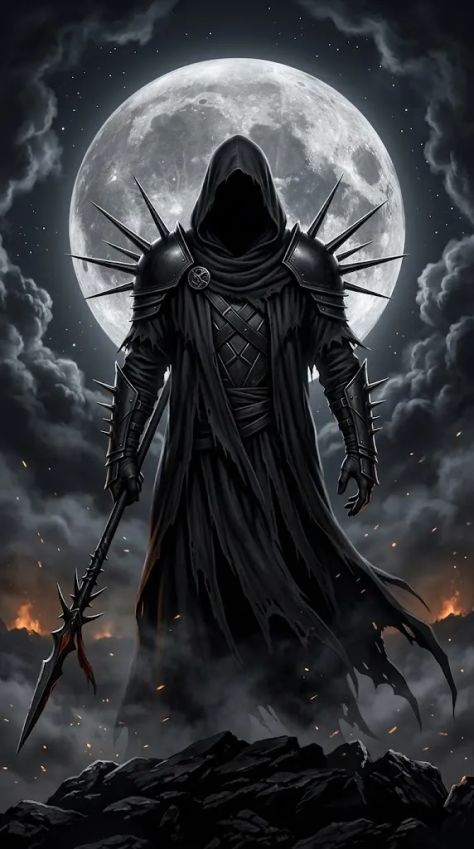
Use the uploaded image as the main visual reference. Recreate the same hooded armored dark-fantasy figure, same enormous full moon, same storm-cloud environment, same black spiked armor and tattered cloak, same downward-pointing thorned polearm, same rocky foreground, same smoke and ember effects, same centered framing, and same high-contrast monochromatic atmosphere with restrained orange fire accents. Do not invent a visible face, visible eyes, exposed skin, new armor design, new weapon, new color scheme, new background, or new camera angle. Follow the uploaded image closely and apply only the corrections below.

Generate a maximum-quality semi-realistic cinematic dark-fantasy digital painting of the same fully concealed hooded armored figure in a 9:16 vertical composition. Show the full body from the top of the oversized hood through the trailing torn cloak hem, with jagged foreground rocks occupying the bottom edge. Center the character precisely on the vertical axis and center the enormous full moon directly behind the head and upper torso. Use a slightly low-angle viewpoint to increase the figure’s visual scale without introducing extreme perspective distortion. Maintain approximately realistic human body proportions, with the hood making the head silhouette appear slightly larger, a narrow upper-body silhouette, broad spiked shoulders, and a cloak expanding into a wide triangular form toward the lower frame. Use a cinematic 40 mm-equivalent perspective, relatively deep scene readability, grain level 2/10, and post-processing intensity approximately 8/10.

Preserve the exact character design and silhouette from the uploaded image. Keep the head facing directly forward with the hood opening directed toward the camera and the head approximately level. Keep the torso frontal with minimal rotational offset. Maintain broad horizontal shoulder armor projecting outward on both sides. Keep both arms lowered beside the torso. Preserve two visible gloved hands: the hand on frame-left hangs beside the body while loosely gripping the downward weapon, and the hand on frame-right hangs beside the body with slightly curled fingers. Keep both palms oriented mostly inward toward the thighs. Keep the feet fully obscured beneath the robes and preserve the visually balanced, symmetrical standing posture.

Preserve complete facial concealment. Build the hood opening as an extremely deep, near-black cavity with brightness approaching zero and no readable skin, eyes, nose, mouth, teeth, facial planes, or internal facial reflections. The face must remain completely absent from view. Do not generate glowing eyes, faint eyes, catchlights, hidden facial outlines, exposed chin, illuminated nose, visible skin, makeup, or any suggestion of a human face inside the hood.

Keep the same oversized black hooded cloak. Render the cloak in near-black around H 215–225° with extremely low saturation and low brightness, shifting into cool charcoal-gray edge highlights around H 215–225° at low saturation and low-to-medium brightness. Give the cloak a heavy matte woven or leather-like fantasy textile response with subdued surface reflectivity. Preserve its voluminous layered construction, long vertical folds descending through the torso, overlapping fabric planes, deep internal creases, and broad shadow valleys. Toward the lower body, split the material into multiple elongated ragged strips shaped by wind and gravity. Keep the hem heavily torn, irregular, asymmetric, and extended into pointed trailing forms rather than a clean garment edge.

Preserve the hood’s large draped structure with a slightly pointed upper contour, heavy fabric mass, narrow cool-gray edge highlights, deep fold channels, and matte surface response. Do not reduce the hood size, expose the forehead, open the facial cavity, or redesign it into a helmet.

Preserve the same layered dark shoulder pauldrons. Construct them from angular segmented plate forms that flare outward from both shoulders. Use satin black metal around H 215–225° with near-zero saturation, extremely low base brightness, and narrow silver-gray specular edges where moonlight strikes. Maintain multiple long conical spikes radiating outward from both shoulder assemblies, preserving their length, orientation, and aggressive radial silhouette. Keep the spikes rigid, sharply tapered, and metallic rather than horn-like, organic, rounded, or decorative.

Under the cloak, retain the partially visible dark chest harness and armor. Preserve crossing straps, overlapping dark textile or leather bands, and geometric central plate structures. Use subtle material separation between matte black fabric, low-gloss leather-like harness components, and satin black metal. Keep these details readable only where moon rim light and minimal environmental fill allow; do not brighten the central torso into a conventionally exposed armor chest.

Preserve the long black forearm armor and gauntlets on both arms. Add repeated outward-facing spikes along the bracers in the same arrangement as the reference. Use a semi-gloss black metal and dark leather material combination, with hard narrow cool highlights on metal edges and broader subdued reflections on leather sections. Keep the gloves fitted and entirely black, with minimal surface detail because of the deep shadow. No exposed fingers, fingernails, wrists, or skin.

Preserve the long dark polearm or spear-like weapon descending diagonally along frame-left. Maintain a narrow dark shaft, multiple thorn-like projecting spikes, and a long sharply pointed terminal blade. Use matte-to-satin black metal with extremely dark central values and thin reflective silver-gray edge lines produced by the moon backlight. Retain only the small restrained dark red-to-orange accent near the blade tip around H 20–30°, high saturation and low-to-medium brightness. Do not redesign the weapon into a sword, scythe, staff, axe, firearm, or oversized fantasy prop. Do not add glowing runes or magical energy to the weapon.

Preserve the small circular metallic brooch or fastening element near the upper chest/shoulder area. Render it as dark metal with a narrow cool-white highlight and small engraved or dimensional details. Do not add necklaces, conventional jewelry, earrings, rings, visible belts with bright ornaments, bags, glasses, crowns, helmets, or additional accessories.

The background should follow the uploaded image as a six-stage depth stack. The nearest layer is jagged black rocky terrain spanning the bottom edge, with irregular broken silhouettes, steep facets, and restrained glossy charcoal-gray edge highlights. Behind the character’s lower body, add low smoke and fog concentrated around the robe hem and feet area, partially obscuring where the figure meets the ground. Behind the smoke, retain a distant low horizon containing isolated dim orange fires and glowing hot areas. Surround the figure with dense volumetric storm-cloud masses rising from both frame edges and lower background. Behind the upper body, place the enormous full moon, and behind and around the moon retain the deep night sky containing numerous small point-like stars.

Make the full moon the dominant background object, occupying most of the upper two-thirds of the image and centered directly behind the figure’s head and upper body. Render it as an enormous luminous circular disk with neutral-to-cool white values, very high brightness, high-contrast crater fields, visible maria, irregular mottling, impact textures, and subtle local tonal variations. Preserve a bright silver-white outer rim and scattered small star-like glints across or near the luminous lunar area. Do not replace the moon with a crescent, planet, eclipse, multiple moons, colored moon, or featureless glowing circle.

Build the clouds as dense dark storm formations along frame-left, frame-right, and the lower background while leaving the moon clearly readable. Use multiple overlapping volumetric cloud masses with billowing lobes, deep charcoal interiors, low-saturation cool-gray illuminated edges, and painterly atmospheric transitions. Keep the clouds dramatically darker than the moon. Maintain irregular openings around the moon and figure so the central silhouette remains visually dominant. Do not turn the clouds into smoke-only textures or bright daylight formations.

Scatter numerous small neutral-white stars around the moon and through unobstructed night-sky regions. Keep them as small point lights of varied brightness with sparse distribution, avoiding recognizable constellations, oversized starbursts, colored nebulae, galaxies, or additional celestial bodies.

Add atmospheric smoke and fog strongest around the lower body and cloak hem. Use low-opacity charcoal-gray plumes that overlap the cloak edges and distant fire horizon without hiding the main silhouette. Keep rain absent. Keep lens flare absent. Keep chromatic aberration absent.

Retain small isolated fire patches and glowing areas across the lower distant horizon. Use orange accents around H 20–30°, high saturation and medium brightness, with small hotter yellow-orange cores and deep ember-red boundaries where appropriate. Keep the fire visually subordinate to the monochrome scene. Add sparse small glowing embers rising through the lower half of the frame, each as tiny warm-orange particles with varied brightness and no dense particle storm. Do not introduce large flames around the character, magical fire surrounding the weapon, or widespread red illumination.

Use the full moon as the dominant backlight positioned at approximately 12 o’clock directly behind the character. Use a cool neutral-white equivalent around 7000 K. The lighting pattern must remain dominant silhouette backlighting rather than frontal portrait illumination. Keep the central hood cavity, torso, cloak mass, arms, and lower garment extremely dark while allowing the moon to trace the outer silhouette.

Create strong silver-white rim illumination around the top and lateral edges of the hood, shoulder armor, shoulder spikes, selected forearm armor edges, cloak contours, and weapon edges. Make metallic highlights hard, thin, and sharply defined. Make cloth highlights broader, softer, and lower in intensity, following fold ridges and fabric curvature. Preserve narrow high-brightness reflections on the armor without turning the black surfaces silver or gray overall.

Keep environmental fill at approximately 10–15%. Allow only enough cool scattered light to reveal selected cloak folds, armor segments, chest harness geometry, gauntlet contours, and weapon construction while preserving very deep blacks across large portions of the character. The figure must remain predominantly a near-black silhouette against the moon.

Add a secondary warm lower light equivalent to approximately 2000 K from the distant fires below and behind the figure. Restrict this warm illumination to faint localized orange edge contamination on the lower cloak, nearby smoke, rock edges, sparse particles, and selected underside surfaces. Do not allow warm light to illuminate the hood cavity or expose the face.

Maintain the dominant palette as near-black and charcoal gray at extremely low saturation, silver-white and cool neutral-gray moonlight at high brightness, and isolated orange around H 20–30° at high saturation and medium brightness. Apply a high-contrast monochromatic cinematic grade with cool silver highlights and restrained warm-orange lower-environment accents. Keep overall saturation extremely low except for the fire and ember elements. Preserve deep black compression, strong silhouette separation, bright lunar highlights, and controlled atmospheric glow.

Render the foreground rocks as near-black jagged formations with irregular fractured planes, sharp angular ridges, rough stone texture, and restrained gray reflective edges. Keep the rocks large enough to frame the character’s lower silhouette without blocking the robe excessively. Do not add vegetation, architecture, gravestones, ruins, trees, furniture, or additional foreground props.

Maintain relatively deep scene readability: keep the character silhouette, primary armor shapes, weapon, moon texture, foreground rock structure, and major cloud formations clearly legible, while allowing smoke, distant fire, and selected cloud boundaries to soften progressively with atmospheric depth. Avoid portrait-style shallow depth of field that blurs the moon or destroys the layered fantasy environment.

Render at maximum semi-realistic dark-fantasy digital-painting quality with highly detailed armor edges, controlled fabric texture, painterly volumetric clouds, crisp silhouette design, realistic moon surface detail, atmospheric haze, restrained glow, and cinematic contrast. Use polished fantasy key-art rendering rather than photorealistic live-action photography. Preserve sharp structural details on the character while retaining painterly transitions in clouds, smoke, and distant environment.

Follow the uploaded image as the primary reference. Preserve the exact character silhouette, complete facial concealment, oversized hood, black layered cloak, shoulder pauldrons, radial shoulder spikes, chest harness, spiked forearm armor, black gloves, thorned polearm, circular clasp, centered low-angle stance, enormous centered moon, storm-cloud framing, rocky foreground, lower smoke, isolated fires, ember particles, cool backlighting, warm lower bounce, and 9:16 composition.

Do not change the character’s design. Do not shift the art style toward photorealistic live-action photography, anime, cartoon, cel shading, or glossy 3D rendering. Do not alter the monochromatic black-and-silver palette except for the restrained existing orange accents. Do not reveal the face. Do not reveal the eyes. Do not create eye glow or catchlights. Do not expose any skin. Do not add makeup or facial detail. Do not reduce the hood shadow. Do not remove the shoulder spikes, forearm spikes, cloak damage, polearm, moon, clouds, smoke, fires, embers, or foreground rocks.

No extra people. No extra creatures. No exposed face. No exposed skin. No visible eyes. No glowing eyes. No extra weapons. No extra objects. No text. No watermark. No logo. No modern objects. No lens flare. No chromatic aberration. No rain. No bright frontal illumination. No washed-out blacks. No excessive bloom. No motion blur. No anatomical errors. No malformed hands. No duplicated limbs. Ultra-high resolution. Sharp armor and silhouette detail. Accurate dark-metal material texture. Layered matte textile texture. High-detail volumetric clouds. Semi-realistic cinematic dark-fantasy digital painting only.

·
Photo Prompts

Reseñas

Inicia sesión para dejar una reseña.

Aún no hay reseñas. Sé el primero.

Lleva PromptLabHub a cualquier dispositivo.

Instala la app para acceder más rápido o descarga la extensión de Chrome y cárgala en el navegador.

Explorar prompts

  • Todos los prompts
  • Prompts de fotos
  • Prompts de video
  • Prompts de comida

Crear

  • Enviar un prompt

Comunidad

  • Foro
  • Creadores
  • Ranking
  • Desafío semanal

Soporte

  • FAQ
  • Contáctanos
  • Política de privacidad
  • Términos de servicio

Síguenos

Descubre y copia prompts de IA seleccionados para Midjourney, DALL-E 3, Sora, Runway y más. Actualizado cada semana.

Política de privacidadTérminos de servicioPolítica de cookies

© 2026 PromptLabHub. All rights reserved.

© 2026 PromptLabHub. All rights reserved.

·
Política de privacidad·Términos de servicio·Política de cookies
Home
PromptLabHub
Cinematic Portrait Space Energetic Backlit Bokeh
0
Prompt

Cinematic Portrait Space Energetic Backlit Bokeh

Use the uploaded image as the main visual reference. Recreate the same hooded armored dark-fantasy figure, same enormous full moon, same storm-cloud environment, same black spiked armor and tattered cloak, same downward-pointing thorned polearm, same rocky foreground, same smoke and ember effects, same centered framing, and same high-contrast monochromatic atmosphere with restrained orange fire accents. Do not invent a visible face, visible eyes, exposed skin, new armor design, new weapon, new color scheme, new background, or new camera angle. Follow the uploaded image closely and apply only the corrections below.

Generate a maximum-quality semi-realistic cinematic dark-fantasy digital painting of the same fully concealed hooded armored figure in a 9:16 vertical composition. Show the full body from the top of the oversized hood through the trailing torn cloak hem, with jagged foreground rocks occupying the bottom edge. Center the character precisely on the vertical axis and center the enormous full moon directly behind the head and upper torso. Use a slightly low-angle viewpoint to increase the figure’s visual scale without introducing extreme perspective distortion. Maintain approximately realistic human body proportions, with the hood making the head silhouette appear slightly larger, a narrow upper-body silhouette, broad spiked shoulders, and a cloak expanding into a wide triangular form toward the lower frame. Use a cinematic 40 mm-equivalent perspective, relatively deep scene readability, grain level 2/10, and post-processing intensity approximately 8/10.

Preserve the exact character design and silhouette from the uploaded image. Keep the head facing directly forward with the hood opening directed toward the camera and the head approximately level. Keep the torso frontal with minimal rotational offset. Maintain broad horizontal shoulder armor projecting outward on both sides. Keep both arms lowered beside the torso. Preserve two visible gloved hands: the hand on frame-left hangs beside the body while loosely gripping the downward weapon, and the hand on frame-right hangs beside the body with slightly curled fingers. Keep both palms oriented mostly inward toward the thighs. Keep the feet fully obscured beneath the robes and preserve the visually balanced, symmetrical standing posture.

Preserve complete facial concealment. Build the hood opening as an extremely deep, near-black cavity with brightness approaching zero and no readable skin, eyes, nose, mouth, teeth, facial planes, or internal facial reflections. The face must remain completely absent from view. Do not generate glowing eyes, faint eyes, catchlights, hidden facial outlines, exposed chin, illuminated nose, visible skin, makeup, or any suggestion of a human face inside the hood.

Keep the same oversized black hooded cloak. Render the cloak in near-black around H 215–225° with extremely low saturation and low brightness, shifting into cool charcoal-gray edge highlights around H 215–225° at low saturation and low-to-medium brightness. Give the cloak a heavy matte woven or leather-like fantasy textile response with subdued surface reflectivity. Preserve its voluminous layered construction, long vertical folds descending through the torso, overlapping fabric planes, deep internal creases, and broad shadow valleys. Toward the lower body, split the material into multiple elongated ragged strips shaped by wind and gravity. Keep the hem heavily torn, irregular, asymmetric, and extended into pointed trailing forms rather than a clean garment edge.

Preserve the hood’s large draped structure with a slightly pointed upper contour, heavy fabric mass, narrow cool-gray edge highlights, deep fold channels, and matte surface response. Do not reduce the hood size, expose the forehead, open the facial cavity, or redesign it into a helmet.

Preserve the same layered dark shoulder pauldrons. Construct them from angular segmented plate forms that flare outward from both shoulders. Use satin black metal around H 215–225° with near-zero saturation, extremely low base brightness, and narrow silver-gray specular edges where moonlight strikes. Maintain multiple long conical spikes radiating outward from both shoulder assemblies, preserving their length, orientation, and aggressive radial silhouette. Keep the spikes rigid, sharply tapered, and metallic rather than horn-like, organic, rounded, or decorative.

Under the cloak, retain the partially visible dark chest harness and armor. Preserve crossing straps, overlapping dark textile or leather bands, and geometric central plate structures. Use subtle material separation between matte black fabric, low-gloss leather-like harness components, and satin black metal. Keep these details readable only where moon rim light and minimal environmental fill allow; do not brighten the central torso into a conventionally exposed armor chest.

Preserve the long black forearm armor and gauntlets on both arms. Add repeated outward-facing spikes along the bracers in the same arrangement as the reference. Use a semi-gloss black metal and dark leather material combination, with hard narrow cool highlights on metal edges and broader subdued reflections on leather sections. Keep the gloves fitted and entirely black, with minimal surface detail because of the deep shadow. No exposed fingers, fingernails, wrists, or skin.

Preserve the long dark polearm or spear-like weapon descending diagonally along frame-left. Maintain a narrow dark shaft, multiple thorn-like projecting spikes, and a long sharply pointed terminal blade. Use matte-to-satin black metal with extremely dark central values and thin reflective silver-gray edge lines produced by the moon backlight. Retain only the small restrained dark red-to-orange accent near the blade tip around H 20–30°, high saturation and low-to-medium brightness. Do not redesign the weapon into a sword, scythe, staff, axe, firearm, or oversized fantasy prop. Do not add glowing runes or magical energy to the weapon.

Preserve the small circular metallic brooch or fastening element near the upper chest/shoulder area. Render it as dark metal with a narrow cool-white highlight and small engraved or dimensional details. Do not add necklaces, conventional jewelry, earrings, rings, visible belts with bright ornaments, bags, glasses, crowns, helmets, or additional accessories.

The background should follow the uploaded image as a six-stage depth stack. The nearest layer is jagged black rocky terrain spanning the bottom edge, with irregular broken silhouettes, steep facets, and restrained glossy charcoal-gray edge highlights. Behind the character’s lower body, add low smoke and fog concentrated around the robe hem and feet area, partially obscuring where the figure meets the ground. Behind the smoke, retain a distant low horizon containing isolated dim orange fires and glowing hot areas. Surround the figure with dense volumetric storm-cloud masses rising from both frame edges and lower background. Behind the upper body, place the enormous full moon, and behind and around the moon retain the deep night sky containing numerous small point-like stars.

Make the full moon the dominant background object, occupying most of the upper two-thirds of the image and centered directly behind the figure’s head and upper body. Render it as an enormous luminous circular disk with neutral-to-cool white values, very high brightness, high-contrast crater fields, visible maria, irregular mottling, impact textures, and subtle local tonal variations. Preserve a bright silver-white outer rim and scattered small star-like glints across or near the luminous lunar area. Do not replace the moon with a crescent, planet, eclipse, multiple moons, colored moon, or featureless glowing circle.

Build the clouds as dense dark storm formations along frame-left, frame-right, and the lower background while leaving the moon clearly readable. Use multiple overlapping volumetric cloud masses with billowing lobes, deep charcoal interiors, low-saturation cool-gray illuminated edges, and painterly atmospheric transitions. Keep the clouds dramatically darker than the moon. Maintain irregular openings around the moon and figure so the central silhouette remains visually dominant. Do not turn the clouds into smoke-only textures or bright daylight formations.

Scatter numerous small neutral-white stars around the moon and through unobstructed night-sky regions. Keep them as small point lights of varied brightness with sparse distribution, avoiding recognizable constellations, oversized starbursts, colored nebulae, galaxies, or additional celestial bodies.

Add atmospheric smoke and fog strongest around the lower body and cloak hem. Use low-opacity charcoal-gray plumes that overlap the cloak edges and distant fire horizon without hiding the main silhouette. Keep rain absent. Keep lens flare absent. Keep chromatic aberration absent.

Retain small isolated fire patches and glowing areas across the lower distant horizon. Use orange accents around H 20–30°, high saturation and medium brightness, with small hotter yellow-orange cores and deep ember-red boundaries where appropriate. Keep the fire visually subordinate to the monochrome scene. Add sparse small glowing embers rising through the lower half of the frame, each as tiny warm-orange particles with varied brightness and no dense particle storm. Do not introduce large flames around the character, magical fire surrounding the weapon, or widespread red illumination.

Use the full moon as the dominant backlight positioned at approximately 12 o’clock directly behind the character. Use a cool neutral-white equivalent around 7000 K. The lighting pattern must remain dominant silhouette backlighting rather than frontal portrait illumination. Keep the central hood cavity, torso, cloak mass, arms, and lower garment extremely dark while allowing the moon to trace the outer silhouette.

Create strong silver-white rim illumination around the top and lateral edges of the hood, shoulder armor, shoulder spikes, selected forearm armor edges, cloak contours, and weapon edges. Make metallic highlights hard, thin, and sharply defined. Make cloth highlights broader, softer, and lower in intensity, following fold ridges and fabric curvature. Preserve narrow high-brightness reflections on the armor without turning the black surfaces silver or gray overall.

Keep environmental fill at approximately 10–15%. Allow only enough cool scattered light to reveal selected cloak folds, armor segments, chest harness geometry, gauntlet contours, and weapon construction while preserving very deep blacks across large portions of the character. The figure must remain predominantly a near-black silhouette against the moon.

Add a secondary warm lower light equivalent to approximately 2000 K from the distant fires below and behind the figure. Restrict this warm illumination to faint localized orange edge contamination on the lower cloak, nearby smoke, rock edges, sparse particles, and selected underside surfaces. Do not allow warm light to illuminate the hood cavity or expose the face.

Maintain the dominant palette as near-black and charcoal gray at extremely low saturation, silver-white and cool neutral-gray moonlight at high brightness, and isolated orange around H 20–30° at high saturation and medium brightness. Apply a high-contrast monochromatic cinematic grade with cool silver highlights and restrained warm-orange lower-environment accents. Keep overall saturation extremely low except for the fire and ember elements. Preserve deep black compression, strong silhouette separation, bright lunar highlights, and controlled atmospheric glow.

Render the foreground rocks as near-black jagged formations with irregular fractured planes, sharp angular ridges, rough stone texture, and restrained gray reflective edges. Keep the rocks large enough to frame the character’s lower silhouette without blocking the robe excessively. Do not add vegetation, architecture, gravestones, ruins, trees, furniture, or additional foreground props.

Maintain relatively deep scene readability: keep the character silhouette, primary armor shapes, weapon, moon texture, foreground rock structure, and major cloud formations clearly legible, while allowing smoke, distant fire, and selected cloud boundaries to soften progressively with atmospheric depth. Avoid portrait-style shallow depth of field that blurs the moon or destroys the layered fantasy environment.

Render at maximum semi-realistic dark-fantasy digital-painting quality with highly detailed armor edges, controlled fabric texture, painterly volumetric clouds, crisp silhouette design, realistic moon surface detail, atmospheric haze, restrained glow, and cinematic contrast. Use polished fantasy key-art rendering rather than photorealistic live-action photography. Preserve sharp structural details on the character while retaining painterly transitions in clouds, smoke, and distant environment.

Follow the uploaded image as the primary reference. Preserve the exact character silhouette, complete facial concealment, oversized hood, black layered cloak, shoulder pauldrons, radial shoulder spikes, chest harness, spiked forearm armor, black gloves, thorned polearm, circular clasp, centered low-angle stance, enormous centered moon, storm-cloud framing, rocky foreground, lower smoke, isolated fires, ember particles, cool backlighting, warm lower bounce, and 9:16 composition.

Do not change the character’s design. Do not shift the art style toward photorealistic live-action photography, anime, cartoon, cel shading, or glossy 3D rendering. Do not alter the monochromatic black-and-silver palette except for the restrained existing orange accents. Do not reveal the face. Do not reveal the eyes. Do not create eye glow or catchlights. Do not expose any skin. Do not add makeup or facial detail. Do not reduce the hood shadow. Do not remove the shoulder spikes, forearm spikes, cloak damage, polearm, moon, clouds, smoke, fires, embers, or foreground rocks.

No extra people. No extra creatures. No exposed face. No exposed skin. No visible eyes. No glowing eyes. No extra weapons. No extra objects. No text. No watermark. No logo. No modern objects. No lens flare. No chromatic aberration. No rain. No bright frontal illumination. No washed-out blacks. No excessive bloom. No motion blur. No anatomical errors. No malformed hands. No duplicated limbs. Ultra-high resolution. Sharp armor and silhouette detail. Accurate dark-metal material texture. Layered matte textile texture. High-detail volumetric clouds. Semi-realistic cinematic dark-fantasy digital painting only.

·
Photo Prompts

Reseñas

Inicia sesión para dejar una reseña.

Aún no hay reseñas. Sé el primero.

Lleva PromptLabHub a cualquier dispositivo.

Instala la app para acceder más rápido o descarga la extensión de Chrome y cárgala en el navegador.

Explorar prompts

  • Todos los prompts
  • Prompts de fotos
  • Prompts de video
  • Prompts de comida

Crear

  • Enviar un prompt

Comunidad

  • Foro
  • Creadores
  • Ranking
  • Desafío semanal

Soporte

  • FAQ
  • Contáctanos
  • Política de privacidad
  • Términos de servicio

Síguenos

Descubre y copia prompts de IA seleccionados para Midjourney, DALL-E 3, Sora, Runway y más. Actualizado cada semana.

Política de privacidadTérminos de servicioPolítica de cookies

© 2026 PromptLabHub. All rights reserved.

© 2026 PromptLabHub. All rights reserved.

·
Política de privacidad·Términos de servicio·Política de cookies
Home